How to control your ego is one of the most important life skills you can develop if you want lasting success, meaningful relationships, and continuous personal growth. While confidence pushes us to pursue our goals, an uncontrolled ego can quietly become our biggest obstacle. It can prevent us from accepting feedback, learning from mistakes, and building genuine connections with others.
Many people mistake ego for confidence, but they are very different. Confidence comes from believing in your abilities while remaining open to learning. Ego, on the other hand, convinces you that you already know enough, that you’re always right, or that you must constantly prove your worth.
The good news is that ego is not something you have to eliminate—it is something you can manage. Learning how to control your ego allows you to become more emotionally intelligent, make wiser decisions, communicate more effectively, and inspire others through humility rather than authority.
Learning how to control your ego also makes you a more patient and understanding parent. Discover practical strategies for raising emotionally healthy children in our guide to wise parenting for peaceful homes.
In this guide, you’ll discover five powerful habits that can help you master your ego and become the best version of yourself.
How to Control Your Ego Infographic
Learning how to control your ego doesn’t happen overnight—it develops through consistent self-awareness and daily practice. The infographic below summarizes the five essential habits that can help you replace pride with humility, improve emotional intelligence, and build stronger relationships. Save it for quick reference whenever you need a reminder to choose growth over ego.
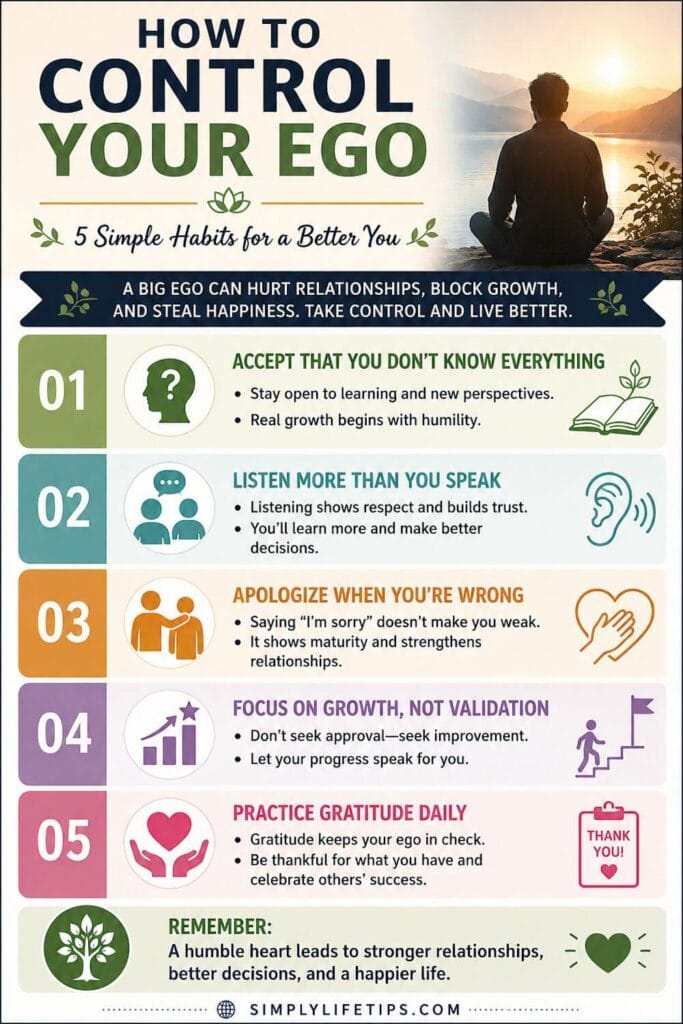
Mastering how to control your ego is a lifelong journey, not a one-time achievement. By accepting that you don’t know everything, listening with empathy, admitting mistakes, focusing on personal growth, and practicing gratitude, you can become a more confident, respected, and emotionally intelligent person. If you found this infographic helpful, share it with your friends, family, or colleagues, and bookmark this guide for future inspiration.
What Does It Mean to Control Your Ego?
Learning how to control your ego doesn’t mean becoming timid or lacking confidence. Instead, it means developing the self-awareness to recognize when pride, insecurity, or the need for validation is influencing your decisions.
A healthy ego motivates you to pursue excellence. An unhealthy ego seeks superiority over others.
People who successfully control their ego typically:
- Listen before they speak.
- Welcome constructive criticism.
- Admit mistakes without excuses.
- Continue learning throughout life.
- Celebrate others’ achievements.
- Stay grateful regardless of success.
Controlling your ego allows you to lead with wisdom instead of pride.
Importance of Learning How to Control Your Ego
Ego affects nearly every aspect of life, including your career, relationships, finances, and emotional well-being.
When ego takes control, it often leads to:
Poor Decision-Making
People driven by ego ignore valuable advice because they believe they already know the answer.
For example, a business owner may reject employee suggestions simply because they didn’t come from management. This can cause missed opportunities and costly mistakes.
Damaged Relationships
Arguments often continue because neither person wants to admit they’re wrong.
Choosing humility over pride can save friendships, marriages, and professional relationships.
Limited Personal Growth
The moment you believe you’ve learned everything is the moment your growth stops.
Successful people remain lifelong students regardless of their experience.
Workplace Conflicts
Employees are more likely to trust leaders who listen, admit mistakes, and value everyone’s contributions.
Leaders controlled by ego often create fear rather than respect.
The Difference Between Confidence and Ego
Many people confuse confidence with arrogance.
Here’s a simple comparison.
| Confidence | Ego |
|---|---|
| Learns continuously | Thinks it knows everything |
| Welcomes feedback | Rejects criticism |
| Celebrates others | Competes with everyone |
| Admits mistakes | Blames others |
| Inspires people | Intimidates people |
| Focuses on improvement | Focuses on validation |
The goal isn’t to eliminate confidence—it’s to prevent confidence from turning into ego.
1: Accept That You Don’t Know Everything
The first step in learning how to control your ego is accepting that knowledge has no finish line.
No matter how experienced you become, there will always be someone who knows something you don’t.
The most successful entrepreneurs, scientists, athletes, and leaders continue learning because they understand that expertise is a journey rather than a destination.
Why Is This Habit Powerful?
When you admit that you don’t know everything, you become:
- More curious.
- More adaptable.
- More innovative.
- More approachable.
- More resilient.
Instead of defending your opinions, you begin exploring new ideas.
Real-Life Example
Imagine a company CEO asking junior employees for suggestions during meetings.
Rather than feeling threatened, the CEO recognizes that great ideas can come from anyone. This creates an innovative workplace where employees feel respected and motivated.
Humility often leads to better solutions than authority.
How to Practice This Habit?
Ask yourself these questions every day:
- What did I learn today?
- Who knows more than I do in this area?
- What feedback have I been ignoring?
- How can I improve?
Replacing certainty with curiosity is one of the most effective ways to control your ego.
2: Listen More Than You Speak
One of the clearest signs of emotional intelligence is the ability to listen carefully before responding.
Many people hear words without truly listening.
Learning how to control your ego means recognizing that every conversation is an opportunity to learn something new.
Benefits of Active Listening
Listening helps you:
- Build trust.
- Strengthen relationships.
- Resolve conflicts faster.
- Understand different perspectives.
- Discover opportunities you might otherwise miss.
People naturally respect those who make them feel heard.
Example
Imagine a manager who begins every team meeting by asking:
“What challenges are you facing, and how can I help?”
Instead of immediately giving instructions, the manager listens carefully.
Employees feel valued, communication improves, and better ideas emerge.
Great leaders spend less time talking and more time understanding.
Simple Ways to Become a Better Listener
- Don’t interrupt.
- Maintain eye contact.
- Ask follow-up questions.
- Listen to understand instead of preparing your reply.
- Pause before responding.
Listening isn’t passive—it’s one of the strongest leadership skills you can develop.
3: Apologize Quickly When You’re Wrong
One of the greatest indicators of emotional intelligence is the ability to admit mistakes without making excuses. If you’re learning how to control your ego, this habit is essential.
Many people avoid apologizing because they believe it makes them appear weak. In reality, refusing to admit mistakes often damages trust far more than the mistake itself.
Strong people acknowledge their errors, take responsibility, and focus on making things right.
Why does admitting mistakes build respect?
A sincere apology demonstrates:
- Honesty
- Accountability
- Emotional maturity
- Self-confidence
- Respect for others
When you admit your mistakes, people are more likely to trust your judgment because they know you’re truthful.
Example
Imagine a project manager who misses an important deadline.
An ego-driven response might be:
“It wasn’t my fault. Everyone else slowed me down.”
A humble response would be:
“I underestimated the workload, and that’s my responsibility. I’ll adjust our plan to make sure it doesn’t happen again.”
The second response inspires confidence because it focuses on solutions instead of blame.
How to Apologize Effectively?
A meaningful apology should:
- Admit the mistake clearly.
- Avoid making excuses.
- Express genuine regret.
- Explain how you’ll improve.
- Follow through with action.
People remember changed behavior more than spoken words.
4: Focus on Growth Instead of Validation
One of the biggest traps of the ego is constantly seeking approval from others.
Whether it’s social media likes, compliments, promotions, or recognition, relying on external validation creates temporary satisfaction rather than lasting confidence.
Learning how to control your ego means shifting your attention from proving yourself to improving yourself.
Growth Creates Lasting Confidence
People with a growth mindset ask questions like:
- What did I learn today?
- How can I improve?
- What skills should I develop next?
- What challenges helped me grow?
Instead of comparing themselves with others, they compare themselves with who they were yesterday.
Validation Is Temporary
Praise feels good, but it fades quickly.
Growth continues producing results for years.
For example, an author who focuses only on book sales may become discouraged during slow periods.
An author who focuses on becoming a better writer continues improving regardless of short-term recognition.
Success eventually follows consistent improvement.
Daily Growth Habits
Replace these thoughts:
- “Do people admire me?”
With:
- “Did I improve today?”
Replace:
- “Am I better than everyone else?”
With:
- “Am I better than I was yesterday?”
This simple mindset shift reduces ego while increasing confidence.
5: Practice Gratitude Every Day
Gratitude is one of the most effective ways to keep your ego under control.
It reminds you that success is rarely achieved alone.
Every accomplishment is influenced by teachers, mentors, coworkers, friends, family members, and countless opportunities along the way.
Recognizing this keeps you humble.
Ego can quietly damage even the strongest family relationships by creating misunderstandings, resentment, and emotional distance. Learn how to recognize these patterns and rebuild stronger connections in our guide on how ego destroys family bonds.
Benefits of Practicing Gratitude
People who regularly practice gratitude often experience:
- Lower stress
- Greater happiness
- Improved emotional health
- Better relationships
- Increased resilience
- Higher life satisfaction
Gratitude shifts your attention from what you lack to what you’ve already gained.
Example
A successful entrepreneur may receive an industry award.
Instead of saying:
“I did everything myself.”
They recognize the contributions of employees, customers, mentors, and family.
That attitude earns admiration and strengthens relationships.
Simple Gratitude Habits
Every evening, write down:
- Three things you’re grateful for.
- One lesson you learned today.
- One person who helped you.
- One opportunity you don’t want to take for granted.
These small habits gradually reshape your mindset and reduce the influence of ego.
Common Signs Your Ego Is Controlling You
Sometimes ego grows quietly, making it difficult to recognize.
Here are some warning signs.
You Always Need to Be Right
Healthy discussions become arguments because winning feels more important than learning.
You Interrupt Others
Instead of listening, you’re waiting for your turn to speak.
You Reject Constructive Criticism
Feedback feels like a personal attack instead of an opportunity to improve.
You Rarely Apologize
Blaming circumstances or other people becomes easier than accepting responsibility.
You Compare Yourself Constantly
Your happiness depends on outperforming others instead of achieving personal growth.
You Need Constant Recognition
Without praise or appreciation, you begin questioning your self-worth.
Recognizing these habits is the first step toward changing them.
Practical Ways to Control Your Ego Every Day
Learning how to control your ego requires consistent practice rather than perfection.
Small daily habits gradually reshape your mindset.
Stay Curious
Approach every conversation as an opportunity to learn.
Ask thoughtful questions instead of trying to impress others.
Accept Feedback Gracefully
Treat constructive criticism as free coaching.
Ask:
“What can I learn from this?”
instead of
“Why are they criticizing me?”
Celebrate Other People’s Success
Someone else’s achievement doesn’t reduce your own.
Compliment coworkers, encourage friends, and genuinely celebrate milestones.
People who uplift others naturally build stronger relationships.
Practice Mindfulness
Before reacting emotionally:
- Pause.
- Take a deep breath.
- Consider your response.
- Choose understanding over pride.
This simple pause prevents many unnecessary conflicts.
Health Benefits Of Mindfulness | A Guide To Better Health
Read and Learn Regularly
Books, podcasts, courses, and conversations expose you to new perspectives.
Lifelong learners rarely become trapped by their ego because they recognize there’s always something new to discover.
Ask for Honest Feedback
Invite trusted friends, colleagues, or family members to share constructive observations.
Questions like:
- “What’s one thing I could improve?”
- “Do I listen well?”
- “How do I handle criticism?”
How Controlling Your Ego Makes You a Better Leader?
The world’s most respected leaders are rarely the loudest people in the room.
They influence others through humility, empathy, and trust.
Leaders who manage their ego:
- Share credit generously.
- Accept responsibility during failures.
- Encourage collaboration.
- Develop future leaders.
- Listen before making decisions.
- Create psychologically safe workplaces.
Employees are more likely to remain loyal to leaders who value people over personal recognition.
Whether you manage a business, coach a sports team, or lead a family, humility creates a stronger and more lasting influence than pride.
The Long-Term Benefits of Learning How to Control Your Ego
Mastering how to control your ego is not about changing who you are—it is about becoming the best version of yourself. While the results may not appear overnight, practicing humility, self-awareness, and emotional intelligence consistently leads to remarkable improvements in every area of life.
Here are some of the long-term benefits you can expect.
Stronger Relationships
People naturally enjoy being around individuals who listen, show empathy, and respect different opinions.
When your ego is under control, you are more willing to:
- Admit mistakes.
- Forgive others.
- Communicate respectfully.
- Resolve disagreements calmly.
- Appreciate different perspectives.
These qualities strengthen friendships, family relationships, and professional connections.
Better Decision-Making
An uncontrolled ego often clouds judgment.
Instead of making decisions based on facts, people may choose options that protect their pride.
By learning how to control your ego, you become more open to advice, willing to evaluate evidence, and confident enough to change your mind when necessary.
This leads to smarter decisions in business, finances, and everyday life.
Greater Emotional Intelligence
Emotional intelligence is the ability to recognize, understand, and manage your emotions while responding appropriately to others.
Controlling your ego strengthens every aspect of emotional intelligence, including:
- Self-awareness
- Self-control
- Empathy
- Social skills
- Motivation
These qualities help you navigate difficult situations with confidence and maturity.
Improved Leadership Skills
The best leaders inspire rather than dominate.
When leaders keep their ego in check, they:
- Encourage teamwork.
- Give credit where it’s due.
- Accept responsibility for mistakes.
- Build trust within their teams.
- Help others reach their potential.
People are more likely to follow leaders who serve rather than seek attention.
Continuous Personal Growth
Perhaps the greatest reward of controlling your ego is that you never stop learning.
Instead of believing you’ve reached your full potential, you remain curious, adaptable, and eager to improve.
This mindset creates opportunities for lifelong success.
Common Myths About Ego
Many misconceptions prevent people from working on their ego. Let’s separate fact from fiction.
Myth 1: Controlling Your Ego Means Being Weak
Reality: Humility requires far more strength than arrogance.
It takes courage to admit mistakes, accept criticism, and continue learning.
Myth 2: Successful People Have Big Egos
Reality: Many of the world’s most respected leaders, entrepreneurs, and innovators remain humble despite their achievements.
They understand that success is built through collaboration, learning, and perseverance.
Myth 3: Confidence and Ego Are the Same
Reality: Confidence is believing in your abilities.
Ego is believing you’re better than everyone else.
Healthy confidence attracts respect.
An inflated ego often pushes people away.
Myth 4: You Should Never Feel Proud
Reality: Taking pride in your accomplishments is healthy.
The problem begins when pride turns into arrogance or superiority.
Celebrate your achievements while remaining grateful and open to learning.
Conclusion
Learning how to control your ego is one of the most valuable investments you can make in yourself. It doesn’t mean becoming less confident—it means becoming more self-aware, emotionally intelligent, and open to growth. By practicing the five pillars—accepting that you don’t know everything, listening more than you speak, apologizing when you’re wrong, focusing on growth instead of validation, and practicing gratitude—you’ll build stronger relationships, become a better leader, and continue growing throughout your life.
True confidence isn’t about proving you’re the smartest person in the room. It’s about having the humility to learn, the courage to admit mistakes, and the wisdom to lift others as you rise. Every day is an opportunity to choose growth over pride, collaboration over competition, and gratitude over entitlement. Master your ego, and you’ll unlock greater success, deeper connections, and a more fulfilling life.
FAQs: How to Control Your Ego
What is ego, and is it always bad?
No. Ego is your sense of self and identity. A healthy ego helps build confidence and self-respect. It becomes harmful only when it leads to arrogance, defensiveness, or an inability to accept feedback.
How can I tell if my ego is controlling me?
Common signs include getting offended easily, always wanting to be right, refusing to apologize, comparing yourself to others, and taking criticism personally. Recognizing these behaviors is the first step toward change.
What are the best daily habits to control your ego?
Practice gratitude, listen more than you speak, accept constructive criticism, admit mistakes, meditate, and regularly reflect on your actions. These habits help you stay humble and emotionally balanced.
Can meditation help reduce ego?
Yes. Meditation increases self-awareness and helps you observe your thoughts without reacting impulsively. Over time, it reduces the need for validation and makes it easier to let go of pride and resentment.
Why is controlling your ego important for relationships?
A controlled ego improves communication, encourages empathy, and makes it easier to resolve conflicts. It helps you value others’ perspectives, build trust, and create stronger personal and professional relationships.

Mathukutty P V is a Blogger, YouTuber, and Content Writer and the founder of Simply Life Tips. After taking voluntary retirement in 2017, he embraced a free lifestyle focused on learning, personal growth, and sharing practical wisdom to help others live with more purpose and positivity.