
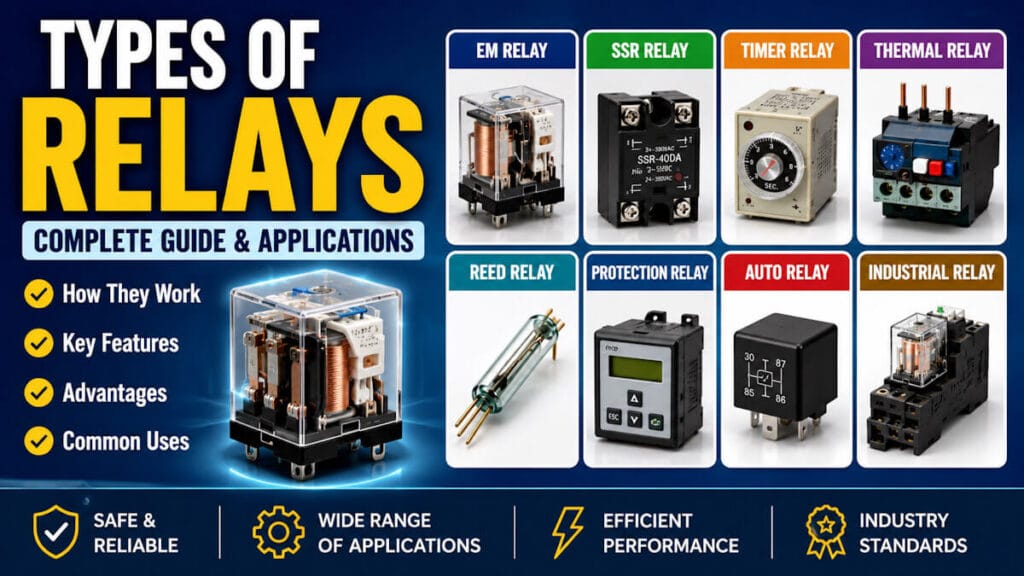
Types of relays are fundamental to modern electrical and electronic systems, enabling safe and efficient control of high-power circuits using low-power signals. From household appliances and industrial automation to automobiles and power distribution systems, relays play a crucial role in switching, protection, timing, and control.
Whether you’re an electrical engineering student, electrician, technician, hobbyist, or DIY enthusiast, understanding the different types of relays helps you select the right device for your application. This comprehensive guide explains types of relays and how each relay works, its advantages, disadvantages, and practical applications.
Learn how each type of electric motor works, its advantages, disadvantages, applications, and the differences between them.
Types of Relays infographic
Not all types of relays perform the same function. Some are designed for high-speed electronic switching, while others protect motors, automate timing sequences, or safeguard electrical power systems. Choosing the right relay depends on the voltage, current, switching speed, and application requirements.
The infographic below provides a quick visual comparison of the seven most common types of relays, explaining how each one works, its key features, and where it is commonly used in industrial, commercial, and automotive applications.
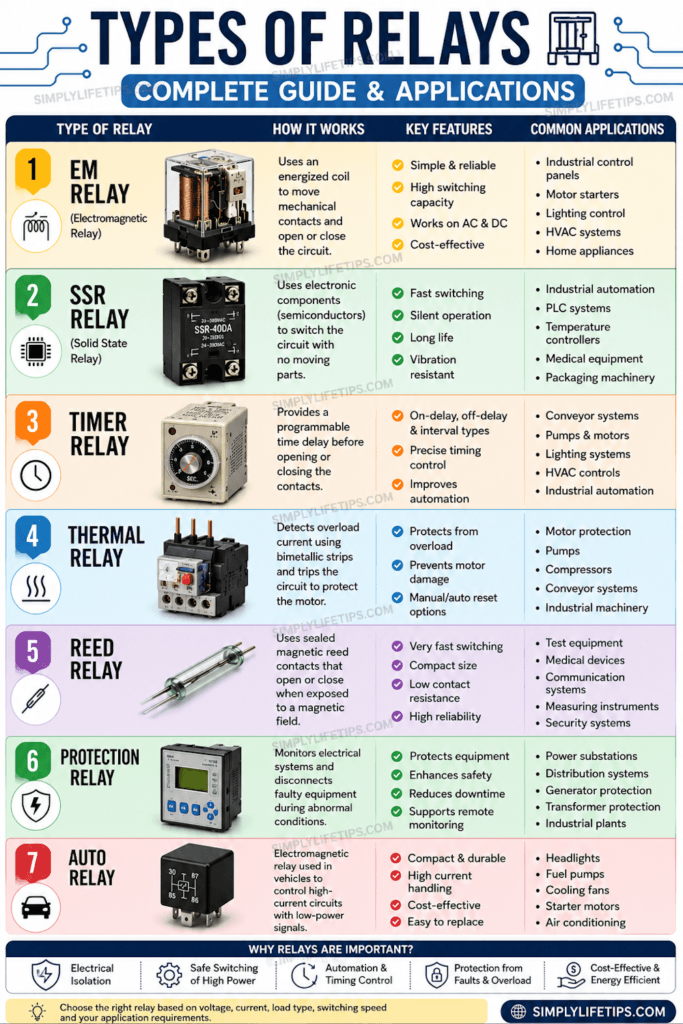
Now that you’ve explored the different types of relays, you can easily identify which relay is best suited for your electrical or automation project. Whether you’re working with industrial machinery, motor protection, PLC systems, automotive circuits, or electronic control systems, selecting the appropriate relay improves reliability, safety, and overall system performance.
For a deeper understanding, continue reading the complete guide below, where each relay type is explained in detail with its working principle, advantages, disadvantages, and real-world applications.
What Is a Relay?
A relay is an electrically operated switching device that opens or closes electrical contacts when triggered by an electrical signal. It allows a low-voltage control circuit to safely operate a high-voltage or high-current load while providing electrical isolation.
Basic Components of a Relay
Most relays consist of:
- Coil (Electromagnet)
- Armature
- Spring
- Fixed Contacts
- Moving Contacts
- Housing
- Terminal Connections
When current energizes the coil, a magnetic field moves the armature, changing the state of the contacts.
Why Are Relays Important?
Relays provide several advantages in electrical systems:
- Safe isolation between control and power circuits
- Remote switching capability
- Automatic circuit protection
- Reliable automation
- High-current load control
- Reduced operator risk
- Improved equipment safety
Types of Relays
The most common relay types include:
- Electromagnetic Relay (EM Relay)
- Solid State Relay (SSR)
- Timer Relay
- Thermal Relay
- Reed Relay
- Protection Relay
- Automotive Relay
Let’s explore each type in detail.
Electromagnetic Relay (EM Relay)
What Is an Electromagnetic Relay?
An Electromagnetic Relay (EM Relay) is the traditional mechanical relay that uses an energized coil to move mechanical contacts. It remains one of the most widely used switching devices because of its simplicity, durability, and ability to switch both AC and DC loads.
How It Works?
When voltage is applied to the coil:
- The coil becomes an electromagnet.
- The armature is attracted toward the coil.
- Electrical contacts open or close.
- Removing power returns the contacts to their original position through a spring.
Advantages
- Simple construction
- Inexpensive
- High switching capacity
- Excellent electrical isolation
- Suitable for AC and DC loads
Disadvantages
- Mechanical wear over time
- Audible clicking sound
- Slower switching speed
- Contact arcing during operation
Common Applications
- Industrial control panels
- Motor starters
- Lighting control
- HVAC systems
- Home appliances
Read How electromagnetic relays work
Solid State Relay (SSR)
What Is a Solid State Relay?
A Solid State Relay (SSR) performs the same switching function as a mechanical relay but uses semiconductor devices instead of moving contacts. This design eliminates mechanical wear and allows much faster, quieter operation.
How It Works
An electronic input signal activates components such as optocouplers and triacs or MOSFETs, enabling current to flow to the load without any moving parts.
Advantages
- Silent operation
- Very fast switching
- Long service life
- No contact wear
- Resistant to vibration
Disadvantages
- Generates heat
- Requires heat sinks for high-current applications
- Higher cost than EM relays
- Small leakage current when off
Common Applications
- Industrial automation
- PLC control systems
- Temperature controllers
- Medical equipment
- Packaging machinery
Timer Relay
What Is a Timer Relay?
A Timer Relay introduces a programmable time delay before opening or closing its contacts. It is essential for automation sequences where events must occur in a specific order.
Types of Timer Relays
On-Delay Timer
The contacts change state after a preset delay once power is applied.
Off-Delay Timer
The contacts remain energized for a preset time after power is removed.
Interval Timer
Provides an output for a fixed duration before automatically switching off.
Advantages
- Precise timing control
- Easy automation
- Reduces manual intervention
- Improves process efficiency
Disadvantages
- More complex programming
- Higher cost than standard relays
Applications
- Industrial automation
- Conveyor systems
- Water pumps
- Lighting systems
- HVAC controls
Thermal Relay
What Is a Thermal Relay?
A Thermal Relay protects electric motors from overheating caused by overload conditions. Instead of switching loads directly, it monitors motor current and disconnects the motor when excessive heat develops.
How It Works
Current flowing through bimetallic strips generates heat. When the temperature exceeds a safe limit, the strips bend and trip the relay, opening the control circuit. Read Motor overload protection using thermal relays
Advantages
- Prevents motor damage
- Reliable overload protection
- Automatic or manual reset options
- Simple operation
Disadvantages
- Cannot detect short circuits
- Slower response than electronic protection
Applications
- Motor control centers
- Pumps
- Compressors
- Conveyor systems
- Industrial machinery
Reed Relay
What Is a Reed Relay?
A Reed Relay contains sealed magnetic reed contacts enclosed in a glass tube. The contacts open or close when exposed to the magnetic field generated by the relay coil.
Advantages
- Extremely fast switching
- Compact size
- Low contact resistance
- Long operational life
- Excellent reliability
Disadvantages
- Limited current handling
- Fragile glass enclosure
- Not suitable for heavy loads
Applications
- Test equipment
- Medical devices
- Communication systems
- Measuring instruments
- Security systems
Protection Relay
What Is a Protection Relay?
A Protection Relay continuously monitors electrical systems and automatically disconnects faulty equipment when abnormal operating conditions occur.
Modern protection relays are typically microprocessor-based and provide advanced monitoring, diagnostics, and communication capabilities.
Types of Protection Relays
- Overcurrent Relay
- Differential Relay
- Distance Relay
- Voltage Relay
- Frequency Relay
- Earth Fault Relay
Advantages
- Prevents equipment damage
- Enhances electrical safety
- Minimizes downtime
- Improves system reliability
- Supports remote monitoring
Disadvantages
- Higher installation cost
- Requires proper configuration
- Needs periodic testing
Applications
- Electrical substations
- Power transmission
- Distribution networks
- Generator protection
- Transformer protection
Automotive Relay
What Is an Automotive Relay?
An Automotive Relay is a compact electromagnetic relay designed specifically for vehicles. It allows low-current switches to safely control high-current automotive devices.
Advantages
- Compact design
- Reliable operation
- High-current switching
- Easy replacement
- Low cost
Disadvantages
- Mechanical wear
- Limited lifespan under frequent switching
Applications
- Headlights
- Horns
- Fuel pumps
- Cooling fans
- Starter motors
- Air conditioning systems
- Power windows
Relay Comparison Table
| Relay Type | Switching Method | Speed | Best For | Maintenance |
|---|---|---|---|---|
| Electromagnetic Relay | Mechanical Contacts | Moderate | General-purpose switching | Medium |
| Solid State Relay | Semiconductor | Very Fast | High-speed automation | Very Low |
| Timer Relay | Mechanical/Electronic | Timed | Sequential control | Low |
| Thermal Relay | Heat Sensing | Slow | Motor overload protection | Low |
| Reed Relay | Magnetic Reed Contacts | Very Fast | Low-power electronics | Very Low |
| Protection Relay | Electronic | Fast | Power system protection | Low |
| Automotive Relay | Mechanical Contacts | Moderate | Vehicle electrical systems | Medium |
How to Choose the Right Relay?
Selecting the appropriate relay depends on several factors:
Operating Voltage
Ensure the relay coil matches your control voltage (12V, 24V, 48V, 120V, 230V, etc.).
Load Current
Choose contacts rated higher than the expected load current for safe operation.
Load Type
Different relays perform better with:
- Resistive loads
- Inductive loads
- Capacitive loads
- Motor loads
Switching Frequency
For frequent switching, Solid State Relays often provide longer service life than mechanical relays.
Environmental Conditions
Consider:
- Temperature
- Humidity
- Dust
- Vibration
- Outdoor exposure
Common Applications Across Industries
Relays are widely used in:
- Industrial automation
- Home automation
- Renewable energy systems
- Electric vehicles
- Manufacturing plants
- Medical equipment
- Telecommunications
- Robotics
- HVAC systems
- Consumer electronics
Safety Tips When Working with Relays
- Disconnect power before installation.
- Verify voltage and current ratings.
- Use proper wire sizes.
- Protect coils with flyback diodes in DC circuits.
- Follow manufacturer wiring diagrams.
- Test relay operation before energizing the system.
- Replace damaged or overheated relays immediately.
Read Electrical relay symbols and standards
Conclusion
Relays remain indispensable components in modern electrical engineering, enabling safe, reliable, and automated control of electrical systems. Whether you need the simplicity of an Electromagnetic Relay, the speed of a Solid State Relay, the precision of a Timer Relay, the protection offered by Thermal and Protection Relays, the compact performance of a Reed Relay, or the rugged reliability of an Automotive Relay, choosing the correct type ensures efficient operation and long-term system reliability.
Understanding the strengths and limitations of each relay type allows engineers, technicians, and DIY enthusiasts to design safer and more efficient electrical systems.
Frequently Asked Questions (FAQs)
What is the most commonly used relay?
Electromagnetic relays are the most widely used because they are economical, versatile, and suitable for many AC and DC switching applications.
What is the difference between an EM Relay and an SSR?
An EM Relay uses mechanical contacts, while a Solid State Relay uses semiconductor components, offering faster, silent operation with no moving parts.
Why are thermal relays used with motors?
Thermal relays protect electric motors from overload conditions that cause overheating, helping prevent insulation damage and extending motor life.
Which relay is best for high-speed switching?
Solid State Relays (SSR) are ideal for high-speed, high-frequency switching because they have no mechanical contacts to wear out.
Can one relay type replace another?
Not always. The best relay depends on the application’s voltage, current, switching speed, environmental conditions, and required protection features.
Thanks for reading! Stay healthy, stay active, and keep learning with Simply Life Tips
— PVM

Mathukutty P V is a Blogger, YouTuber, and Content Writer and the founder of Simply Life Tips. After taking voluntary retirement in 2017, he embraced a free lifestyle focused on learning, personal growth, and sharing practical wisdom to help others live with more purpose and positivity.



