
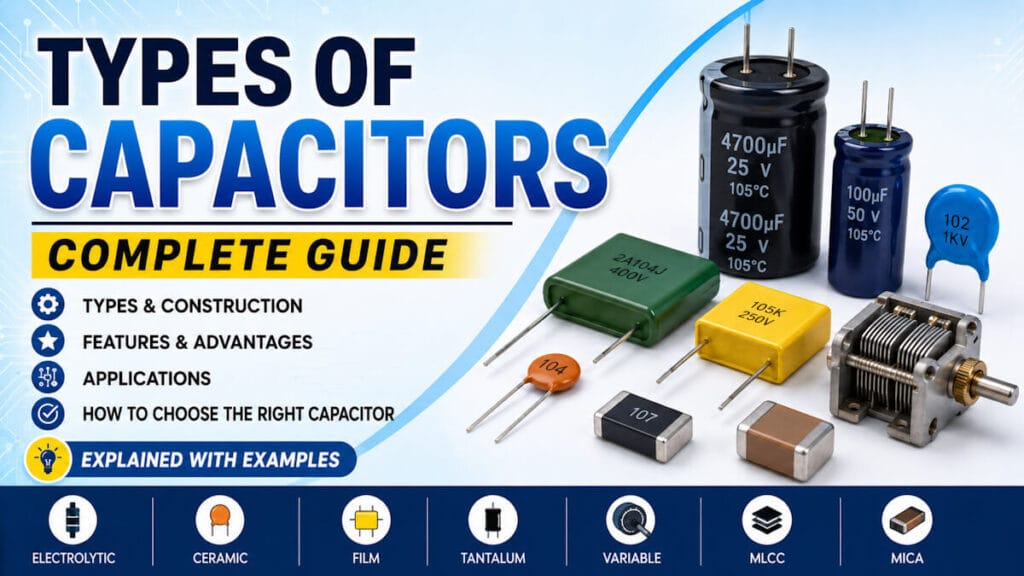
Types of Capacitors are among the most essential topics in electronics because capacitors are used in nearly every electrical and electronic circuit. Whether you’re building a simple LED circuit, designing a power supply, repairing household appliances, or developing industrial automation systems, selecting the right capacitor is critical for performance and reliability.
Capacitors store electrical energy in an electric field and release it when needed. Different capacitor technologies offer unique characteristics, making each suitable for specific applications.
In this guide, you’ll learn about the most common capacitor types, their construction, advantages, disadvantages, and practical uses.
Learn how each type of electric motor works, its advantages, disadvantages, applications, and the differences between them.
Types of Capacitors Guide
Choosing the right capacitor becomes much easier when you can compare different types side by side. The infographic below provides a quick reference to the most common capacitor types, including their key features, advantages, typical applications, and practical selection tips. Whether you’re an electronics student, hobbyist, technician, or engineer, save this guide for easy reference during circuit design, troubleshooting, or component selection.
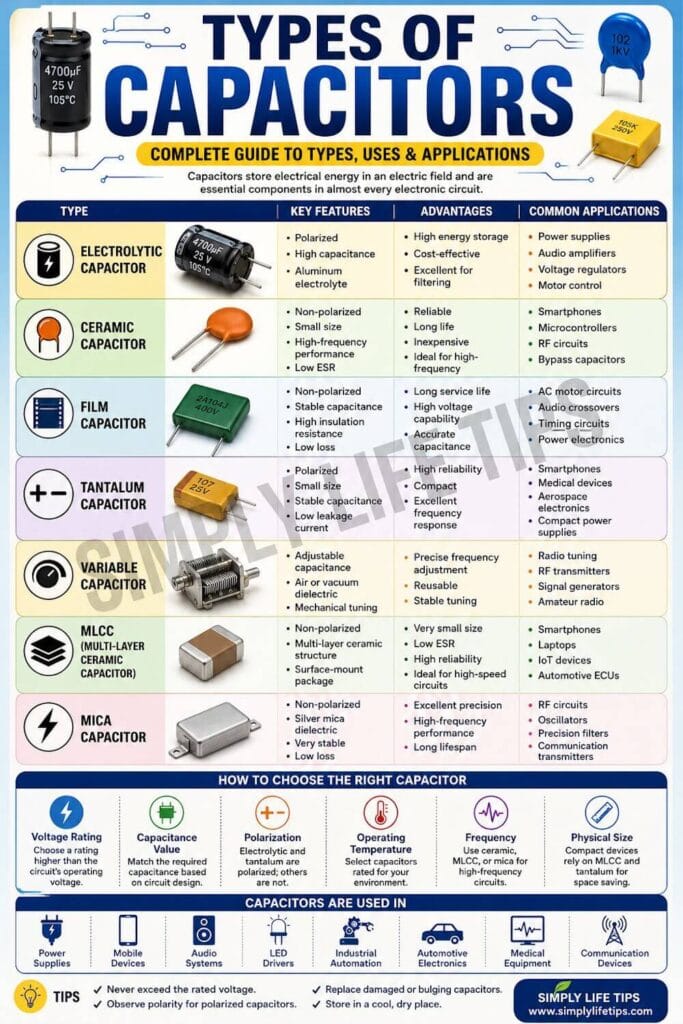
The infographic offers a simplified overview, but selecting the right capacitor also depends on your circuit’s voltage, capacitance, operating frequency, temperature, ESR, tolerance, and physical size requirements. Understanding these factors helps improve circuit performance, reliability, and longevity.
If you’re building or repairing electronic equipment, bookmark this guide and share it with fellow electronics enthusiasts. For more practical tutorials on electrical engineering, electronic components, DIY projects, and technology, visit Simply Life Tips
What Is a Capacitor?
A capacitor is a passive electronic component that stores electrical charge between two conductive plates separated by an insulating material called the dielectric.
Its main functions include:
- Energy storage
- Voltage smoothing
- Signal filtering
- Noise reduction
- Timing circuits
- Power conditioning
- Frequency tuning
Capacitance is measured in Farads (F).
Common units include:
- Microfarad (µF)
- Nanofarad (nF)
- Picofarad (pF)
Types of Capacitors
Electrolytic Capacitor
Electrolytic capacitors provide high capacitance values in relatively small packages. They are polarized, meaning they must be connected with the correct polarity.
Features
- High capacitance
- Polarized
- Aluminum or tantalum electrolyte
- Affordable
Advantages
- Excellent for filtering
- High energy storage
- Cost-effective
Disadvantages
- Shorter lifespan
- Sensitive to reverse polarity
- Higher leakage current
Applications
- Power supplies
- Audio amplifiers
- Battery chargers
- Motor control circuits
- Voltage regulators
Example: Desktop computer power supply filtering.
Ceramic Capacitor
Ceramic capacitors are among the most widely used capacitors due to their small size, stability, and low cost.
Features
- Non-polarized
- Compact
- High-frequency performance
- Low ESR
Advantages
- Reliable
- Long life
- Inexpensive
- Excellent for high-frequency circuits
Disadvantages
- Lower capacitance than electrolytic
- Capacitance may change with temperature (certain classes)
Applications
- Smartphones
- Microcontrollers
- RF circuits
- Oscillators
- Bypass capacitors
Example: Noise filtering near microprocessor power pins.
Film Capacitor
Film capacitors use thin plastic films as their dielectric material.
Features
- Non-polarized
- Stable capacitance
- High insulation resistance
- Low loss
Advantages
- Excellent reliability
- Long service life
- High voltage capability
- Accurate capacitance
Disadvantages
- Larger than ceramic capacitors
- More expensive
Applications
- Audio crossover networks
- AC motor circuits
- Timing circuits
- Power electronics
- Inverters
Example: Industrial motor run capacitors.
Tantalum Capacitor
Tantalum capacitors offer high capacitance with excellent stability in compact sizes.
Features
- Polarized
- Small size
- Stable capacitance
- Low leakage current
Advantages
- High reliability
- Compact design
- Excellent frequency response
Disadvantages
- More expensive
- Sensitive to voltage spikes
- Can fail catastrophically if reverse-connected
Applications
- Smartphones
- Medical devices
- Aerospace electronics
- Compact power supplies
Example: Mobile phone motherboard.
Variable Capacitor
Variable capacitors allow the capacitance value to be adjusted manually.
Features
- Adjustable capacitance
- Air dielectric or vacuum dielectric
- Mechanical tuning
Advantages
- Precise frequency adjustment
- Reusable
- Stable tuning
Disadvantages
- Bulky
- Mechanical wear
Applications
- Radio tuning
- RF transmitters
- Signal generators
- Amateur radio
Example: Old AM/FM radios.
MLCC (Multi-Layer Ceramic Capacitor)
MLCCs are modern ceramic capacitors built with multiple ceramic layers to increase capacitance.
Features
- Surface-mount package
- Small size
- Excellent frequency response
- High reliability
Advantages
- Ideal for compact electronics
- Low ESR
- Long life
- High-speed operation
Disadvantages
- Can crack under mechanical stress
- Limited capacitance compared to electrolytic types
Applications
- Smartphones
- Laptops
- IoT devices
- Automotive ECUs
- 5G communication equipment
Example: Every modern PCB contains dozens or even hundreds of MLCCs.
Mica Capacitor
Mica capacitors are known for exceptional stability and precision.
Features
- Silver mica dielectric
- Very stable
- Low loss
- High accuracy
Advantages
- Excellent precision
- High-frequency performance
- Long lifespan
Disadvantages
- Expensive
- Limited capacitance values
Applications
- RF circuits
- Oscillators
- Precision filters
- Military electronics
Example: Communication transmitters.
Comparison of Capacitor Types
| Capacitor Type | Polarized | Typical Capacitance | Best For |
|---|---|---|---|
| Electrolytic | Yes | High | Power supplies |
| Ceramic | No | Low to Medium | High-frequency circuits |
| Film | No | Medium | Audio and AC applications |
| Tantalum | Yes | Medium | Compact electronics |
| Variable | No | Adjustable | Radio tuning |
| MLCC | No | Low to Medium | Surface-mount electronics |
| Mica | No | Low | Precision RF circuits |
How to Choose the Right Capacitor?
Selecting the right capacitor is essential for ensuring your electronic circuit operates safely, efficiently, and reliably. Using the wrong type of capacitor can lead to poor performance, overheating, reduced lifespan, or even complete circuit failure. Engineers consider several factors before selecting a capacitor for any application. Understanding these factors will help you make the right choice whether you’re repairing electronics, designing printed circuit boards (PCBs), or building DIY projects.
Voltage Rating
The voltage rating indicates the maximum voltage a capacitor can safely withstand. Choosing a capacitor with an insufficient voltage rating can cause dielectric breakdown, overheating, or explosion in extreme cases.
As a general rule, always select a capacitor with a voltage rating at least 20–50% higher than the circuit’s maximum operating voltage. This safety margin improves reliability and extends the capacitor’s lifespan.
Example:
- Circuit voltage: 12V
- Recommended capacitor rating: 16V or 25V
- Avoid using a 10V capacitor because it may fail prematurely.
For high-voltage applications such as inverters, motor drives, or industrial power supplies, capacitors rated at 250V, 400V, or even higher are commonly used.
Capacitance Value
Capacitance determines how much electrical charge a capacitor can store. Selecting the correct capacitance value is crucial because it directly affects the circuit’s operation.
Using a value that is too low may result in insufficient filtering or unstable operation, while an excessively high value may increase startup current or alter timing characteristics.
Common capacitance ranges include:
- Picofarads (pF): RF circuits, oscillators, antennas
- Nanofarads (nF): Signal coupling, filters
- Microfarads (µF): Power supplies, audio circuits, motor control
Example:
A 1000 µF capacitor is commonly used to smooth the output of a DC power supply, while a 100 nF ceramic capacitor is placed near integrated circuits to filter high-frequency noise.
Always follow the value specified in the circuit schematic or manufacturer’s recommendations.
Polarization
Some capacitors are polarized, meaning they have positive (+) and negative (-) terminals that must be connected correctly. Reversing the polarity can permanently damage the capacitor and, in severe cases, cause it to burst.
Polarized capacitors include:
- Electrolytic capacitors
- Tantalum capacitors
Non-polarized capacitors include:
- Ceramic capacitors
- Film capacitors
- Mica capacitors
- MLCCs
- Variable capacitors
Before soldering, always check the polarity markings on both the capacitor and the PCB.
Example:
In a DC power supply, the negative terminal of an electrolytic capacitor connects to the ground line, while the positive terminal connects to the positive voltage rail.
Operating Temperature
Electronic components often operate in environments with varying temperatures. Excessive heat accelerates capacitor aging, reduces capacitance, and shortens service life.
Always choose a capacitor rated for the expected operating temperature.
Typical temperature ratings include:
- 85°C: Consumer electronics
- 105°C: Power supplies and industrial equipment
- 125°C and above: Automotive and harsh industrial environments
Higher-temperature capacitors generally offer better durability and longer operational life.
Example:
An automotive engine control module (ECU) experiences temperatures exceeding 100°C, making high-temperature-rated capacitors essential for reliable operation.
Frequency Characteristics
Different capacitor technologies perform differently at various frequencies.
For high-frequency circuits, capacitors with low Equivalent Series Resistance (ESR) and low inductance are preferred because they minimize signal loss and improve filtering performance.
Recommended capacitor types include:
- Ceramic capacitors
- MLCCs
- Silver mica capacitors
These capacitors are widely used in:
- RF transmitters
- Communication equipment
- Oscillators
- Microprocessors
- High-speed digital circuits
Example:
A 100 nF ceramic capacitor is commonly placed next to a microcontroller’s power pins to suppress high-frequency electrical noise.
Physical Size
Modern electronic devices are becoming increasingly compact, making capacitor size an important design consideration.
Surface-Mount Devices (SMD) dominate today’s electronics because they save PCB space and enable automated assembly.
Common compact capacitor choices include:
- MLCC
- Tantalum
- Small ceramic capacitors
Larger through-hole capacitors are still widely used in power electronics where higher capacitance and voltage ratings are required.
Example:
A smartphone motherboard may contain hundreds of tiny MLCC capacitors measuring less than 1 mm in size, while a desktop computer power supply uses much larger electrolytic capacitors for energy storage.
Tolerance
Capacitor tolerance indicates how much the actual capacitance may vary from its stated value.
Typical tolerance ratings include:
- ±1%
- ±2%
- ±5%
- ±10%
- ±20%
Precision circuits such as oscillators, timers, and measuring instruments require capacitors with tighter tolerances, while power filtering applications can generally tolerate larger variations.
Example:
A crystal oscillator circuit may require a capacitor with a ±2% tolerance to maintain accurate frequency stability.
Equivalent Series Resistance (ESR)
ESR represents the internal resistance of a capacitor. Lower ESR results in better efficiency, reduced heat generation, and improved performance, particularly in switching power supplies.
Low-ESR capacitors are commonly used in:
- DC-DC converters
- Computer motherboards
- LED drivers
- Solar inverters
- High-efficiency power supplies
Example:
Switch-mode power supplies (SMPS) often use low-ESR electrolytic capacitors to minimize power losses and voltage ripple.
Expected Lifespan
Capacitors have finite service lives that depend on temperature, voltage stress, and operating conditions.
General lifespan comparison:
- Ceramic capacitors: Very long lifespan
- Film capacitors: Excellent longevity
- Mica capacitors: Extremely durable
- Electrolytic capacitors: Limited lifespan due to electrolyte aging
- Tantalum capacitors: Long-lasting when operated within ratings
For equipment expected to run continuously for many years, investing in high-quality capacitors improves long-term reliability.
Cost and Availability
Budget is another practical consideration when selecting capacitors. While premium capacitors often provide superior performance and durability, standard components are sufficient for many everyday applications.
For example:
- Ceramic capacitors are inexpensive and suitable for general-purpose circuits.
- Film capacitors cost more but offer excellent stability and reliability.
- Tantalum capacitors are compact and stable but are generally more expensive than aluminum electrolytic capacitors.
Choosing the right balance between cost, performance, and reliability helps optimize both the design and overall project budget.
Quick Checklist Before Selecting a Capacitor
Before purchasing or installing a capacitor, verify the following:
- Correct capacitance value
- Voltage rating higher than the operating voltage
- Correct polarity (if polarized)
- Suitable operating temperature
- Appropriate frequency characteristics
- Proper physical size and mounting type
- Required tolerance
- Low ESR for power applications
- Expected service life
- Cost and availability
By carefully evaluating these factors, you can choose a capacitor that delivers optimal performance, improves circuit reliability, and ensures the long-term success of your electronic project.
Common Applications of Capacitors
Capacitors are found in countless electronic systems, including:
- Mobile phones
- Computers
- Televisions
- LED drivers
- Power supplies
- Solar inverters
- Electric vehicles
- Industrial automation
- Medical equipment
- Audio systems
- Communication devices
- Consumer electronics
Best Practices for Using Capacitors
- Never exceed the rated voltage.
- Observe polarity for polarized capacitors.
- Avoid excessive heat during soldering.
- Replace damaged or bulging electrolytic capacitors immediately.
- Store capacitors in dry environments.
- Use appropriate capacitance and tolerance values for critical circuits.
Learn about the most common types of relays, explaining how each one works, its key features, and where it is commonly used in industrial, commercial, and automotive applications.
Conclusion
Understanding the Types of Capacitors helps engineers, students, hobbyists, and technicians design safer and more efficient electronic circuits. Each capacitor type has unique electrical characteristics that make it suitable for specific applications. Electrolytic capacitors excel in power filtering, ceramic and MLCC capacitors dominate high-frequency electronics, film capacitors offer long-term reliability, tantalum capacitors provide compact high-capacitance solutions, variable capacitors enable frequency tuning, and mica capacitors deliver exceptional precision.
Choosing the right capacitor improves circuit performance, enhances reliability, and extends the lifespan of electronic equipment.
Frequently Asked Questions (FAQs)
Which capacitor is most commonly used?
Ceramic capacitors and MLCCs are the most widely used due to their reliability, compact size, and versatility.
Why are electrolytic capacitors polarized?
Their internal construction uses an oxide layer that only functions correctly when connected with the proper polarity.
What is an MLCC capacitor?
An MLCC (Multi-Layer Ceramic Capacitor) is a surface-mount capacitor made with multiple ceramic layers, offering high reliability and compact size.
Which capacitor is best for high-frequency circuits?
Ceramic, MLCC, and mica capacitors provide the best performance for high-frequency applications.
How do I choose the correct capacitor?
Consider capacitance, voltage rating, polarity, temperature range, frequency, tolerance, and physical size before selecting a capacitor.
External Resources
For additional technical information, refer to these trusted resources:
- Analog Devices – Capacitor Basics: https://www.analog.com/
- Texas Instruments – Passive Components Guide: https://www.ti.com/
- Electronics Tutorials – Capacitors: https://www.electronics-tutorials.ws/
Thanks for reading! Stay healthy, stay active, and keep learning with Simply Life Tips
— PVM

Mathukutty P V is a Blogger, YouTuber, and Content Writer and the founder of Simply Life Tips. After taking voluntary retirement in 2017, he embraced a free lifestyle focused on learning, personal growth, and sharing practical wisdom to help others live with more purpose and positivity.



