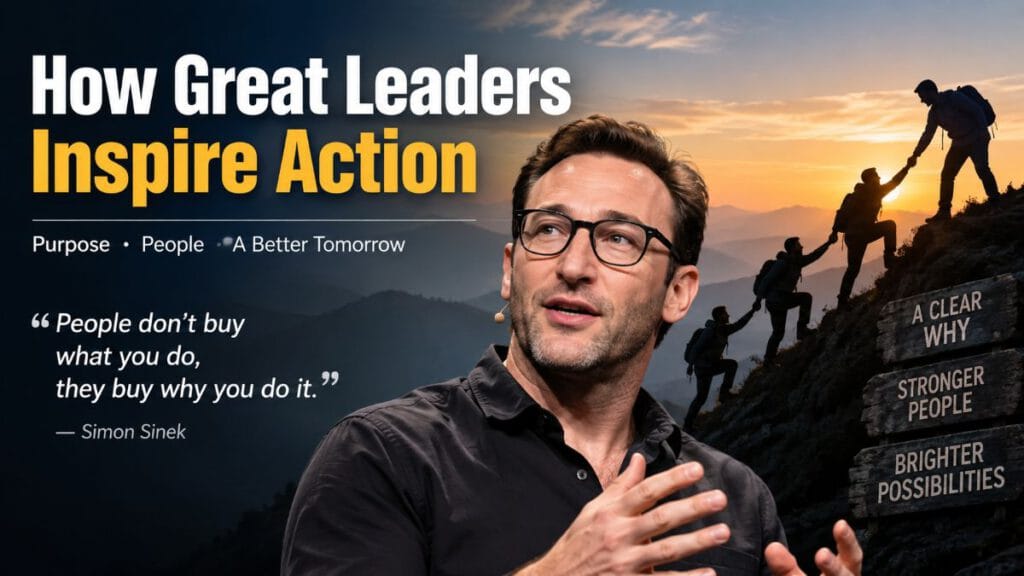
How Great Leaders Inspire Action is a question worth asking because leadership is not simply about having authority, giving instructions, or holding an important position. The strongest leaders make people want to contribute, believe in a shared purpose, and take meaningful action.
Some leaders can tell people exactly what to do, yet struggle to create genuine commitment. Others seem to bring energy and purpose to everything they do. What makes the difference? Often, it is the ability to connect people with a reason that matters.
Simon Sinek explored this idea in his famous TED Talk, How Great Leaders Inspire Action. Presented at TEDxPugetSound in 2009, the talk introduced his widely known Golden Circle and the simple question at its centre: “Why?”
The idea remains relevant because people want more than instructions. They want to understand why their work matters.
What Makes Great Leaders Inspire Action?
A manager can tell people what needs to be done. A leader goes further by helping people understand why it matters.
That difference may seem small, but it can completely change how people respond.
Imagine a team leader saying, “We need to finish this project by Friday.”
The instruction is clear, but it does not necessarily create enthusiasm.
Now imagine the leader saying, “This project will make it easier for our customers to solve a problem they have struggled with for years. Let’s make sure we deliver something we can be proud of by Friday.”
The task has not changed. The deadline has not changed. But the meaning behind the work has become clearer.
This is one of the central lessons of how great leaders inspire action. They give people a reason to care about the outcome rather than relying entirely on authority or pressure.
Simon Sinek and the Power of Why
Simon Sinek became widely known for his Golden Circle and the philosophy explained in his book Start With Why. The model consists of three layers: WHY, HOW, and WHAT.
The WHY represents purpose, cause, or belief.
The HOW describes the principles, processes, or methods used to bring that purpose to life.
The WHAT represents the products, services, or actions that result.
Sinek explains the model in greater detail on his official Golden Circle page and in his book Start With Why.
“People don’t buy what you do, they buy why you do it.”
That well-known idea captures the heart of his philosophy. The same principle can apply to leadership: people may follow instructions because they have to, but they are more likely to commit themselves when they believe in the reason behind the work.
Watch Simon Sinek Explain How Great Leaders Inspire Action
If you have never watched Simon Sinek’s original TED Talk, it is worth watching. His examples include Apple, Martin Luther King Jr., and the Wright brothers as he explains how purpose can influence behaviour and inspire people to act.
The talk is not a formula that magically turns someone into a great leader. Its real value is that it encourages us to reconsider how we communicate, motivate, and build commitment.
For anyone interested in how great leaders inspire action, the TED Talk provides a useful starting point for understanding the relationship between purpose and behaviour.
1. Great Leaders Start With Purpose
Great leaders know where they are going and why the journey matters.
Purpose gives people something bigger than a task to connect with. A teacher, for example, is not simply delivering lessons. The deeper purpose may be helping young people develop confidence, curiosity, knowledge, and the ability to build their future.
A business leader may not simply be selling a product. The organisation may exist to solve a particular problem or improve people’s lives.
When leaders communicate that purpose clearly, everyday work can become more meaningful.
This does not mean every task needs a dramatic mission statement. Sometimes a simple explanation is enough.
Instead of saying, “Complete this report,” a leader might explain, “This report will help us understand where our customers are struggling so we can improve the service.”
The work now has a reason.
That is one of the simplest ways great leaders inspire action: they connect an ordinary task with a meaningful purpose.
2. Great Leaders Communicate a Clear Vision
Purpose answers “Why?” but people also need to understand where they are going.
A clear vision gives people direction.
Consider a sports coach preparing a team for an important competition. Saying “Work harder” may create temporary pressure, but it does not necessarily create commitment.
A better leader explains what the team is trying to achieve, why the goal matters, and what success will look like.
A strong vision does not have to be complicated. In fact, the simpler it is, the easier it may be for people to remember and communicate.
When people can see the destination, they are more likely to understand the importance of the journey.
Great leaders inspire action by making the destination clear enough for people to see themselves as part of it.
3. Great Leaders Build Trust
Inspiration without trust is fragile.
People may listen to a leader because of their position, but genuine commitment develops when people believe the leader is honest, dependable, and genuinely concerned about the team.
Simon Sinek has frequently connected effective leadership with trust and a sense of safety within teams. His work encourages leaders to create environments where people can cooperate and contribute without constantly feeling threatened.
Trust grows through everyday behaviour.
A leader builds trust by keeping promises, accepting responsibility for mistakes, listening carefully, giving credit to others, and treating people with respect.
It is difficult to inspire people when they are constantly wondering whether their leader will support them.
This is why trust is an essential part of how great leaders inspire action. People are more willing to take initiative when they know their leader will not immediately blame them when something goes wrong.
4. Great Leaders Lead by Example
People notice what leaders do more than what they say.
A leader who talks about teamwork but takes all the credit sends a contradictory message.
A leader who asks people to remain calm but reacts angrily to every mistake weakens their own credibility.
By contrast, leaders who demonstrate the behaviour they expect from others make their values visible.
If you want people to listen, listen first.
If you want people to accept responsibility, accept responsibility yourself.
If you want people to keep learning, continue learning.
Leadership becomes powerful when values are demonstrated rather than merely announced.
This is another reason great leaders inspire action through behaviour. People can see the standard instead of simply hearing about it.
5. Great Leaders Give People Ownership
Inspiring action does not mean controlling every action.
When leaders provide a clear purpose but allow people some freedom in how they contribute, they create a stronger sense of ownership.
Imagine a manager who explains the desired outcome and then gives an employee freedom to decide how to achieve it.
Compare that with a manager who dictates every small step.
The first approach can encourage responsibility, creativity, and confidence. The second can make people dependent on constant instructions.
Simon Sinek puts the idea beautifully:
“A great leader inspires us to have confidence in what WE can do”
That is an important distinction.
Great leadership is not about making everyone dependent on the leader. It is about helping people discover what they are capable of doing.
When people believe their contribution matters, they are more likely to take action without waiting for someone to tell them what to do.
6. Great Leaders Listen Before They Speak
Leadership is often associated with powerful speeches and confident communication. But listening may be just as important.
A leader who listens can understand problems before attempting to solve them.
Consider an employee who makes a mistake. A poor leader may immediately criticise the person.
A better leader might first ask:
“What happened?”
“What made this difficult?”
“What could we do differently next time?”
Listening does not mean avoiding accountability. It means understanding before judging.
This approach can also reveal ideas that a leader would otherwise miss.
People are more likely to contribute when they believe their opinions are genuinely valued.
Listening therefore becomes an important part of inspiring action. People who feel heard are often more willing to participate, suggest improvements, and take responsibility.
7. Great Leaders Connect Individual Work to a Bigger Purpose
People can lose motivation when they cannot see how their work contributes to something meaningful.
A leader can change that by connecting individual responsibilities with the larger mission.
A receptionist may think, “I answer calls all day.”
A good leader can help that person see, “You are often the first person our customers meet. The way you welcome them shapes their entire experience with us.”
The task remains the same, but its meaning changes.
That is the power of purpose.
This principle applies everywhere.
A parent can explain to a child why responsibility matters rather than simply demanding obedience. A teacher can show students how a difficult lesson connects to their future. A manager can explain how a routine task affects customers and colleagues.
People often become more committed when they understand that their contribution matters.
For another perspective, read True Leadership: Why It’s About People, Not Power, which explores why meaningful leadership is about people rather than simply holding authority.
8. Great Leaders Make People Want to Act
This brings us back to the central question: how great leaders inspire action.
They do not simply push people from behind.
They create a reason to move forward.
They communicate purpose. They build trust. They demonstrate their values. They listen. They give people ownership. They connect everyday work with something larger.
That does not mean every person will agree with every decision. Leadership is not about making everyone happy.
It is about creating enough clarity, trust, and shared purpose for people to move in the same direction.
A leader who inspires action does not necessarily have the loudest voice in the room. Often, the most effective leader is the person who helps everyone else find their reason to contribute.
The Golden Circle in Everyday Life
The Golden Circle is not limited to large companies or famous leaders.
A parent can use it.
A teacher can use it.
A community volunteer can use it.
A small-business owner can use it.
Even someone leading a personal project can use it.
Suppose a person wants to encourage a group of volunteers to clean a neglected public space.
A WHAT-focused message might be:
“We need to clean this area on Saturday.”
A WHY-focused message could be:
“This place belongs to all of us. If we restore it, children will have a cleaner and safer space to play, and our neighbourhood will become a better place for everyone.”
The physical task is identical.
The emotional meaning is different.
That is why understanding how great leaders inspire action can be useful far beyond the workplace.
The Golden Circle becomes easier to understand when we connect it with the everyday behaviours of effective leaders. The infographic below brings together the key ideas behind how great leaders inspire action, from starting with purpose to building trust and giving people ownership.
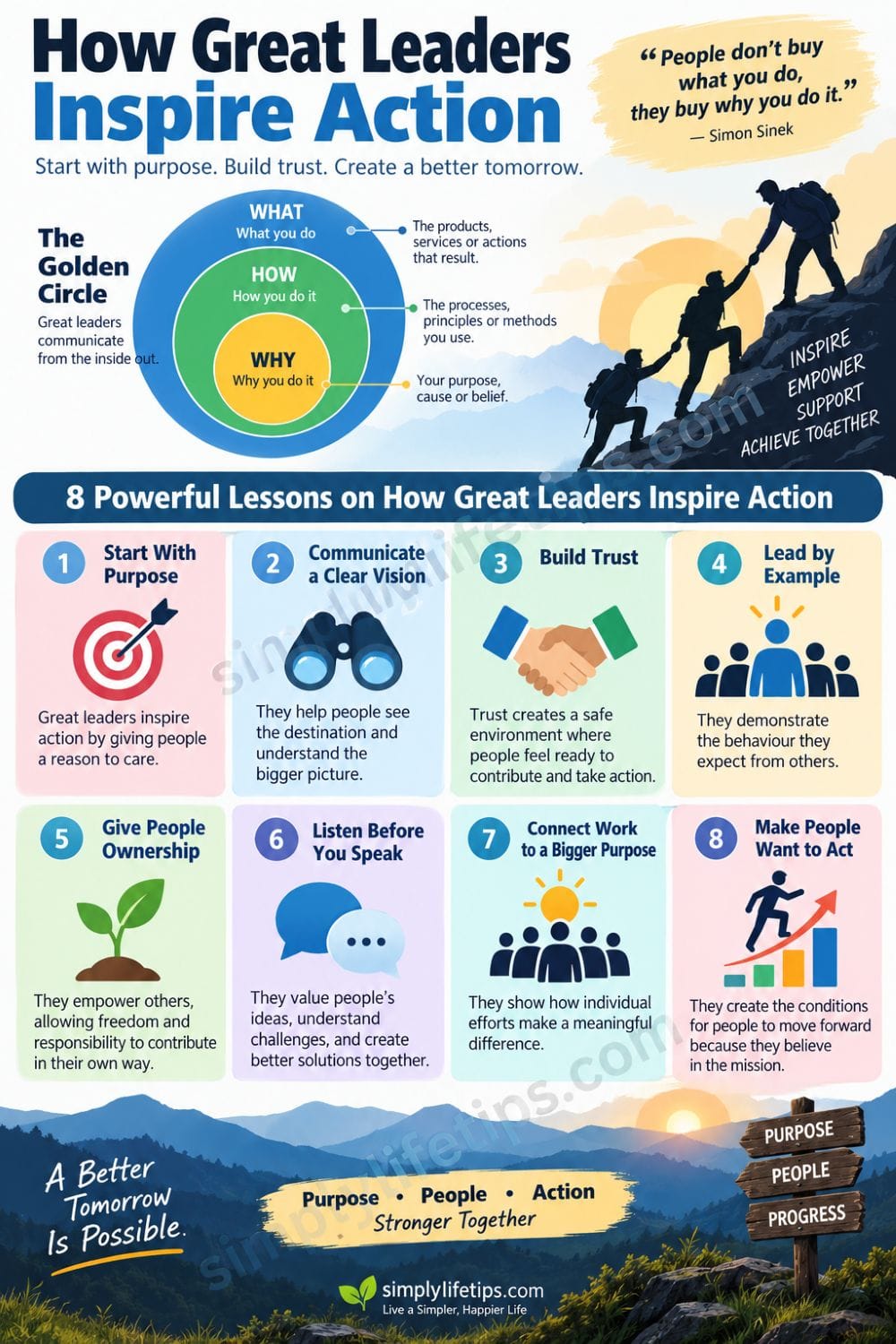
These principles show that inspiring leadership is not about having all the answers or telling everyone what to do. It is about giving people a meaningful reason to contribute, creating trust, and helping them see how their efforts can make a difference.
Leadership Is More Than Motivation
There is an important lesson here: inspiring action is not the same as giving people constant motivation.
Motivation can rise and fall.
Purpose can provide a more stable foundation.
A leader cannot realistically deliver an inspiring speech every morning. But a leader can create an environment where people understand the mission, trust one another, and know that their work has value.
That is why leadership is ultimately about relationships and consistency.
A powerful message followed by poor behaviour will not create lasting trust.
A simple message supported by consistent action can be much more powerful.
For another perspective on the science and behaviour behind effective leadership, read Leadership Brain: The Neuroscience Behind True Leadership.
And if you want to explore Simon Sinek’s journey and broader lessons, read Simon Sinek Inspiring Success Story.
What Can We Learn From Simon Sinek?
The most useful lesson from Simon Sinek’s work is not that every leader must copy his communication style.
It is that leaders should understand the reason behind what they do.
A clear WHY can guide decisions when circumstances change.
It can help teams understand priorities.
It can make communication more meaningful.
And it can help people see that their work is part of something larger than a list of daily tasks.
His Golden Circle has therefore become a useful framework for thinking about leadership, communication, business, and purpose.
Ultimately, the lesson behind how great leaders inspire action is remarkably simple: people need a reason to believe that their effort matters.
Conclusion
How Great Leaders Inspire Action ultimately comes down to something deeper than authority.
People are more likely to act when they understand the purpose, trust the person leading them, believe in the direction, and feel that their own contribution matters.
Simon Sinek’s Golden Circle provides a simple way to remember this: start with WHY, explain HOW, and then show WHAT you are doing.
The best leaders do not simply tell people what to do. They help people understand why the work matters and give them the confidence and freedom to contribute.
As Simon Sinek says:
“Success is a team sport.”
That may be one of the simplest ways to understand inspiring leadership. A leader’s greatest achievement is not doing everything personally. It is helping other people believe in a shared purpose and take action together.
FAQs about How Great Leaders Inspire Action
What is the main idea behind How Great Leaders Inspire Action?
The main idea is that inspiring leaders begin with purpose. Simon Sinek’s Golden Circle explains this through WHY, HOW, and WHAT, with WHY representing the purpose, cause, or belief behind an organisation or action.
What is Simon Sinek’s Golden Circle?
The Golden Circle consists of three layers: WHY at the centre, HOW in the middle, and WHAT on the outside. Sinek argues that inspirational leaders and organisations communicate from the inside out, starting with WHY.
Why is purpose important in leadership?
Purpose helps people understand why their work matters. When individuals can connect everyday responsibilities with a meaningful goal, they may develop stronger commitment and ownership.
How can a leader inspire action without using authority?
A leader can inspire action by communicating a clear purpose, building trust, listening to people, leading by example, giving people ownership, and connecting individual contributions with a shared goal.
Is Simon Sinek’s TED Talk worth watching?
Yes. How Great Leaders Inspire Action presents his Golden Circle through examples including Apple, Martin Luther King Jr., and the Wright brothers. The TED Talk is available through the official TED platform.

Mathukutty P V is a Blogger, YouTuber, and Content Writer and the founder of Simply Life Tips. After taking voluntary retirement in 2017, he embraced a free lifestyle focused on learning, personal growth, and sharing practical wisdom to help others live with more purpose and positivity.