

Personality types prone to burnout often share patterns such as perfectionism, people-pleasing, overachievement, difficulty setting boundaries, or constantly putting other people’s needs before their own. While personality alone does not determine whether someone will experience burnout, certain habits and behavioral tendencies can make it easier to ignore stress and harder to rest.
Burnout can develop gradually. A person may continue working, helping others, meeting high expectations, or trying to maintain control without realizing how much physical and emotional energy they are using. Over time, constant pressure without adequate recovery can lead to exhaustion, reduced motivation, irritability, and a feeling of being overwhelmed.
Learning about personality types prone to burnout is not about labeling people or deciding that a particular personality inevitably leads to burnout. Most of us can recognize ourselves in several of them depending on our circumstances. Instead, recognizing potentially unhealthy patterns can help us establish boundaries, manage expectations, and make time for recovery.
Let’s explore eight personality types prone to burnout and the habits that can contribute to it.
The following infographic highlights eight personality patterns that may be more vulnerable to burnout. While these patterns can have positive qualities, they may also become stressful when combined with excessive pressure, poor boundaries, or insufficient rest.
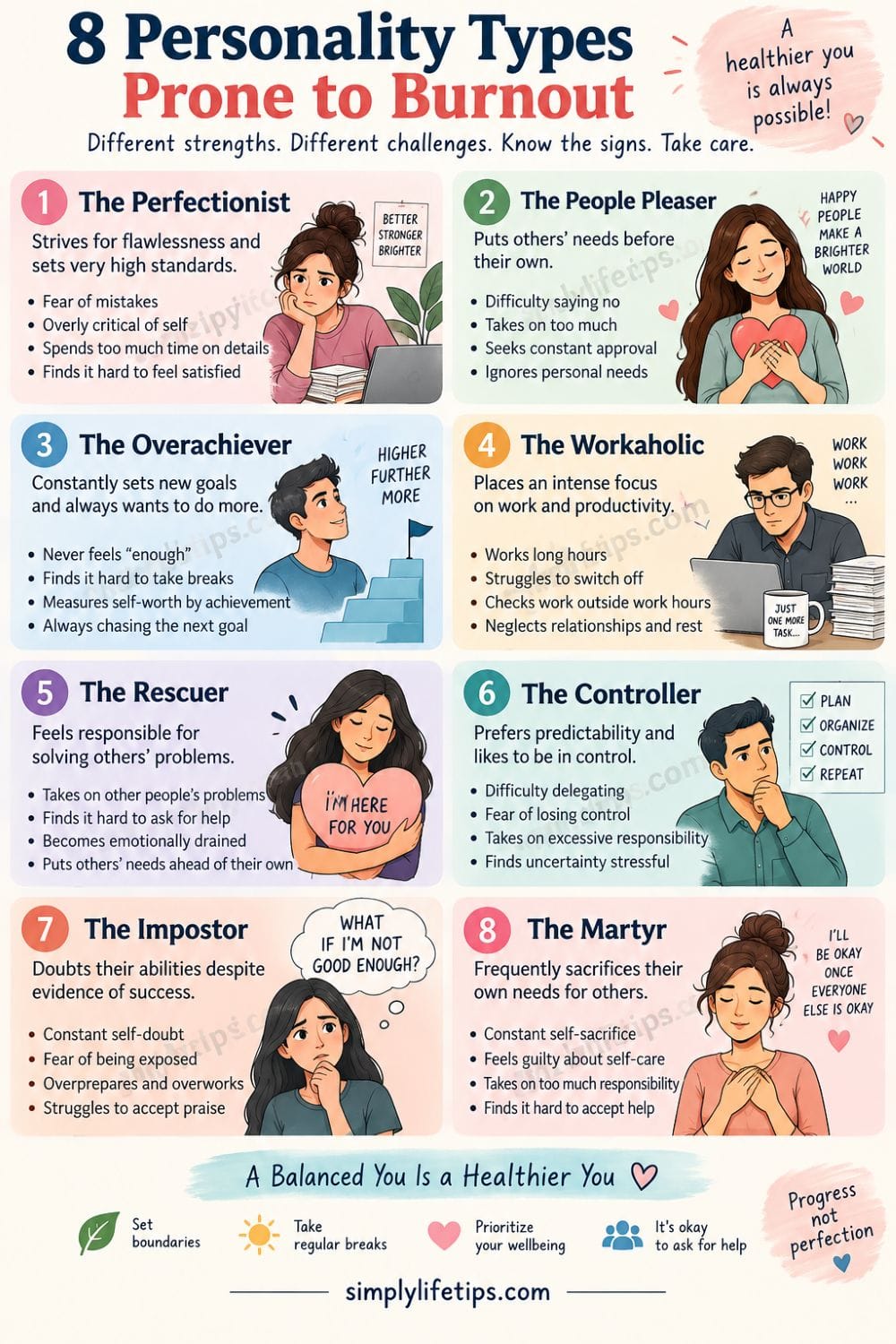
The infographic above highlights the key personality types prone to burnout. The detailed explanations below explore how each personality pattern may increase stress and exhaustion over time.
Personality patterns can vary widely, and most people show a combination of traits rather than fitting neatly into one category. You can explore more examples in our guide to 9 common types of people and their unique traits.
8 Personality Types Prone to Burnout
No single personality type automatically causes burnout. Many factors, including workload, lack of control, workplace conditions, ongoing stress, relationships, and insufficient recovery can influence burnout. However, some personality patterns may encourage behaviors that increase stress or make it harder to recognize when it is time to slow down.
The World Health Organization describes burnout as an occupational phenomenon resulting from chronic workplace stress that has not been successfully managed. WHO: Burn-out as an occupational phenomenon
Some personality types prone to burnout may share behavioral patterns such as perfectionism, people-pleasing, overachievement, or difficulty setting boundaries.
The eight patterns below are not formal clinical personality types. Instead, they describe common behaviors and tendencies that may contribute to burnout when they become excessive or are combined with prolonged stress.
1. The Perfectionist
Among the personality types prone to burnout, perfectionists may be particularly vulnerable when high standards become unrealistic expectations. The perfectionist sets exceptionally high standards and may feel that anything less than excellent is unacceptable. They often pay close attention to details and take pride in producing high-quality work, but their pursuit of flawlessness can become a constant source of pressure.
For example, a perfectionist might spend hours correcting a report that is already perfectly acceptable because they believe it could still be improved. Even after completing an important task, they may focus more on small mistakes than on what they accomplished.
Perfectionism can become particularly exhausting when a person connects their self-worth with flawless performance. Instead of seeing mistakes as a normal part of learning, they may interpret them as evidence that they have failed.
Perfectionism can be productive when balanced, but excessively high standards and constant self-criticism can become exhausting. Learn more about destructive perfectionist habits and ways to overcome them
Common burnout risks include:
- Setting unrealistic standards
- Fear of making mistakes
- Excessive self-criticism
- Difficulty feeling satisfied with achievements
- Spending too much time on minor details
Healthy perfectionism can encourage quality and discipline, but learning when something is good enough can help protect energy and reduce unnecessary stress.
2. The People-Pleaser
People-pleasing is another pattern often discussed when considering personality types prone to burnout, particularly when saying no feels difficult. A people-pleaser often prioritizes other people’s needs, opinions, and feelings while neglecting their own. They may find it difficult to say no because they worry about disappointing others or creating conflict.
For example, someone may already have a demanding workload but agree to help a colleague because they feel uncomfortable refusing. One request becomes another, and eventually their schedule becomes filled with responsibilities they never needed to accept.
The desire to help others is not inherently unhealthy. The problem arises when helping becomes a constant obligation and personal boundaries disappear.
Common burnout risks include:
- Difficulty saying no
- Taking on too many responsibilities
- Seeking constant approval
- Avoiding conflict
- Ignoring personal needs
Learning to set respectful boundaries and understanding that saying no does not make someone selfish can be an important part of preventing burnout.
3. The Overachiever
For some personality types prone to burnout, achievement can become closely connected with self-worth, making it difficult to slow down after reaching a goal. The overachiever is highly motivated by accomplishment and may constantly set new goals. Success can provide satisfaction, but an endless need to achieve can make rest feel unproductive.
For example, after completing an important project, an overachiever may immediately begin planning the next goal instead of taking time to recover. Their achievements may continue increasing while their energy gradually decreases.
Overachievement becomes problematic when a person believes they must always be doing more to feel valuable or successful.
Common burnout risks include:
- Constantly chasing new goals
- Difficulty taking breaks
- Measuring self-worth through achievement
- Comparing accomplishments with others
- Feeling guilty when not being productive
Achievement is valuable, but sustainable success requires recovery as well as effort.
4. The Workaholic
The workaholic is one of the clearest examples of a behavioral pattern that can appear among personality types prone to burnout, especially when work consistently takes priority over recovery. A workaholic places an unusually strong emphasis on work and may struggle to disconnect from professional responsibilities. Unlike simply being hardworking, workaholism can involve a persistent psychological need to work even when rest is necessary.
For example, a person may continue checking work emails late at night, work during weekends, or feel uncomfortable taking a vacation because they believe they should always be available.
Over time, this pattern can interfere with sleep, relationships, hobbies, and physical recovery.
Common burnout risks include:
- Excessive working hours
- Difficulty switching off
- Checking work outside working hours
- Neglecting relationships
- Feeling guilty about resting
A healthy work ethic does not require working constantly. Establishing clear working hours and genuine periods of recovery can help create a more sustainable routine.
5. The Rescuer
The rescuer instinctively wants to solve other people’s problems. They may become the person everyone calls during a crisis because they are dependable, compassionate, and willing to help.
For example, a rescuer may repeatedly support friends, family members, or coworkers while ignoring their own emotional exhaustion. They may feel responsible for fixing situations that are ultimately outside their control.
Helping others can be deeply rewarding, but constantly carrying other people’s problems can become emotionally draining.
Common burnout risks include:
- Taking responsibility for other people’s problems
- Difficulty asking for help
- Emotional overload
- Neglecting personal needs
- Feeling responsible for everyone else’s well-being
Healthy support requires boundaries. Sometimes the most helpful response is to listen, encourage, or guide someone toward appropriate support rather than trying to solve everything yourself.
Compassion is valuable, but caring for others should not require completely neglecting your own needs. Learn more about the power of compassion and its importance and benefits.
6. The Controller
The controller prefers predictability, organization, and certainty. They may find it difficult to delegate because they believe tasks will only be completed correctly if they personally oversee them.
For example, a manager may take responsibility for every important detail instead of trusting team members with specific tasks. Although this can create a temporary sense of control, it also creates an enormous personal workload.
Life and work inevitably contain uncertainty. Trying to control every outcome can therefore become exhausting.
Common burnout risks include:
- Difficulty delegating
- Fear of losing control
- Excessive responsibility
- Overplanning
- Difficulty accepting uncertainty
Learning to distinguish between what you can control and what you cannot can reduce unnecessary mental pressure.
7. The Impostor
A person experiencing impostor feelings may doubt their abilities despite having evidence of competence and success. They may believe they are not as capable as other people think and worry that others will eventually discover they are not good enough.
For example, someone who receives a promotion may immediately worry that they were chosen by mistake. Instead of enjoying the achievement, they may work excessively to prove that they deserve the position.
These feelings can create a cycle in which success leads to more pressure rather than confidence.
Common burnout risks include:
- Constant self-doubt
- Fear of being exposed as inadequate
- Overpreparing
- Difficulty accepting praise
- Working excessively to prove competence
Recognizing accomplishments and separating genuine areas for improvement from unrealistic self-doubt can help break this cycle.
8. The Martyr
The martyr frequently sacrifices their own needs for work, family, or other people. They may take pride in being the person who always gives more, even when they are exhausted.
For example, a parent may handle every household responsibility while refusing assistance because they believe others need them. An employee might repeatedly accept additional tasks while quietly becoming resentful and exhausted.
Self-sacrifice can sometimes be necessary, particularly during difficult periods. However, making it a permanent lifestyle can leave little room for personal recovery.
Common burnout risks include:
- Constant self-sacrifice
- Refusing help
- Suppressing personal needs
- Taking on excessive responsibilities
- Feeling guilty about prioritizing oneself
Caring for yourself is not the opposite of caring for others. Sustainable support requires enough energy to continue giving without completely depleting yourself.
Why Are Some Personality Patterns More Vulnerable to Burnout?
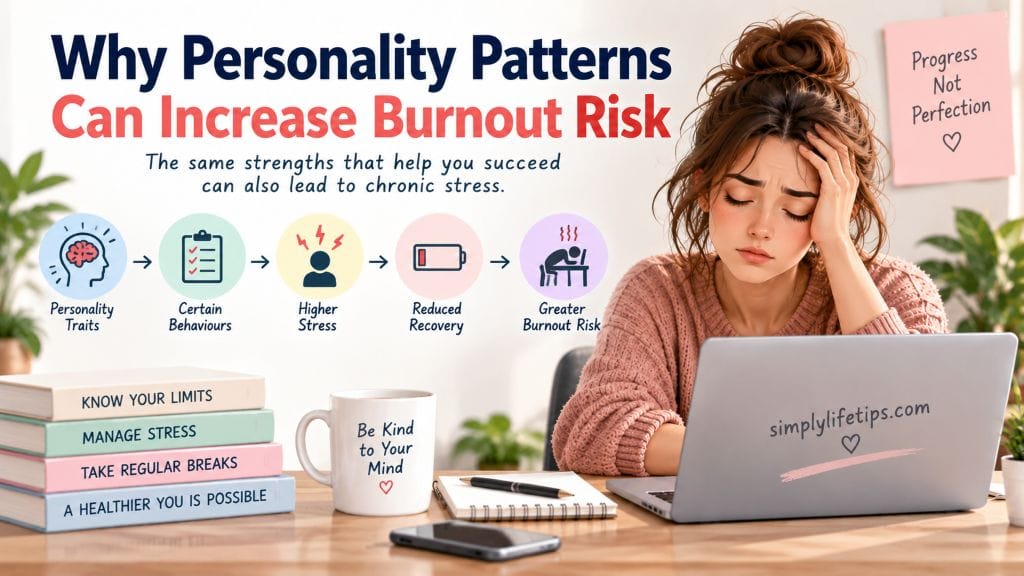
Understanding personality types prone to burnout requires looking beyond personality itself. Burnout is shaped by both individual behaviors and external circumstances. Personality patterns can influence how people respond to stress, but they do not operate in isolation. A perfectionist working in a supportive environment with realistic expectations may cope very differently from a perfectionist facing an excessive workload and little control.
Understanding these personality types prone to burnout can help you recognize unhealthy patterns before they affect your mental and emotional well-being.
The same is true for people-pleasers, workaholics, overachievers, and rescuers. Their positive qualities can become problematic when taken to an extreme.
For example, dedication can become overwork, compassion can become emotional exhaustion, attention to detail can become perfectionism, and responsibility can become an inability to delegate.
This is why burnout should not simply be blamed on someone’s personality. Working conditions, workload, organizational culture, relationships, financial pressures, sleep, and opportunities for recovery can all play important roles.
Personality traits may influence burnout risk, but factors such as workload, work-life balance, lack of control, and workplace support also play important roles. Mayo Clinic: Job burnout
Signs You May Be One of the Personality Types Prone to Burnout
Recognizing the pattern early can make it easier to change unhealthy habits. Some warning signs include constantly feeling exhausted, becoming unusually irritable, losing enthusiasm for activities you once enjoyed, struggling to concentrate, or feeling that you can never switch off.
You may also notice behavioral changes. Perhaps you keep saying yes when you want to say no, work long after your responsibilities are finished, repeatedly check messages during personal time, or feel guilty whenever you take a break.
These signs do not automatically mean that you have burnout. However, they can be useful signals that your current approach to work, responsibilities, and recovery may need attention.
Recognizing these warning signs can help people with personality types prone to burnout identify unhealthy patterns before prolonged stress becomes overwhelming.
How to Reduce Burnout Risk
Preventing burnout often starts with small changes rather than one dramatic lifestyle transformation. Begin by identifying the behaviors that consume the most energy and asking whether they are genuinely necessary.
If you are a perfectionist, practice completing appropriate tasks without endlessly refining them. If you are a people-pleaser, experiment with setting one small boundary. If you are a workaholic, establish a time when work-related notifications stop.
Regular recovery is equally important. Adequate sleep, physical activity, enjoyable hobbies, social connection, breaks, and time away from work can all contribute to better overall well-being.
It is also important to seek support when stress becomes difficult to manage. Persistent exhaustion, hopelessness, severe anxiety, or significant changes in daily functioning deserve professional attention rather than simply trying to work harder.
If you recognize yourself in one of these personality types prone to burnout, the goal is not to change your personality but to develop healthier habits and boundaries.
Chronic work stress can become overwhelming and affect both physical and emotional health, making healthy boundaries and recovery important parts of managing workplace stress. American Psychological Association: Coping with stress at work
Personality Types and Burnout: What Should You Remember?
The most important lesson is that personality types do not determine your destiny. Being a perfectionist, ambitious person, helper, or highly responsible worker does not mean you will inevitably experience burnout.
Many traits associated with burnout risk also have valuable positive qualities. Perfectionists can produce excellent work. People-pleasers can be compassionate and considerate. Workaholics can be dedicated. Rescuers can be supportive. Overachievers can be highly motivated.
The goal is not to eliminate these qualities. Instead, it is to recognize when a useful trait becomes excessive and begins damaging your well-being.
Understanding your behavioral patterns can help you create healthier boundaries, recognize stress earlier, and build a more sustainable balance between achievement, responsibility, relationships, and rest.
Conclusion
Personality types prone to burnout often share positive qualities such as ambition, compassion, dedication, responsibility, and attention to detail. However, when these strengths become extreme and recovery is ignored, they can contribute to chronic stress and emotional exhaustion.
The purpose of recognizing these patterns is not to label yourself or someone else. Instead, it is to notice behaviors that may be draining your energy and make practical changes before exhaustion becomes overwhelming.
Which of these personality patterns do you recognize most in yourself?
FAQs About Personality Types Prone to Burnout
Which personality types are prone to burnout?
Personality types prone to burnout may include people with strong perfectionistic, people-pleasing, overachieving, workaholic, rescuing, controlling, impostor-related, or self-sacrificing patterns. However, personality is only one possible factor, and burnout can affect people with many different personalities.
Can perfectionists be prone to burnout?
Yes. Perfectionists may be among the personality types prone to burnout when exceptionally high standards, fear of mistakes, and constant self-criticism create prolonged stress.
Can workaholics experience burnout?
Yes. Persistent overwork and insufficient recovery can contribute to burnout. Workaholism is therefore an important behavioral pattern to consider when discussing personality types prone to burnout.
Can people-pleasing lead to burnout?
Yes. Constantly saying yes, taking on other people’s responsibilities, and neglecting personal needs can create excessive emotional and practical demands over time.
Can you change behaviors that increase burnout risk?
Yes. People can develop healthier habits and boundaries. Learning to delegate, saying no when appropriate, taking regular breaks, managing expectations, and making time for recovery can help create a more sustainable routine.

Mathukutty P V is a Blogger, YouTuber, and Content Writer and the founder of Simply Life Tips. After taking voluntary retirement in 2017, he embraced a free lifestyle focused on learning, personal growth, and sharing practical wisdom to help others live with more purpose and positivity.



