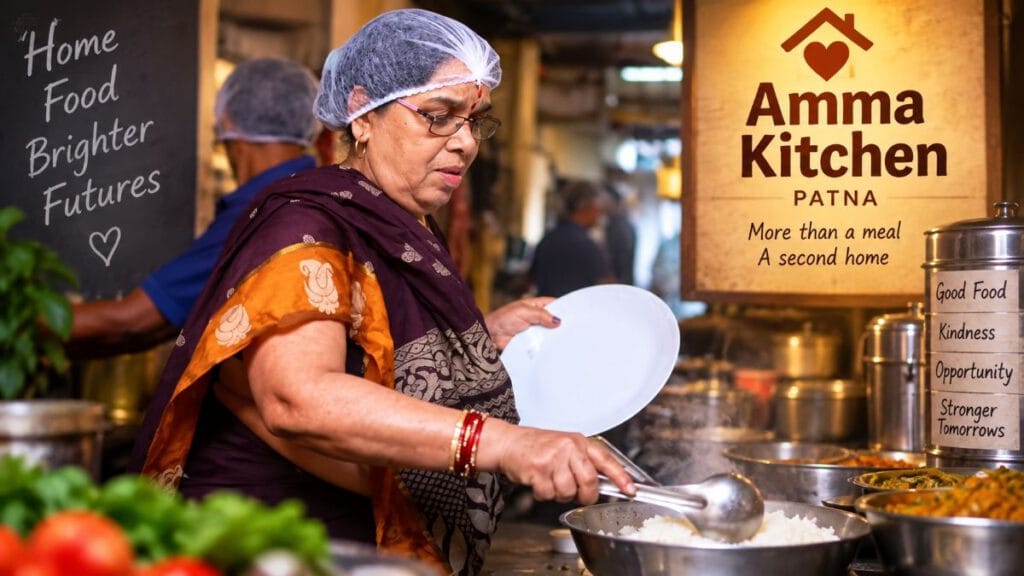
Amma Kitchen Patna began with a ₹20 meal, one tiffin, and a woman who simply wanted to give students something better to eat. More than two decades later, Devni Devi’s small beginning has grown into an inspiring business story that shows what patience, courage, and consistency can achieve.
Devni Devi came from a farming family in Nalanda, Bihar. She did not have much formal education, but she had something equally valuable: years of experience managing a home and cooking for a large family. When she moved to Patna, she noticed that many students living away from home were not happy with the food available to them.
She understood their problem because food was something she knew well. Instead of thinking about starting a big business, she started with what she had. She began preparing simple, home-style meals for students.
The beginning was very small.
As Devni Devi explains in a BBC News report, she started with just one tiffin. She prepared the food herself and gave it to a student. The price was ₹20, and students paid according to the days they ate. If a student did not eat on a particular day, that day’s amount was deducted.
There was no restaurant and no large kitchen. There was simply a woman cooking food that students wanted.
One early customer, a student named Saurabh, liked the food and told others about it. Gradually, more students began ordering from her. Her food became known through word of mouth.
That is how the story began.
Watch the BBC News report on Devni Devi and Amma Kitchen Patna.
The BBC report gives a closer look at her journey, including the early days, the opposition she faced from her family, and how the small food service eventually grew into Amma Kitchen.
Amma Kitchen Patna: From one tiffin to a trusted name
Devni Devi was not trying to build a famous brand when she started. She was solving an everyday problem.
Students living away from their families wanted food that felt like home. Her meals were affordable, familiar, and prepared with care. Those qualities encouraged people to return.
Over time, the customers became more than people who simply bought food from her.
They developed a relationship with her.
Many began calling her “Amma”.
That name would eventually become the name of the business itself.
But getting there was not easy. Her family did not immediately support her decision to work in Patna. In the BBC report, Devni Devi recalls the criticism she faced. Family members were concerned about what people would say and questioned why she had gone to Patna to do this kind of work.
Her husband also objected.
For a woman who had spent much of her life caring for her family, starting an independent livelihood was a major change. Yet she continued.
She did not have the certainty that her work would become successful. She simply believed that it was worth doing.
That determination slowly changed the way people around her viewed the work.
The years nobody noticed
Today, people may look at Amma Kitchen and see a successful food business.
It is easy to focus on the reported revenue, the outlets, and the number of employees.
But there is something more important behind those numbers.
Time.
Devni Devi started serving meals in the early 2000s. She spent years building her customer base before the business received wider attention.
That is an important reminder in a world where success stories are often presented as if they happened overnight.
A viral post may show the final result.
It rarely shows the thousands of ordinary days that came before it.
Devni Devi’s journey was built one meal at a time. One customer became another. A small reputation became trust. Trust became a customer base.
The same principle applies to many areas of life. The Power of Consistency explains why small actions repeated over time can become much more powerful than occasional bursts of effort.
When the Pandemic Changed Everything
Just when the business was moving forward, the COVID-19 pandemic created another difficult period. Students returned home, regular routines were disrupted, and like many small food businesses, Devni Devi’s work was affected. Yet the difficult period also revealed how strong the relationships she had built over the years had become.
According to reports, students she had served helped care for Devni Devi when she became ill with COVID-19 and was admitted to Patna Medical College and Hospital. It is a touching part of her story. She had spent years preparing food for students who were living away from their families. When she became vulnerable herself, some of those students were there for her.
That is a kind of success that cannot be measured in rupees. A business can generate revenue, but a person can also build trust, affection, and lasting relationships. Devni Devi appears to have built both.
A new chapter with Amma Kitchen
After the pandemic, her son helped take the business in a new direction.
The family developed the operation into a cloud kitchen and called it Amma Kitchen. Online food delivery opened possibilities that had not existed when Devni Devi was delivering her first ₹20 tiffins herself.
This was an important change.
The business could now reach customers beyond the students who had known her in the early years.
Recent media reports say the business later expanded into two outlets in Patna. Reports have also put its annual revenue at around ₹2.5 crore and described a workforce of roughly 25–30 people, although figures vary between reports and should be understood as reported business numbers rather than audited profit. India Today and Moneycontrol have both reported on the business’s growth.
The numbers are impressive, but technology did not create the foundation.
The foundation had already been built.
The food came first.
The trust came first.
The customers came first.
Technology simply gave the business another way to reach people.
Growth did not make her forget her beginning
One of the most touching details in the BBC report is that Devni Devi has not forgotten the students and people with limited means who were part of her early journey.
Even after the business expanded, affordable meals continued to be offered. The report mentions meals costing around ₹30 and ₹40 for students and people who cannot afford more expensive food.
That is significant.
A business can change as it grows. Prices may increase, new customers may arrive and the operation may become more sophisticated.
But Devni Devi has tried to keep a connection with the reason she started in the first place.
She wanted people to have a decent meal at a price they could afford.
That purpose still matters.
Amma Kitchen Patna: The Woman Behind the Name
The BBC report also gives us a glimpse of Devni Devi’s relationship with the people who work with her. Some employees have been with her for many years and describe her as someone who remains closely involved with the food and the kitchen. Even as the business has grown, she continues to supervise the preparation of meals and, when necessary, is ready to step into the kitchen herself.
One employee describes being around her as feeling similar to being at home. Devni Devi asks people what they would like to eat and maintains a personal connection with those who work alongside her. It is this warmth and involvement that may explain why the word “Amma” feels so natural.
It is not simply a business name or a marketing idea. For the people around her, “Amma” reflects the way they see Devni Devi—a woman who built a business through food while continuing to make the people around her feel at home.
What Can We Learn from Devni Devi?
Devni Devi’s story does not require a complicated business lesson. She saw a problem and tried to solve it with a skill she already possessed. She started very small and continued even when people around her doubted her decision. When circumstances changed, she adapted, and when technology opened a new opportunity, she used it to take her food business further.
That is a practical approach not only to business but also to life. We do not always need to know exactly where our journey will end before we begin. Sometimes, we only need to recognise what useful thing we can do today and have the courage to begin.
A ₹20 meal may seem insignificant. One tiffin may seem insignificant. One customer may seem insignificant. But small things can become meaningful when they are done with care and repeated consistently over many years. Devni Devi’s journey from one simple meal to Amma Kitchen is a powerful reminder that success does not always begin with a big idea. Sometimes, it begins with doing one small thing well.
Success can come later in life
There is another reason Devni Devi’s journey is worth remembering. She is not being celebrated as a young startup founder who discovered success early in life. Her journey grew out of years of family responsibilities and ordinary life, which makes her story particularly encouraging for people who feel they have missed their opportunity.
Perhaps you are 40. Perhaps you are 50. Perhaps you are already 60. It is easy to believe that the time for starting something new has passed. Devni Devi’s journey suggests otherwise. A new beginning does not have to look like the beginning of someone else’s life.
You can build from the experience you already have. You can start small, move at your own pace, and discover a new purpose in skills you have used for years. Sometimes, what you have considered an ordinary part of your life can become the foundation for something you never imagined.
Life After 60: Your Best Chapter Begins explores why reaching 60 does not have to mean closing the door on new possibilities.
A Message for Women
Devni Devi also has a message for women. She believes that women should try to stand on their own feet and become financially independent. Her own journey gives meaning to those words because she did not begin with a large investment, formal business education, or a carefully prepared business plan. She began with something she knew how to do—prepare good, affordable food.
Her story is not a message that every woman must become an entrepreneur. It is a reminder that women should have the confidence and opportunity to use their abilities. Financial independence does not always begin with a large business or a major investment. Sometimes it begins with something very small: a skill, a service, a few customers, and the decision to try.
What matters then is making another decision—to continue, learn, adapt, and keep moving forward.
Amma Kitchen Patna: The Real Story Behind the ₹2.5 Crore Figure
The headline number may be what attracts attention, but it should not become the whole story.
Recent reports put Amma Kitchen’s annual business revenue at around ₹2.5 crore. That is an impressive transformation from the ₹20 meals Devni Devi began serving more than two decades ago. But revenue is not profit, and one number cannot tell us everything about a business built over many years.
The more valuable story is everything that happened between those two figures. There were years of work that attracted little attention. Customers returned because they trusted her food. People recommended her meals to others. She faced opposition from her family, survived the disruption caused by the pandemic, and adapted when circumstances changed.
Behind the reported ₹2.5 crore figure is not a sudden success story. It is the result of a small beginning, years of consistency, changing with the times, and a woman who continued to show up and do the work.
That is why the story of Amma Kitchen Patna matters. The number is impressive, but the journey behind it is even more valuable.
Sometimes the First Step Is the Most Important One
Imagine Devni Devi preparing that first ₹20 meal. She could not have known where it would lead. She was not looking at a future business worth crores. She was simply preparing food for someone who needed it. Most of us face the same uncertainty when we begin something new. We do not know whether the idea will work, whether people will appreciate it, or how long it will take to see results. But we can still take the first step.
Devni Devi’s story reminds us that a small beginning is not necessarily a small future. One meal became many. One customer became many customers. A home-style food service became Amma Kitchen. And years of ordinary work became a story worth telling.
If you are waiting for the perfect moment to begin something meaningful, perhaps the better question is simpler: What small thing can you start today?
Conclusion
The story of Amma Kitchen Patna is not really about ₹20 becoming ₹2.5 crore.
It is about the years between those two numbers.
Devni Devi started with one tiffin and a simple idea. She saw students who needed affordable food and used the skill she already had to help them.
She faced criticism.
She faced difficult times.
She survived a pandemic that disrupted her work.
Then, with the help of her son, she adapted the business and entered the world of online food delivery and cloud kitchens.
But she did not forget her beginning.
Even as the business grew, she continued to think about students and people who could not afford expensive meals.
Perhaps that is the most beautiful part of her journey.
Success did not completely change the reason she started.
Her story reminds us that progress does not always happen quickly. Sometimes it takes years of quiet work before other people notice.
So, when you see an overnight success story, remember Devni Devi.
There may be twenty years behind that one headline.
And sometimes, all those years began with something as simple as one ₹20 meal.
FAQs about Amma Kitchen Patna
What is Amma Kitchen Patna?
Amma Kitchen is a food business in Patna that grew from Devni Devi’s small home-style meal service for students.
How did Devni Devi start her business?
She began by preparing affordable home-cooked meals for students living away from home. Her early meals cost around ₹20, and she initially started with just one tiffin.
When did Devni Devi start selling meals?
The BBC report places the beginning of her journey around 2003, while some other reports give 2002. It is therefore safest to describe her food service as beginning in the early 2000s.
How did Amma Kitchen grow?
The business initially grew through customer relationships and word of mouth. Later, her son helped move the operation toward a cloud-kitchen and online delivery model, allowing it to reach more customers.
What is the main lesson from Devni Devi’s story?
Her journey shows that a small beginning can become something much larger when it is supported by useful skills, consistent effort, trust, and the willingness to adapt.

Mathukutty P V is a Blogger, YouTuber, and Content Writer and the founder of Simply Life Tips. After taking voluntary retirement in 2017, he embraced a free lifestyle focused on learning, personal growth, and sharing practical wisdom to help others live with more purpose and positivity.