

The Power of Your Subconscious Mind is a fascinating subject because so much of everyday life happens without deliberate thought. You may decide consciously that you want to exercise, read more, stop procrastinating, or become more confident, yet you can still find yourself repeating familiar behaviors. You wake up and follow the same morning routine, reach for your phone when you feel bored, automatically react to certain situations, or find yourself thinking the same thoughts you have had many times before. These experiences are often described as the work of the subconscious mind.
While the word “subconscious” is widely used in self-help, psychology tends to describe these processes more precisely in terms of automaticity, habits, implicit learning, learned associations, and mental processes that occur outside immediate conscious awareness. Understanding the subject this way can make the idea of subconscious mind power much more practical. Instead of viewing the subconscious as a mysterious force capable of magically creating anything you desire, you can look at how repeated experiences and behaviors influence your patterns and how deliberate practice can help you develop different ones.
Understanding the Power of Your Subconscious Mind can help explain why certain thoughts and behaviors become automatic.
You can also explore these subconscious mind exercises for additional practical techniques that can be incorporated into your daily routine.
What Is the Subconscious Mind?
The Power of Your Subconscious Mind becomes easier to understand when we look at how your inner mind connects repeated experiences with familiar thoughts, habits, and behaviors.
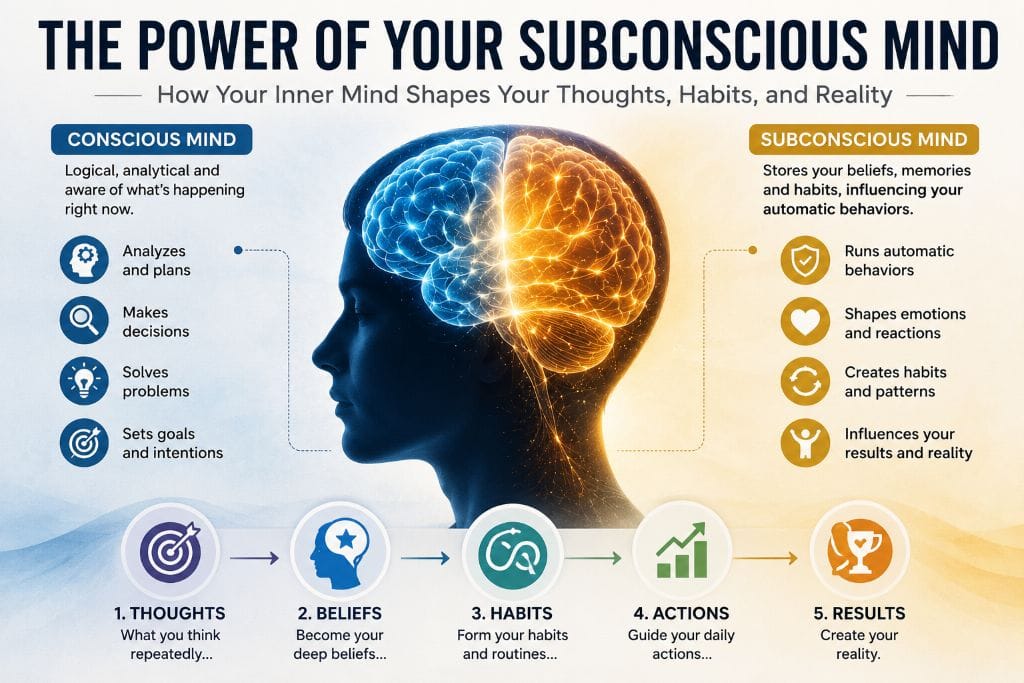
The Power of Your Subconscious Mind is often discussed in relation to learned patterns, memories, emotions, and automatic responses.
The subconscious mind is commonly described as the part of the mind that operates beneath conscious awareness. People often use the term when talking about memories, habits, beliefs, emotional reactions, instincts, and automatic behaviors. However, it is important to understand that “subconscious mind” is not a single, clearly defined structure in the brain. Modern psychology uses several more specific concepts to describe processes that can happen without conscious awareness or deliberate control.
Think about something as simple as walking. When you first learned to walk, the process required enormous amounts of learning and attention. Today, you can walk while thinking about something completely different. The same thing happens with many familiar skills. Once you have practiced something repeatedly, you no longer need to consciously direct every small part of the behavior. Driving a familiar route, typing commonly used words, preparing a regular meal, or following a morning routine can all become highly familiar.
This is one practical way to understand the power of your subconscious mind. Your brain is constantly learning from experience, and some responses become more automatic with repetition. That automaticity can be helpful because it allows you to perform familiar tasks without spending conscious attention on every detail. At the same time, automatic patterns can sometimes work against your goals when the behavior has become unwanted or unhelpful.
The Power of Your Subconscious Mind in Everyday Life
The influence of automatic patterns can be seen in ordinary situations rather than only in dramatic examples. Imagine that you sit down at your computer intending to work on an important project. The task seems difficult, so you experience a little discomfort. Without consciously planning to procrastinate, you open a social-media website. You tell yourself that you will spend only a minute there, but twenty minutes later you are still scrolling.
It may be tempting to describe this simply as a lack of discipline. A more useful approach is to examine the pattern. The difficult task may have acted as a trigger, discomfort may have followed, and checking social media may have provided immediate relief or entertainment. After repeated experiences, that sequence can become familiar.
Once you recognize the pattern, you can begin changing it. You might put your phone in another room, work for only five minutes before taking a break, divide the difficult task into smaller steps, or identify what emotion is causing you to avoid the work. You are not magically commanding your subconscious mind to behave differently. You are creating new conditions in which a different response can be practiced.
That is a more grounded and useful interpretation of subconscious mind power.
How Automatic Patterns Develop
Automatic patterns often develop because behaviors are repeated in particular situations. Imagine that you drink tea every evening while sitting in the same chair and watching television. At first, making the tea may be a deliberate decision. After repeating the routine for months, the time, location, and activity may become associated with the behavior. Eventually, sitting down in the evening may make preparing tea feel almost automatic.
The same process can occur with behaviors you would like to change. If you repeatedly check your phone whenever you feel bored, boredom can become associated with reaching for the device. If you repeatedly avoid difficult tasks whenever you feel uncertain, uncertainty can become associated with procrastination. If you repeatedly go for a walk after breakfast, breakfast can eventually become a cue for the walking routine.
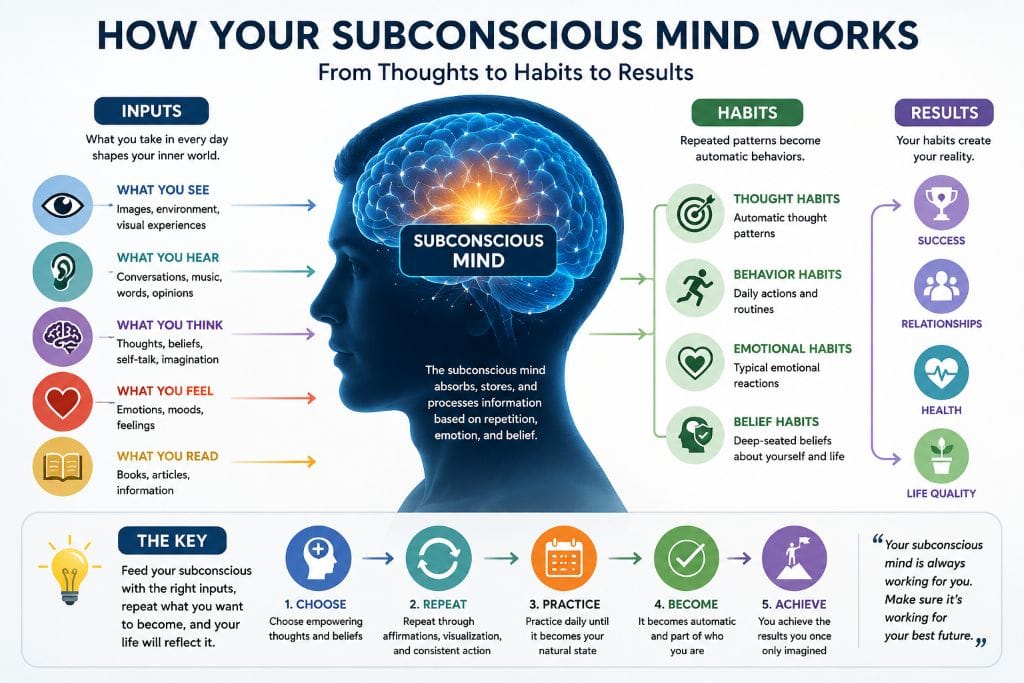
Habit research describes this relationship between repeated behavior and recurring context as an important part of automaticity. With repetition, a behavior can become increasingly familiar and easier to initiate in the presence of relevant cues.
This doesn’t mean that every repeated behavior becomes permanent. It means that repetition can make certain responses more familiar and automatic. That is why changing a well-established habit may require more than simply making a new decision once.
Understanding how automatic patterns develop makes the idea of the subconscious mind much easier to visualize. The infographic below shows how repeated inputs can become familiar thought, behavior, emotional, and belief patterns.
The Power of Repetition
Repetition is one of the most important ideas when considering the power of your subconscious mind. People sometimes look for a dramatic technique that will instantly transform their thinking, but many useful behavioral changes are much less dramatic. They involve doing a small thing repeatedly until it becomes increasingly familiar.
Repetition is central to many discussions about the Power of Your Subconscious Mind because repeated experiences can strengthen familiar patterns.
For example, you could decide that after breakfast you will walk for ten minutes. You could decide that after your morning coffee you will write for twenty minutes. You could read five pages before going to bed each night. You could spend five minutes reviewing your priorities before starting work.
These behaviors are small enough to repeat, and they are connected to activities that already exist in your routine. That matters because consistency gives your brain repeated exposure to the same behavioral sequence.
Research on habit formation suggests that repeating behavior in a stable context can contribute to automaticity, although the speed and strength of habit formation vary considerably between individuals and behaviors.
This is why it is usually better to choose a behavior you can realistically maintain than to create an ambitious routine that lasts only a few days.
Consistent daily habits can therefore become an important part of turning intentions into repeated behavior.
Your Subconscious Mind and Habits
Habits are one of the clearest ways to understand what people often mean by subconscious mind power. A habit is a learned pattern that can become easier to perform when a familiar situation or cue appears.
One practical way to understand the Power of Your Subconscious Mind is to look at how repeated behaviors gradually become familiar.
Consider learning to drive. In the beginning, you may consciously think about mirrors, pedals, steering, traffic signs, and gear changes. With practice, many of these actions become more automatic. You still remain responsible for driving, but you don’t have to consciously calculate every movement.
Similar processes can occur in everyday life. Someone who has exercised at the same time every morning for years may not need to have a long internal discussion about whether to exercise. The behavior has become part of the person’s routine.
However, habits do not mean that you have no control. Human behavior involves both automatic and deliberate processes. Goals, intentions, attention, and environmental changes can interact with established habits.
This is encouraging if you are trying to change an unwanted behavior. An automatic response may be strong, but you can still create opportunities to practice another response.
Understanding these patterns can make building better habits more practical because you can work with existing cues rather than depending entirely on motivation.
The Power of Your Subconscious Mind and Your Beliefs
Beliefs can influence the way you interpret experiences and approach challenges. Suppose someone repeatedly tells themselves, “I’m not good at speaking in public.” Before a presentation, that belief may contribute to anxiety and avoidance. If the person avoids practice because they expect failure, they may feel even less prepared when the presentation arrives. A difficult experience can then appear to confirm the original belief.
The pattern can become self-reinforcing.
A more flexible belief might be, “Public speaking is difficult for me right now, but I can improve with practice.” This statement does not guarantee success. It simply leaves room for learning and action.
That distinction is important. You don’t need to replace every negative thought with an exaggerated positive statement. A healthier approach is to develop thoughts that are realistic, useful, and consistent with action.
Instead of telling yourself that you can achieve absolutely anything, you might remind yourself that you can learn, practice, adapt, and improve.
Can You Reprogram Your Subconscious Mind?
“Reprogramming your subconscious mind” is a popular expression in personal development. It can be useful as a metaphor for changing learned patterns, but it should not be understood as literally rewriting a computer program inside your brain.
If you want to explore practical ways to change these learned patterns, our guide on reprogram your subconscious mind explains how awareness, repetition, and intentional behavior can work together.
Changing an established pattern usually involves awareness, repetition, environmental adjustments, and learning. A useful framework is simple: notice the pattern, understand the trigger, interrupt the automatic response, choose an alternative, and repeat the new behavior.
Suppose you automatically check your phone whenever you begin writing. First, notice that the behavior is happening. Then identify the trigger. Perhaps the writing task feels difficult or uncertain. Next, introduce an interruption by putting the phone somewhere inaccessible. Replace the old response with a smaller action, such as writing for five minutes. Finally, repeat that process during future writing sessions.
The first few attempts may feel uncomfortable because the old pattern is familiar. That doesn’t mean the new approach is failing. It means you are practicing a different response.
The Role of Your Environment
Your environment can make certain behaviors easier and others more difficult. This is particularly important because people often try to change habits by relying entirely on motivation.
Imagine that you want to read more. You could simply promise yourself that you will read every evening. A more practical approach is to keep your current book beside your bed where you can easily see it.
Want to exercise in the morning? Prepare your workout clothes the night before. Want to eat healthier? Make nutritious choices convenient and readily available. Want to reduce social-media use? Disable unnecessary notifications and keep distracting apps away from your primary workspace.
These changes may seem insignificant, but they change the conditions surrounding the behavior. Instead of repeatedly asking yourself to resist temptation, you can sometimes reduce the number of situations in which temptation is presented.
The environment therefore becomes part of your behavior-change strategy.
The Power of Visualization
Visualization is another practice commonly associated with the Power of Your Subconscious Mind, particularly when it is combined with consistent action.
Visualization is frequently associated with subconscious mind techniques. It can be approached in a practical way by focusing on the process rather than imagining that simply picturing an outcome will make it happen.
Suppose you have an important presentation. Instead of imagining only the applause at the end, imagine yourself preparing your notes, practicing the opening, speaking clearly, pausing when necessary, answering a difficult question, and recovering if you make a mistake.
The same approach can be used for many goals. A student can mentally rehearse opening a textbook and beginning a study session. A writer can visualize sitting down and completing the first paragraph. Someone preparing for an interview can imagine entering the room, listening carefully, and answering questions calmly.
Visualization is most useful when it supports actual preparation and action. It should complement practice rather than replace it.
Positive Self-Talk and the Subconscious Mind
The way you talk to yourself can affect how you interpret mistakes and challenges. Consider the difference between saying, “I always fail,” and saying, “This didn’t work this time; what can I change?”
The second statement doesn’t pretend that everything is perfect. It simply creates room for learning.
Positive self-talk therefore doesn’t have to mean repeating unrealistic affirmations. It can involve using accurate and constructive language.
Instead of saying, “I’ll never be disciplined,” you might say, “I’m working on becoming more consistent.”
Instead of saying, “I’m terrible at writing,” you might say, “Writing is a skill I can improve through practice.”
These statements are useful because they connect mindset with behavior. They don’t promise a guaranteed outcome.
Developing realistic self-talk can also become part of a broader positive thinking practice, especially when you are trying to respond differently to setbacks.
Mindfulness and Automatic Patterns
Mindfulness can help you notice thoughts, emotions, and impulses before automatically acting on them.
Imagine receiving a message that makes you angry. Your first impulse may be to respond immediately. A short pause can create space between the emotional reaction and the action.
You might notice the anger, take a breath, read the message again, and decide whether a response is necessary.
The emotion has not necessarily disappeared.
The difference is that you have created an opportunity to choose your response.
This ability to pause can be valuable when working with automatic behaviors because awareness is often the first step toward changing a pattern.
Regular mindfulness practice can help you become more aware of thoughts, emotions, and impulses before automatically reacting to them.
10 Ways to Harness the Power of Your Subconscious Mind
1. Observe Your Automatic Reactions
Begin by paying attention to behaviors that seem to happen without much conscious thought. You might notice that you check your phone whenever you become bored, eat when you are stressed, postpone difficult tasks, or become defensive during particular conversations. Rather than criticizing yourself, simply observe the pattern. Ask what usually happens immediately before the behavior. This can help you identify the trigger and understand why the behavior keeps repeating.
2. Track Your Habit Patterns
A simple journal can reveal patterns that are difficult to notice during a busy day. Write down the trigger, the behavior, and the immediate result. For example, you might record that boredom leads to social-media scrolling, which provides temporary entertainment but leaves you feeling that you have wasted time. Once the pattern becomes visible, you can begin experimenting with a different response.
3. Connect New Habits to Existing Routines
One practical way to make a new behavior easier to remember is to connect it with something you already do. You might stretch after brushing your teeth, walk after breakfast, write after your morning coffee, or read after turning off the television. Existing routines provide recognizable cues, making the new behavior easier to integrate into daily life.
4. Change Your Environment
Your surroundings can either support or interfere with your goals. If your phone repeatedly interrupts your concentration, move it away from your workspace. If you want to read more, keep a book where you can easily reach it. If you want to exercise, prepare the necessary equipment in advance. The objective is to make useful behavior easier and unwanted behavior less convenient.
5. Practice Constructive Self-Talk
Pay attention to the language you use when something goes wrong. Statements such as “I always fail” can make a single mistake feel like a permanent identity. More constructive language focuses on the specific situation and what you can do next. Instead of judging yourself, ask what the experience can teach you and what action you can take.
6. Visualize the Process
When using visualization, focus on the steps you need to perform. If your goal is to become a better writer, imagine opening your document, writing through the difficult beginning, reviewing your work, and completing the session. This makes visualization a form of mental rehearsal rather than simply wishful thinking.
7. Practice a Mindful Pause
When you notice yourself about to perform an automatic behavior, pause for a few seconds. Ask yourself what triggered the impulse and whether the response will actually help. Even a short pause can create an opportunity to make a deliberate choice instead of immediately following the familiar pattern.
8. Use Journaling to Identify Patterns
Writing down recurring thoughts and behaviors can make them easier to understand. You might discover that you procrastinate mainly when tasks are unclear, become irritable when you are tired, or spend more time online when you feel lonely. Once you identify the underlying context, you can design a more appropriate response.
9. Practice One Small Behavior Consistently
Choose one change rather than trying to transform everything simultaneously. If you want to exercise, start with a short daily walk. If you want to read, begin with a few pages. If you want to write, begin with a small writing session. A behavior that is realistic enough to repeat is often more useful than an ambitious routine that quickly becomes overwhelming.
10. Review Your Progress
Set aside a few minutes each week to review what happened. Ask yourself what pattern you noticed, what triggered it, what response you practiced, and what worked. This turns personal development into an ongoing learning process rather than a pass-or-fail challenge.
How to Increase Subconscious Mind Power Naturally
People often search for ways to make their subconscious mind more powerful. A more useful question is how to develop mental and behavioral patterns that support the life you want to build.
Sleep, learning, physical activity, focused attention, reflection, and consistent routines all contribute to overall cognitive and behavioral functioning. Rather than searching for one secret technique, build practices that support your ability to think clearly and act consistently.
For example, if you want to become a better writer, create a regular writing routine. If you want to become more physically active, establish a repeatable movement routine. If you want to reduce distractions, redesign your environment.
The goal isn’t to unlock supernatural subconscious powers. It is to make useful patterns easier to practice.
The Power of Your Subconscious Mind for Success
Success is frequently presented as something that can be achieved by programming your subconscious mind with the right thoughts. Real life is more complicated.
Your mindset can influence how you approach challenges, but success also depends on skills, effort, opportunities, resources, relationships, circumstances, and persistence.
Consider someone who wants to build a successful blog. Thinking about success is not enough. The person needs to research topics, create useful content, understand their audience, improve their writing, learn SEO, publish consistently, analyze results, and update older content.
A useful subconscious pattern might simply be:
Every weekday morning → spend 30 minutes working on the blog.
The value comes from turning a large goal into a repeated behavior.
This is where subconscious mind power becomes practical. Automatic routines can support consistent action, while conscious thinking continues to guide the larger goal.
The Power of Your Subconscious Mind by Joseph Murphy
The phrase The Power of Your Subconscious Mind is also strongly associated with Joseph Murphy’s well-known self-help book. This creates an important distinction for anyone researching the topic online.
Murphy’s book presents the subconscious mind through a self-help and spiritual framework. It discusses ideas involving belief, imagination, suggestion, affirmation, and the influence of repeated mental patterns. The book has become a long-standing personal-development title and continues to attract readers interested in changing their thinking and circumstances.
For readers approaching the book today, it can be useful to distinguish between Murphy’s philosophical and self-help ideas and terminology used in contemporary psychology.
You can find value in some of the book’s practical themes, such as paying attention to repeated thoughts, developing constructive mental habits, and focusing on purposeful behavior, without assuming that every claim in the book represents an established scientific finding.
This distinction is especially important when discussing claims that thoughts alone can guarantee wealth, health, success, or a particular life outcome.
A balanced approach allows readers to explore the book while also understanding the difference between inspirational philosophy and scientific evidence.
What the Book Teaches About the Subconscious Mind
One of the central ideas associated with Murphy’s work is that repeated mental patterns can influence how people experience and approach life. The book encourages readers to cultivate constructive thoughts and beliefs rather than constantly reinforcing fear, doubt, and negative expectations.
From a modern perspective, some of these ideas can be interpreted as encouragement to pay attention to thought patterns and behavior. However, readers should avoid treating metaphorical or philosophical statements as literal descriptions of how the brain works.
For example, repeating a positive statement may help some people focus their attention on a desired goal, but it does not mean that the subconscious mind is required to make the desired outcome happen.
The practical question is therefore not simply, “What do I want to believe?”
It is:
“How does what I repeatedly think influence what I notice, how I behave, and what actions I take?”
That question leads back to something you can actually control.
Common Myths About Subconscious Mind Power
Your subconscious mind can give you anything you want
This is one of the most attractive claims in popular self-help literature, but it is too simplistic. Thinking about a desired outcome does not guarantee that the outcome will occur. Your actions, skills, resources, opportunities, and circumstances all matter.
A better approach is to use your thoughts to support useful behavior. If you want to become healthier, for example, thinking positively can be helpful, but you still need to make appropriate choices and take action.
One affirmation can completely change your life
Affirmations may be useful as reminders or prompts, but repeating a sentence does not automatically erase years of learned behavior. If you want to become more confident, for example, constructive self-talk can support the process, but gaining confidence may also require practice, exposure, preparation, and experience.
You can eliminate every negative thought
Negative thoughts are part of ordinary human experience. Trying to eliminate every unwanted thought can become another source of frustration. A more useful goal is to notice difficult thoughts without automatically accepting them as facts or allowing them to dictate your behavior.
Your subconscious mind controls everything
Human behavior is influenced by many interacting factors. Automatic processes matter, but conscious decisions, social circumstances, physical conditions, learning, and the environment also influence behavior.
You can change any pattern instantly
Established habits often require repeated practice to change. Expecting an immediate transformation can lead to disappointment. A better approach is to measure progress by whether you are becoming more aware of the pattern and increasingly able to choose a different response.
What the Subconscious Mind Cannot Do
A practical discussion of subconscious mind power also needs clear boundaries.
Your subconscious mind should not be treated as a supernatural force that can guarantee wealth, control other people, predict the future, eliminate every difficult emotion, or make every goal inevitable.
Similarly, mental techniques should not be presented as replacements for professional medical or psychological care when someone is experiencing a serious health or mental-health problem.
The useful lesson is more modest but still powerful: your learned patterns can influence how you respond to situations, and you can often work deliberately on those patterns through awareness, practice, environmental changes, and repeated behavior.
That is meaningful without requiring extraordinary claims.
Power of Your Subconscious Mind and Goal Setting
Goals provide direction, but daily behavior determines whether you actually move toward them.
When used realistically, the Power of Your Subconscious Mind can be viewed as part of a broader process of directing attention toward meaningful goals.
Suppose your goal is to write a book.
You could spend hours imagining yourself holding the finished book.
Or you could create a routine in which you write 500 words each morning.
The second approach connects the goal with behavior.
The same principle applies to almost anything.
If you want to learn a language, practice regularly.
If you want to become fitter, move your body consistently.
If you want to improve your finances, review your spending and develop useful financial habits.
If you want to become a better communicator, practice listening and speaking.
The subconscious mind doesn’t need to perform a miracle.
You need to create patterns that make useful action more likely.
Effective goal setting gives these repeated behaviors a clear direction, helping you connect your daily actions with a larger objective.
A Simple Daily Subconscious Mind Practice
You can begin with a routine that takes only a few minutes.
A simple daily routine can help you apply the Power of Your Subconscious Mind through awareness, repetition, and intentional behavior.
In the morning, choose one behavior you want to practice that day. Make it specific enough that you know exactly what action you will take.
During the day, notice one automatic reaction. Perhaps you become distracted, procrastinate, react emotionally, or reach for your phone without thinking.
Pause and ask what triggered the behavior.
In the evening, write down what happened. Identify the trigger, your automatic response, the result, and one alternative response you could try next time.
Before going to bed, decide on one small behavior to repeat tomorrow.
This practice doesn’t require you to believe in a mysterious subconscious force. It simply develops awareness and creates repeated opportunities to practice different responses.
A 30-Day Approach to Changing Automatic Patterns
A 30-day period can be useful as a structured experiment, but it should not be treated as a guarantee that every habit will disappear or become permanent within exactly 30 days.
During the first week, focus mainly on observation. Pay attention to recurring behaviors and identify the situations in which they appear.
During the second week, introduce a pause. When the trigger occurs, interrupt the usual sequence before automatically performing the behavior.
During the third week, practice a replacement. Choose a realistic behavior that can occupy the same situation.
During the fourth week, reinforce the new pattern. Review your progress, identify obstacles, and adjust your environment where necessary.
The purpose is not to complete a magical 30-day transformation.
The purpose is to give yourself enough structured practice to understand one pattern and experiment with changing it.
When Subconscious Mind Techniques May Not Be Enough
Subconscious mind exercises can be useful for ordinary personal development, habit awareness, and behavior change. However, they should not be presented as a universal solution for serious psychological or medical problems.
Persistent anxiety, depression, trauma-related difficulties, addiction, severe emotional distress, or other significant problems may require professional assessment and evidence-based treatment.
Self-help techniques can sometimes complement professional support, but they should not be used to replace appropriate care.
Knowing the limits of a technique is part of using it responsibly.
How to Make Subconscious Mind Work Practical
The most useful way to approach subconscious mind work is to bring it back to everyday behavior.
Notice the pattern you repeat.
Identify what triggers it.
Create a pause before automatically responding.
Choose a realistic alternative.
Make your environment support that alternative.
Repeat the behavior.
Review your progress.
For example, if you want to stop checking your phone while writing, don’t simply tell yourself that you will have more discipline tomorrow. Put the phone away, decide how long you will write, begin with a small target, and repeat the process.
If you want to exercise more, don’t depend entirely on motivation. Connect exercise to an existing routine and prepare what you need in advance.
If you want to read more, keep your book visible and choose a consistent time.
The process is simple, but simple doesn’t mean effortless.
Changing familiar patterns takes practice.
Conclusion
The Power of Your Subconscious Mind becomes more useful when we understand it through the everyday patterns that influence our thoughts, emotions, and behavior rather than through promises of instant transformation. The mind can learn from repeated experiences, behaviors can become increasingly automatic, familiar situations can provide cues for particular responses, and beliefs can influence how we interpret challenges. At the same time, conscious decisions give us an opportunity to notice these patterns and practice different responses.
You do not have to believe that your subconscious mind can magically create anything you want, nor do you need to dismiss the entire concept because some popular claims about it are exaggerated. A more practical middle ground is to pay attention to the patterns you have developed, identify the behaviors that support your goals and those that repeatedly work against them, and recognize the situations that trigger them. From there, you can change your environment when possible, practice realistic self-talk, use visualization as a form of preparation rather than wishful thinking, and most importantly, connect your intentions with consistent action.
If you want to become a writer, write. If you want to exercise, exercise. If you want to read more, make reading part of your routine. If you want to respond more calmly, practice pausing before reacting. These simple actions may seem ordinary, but repeated actions are precisely how new patterns become familiar.
The real value of subconscious mind power may not be discovering a hidden force that controls your destiny. It may be learning to recognize the automatic patterns you have developed and becoming more deliberate about the patterns you continue to reinforce. Small choices, practiced consistently, can gradually become meaningful changes in the way you think, behave, and live.
Frequently Asked Questions
What is the power of your subconscious mind?
The phrase generally refers to the influence of mental processes that occur outside immediate conscious awareness, including automatic behaviors, learned associations, and habits. Psychology often uses more specific terminology rather than treating the subconscious as one separate mental system.
Can you reprogram your subconscious mind?
“Reprogramming” is commonly used as a metaphor for changing learned patterns. You can work on automatic behaviors through awareness, environmental changes, repeated practice, and deliberately choosing alternative responses.
How can I use the power of my subconscious mind?
Start by identifying one automatic behavior you want to change. Look for its trigger, create a short pause before responding, choose a realistic alternative, and practice that alternative consistently in similar situations.
How can I increase subconscious mind power?
Rather than trying to increase subconscious power in a supernatural sense, focus on developing useful habits, maintaining consistent routines, practicing mindfulness, learning new skills, reflecting on your behavior, and creating an environment that supports your goals.
Can the subconscious mind help you achieve success?
Automatic habits can support consistent action toward a goal, but they cannot guarantee success. Skills, effort, opportunities, circumstances, resources, and adaptation also play important roles.
References
- Habit research and automaticity — PubMed
- The automatic component of habit — PubMed
- Context stability and habit formation — PubMed
- Habits and goal-directed behavior — PubMed
- The Power of Your Subconscious Mind — Penguin India

Mathukutty P V is a Blogger, YouTuber, and Content Writer and the founder of Simply Life Tips. After taking voluntary retirement in 2017, he embraced a free lifestyle focused on learning, personal growth, and sharing practical wisdom to help others live with more purpose and positivity.



