

Don’t take yourself too seriously. Sometimes, a harmless joke, a casual remark, or a small misunderstanding can turn into a serious argument that damages a friendship or relationship for years. Learning to laugh at ourselves, let go of minor issues, and consider another person’s perspective can make life more peaceful and relationships stronger.
We all want to be respected, understood, and appreciated. However, when our ego becomes too sensitive, even an innocent joke can feel like an insult. Instead of enjoying a conversation, we may become defensive, argue over insignificant matters, and sometimes lose people who genuinely matter to us.
The secret is not to ignore our feelings or tolerate disrespect. It is to recognise when a situation deserves a serious response and when we can simply smile, laugh, and move on.
Learning not to take yourself too seriously can help you handle everyday challenges with greater humour, humility, and self-awareness. Here are 10 practical ways to reduce unnecessary stress, let go of minor disagreements, and build healthier relationships.
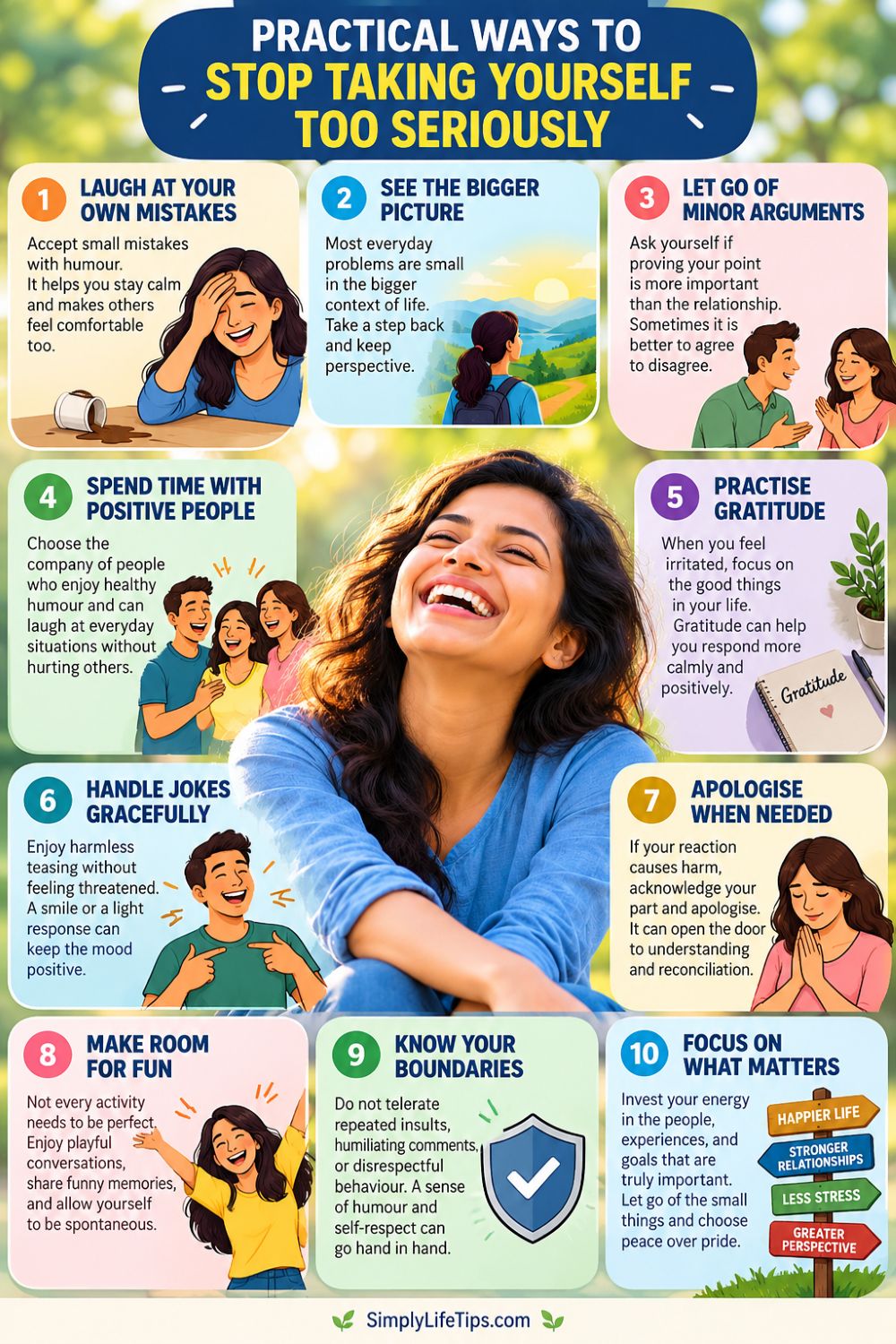
Remember, not every mistake, joke, or disagreement deserves a serious reaction. Practise these simple habits, protect your self-respect, and make room for more laughter, understanding, and happiness in your life.
Don’t Take Yourself Too Seriously: What Does It Mean?
Taking yourself too seriously means giving excessive importance to your opinions, image, achievements, or the way other people treat you. You may feel hurt when someone disagrees with you, become defensive when receiving criticism, or interpret harmless teasing as a personal attack.
Imagine two friends chatting casually. One makes a lighthearted comment about the other’s habit of arriving late. Instead of laughing, the second friend feels insulted and responds angrily. The conversation quickly becomes an argument.
The original comment may have been insignificant, but the reaction turns it into a major problem.
This does not mean every joke is harmless. Some remarks are genuinely offensive, and people have every right to express their discomfort. The problem arises when we react automatically without first understanding the other person’s intention.
Learning to recognise this difference is an important step towards emotional maturity.
How Ego Turns Small Jokes into Big Arguments
Ego often makes us believe that accepting a joke, admitting a mistake, or acknowledging another person’s point of view will make us look weak.
As a result, we may defend ourselves even when there is nothing important to defend.
When a casual remark becomes a personal insult
Consider two colleagues discussing a project. One jokingly says, “You certainly took your time finishing that!”
The other replies, “At least I do my work properly. You should look at your own performance first.”
What began as a casual remark becomes a tense exchange. Both people start defending themselves, and the original issue disappears beneath their wounded pride.
If the first person intended harmless teasing, a simple smile or calm response could have prevented the disagreement. If the remark was deliberately disrespectful, a measured response could still address the problem without escalating it.
Why admitting a mistake can feel difficult
Some people believe they must always appear intelligent, capable, and correct. They find it difficult to admit mistakes because they fear losing respect.
However, acknowledging a small mistake often demonstrates confidence rather than weakness.
For example, if you forget someone’s name and they jokingly remind you, you could laugh and say, “My memory needs a little maintenance today!”
A simple response like this can ease embarrassment and help everyone feel comfortable.
The ability to acknowledge our imperfections allows us to move forward without turning every small incident into a struggle for dignity.
Why You Shouldn’t Take Yourself Too Seriously
Life is already filled with responsibilities, uncertainties, and challenges. If we treat every disagreement, mistake, or joke as a serious personal matter, we create unnecessary stress.
Learning not to take yourself too seriously can help you approach everyday situations with greater flexibility.
You can protect your relationships
Relationships rarely break down because of one small misunderstanding alone. More often, repeated arguments, unresolved resentment, and an unwillingness to compromise gradually create distance.
Imagine two siblings who disagree over a playful comment during a family gathering. One feels insulted and refuses to speak to the other. Days become weeks, and eventually, both avoid each other.
How much pain could have been avoided if they had clarified the intention, apologised where necessary, and refused to let pride control their relationship?
A willingness to let go of minor disagreements can preserve valuable connections.
For more practical guidance, read our article on how to improve self-esteem and relationships.
You can reduce unnecessary stress
When we repeatedly replay conversations in our minds, we may turn small incidents into major emotional burdens.
A friend’s passing remark can occupy our thoughts for hours. We begin imagining hidden meanings, questioning our worth, and preparing arguments for a conversation that may never happen.
Instead, pause and ask yourself three questions:
- Will this matter a week from now?
- Do I know that the person intended to hurt me?
- Is responding angrily likely to improve the situation?
These questions can help you distinguish between a genuine problem and temporary discomfort.
Learning to put small issues into perspective does not eliminate life’s challenges. It helps us use our energy where it matters most.
How to Learn to Laugh at Yourself
One of the most useful ways to stop taking yourself too seriously is to develop a healthy sense of humour about your own imperfections.
You do not need to become a comedian or make yourself the subject of every joke. You simply need to recognise that making mistakes is part of being human.
Accept your imperfections
Everyone forgets things, makes awkward comments, misunderstands instructions, and occasionally behaves foolishly.
Suppose you confidently explain something to your friends, only to discover that you misunderstood the facts. You can either become defensive or admit your mistake with a smile.
Saying, “Well, that sounded much more convincing in my head!” can help everyone move on comfortably.
Accepting your imperfections does not diminish your value. It reminds you that your worth does not depend on being right all the time.
Stop worrying excessively about what others think
You cannot control everyone’s opinions about you. Some people may misunderstand your words, disagree with your choices, or form opinions that have little connection with who you really are.
Constantly trying to manage everyone’s perception can become exhausting.
Instead, focus on behaving according to your values. Listen to constructive feedback, correct genuine mistakes, and allow minor misunderstandings to pass when they do not deserve further attention.
Healthy self-esteem means recognising your worth without needing to prove it in every conversation.
How to Stop Taking Yourself Too Seriously
Learning not to take yourself too seriously becomes easier when you develop the habit of pausing before reacting.
1. Pause before responding
When a comment hurts your feelings, avoid replying immediately. Give yourself a moment to understand what happened.
A brief pause can prevent an impulsive response that you may later regret.
For example, if a friend jokes about your cooking, you do not need to respond with an equally sharp remark. You could laugh if the comment feels harmless or calmly explain that it hurt you if it crossed a boundary.
2. Consider the other person’s intention
Not every awkward comment is intended to cause harm. Some people express themselves clumsily, while others use humour to create a sense of connection.
Before assuming the worst, consider the context, your relationship with the person, and their usual manner of speaking.
If you are uncertain, ask a simple question: “Did you mean that as a joke?”
Clarifying an intention is often more productive than building an argument around an assumption.
3. Learn to let go of minor mistakes
Perfection is an unrealistic expectation. If you expect every conversation to go smoothly and every person to respond exactly as you wish, disappointment is inevitable.
Perhaps you said something awkward at a gathering or made a mistake during a meeting. Instead of repeatedly criticising yourself, acknowledge what happened and learn from it.
If an apology is necessary, offer one sincerely. If the mistake is insignificant, allow yourself to move on.
You do not have to punish yourself indefinitely for being human.
4. Practise seeing situations from another perspective
Everyone has different experiences, expectations, and communication styles. A comment that seems perfectly harmless to one person may feel uncomfortable to another.
Try to understand both perspectives before deciding how to respond.
This does not mean you must agree with everyone. It means you are willing to consider information beyond your own immediate feelings.
For more practical strategies, explore our guide to mindful communication and thinking before you speak.
Why You Shouldn’t Expect Everything to Be Perfect
Some people feel uncomfortable when situations do not unfold exactly as they expect. They want conversations to follow their preferences, others to agree with their opinions, and every task to be completed in a particular way.
When reality differs from these expectations, frustration follows.
Imagine organising a family outing. You have planned everything carefully, but someone arrives late, another person suggests a different restaurant, and the weather changes your plans.
You can spend the entire day complaining that nothing is going right, or you can adapt and enjoy what remains possible.
Flexibility does not mean abandoning standards or accepting irresponsibility. It means recognising that not every inconvenience deserves an emotional battle.
The same principle applies to relationships. People will occasionally disappoint us, misunderstand us, and disagree with us. Allowing room for ordinary human imperfections makes it easier to maintain meaningful connections.
The Difference Between Humility and Losing Self-Respect
There is an important distinction between not taking yourself too seriously and allowing others to treat you badly.
Humility means recognising that you are not always right and that other people deserve respect. It does not mean believing that your feelings, opinions, or needs are unimportant.
When a joke is harmless
If a trusted friend gently teases you about a minor mistake and everyone is comfortable, laughing along may be the simplest response.
You can acknowledge the humour without feeling that your dignity is threatened.
When a joke crosses the line
Repeated insults, humiliating comments, discriminatory remarks, and deliberate attempts to undermine you are not made acceptable simply because someone calls them jokes.
If a comment genuinely hurts you, communicate clearly and calmly.
You might say, “I understand that you were joking, but I am not comfortable with comments like that.”
A respectful person should be willing to listen and adjust their behaviour.
If the behaviour continues, setting firmer boundaries may be necessary. Our guide to healthy boundaries in relationships offers further guidance on maintaining mutual respect.
The goal is to become less defensive about insignificant matters without becoming less protective of your dignity.
Practical Ways to Stop Taking Yourself Too Seriously
Learning how to stop taking yourself too seriously begins with small, consistent changes. By developing a healthy sense of humour, accepting imperfections, and letting go of minor disagreements, you can enjoy life more and build stronger relationships.
Spend time with people who enjoy positive humour
Surround yourself with people who can laugh at everyday mistakes without humiliating others. Healthy humour can make conversations more relaxed and help people feel connected.
Avoid confusing cruelty with wit. The best humour allows people to feel included rather than diminished.
Stop trying to win every argument
Ask yourself whether proving your point is more important than preserving the relationship.
Sometimes, you need to correct misinformation or defend an important principle. At other times, disagreement over a minor preference is not worth continuing.
You can say, “We see this differently, and that is fine,” without feeling that you have lost.
Practise gratitude and perspective
When you become irritated by a small inconvenience, remember the people, opportunities, and experiences you value.
A delayed response, a minor mistake, or a disagreement may feel important in the moment. Placing it within the wider context of your life can help you respond more calmly.
Apologise when your reaction causes harm
Even when another person’s remark was careless, your response may have made the situation worse.
If you spoke harshly or made an unfair accusation, acknowledge your part.
A simple apology such as, “I reacted too quickly, and I am sorry for the way I spoke,” can open the door to reconciliation without requiring you to deny your own feelings.
Make room for fun and spontaneity
Not every conversation needs to be productive, and not every activity needs to be perfect.
Enjoy a playful conversation, share a funny memory, or laugh at a harmless mistake. Allow yourself to experience ordinary moments without constantly evaluating how you appear to others.
Clinical psychologist Natalie Dattilo explains how healthy self-deprecating humour can encourage self-awareness and connection without turning into harsh self-criticism. Read the Harvard Gazette article on taking yourself less seriously.
How Humour Can Strengthen Relationships
Humour can create shared experiences, ease tension, and help people feel comfortable with one another. Learning not to take yourself too seriously can help you laugh at harmless mistakes, accept different perspectives, and avoid unnecessary arguments.
A meta-analysis published in Personal Relationships examined 43 samples from 39 research papers involving 15,177 participants. It found that positive forms of humour were associated with greater satisfaction in romantic relationships, while several negative forms were associated with lower satisfaction.
Read the research study, Humor in Romantic Relationships: A Meta-Analysis, to learn more.
The lesson is not that humour solves every relationship problem. Rather, the way people use humour matters.
A playful remark that both people enjoy can bring them closer. Sarcasm intended to embarrass someone can create resentment. Good humour depends on mutual comfort, timing, and respect.
When people can laugh together, admit mistakes, and discuss hurt feelings without turning every disagreement into a contest, relationships have more room to grow.
Practical Examples of Healthy Humour in Relationships
Healthy humour can help us stop taking ourselves too seriously, ease tension, and strengthen relationships. Here are a few simple ways to practise it in everyday life.
Laugh at your own small mistakes. If you accidentally spill coffee or forget something important, try responding with a lighthearted comment instead of becoming embarrassed or defensive. Saying, “That wasn’t my finest moment!” can help everyone relax.
Turn minor misunderstandings into shared laughter. If you misunderstand a friend’s message or arrive at the wrong place, acknowledge the mix-up with a smile. Laughing together can make an awkward situation easier to handle.
Accept harmless teasing gracefully. When a close friend gently jokes about your habit of arriving late, you might smile and say, “I’m working hard to improve my reputation!” This shows that you can enjoy a joke without feeling that your dignity is threatened.
Use humour to ease everyday tension. If a family member struggles to assemble a piece of furniture, a gentle remark such as, “Perhaps we should read the instructions before inventing our own design!” can lighten the mood without blaming anyone.
Know when humour is inappropriate. If someone is upset about a serious problem, listen and offer support instead of making jokes. Healthy humour should bring people together, not dismiss their feelings.
Remember that good humour is kind, respectful, and shared. The aim is not to make someone the target of a joke but to create moments of laughter that help people feel comfortable with one another.
Conclusion
Don’t take yourself too seriously. Learning to laugh at harmless mistakes, accept different perspectives, and let go of minor disagreements can make life more peaceful and relationships stronger.
We cannot control every comment, disagreement, or misunderstanding, but we can choose how we respond. A little humour, a willingness to admit mistakes, and the ability to see another person’s perspective can prevent unnecessary conflict.
Remember, taking yourself less seriously does not mean ignoring your feelings or accepting disrespect. It means recognising that your worth does not depend on winning every argument, correcting every mistake, or receiving everyone’s approval.
Some things deserve a serious conversation. Others deserve a calm response, a smile, or simply the decision to move on.
Life becomes more enjoyable when we stop turning every small incident into a battle of pride and make more room for understanding, laughter, and kindness.
Can you let go of one small disagreement today and choose peace over pride?
FAQs About Don’t Take Yourself Too Seriously
1. What does it mean to not take yourself too seriously?
It means accepting your imperfections, laughing at harmless mistakes, and not treating every criticism or joke as a threat to your self-worth. It does not mean ignoring your responsibilities or accepting disrespect.
2. How can I stop taking things personally?
Pause before reacting, consider the other person’s intention, and ask for clarification when necessary. Learn to let go of minor misunderstandings while setting clear boundaries when someone behaves disrespectfully.
3. Why do people take themselves too seriously?
People may take themselves too seriously because of insecurity, fear of embarrassment, perfectionism, past experiences of criticism, or a strong need for approval. Recognising these patterns can help them respond more calmly.
4. Is it good to laugh at yourself?
Yes. Laughing at harmless mistakes can reduce embarrassment, encourage self-acceptance, and help others feel comfortable around you. However, you should never feel pressured to accept hurtful jokes or put yourself down to please others.
5. Does not taking yourself too seriously mean tolerating disrespect?
No. You can laugh at harmless teasing while firmly addressing bullying, humiliation, or repeated boundary violations. Maintaining a sense of humour and protecting your self-respect can go hand in hand.

Mathukutty P. V. is the founder of Simply Life Tips. He shares practical advice and useful insights on personal growth, health, well-being, technology, and everyday living. His goal is to help readers build positive habits and make informed decisions. He believes in continuous learning and sharing knowledge to help people live healthier, happier, and more meaningful lives.