

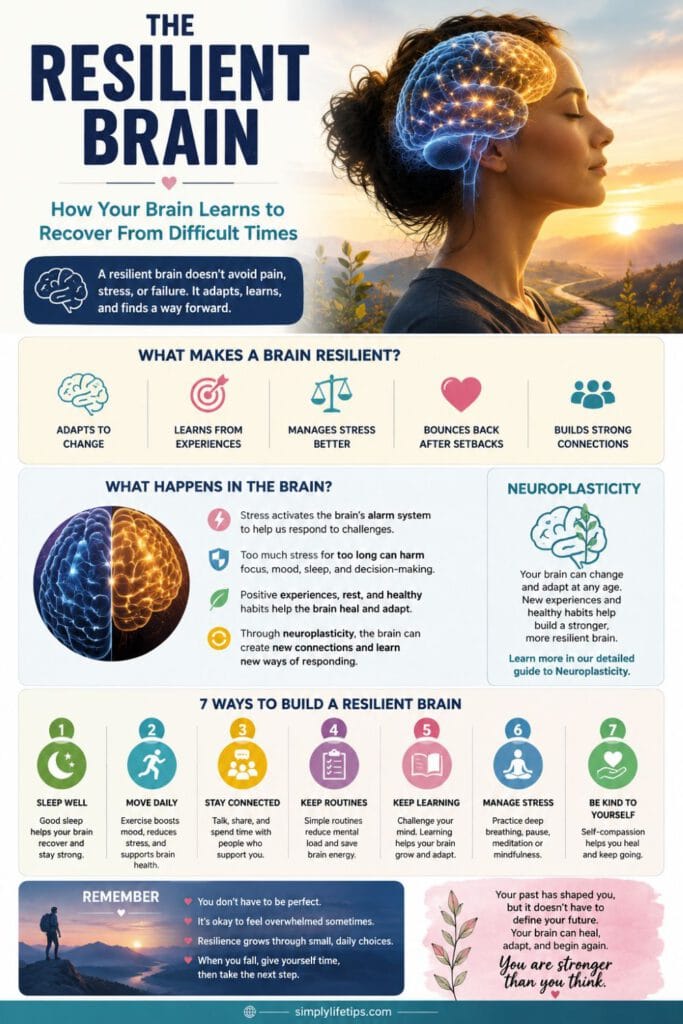
A resilient brain is not a brain that never feels pain, fear, stress, or disappointment. It is a brain that can adapt to difficult experiences and gradually find a way forward.
Life does not affect everyone in the same way.
A failure can make one person give up.
The same failure can make another person stop, think, learn, and try again.
A difficult experience can leave one person feeling helpless, while another slowly discovers a strength they did not know they had.
What makes the difference?
It is not always the situation.
Part of the answer lies in how we respond to the situation—and how the brain adapts over time.
What Is a Resilient Brain?
A resilient brain does not mean a fearless brain.
Strong people also worry.
They also feel sad.
They also become tired.
Sometimes they need to step away from everything and simply rest.
The difference is what happens after the difficult moment.
They gradually find a way to continue.
Resilience is the ability to adapt to difficult circumstances and recover from adversity. It is influenced by biological, psychological, and social factors rather than by one single quality.
That is why mental strength should not be confused with pretending to be strong.
Sometimes strength looks very ordinary.
Getting out of bed.
Making one phone call.
Taking a walk.
Starting again.
Asking someone for help.
Taking one more step.
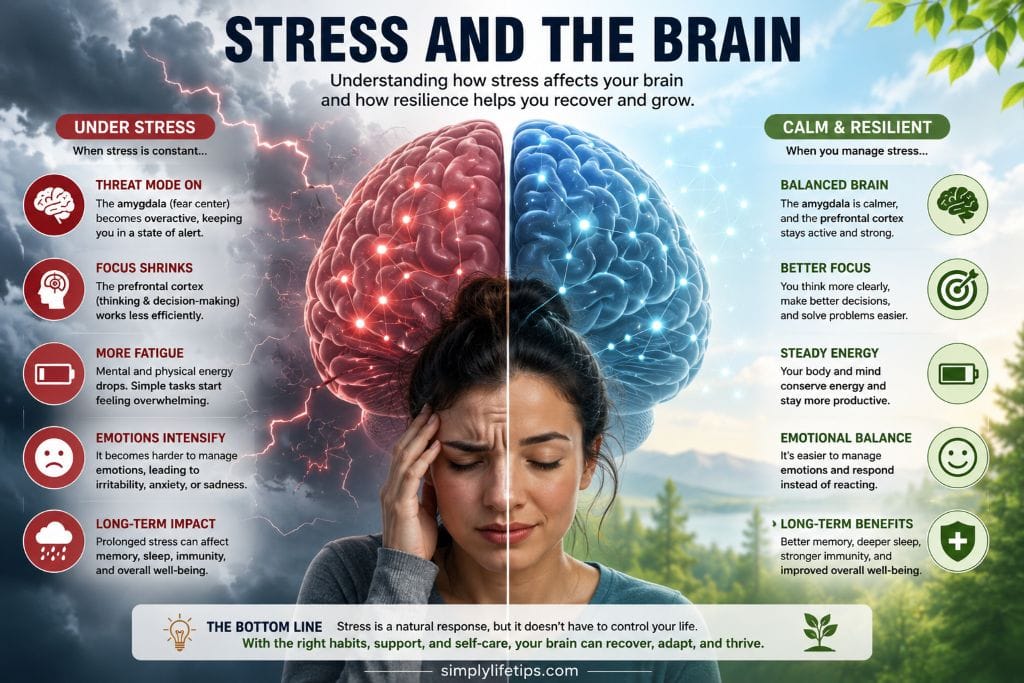
Stress Changes How the Brain Responds
Stress is a normal part of life.
A little stress can help us respond to challenges. But when stress becomes excessive or continues for a long time, it can affect our mental and physical well-being.
During stressful situations, the brain and body move into a state of increased alertness.
You may notice that:
- concentration becomes difficult
- small problems feel much bigger
- sleep becomes disturbed
- emotions become harder to control
- decision-making becomes tiring
This is one reason prolonged stress can leave you feeling mentally exhausted.
If you have experienced that feeling of being tired even when you have not done much physical work, our article on Mental Exhaustion: Signs, Causes, and Ways to Recover may be useful.
The important point is this:
Feeling overwhelmed does not automatically mean you are weak.
Sometimes your brain simply needs recovery.
Neuroplasticity: The Brain Can Adapt
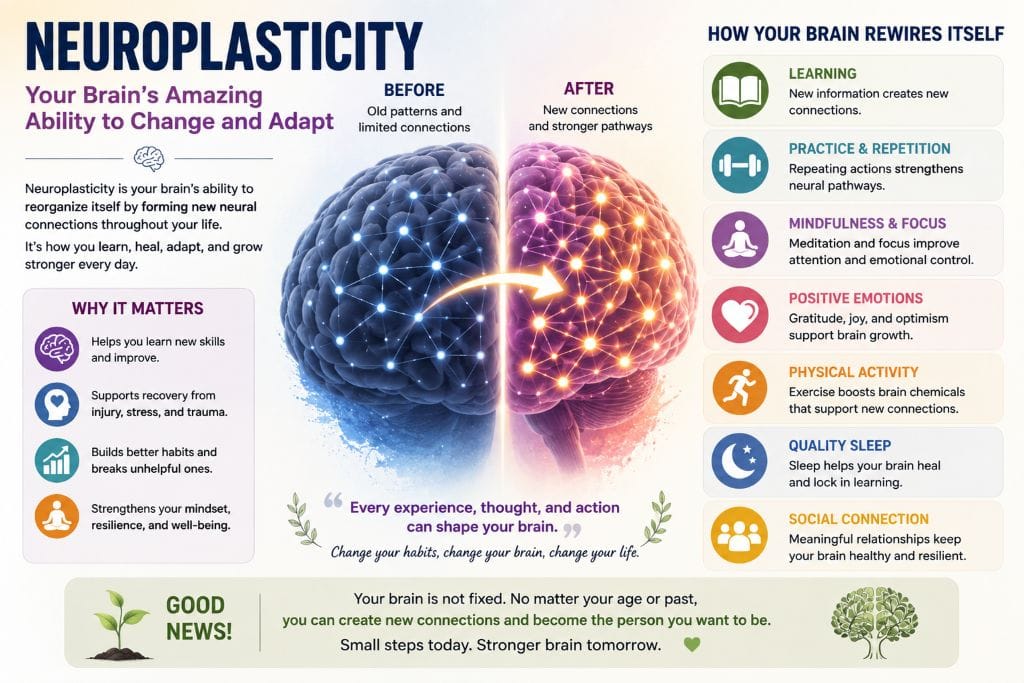
One of the most interesting things about the human brain is its ability to change.
This is known as neuroplasticity.
In simple terms, the brain can adapt in response to experiences, learning, and repeated patterns of activity.
Neuroplasticity helps explain why the brain is capable of learning and adapting. But resilience is about something more specific: how we respond when life becomes difficult. If you want to understand the science of the brain’s ability to change, read our detailed guide to neuroplasticity
Researchers are increasingly studying the relationship between stress, neuroplasticity, and resilience. A 2025 review describes stress responses as potentially contributing to neuroplasticity and adaptation, while also emphasizing that resilience is a complex process.
Think about learning to ride a bicycle.
At first, balancing feels difficult.
You make mistakes.
You may fall.
But you keep practicing.
Eventually, something that once required intense concentration becomes much easier.
The brain has learned.
Mental habits can also develop through repetition.
Learning to pause before reacting.
Learning to deal with disappointment.
Returning to a difficult task after failure.
Practising healthier ways to manage stress.
These experiences can become part of how we respond to future challenges.
That does not mean we can simply “rewire the brain” by thinking positively.
The human brain is far more complicated than that.
But it does mean that our patterns of response are not necessarily fixed forever.
A Resilient Brain Does Not Always Feel Strong
This is something worth remembering.
There may be days when a resilient person feels anything but resilient.
They may feel lost.
They may question themselves.
They may cry.
They may want to give up.
That does not erase their strength.
Sometimes resilience is simply the decision to try again tomorrow.
This is also why we should be careful with phrases such as:
“Everything happens for a reason.”
“Pain always makes you stronger.”
“Just be positive.”
Real life is not that simple.
Does Suffering Make Us Stronger?
Not automatically.
This is an important difference between an inspirational message and a scientifically responsible one.
A difficult experience can sometimes lead to learning, personal growth, or greater appreciation of life.
But severe or prolonged stress can also harm mental health.
People respond to adversity differently. Some recover quickly. Others need considerable support. Some may develop lasting psychological difficulties.
So we should never tell someone who is suffering that their pain is good for them.
Sometimes what a person needs is not another motivational speech.
They need rest.
They need understanding.
They need someone to listen.
And sometimes they need professional help.
That is also resilience.
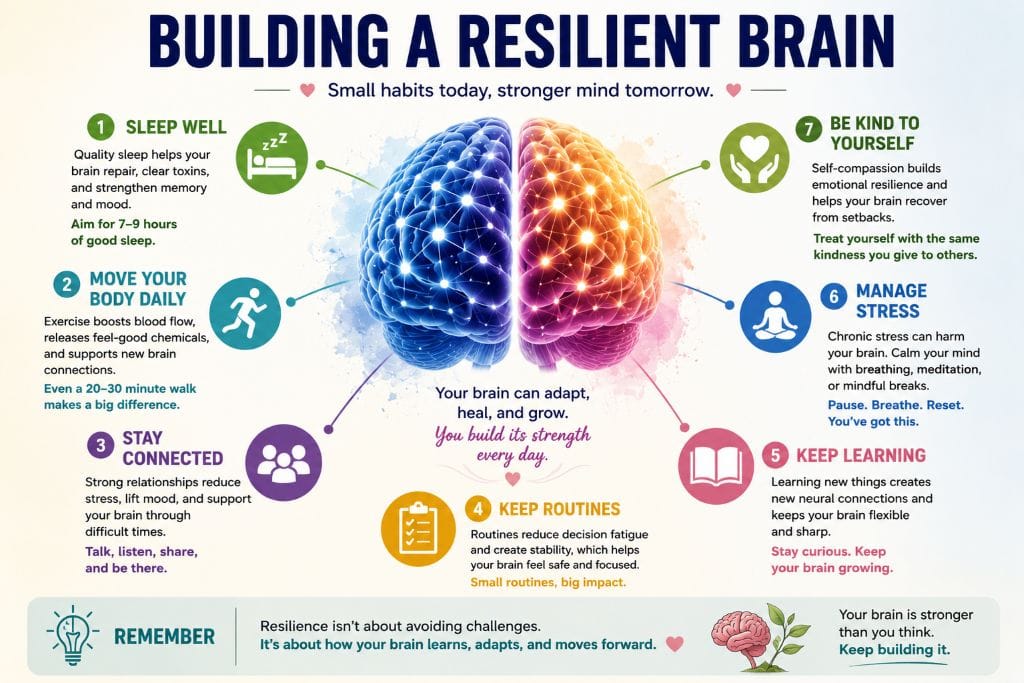
How Can You Build a More Resilient Brain?
You do not have to transform your life overnight.
Small things matter.
Sleep Before You Push Harder
When life becomes busy, sleep is often the first thing we sacrifice.
But sleep is part of recovery.
The World Health Organization recommends adequate sleep as part of healthy stress management and notes that sleep helps the body and mind recover.
Instead of asking:
“How much more can I do today?”
Sometimes ask:
“Have I given my brain enough time to recover?”
Move Your Body
You do not need an expensive gym membership to support your mental health.
Walking counts.
Cycling counts.
Dancing counts.
Household activity counts.
Regular physical activity can improve mental health, well-being, sleep, and brain health.
A simple daily walk can be a good beginning.
Stay Connected
When people are struggling, they sometimes withdraw from everyone.
But supportive relationships can make difficult periods easier to handle.
Talk to someone you trust.
You do not always need advice.
Sometimes you simply need someone who will listen.
WHO also recommends maintaining connections with family and friends as part of managing stress.
Reduce Unnecessary Decisions
A tired brain does not need hundreds of unnecessary choices.
What should I eat?
When should I exercise?
Which task should I start?
Should I answer this message now?
Simple routines can remove some of this mental load.
Your existing article on The Power of Daily Discipline: How Small Habits Create Massive Success explores how routines and small habits can make everyday actions easier.
Keep Learning
The brain benefits from being challenged.
Read something new.
Learn a skill.
Ask questions.
Try something outside your usual routine.
Learning does not have an expiry date.
As you have explored in your article Never Stop Learning: Always Update Your Knowledge, continuing to learn can keep life interesting and help us adapt to change.
Learn From Setbacks
When something goes wrong, our first thought may be:
“I failed.”
Try changing the question.
“What can I learn from this?”
Maybe your plan was wrong.
Maybe you needed more preparation.
Maybe you made a poor decision.
Maybe the situation was simply outside your control.
Learning from a setback does not remove the pain.
But it can prevent the pain from becoming meaningless.
Your Brain Is Not Your Enemy
Sometimes we become frustrated with our own minds.
“Why can’t I stop worrying?”
“Why do I keep thinking about the past?”
“Why can’t I concentrate?”
“Why am I so tired?”
Instead of fighting yourself all day, try to understand what your mind may be responding to.
Stress can affect concentration, sleep, emotions, and decision-making.
Understanding this can change the way you treat yourself.
You may stop calling yourself lazy.
You may stop thinking that you are weak.
You may realize that you need recovery rather than more pressure.
That change in perspective can be important.
Small Choices Can Shape Big Changes
A resilient brain is not built in one dramatic moment.
It develops through countless ordinary experiences.
One healthy meal.
One good night’s sleep.
One walk.
One honest conversation.
One difficult task completed.
One mistake understood.
One decision to try again.
One decision to ask for help.
These things may look small.
But life itself is built from small choices.
And the brain learns from experience.
When You Need More Than Self-Help
Resilience does not mean handling everything alone.
If stress, sadness, anxiety, or exhaustion continues and begins interfering with your daily life, relationships, work, or sleep, professional support may be appropriate.
WHO notes that persistent stress can contribute to mental health problems and recommends seeking help when difficulties coping begin affecting daily functioning.
Asking for help is not failure.
It is a responsible decision.
The Brain Can Learn a New Response
Your past experiences may have influenced the way you think today.
They may have created habits.
They may have changed what you fear.
They may have taught you to expect disappointment.
But that does not necessarily mean your future must follow exactly the same pattern.
The brain continues to adapt.
New experiences create new learning.
Healthy habits support healthier ways of coping.
Supportive people can change how we experience difficult periods.
And sometimes a painful chapter teaches us something we could not have learned any other way.
Not because the pain was good.
But because we found a way to grow around it.
Conclusion
A resilient brain is not a brain made of stone.
It can feel pain.
It can become tired.
It can become frightened.
It can struggle.
But it can also learn, adapt, recover, and begin again.
You do not need to become fearless.
You do not need to handle everything perfectly.
You simply need to keep giving your brain opportunities to learn healthier ways of responding.
Sleep when you need rest.
Move when you feel stuck.
Talk when you feel alone.
Learn when you fail.
Ask for help when the burden becomes too heavy.
And when life knocks you down, remember one simple thing:
You are allowed to take time to recover before you take your next step.
Your past has influenced you.
But it does not have to write every page of your future.
What difficult experience has taught you something that you still carry today?
Frequently Asked Questions
What is a resilient brain?
A resilient brain is one that can adapt to stress and difficult experiences and gradually recover. It does not mean never feeling pain or becoming immune to stress.
Can you develop a resilient brain?
Resilience is influenced by many factors, including biology, experience, relationships, and coping strategies. Healthy habits and supportive environments can help people develop better ways of adapting to stress.
What is neuroplasticity?
Neuroplasticity is the brain’s ability to adapt and change in response to experiences, learning, and other influences.
Does suffering make the brain stronger?
Not necessarily. Difficult experiences can sometimes lead to learning or growth, but prolonged or severe stress can also harm mental health. The outcome varies from person to person.
What are simple ways to support brain resilience?
Adequate sleep, regular physical activity, supportive relationships, healthy routines, learning, stress-management skills, and professional support when necessary can all contribute to better mental well-being.
External sources
- World Health Organization – Stress — useful authoritative reference for stress, sleep, routines, exercise, and social connection.
- PubMed – Building Resilience: The Stress Response as a Driving Force for Neuroplasticity and Adaptation — recent scientific review supporting the neuroscience section.
- WHO – Physical Activity — supporting source for exercise, mental health, sleep, and brain health.

Mathukutty P. V. is the founder of Simply Life Tips. He shares practical advice and useful insights on personal growth, health, well-being, technology, and everyday living. His goal is to help readers build positive habits and make informed decisions. He believes in continuous learning and sharing knowledge to help people live healthier, happier, and more meaningful lives.