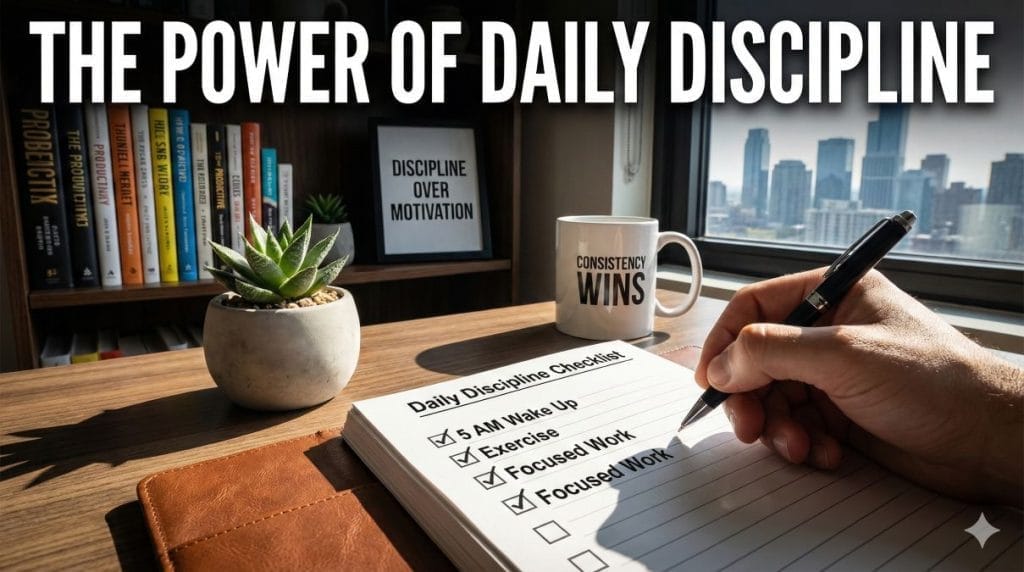
To master your life, you must first understand the daily discipline required to turn vague dreams into concrete reality. Most people believe that success comes from a single “big break” or a stroke of lightning-fast genius. In reality, the most successful people in the world—from Olympic athletes to billionaire CEOs—rely on a boring, repetitive, and quiet superpower: the ability to do the same productive things over and over again.
This guide will break down everything you need to know about building a life centred on consistency. We will explore what this concept truly means, why it is the foundation of all achievement, the life-changing benefits it offers, and a step-by-step roadmap to implementing it today.
What is Daily Discipline?
At its core, daily discipline is the practice of self-regulation. It is the mental muscle that allows you to follow through on your intentions regardless of your emotional state. While motivation is a feeling that comes and goes, discipline is a system that stays.
Imagine your mind is a ship. Motivation is the wind—when it blows, you move fast and effortlessly. But when the wind dies down, you sit still in the water. Daily discipline is the engine. It doesn’t care if the wind is blowing or if the sea is choppy; it keeps the ship moving toward the destination at a steady pace.
The “Small Wins” Philosophy
Discipline isn’t about doing 1,000 things at once. It’s about doing one thing 1,000 times. It is the decision to choose “delayed gratification” (a reward later) over “instant gratification” (a reward now).
Example: Choosing to drink a glass of water instead of a soda. In the moment, the soda tastes better. But the disciplined choice of water leads to better health, clearer skin, and higher energy hours later.
Why is Daily Discipline Important?
Without discipline, talent is wasted. We all know someone who is incredibly smart or gifted but never seems to “get it together.” Usually, the missing ingredient is a lack of daily structure.
1. It Creates Reliability
When you are disciplined, you become a person that others—and more importantly, you—can count on. You stop being a slave to your moods. If you say you are going to work on a project at 4:00 PM, you do it because it’s 4:00 PM, not because you “feel inspired.”
2. It Negates Decision Fatigue
The human brain can only make a certain number of good decisions per day. By turning productive actions into disciplined routines, you save your brainpower for the big stuff.
Example: Steve Jobs famously wore the same black turtleneck every day. By making his outfit a “disciplined routine,” he didn’t have to waste mental energy choosing clothes, leaving more energy to run Apple.
3. It Overcomes the “Resistance”
Author Steven Pressfield calls the force that keeps us from our work “The Resistance.” It’s that voice in your head that says, “I’ll do it tomorrow” or “I’m not ready yet.” Daily discipline is the only weapon that can defeat the Resistance.
The Life-Changing Benefits of Daily Discipline
The benefits of staying disciplined extend far beyond just “getting things done.” It changes the very chemistry of your life.
1. Increased Self-Confidence
Self-confidence isn’t something you’re born with; it’s something you earn. Every time you finish a task you promised yourself you’d do, you build “internal trust.”
Example: If you commit to a 10-minute walk every day and actually do it for 30 days straight, you prove to yourself that you are a person of integrity. That feeling of “I did what I said I would do” is the foundation of high self-esteem.
How To Boost Self-Confidence With Easy Steps?
2. The Compound Effect
The most powerful force in the universe is compound interest, and it applies to habits, too. Small improvements, when repeated daily, lead to exponential growth.
Example: If you improve a skill by just 1% every day, thanks to the math of compounding, you will be 37 times better by the end of one year
3. Reduced Stress and Anxiety
Much of our stress comes from “procrastination debt”—the heavy feeling of knowing we have work to do but haven’t started. Discipline clears this debt. When you have a daily schedule, you know exactly when work starts and when it ends, allowing you to truly relax during your downtime.
4. Better Physical Health
Discipline is the key to fitness. It is the difference between a “crash diet” that fails after a week and a lifestyle where you consistently move your body and eat whole foods.
How to Build Daily Discipline (Step-by-Step)
Building discipline is like training for a marathon. You don’t run 26 miles on day one. You start with a walk around the block.
Step 1: Define Your “Why”
Discipline for the sake of discipline is hard. You need a reason. Ask yourself: Who do I want to become?
Example: Instead of saying “I want to be disciplined at the gym,” say “I want to be a healthy parent who has the energy to play with my kids for the next 20 years.”
Step 2: Start Ridiculously Small
The biggest mistake people make is trying to change everything at once. This triggers the brain’s “fear centre,” and you quit.
The 2-Minute Rule: If a new habit takes less than two minutes, do it now. Want to read more? Read one page a night. Want to do pushups? Do three pushups.
Example: If your goal is a clean house, commit to cleaning just one drawer every morning. The momentum will eventually carry you to the rest of the room.
Step 3: Use “Habit Stacking”
The easiest way to form a new disciplined habit is to “stack” it on top of an old one.
- The Formula: After [Current Habit], I will [New Disciplined Action].
- Example: “After I pour my morning coffee (current habit), I will write down my top 3 goals for the day (new discipline).”
Step 4: Design Your Environment
Willpower is a limited resource. Don’t rely on it. Instead, change your surroundings so that discipline is the path of least resistance.
Example: If you want to stop checking your phone first thing in the morning, put your phone in a different room and buy a cheap analogue alarm clock. You’ve now made the “bad” habit harder and the “good” habit easier.
Step 5: Forgive Yourself and Refocus
You will fail. You will miss a day. The difference between a disciplined person and an undisciplined one is how they handle a slip-up.
The Rule of “Never Miss Twice”: If you miss one day, it’s an accident. If you miss two days, it’s the start of a new (bad) habit. Get back on track immediately.
Amazing Benefits Of Self-Forgiveness And Forgiveness
Examples of Daily Discipline in Action
In Finance
A disciplined person doesn’t wait until the end of the month to see what’s left to save. They use a “Pay Yourself First” system.
- The Action: Setting up an automatic transfer of $50 to a savings account every payday.
- The Result: Over 10 years, with interest, that’s over $8,000 without ever having to “think” about being disciplined.
In Creative Work
Professional writers don’t wait for the “Muse” to visit them. They show up at the desk at the same time every day.
- The Action: Sitting at the computer from 8:00 AM to 9:00 AM, even if they only type “I don’t know what to write” for sixty minutes.
- The Result: Eventually, the brain realises it has to work during that hour. This is how books are finished.
In Relationships
Discipline applies to how we treat others. It’s the discipline of listening instead of interrupting.
- The Action: Putting your phone face down every time your partner or child talks to you.
- The Result: Deep, meaningful connections built on a foundation of respect.
Summary Table: Discipline vs. Motivation
| Feature | Motivation | Daily Discipline |
| Source | External (videos, quotes, music) | Internal (systems, identity, rules) |
| Consistency | Low (peaks and valleys) | High (steady line) |
| Reliability | Only works when you “feel” like it | Works regardless of feelings |
| Result | Short-term bursts | Long-term transformation |
Concluision
Mastering the power of daily discipline is not about achieving perfection; it is about committing to the process. It is the quiet, invisible work that happens behind the scenes of every great success story. By shifting your focus from short-term intensity to long-term consistency, you remove the stress of “trying” to be successful and instead allow your systems to carry you there.
Remember that every master was once a beginner who simply refused to quit. Whether you are looking to improve your health, grow your business, or find inner peace, the secret is hidden in your daily routine. Start where you are, use what you have, and do what you can. The person you want to become is waiting on the other side of the small choices you make today.
I would love to hear from you as we grow this community together. What is one small habit you are going to commit to starting tomorrow to harness the power of daily discipline in your own life?
The Power of Discipline Story | How Ryan Mastered His Mind to Achieve His Dreams
FAQs About Daily Discipline
Understanding the mechanics of consistency can help you stay on track when things get difficult. Here are five of the most common questions people ask about building a disciplined life.
1. What is the difference between discipline and willpower?
While they are related, willpower is a short-term burst of mental energy used to resist temptation (like saying no to a cookie). Discipline is a long-term system of habits that makes willpower less necessary. Think of willpower as a battery that drains throughout the day, while discipline is the wiring in your house that provides a steady flow of power.
2. How long does it actually take to become disciplined?
You may have heard it takes 21 days to form a habit, but modern research suggests it’s closer to 66 days on average. The time varies depending on the complexity of the task and your environment. The key is not to focus on the “end date” but to focus on the daily streak.
3. Can you be “too disciplined”?
Yes, discipline should be a tool for freedom, not a cage. If your discipline becomes so rigid that you cannot enjoy a meal with friends or take a rest day when you are sick, it can lead to burnout. Healthy discipline includes planned flexibility.
4. What should I do if I lose my discipline for a week?
The most important step is to avoid the “all-or-nothing” mindset. Many people fail for one week and decide they “just aren’t a disciplined person.” Instead, treat it like a minor detour on a long road trip. You don’t drive back to the start; you just get back on the highway at the next exit.
5. Does daily discipline kill creativity?
Many artists fear that a schedule will kill their “vibe.” In reality, discipline provides a canvas for creativity to flourish. By automating the “boring” parts of your life (when you eat, when you clean, when you sit at your desk), you free up your mental energy for deep, creative work.

Mathukutty P V is a Blogger, YouTuber, and Content Writer and the founder of Simply Life Tips. After taking voluntary retirement in 2017, he embraced a free lifestyle focused on learning, personal growth, and sharing practical wisdom to help others live with more purpose and positivity.