
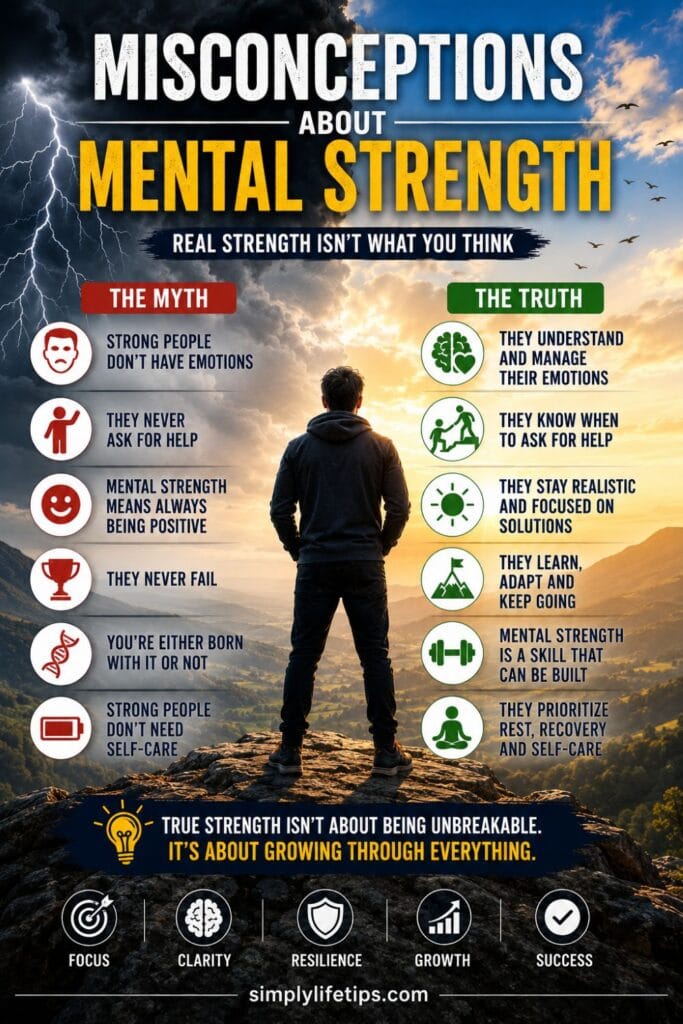
Misconceptions About Mental Strength are surprisingly common in today’s world. Many people assume that mentally strong individuals never cry, never struggle, and always appear confident. In reality, mental strength is not about being emotionless or invincible. It is about managing emotions, adapting to challenges, and continuing forward despite difficulties.
Understanding the truth behind these Misconceptions About Mental Strength can help you develop genuine resilience and improve your personal and professional life.
Explore the most common misconceptions about healing and discover what true recovery looks like.
What Is Mental Strength?
Mental strength is the ability to regulate emotions, maintain focus under pressure, make thoughtful decisions, and recover from setbacks. It involves self-awareness, emotional control, perseverance, and adaptability.
For example, a mentally strong employee who receives criticism does not immediately become defensive. Instead, they evaluate the feedback, learn from it, and use it to improve.
Unfortunately, many myths prevent people from developing this valuable trait.
10 Misconceptions About Mental Strength
1. Mentally Strong People Never Feel Fear
One of the biggest misconceptions about mental strength is that mentally strong people are fearless.
The truth is that everyone experiences fear. Fear is a natural human response to uncertainty, risk, or danger. The difference is that mentally strong individuals do not allow fear to control their decisions.
For example, a person may feel nervous before giving a presentation. A mentally strong individual acknowledges the anxiety but still delivers the presentation because the goal is more important than the temporary discomfort.
Courage is not the absence of fear. It is taking action despite fear.
2. Mental Strength Means Never Showing Emotions
Many people believe that expressing emotions is a sign of weakness.
In reality, suppressing emotions often creates more problems than healthily expressing them. Mental strength involves recognizing emotions, understanding them, and responding appropriately.
A parent who openly discusses feelings with their children demonstrates emotional maturity. A leader who admits disappointment after a setback can inspire trust and authenticity.
Being emotionally aware is a sign of strength, not weakness.
3. Mentally Strong People Never Need Help
Another common myth is that strong people handle everything alone.
The reality is that seeking help often requires tremendous strength. Mentally strong individuals understand their limitations and know when support is necessary.
For example, successful entrepreneurs frequently rely on mentors, advisors, and experienced team members. Athletes work with coaches to improve performance. Even the strongest people benefit from guidance and support.
Asking for help is a strategic decision, not a weakness.
4. Mental Strength Means Constant Positivity
Many people confuse mental strength with always being positive.
While optimism can be beneficial, mentally strong people do not ignore reality. They acknowledge challenges while maintaining hope and focusing on solutions.
For example, if a business experiences financial difficulties, a mentally strong owner does not pretend everything is fine. Instead, they assess the situation honestly and create a plan to move forward.
True resilience balances realism and optimism.
5. Strong People Never Fail
Failure is often viewed as evidence of weakness.
However, mentally strong individuals understand that failure is a natural part of growth. They see setbacks as learning opportunities rather than permanent defeats.
Thomas Edison reportedly conducted thousands of unsuccessful experiments before inventing the practical electric light bulb. His persistence demonstrates that success often follows repeated failures.
Growth rarely occurs without mistakes.
6. Mental Strength Is Something You Are Born With
Many people assume that some individuals are naturally mentally strong while others are not.
In reality, mental strength is a skill that can be developed over time. Just as muscles become stronger through exercise, mental resilience improves through consistent practice.
Daily habits such as self-discipline, emotional regulation, problem-solving, and healthy coping strategies gradually strengthen the mind.
Anyone can improve their mental strength through intentional effort.
7. Being Mentally Strong Means Never Feeling Stressed
Stress is a normal part of life.
The misconception is that mentally strong people never experience stress. In reality, they experience stress just like everyone else. The difference lies in how they manage it.
For example, when facing a tight deadline, a mentally strong professional prioritizes tasks, remains organized, and focuses on what can be controlled instead of becoming overwhelmed.
Effective stress management is a hallmark of mental strength.
8. Mental Strength Is the Same as Stubbornness
Some people mistake stubbornness for mental toughness.
However, stubbornness involves refusing to change, while mental strength involves adaptability and wisdom. Mentally strong individuals are willing to change their opinions when presented with new information.
For example, a business leader who adjusts strategies based on market changes demonstrates flexibility rather than stubbornness.
Adaptability is often a greater strength than persistence alone.
9. Mentally Strong People Do Not Need Self-Care
Many people believe that strong individuals can push themselves endlessly without rest.
The truth is that mental strength includes recognizing the importance of recovery. Rest, sleep, exercise, and healthy relationships are essential for maintaining emotional and psychological well-being.
Consider professional athletes. Despite their physical toughness, they prioritize recovery because they understand that performance suffers without it.
The same principle applies to mental health.
3 Powerful Habits That Highlight the Importance of Self-Care
10. Confidence and Mental Strength Are the Same Thing
Confidence and mental strength are related but not identical.
Confidence is belief in your abilities. Mental strength is the ability to continue functioning effectively even when confidence is shaken.
For example, a job applicant may feel uncertain before an interview but still perform well because they have developed resilience and emotional control.
Mental strength often sustains people when confidence temporarily disappears.
11. Mental Strength Means Winning Every Battle
Life does not always go according to plan.
Mentally strong people understand that some situations cannot be changed. Instead of wasting energy fighting every battle, they focus on what they can influence and accept what they cannot.
For example, after losing an opportunity, they may feel disappointed but eventually redirect their energy toward new possibilities.
Acceptance is often one of the strongest forms of resilience.
How to Build Genuine Mental Strength?
Developing mental strength requires consistent practice. Some effective strategies include:
- Practice self-awareness and emotional regulation.
- Accept challenges as opportunities to grow.
- Learn from mistakes instead of dwelling on them.
- Develop healthy coping mechanisms for stress.
- Build supportive relationships.
- Maintain physical health through exercise and proper sleep.
- Focus on solutions rather than problems.
- Set realistic goals and remain disciplined.
- Embrace change and adaptability.
- Practice gratitude and perspective.
Small daily actions gradually create significant mental resilience.
The Benefits of Understanding Mental Strength Correctly
When people overcome misconceptions about mental strength, they gain a healthier perspective on personal growth.
Benefits include:
- Better emotional control
- Stronger relationships
- Improved decision-making
- Increased resilience during setbacks
- Greater confidence and self-awareness
- Enhanced workplace performance
- Reduced stress and anxiety
- Improved overall well-being
Understanding the truth allows individuals to develop authentic strength rather than chasing unrealistic ideals.
FAQs – Misconceptions About Mental Strength
What is the biggest misconception about mental strength?
The biggest misconception is that mentally strong people never experience fear, sadness, or stress. In reality, they experience these emotions but manage them effectively.
Can mental strength be learned?
Yes. Mental strength is a skill that can be developed through practice, discipline, self-awareness, and experience.
Is crying a sign of mental weakness?
No. Healthy emotional expression is often a sign of emotional intelligence and mental resilience.
How can I become mentally stronger?
Focus on building healthy habits, managing emotions, learning from failures, and developing a growth mindset.
Why is mental strength important?
Mental strength helps people navigate challenges, recover from setbacks, maintain healthy relationships, and achieve long-term goals.
- Misconceptions About Self-Love | 10 Common Myths That Hold People Back
- 15 Misconceptions About Wives That Can Ruin Your Marriage
Conclusion
The most damaging misconceptions about mental strength often create unrealistic expectations about what it means to be resilient. True mental strength is not about suppressing emotions, avoiding fear, or never failing. It is about facing life’s challenges with courage, adaptability, self-awareness, and perseverance. When you understand these myths and embrace the reality of mental resilience, you create a stronger foundation for personal growth, healthier relationships, and long-term success.
“Mental strength is not about being unbreakable; it is about learning how to rebuild, adapt, and move forward.”
What misconception about mental strength do you think prevents the most people from reaching their full potential?

Mathukutty P V is a Blogger, YouTuber, and Content Writer and the founder of Simply Life Tips. After taking voluntary retirement in 2017, he embraced a free lifestyle focused on learning, personal growth, and sharing practical wisdom to help others live with more purpose and positivity.