

Leadership styles of famous leaders teach one powerful lesson: successful leadership is not about following one fixed approach. The best leaders adapt their leadership style depending on the situation, team, goals, and challenges they face.
The infographic above perfectly explains this idea by showcasing nine different leadership styles through world-famous personalities such as Elon Musk, Steve Jobs, Nelson Mandela, Mahatma Gandhi, Oprah Winfrey, Angela Merkel, Martin Luther King Jr., Indra Nooyi, and Jeff Bezos.
Many people believe leadership means always being strict, motivational, democratic, or visionary. But high-performing leaders know that every situation requires a different approach. A leadership style that works during a crisis may completely fail during innovation projects. A method that motivates experienced employees may confuse beginners.
The most successful leaders understand how to shift their leadership style based on:
- Team experience
- Business goals
- Deadlines
- Crises
- Organizational culture
- Employee motivation
- Long-term vision
This article analyzes the infographic deeply and explains the leadership styles of famous leaders. How famous leader represents a unique leadership style, when those styles work best, their strengths, weaknesses, and practical workplace applications.
Why One Leadership Style Does Not Work Everywhere?
One of the biggest leadership mistakes is believing there is only one “correct” way to lead.
Some managers try to become extremely commanding because they admire powerful CEOs. Others attempt to involve everyone in every decision because they want to be democratic leaders. Some rely only on motivation while ignoring discipline and accountability.
This creates problems because leadership is situational.
For example:
- A hospital emergency room requires fast commanding leadership
- A startup building new technology needs visionary leadership
- A creative design team may perform best under delegative leadership
- A government organization often depends on bureaucratic leadership
The infographic highlights this beautifully by showing not only how each leadership style works, but also when it should and should not be used.
That balance is what separates average managers from exceptional leaders.
Leadership Styles of Famous Leaders Infographic
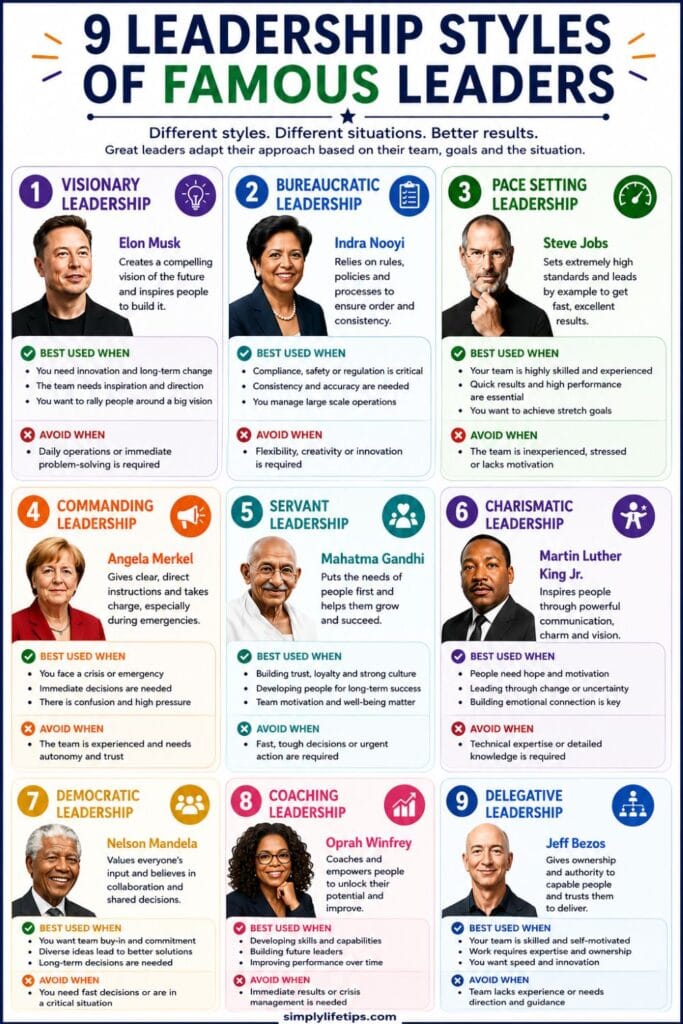
Visionary Leadership – Elon Musk
The infographic uses Elon Musk to represent visionary leadership because he inspires people through ambitious, future-focused goals.
Elon Musk’s success story demonstrates the power of bold vision, continuous innovation, and an unwavering determination to push beyond limitations.
Musk is known for talking about:
- Colonizing Mars
- Sustainable energy
- Artificial intelligence
- Space exploration
- The future of transportation
His leadership style motivates employees and investors to believe in possibilities that initially seem impossible.
What Is Visionary Leadership?
Visionary leadership focuses on inspiring people with a clear and exciting vision of the future.
Visionary leaders:
- Think long-term
- Inspire innovation
- Motivate teams emotionally
- Encourage creativity
- Focus on transformation
How Elon Musk Uses Visionary Leadership?
At Tesla and SpaceX, Musk constantly communicates missions bigger than profits.
Instead of simply selling products, he promotes ideas such as:
- Saving the planet through electric vehicles
- Making humanity multi-planetary
This creates strong emotional commitment among employees and supporters.
When Visionary Leadership Works Best?
The infographic correctly explains that visionary leadership works best:
- During innovation
- During a major organizational change
- When teams need inspiration
- When building long-term transformation
Weaknesses of Visionary Leadership
Visionary leadership may fail:
- During day-to-day operational management
- During immediate crisis handling
- When detailed execution is required
A leader who focuses only on dreams without systems may create confusion.
Leadership Lesson from Elon Musk
People work harder when they feel connected to a meaningful long-term mission.
Bureaucratic Leadership – Indra Nooyi
The infographic associates Indra Nooyi, former CEO of PepsiCo, with bureaucratic leadership because of her strong focus on systems, operational discipline, and organizational structure.
Indra Nooyi is truly a remarkable example of women’s empowerment. She has inspired millions of women around the world, especially in India. Her journey and achievements prove that women can accomplish extraordinary goals and that there are no limits to what determination, talent, and hard work can achieve.
What Is Bureaucratic Leadership?
Bureaucratic leadership follows rules, procedures, policies, and structure to maintain consistency and order.
This leadership style focuses on:
- Compliance
- Documentation
- Safety
- Accountability
- Standardized processes
How Indra Nooyi Demonstrated Bureaucratic Leadership?
Managing a multinational corporation like PepsiCo requires:
- Strong governance
- Operational control
- Financial discipline
- Regulatory compliance
Indra Nooyi successfully balanced innovation with corporate structure.
When Bureaucratic Leadership Works Best?
The infographic explains that this style works best:
- In regulated industries
- In compliance-focused organizations
- Where safety and accuracy matter
Examples include:
- Banking
- Healthcare
- Government
- Aviation
Weaknesses
This style becomes problematic:
- When flexibility is required
- During rapid innovation
- In highly creative industries
Too many rules can slow decision-making and reduce creativity.
Leadership Lesson from Indra Nooyi
Strong systems and disciplined execution are essential for managing large organizations successfully.
Pace Setting Leadership – Steve Jobs
The infographic uses Steve Jobs as the example of pace-setting leadership because he is obsessed with excellence and innovation.
Steve Jobs was a visionary entrepreneur who transformed the technology industry through innovation and creativity. His leadership at Apple revolutionized personal computing, smartphones, and digital entertainment. His journey continues to inspire millions to think differently, pursue excellence, and never stop innovating.
What Is Pace Setting Leadership?
Pace-setting leadership involves setting extremely high standards and leading through personal example.
Pace-setting leaders:
- Move quickly
- Demand excellence
- Focus heavily on performance
- Expect high productivity
- Push teams toward ambitious goals
How Steve Jobs Used Pace-Setting Leadership?
Steve Jobs became famous for:
- Demanding perfection
- Challenging employees intensely
- Obsessing over design quality
- Maintaining extremely high standards
His leadership helped Apple create revolutionary products like:
- iPhone
- iPad
- MacBook
When Pace Setting Leadership Works Best?
The infographic correctly explains that this style works well:
- With highly skilled teams
- During product launches
- When quick results are necessary
Weaknesses
This leadership style may create:
- Employee burnout
- High stress
- Fear of failure
- Reduced morale
Inexperienced employees often struggle under constant pressure.
Leadership Lesson from Steve Jobs
High standards can produce extraordinary innovation when supported by talented teams.
Commanding Leadership – Angela Merkel
The infographic associates Angela Merkel with commanding leadership because of her decisive approach during major European crises.
What Is Commanding Leadership?
Commanding leadership focuses on fast decisions, clear authority, and direct instructions.
These leaders:
- Take control quickly
- Reduce confusion
- Give clear orders
- Maintain discipline
- Prioritize urgent action
How Angela Merkel Demonstrated Commanding Leadership?
During financial and political crises in Europe, Merkel often provided:
- Stability
- Clear direction
- Calm decision-making
- Strong crisis management
Her leadership became especially important during uncertain periods.
When Commanding Leadership Works Best
The infographic explains that this style is effective:
- During emergencies
- During crises
- In disaster situations
- When quick decisions are necessary
Weaknesses
Overusing commanding leadership can:
- Reduce creativity
- Lower morale
- Frustrate experienced professionals
Autonomous teams may dislike excessive control.
Leadership Lesson from Angela Merkel
Strong leaders must sometimes make difficult decisions quickly during uncertainty.
Servant Leadership – Mahatma Gandhi
The infographic uses Mahatma Gandhi to represent servant leadership because he focused on serving others rather than seeking personal power.
What Is Servant Leadership?
Servant leadership prioritizes the needs, growth, and well-being of others.
Servant leaders:
- Put people first
- Show empathy
- Build trust
- Support employee growth
- Encourage collaboration
How Gandhi Demonstrated Servant Leadership?
Gandhi inspired millions through:
- Humility
- Service
- Sacrifice
- Nonviolent leadership
People followed him because they trusted his character and intentions.
When Servant Leadership Works Best
The infographic explains that servant leadership works effectively:
- For long-term team development
- For building loyalty
- For creating a strong workplace culture
Weaknesses
This style may struggle:
- During emergencies
- When quick action is necessary
- In highly competitive urgent situations
Leadership Lesson from Gandhi
People trust leaders who genuinely care about others.
Charismatic Leadership – Martin Luther King Jr.
The infographic associates Martin Luther King Jr. with charismatic leadership because of his powerful communication and emotional influence.
What Is Charismatic Leadership?
Charismatic leadership relies on inspiration, emotional connection, and persuasive communication.
Charismatic leaders:
- Inspire people emotionally
- Build hope
- Motivate through speeches
- Create a strong personal influence
How Martin Luther King Jr. Used Charismatic Leadership?
His speeches united millions during the civil rights movement.
His leadership style included:
- Powerful storytelling
- Emotional inspiration
- Clear moral vision
- Strong communication
When Charismatic Leadership Works Best?
The infographic explains that this style works best:
- During uncertainty
- During organizational change
- When morale is low
Weaknesses
Charisma alone cannot replace:
- Technical expertise
- Strategic planning
- Operational execution
Leadership Lesson from Martin Luther King Jr.
Powerful communication can unite people behind a common purpose.
Democratic Leadership – Nelson Mandela
The infographic uses Nelson Mandela as the example of democratic leadership because he valued inclusion, dialogue, and collective decision-making.
Nelson Mandela was a global symbol of courage, equality, and forgiveness. He dedicated his life to fighting racial discrimination and played a historic role in ending apartheid in South Africa. His leadership, resilience, and commitment to peace continue to inspire people around the world.
What Is Democratic Leadership?
Democratic leadership encourages participation and team involvement in decision-making.
These leaders:
- Listen carefully
- Encourage discussion
- Build consensus
- Include different perspectives
How Nelson Mandela Demonstrated Democratic Leadership?
After apartheid, Mandela promoted:
- National unity
- Reconciliation
- Inclusion
- Open dialogue
Instead of division, he encouraged collaboration and healing.
When Democratic Leadership Works Best
The infographic explains that this style works effectively:
- For team buy-in
- During collaboration
- For innovation and creativity
Weaknesses
Democratic leadership may become ineffective:
- During emergencies
- Under strict deadlines
- When immediate action is necessary
Leadership Lesson from Nelson Mandela
People support decisions more strongly when they feel included.
Coaching Leadership – Oprah Winfrey
The infographic associates Oprah Winfrey with coaching leadership because of her focus on helping people grow and reach their potential.
Oprah Winfrey is one of the most influential media personalities in the world and a powerful example of determination and resilience. Rising from a difficult childhood, she built a successful career through hard work, confidence, and communication skills. Her journey inspires millions to overcome challenges and believe in their potential.
What Is Coaching Leadership?
Coaching leadership develops employee skills, confidence, and long-term growth.
Coaching leaders:
- Mentor employees
- Give constructive feedback
- Encourage improvement
- Build future leaders
How Oprah Winfrey Demonstrated Coaching Leadership?
Through her media career, Oprah empowered people by:
- Encouraging personal development
- Sharing life lessons
- Supporting emotional growth
- Inspiring confidence
When Coaching Leadership Works Best?
The infographic explains that coaching leadership is ideal:
- For employee development
- For long-term team growth
- For leadership training
Weaknesses
This style may struggle:
- During crises
- Under urgent deadlines
- When immediate action is needed
Leadership Lesson from Oprah Winfrey
Investing in people’s growth creates stronger long-term success.
Delegative Leadership – Jeff Bezos
The infographic uses Jeff Bezos as the example of delegative leadership because Amazon empowers teams to make independent decisions.
Jeff Bezos is a visionary entrepreneur who transformed online shopping and digital business through innovation and long-term thinking. As the founder of Amazon, he built one of the world’s largest companies by focusing on customer satisfaction and continuous improvement. His success story inspires aspiring entrepreneurs to think big, take risks, and embrace innovation.
What Is Delegative Leadership?
Delegative leadership gives employees authority and ownership over their tasks.
Delegative leaders:
- Trust skilled employees
- Avoid micromanagement
- Encourage independence
- Empower decision-making
How Jeff Bezos Demonstrated Delegative Leadership?
Amazon encourages:
- Autonomous teams
- Fast innovation
- Independent decision-making
- Employee ownership
Bezos famously promoted small independent “two-pizza teams” to improve speed and innovation.
When Delegative Leadership Works Best
The infographic explains that this style works well:
- With highly skilled employees
- With motivated teams
- In creative environments
Weaknesses
Delegative leadership may fail:
- With inexperienced teams
- Without accountability
- When employees need guidance
Leadership Lesson from Jeff Bezos
Trusting capable employees improves innovation and speed.
How Successful Leaders Blend Different Leadership Styles?
The world’s best leaders rarely use one leadership style permanently.
For example:
- Elon Musk combines visionary and pace-setting leadership
- Steve Jobs combined visionary and commanding leadership
- Nelson Mandela combined democratic and servant leadership
- Oprah Winfrey combines coaching and charismatic leadership
Great leadership is flexible.
A high-performing leader understands:
- When to inspire
- When to guide
- When to delegate
- When to take control
That adaptability creates stronger teams and better business outcomes.
Common Leadership Mistakes
Many leaders fail because they:
- Use one leadership style everywhere
- Ignore team maturity
- Over-control employees
- Avoid communication
- Focus only on results
- Resist change
The infographic teaches a valuable lesson:
Every leadership style has strengths and weaknesses.
FAQs
What is the best leadership style?
There is no single best leadership style. Effective leaders adapt their approach depending on the team, situation, and goals.
Why is Elon Musk considered a visionary leader?
Elon Musk inspires people with ambitious future-focused goals related to sustainable energy, technology, and space exploration.
Why is Steve Jobs associated with pace-setting leadership?
Steve Jobs demanded extremely high standards and pushed teams toward innovation and excellence.
What leadership style did Nelson Mandela use?
Nelson Mandela strongly demonstrated democratic leadership through inclusion, collaboration, and consensus-building.
Can leaders use multiple leadership styles?
Yes. Most successful leaders combine different leadership styles depending on the situation and organizational needs.
Conclusion
The infographic delivers an important leadership lesson: great leaders adapt their leadership style based on the situation.
Elon Musk inspires through vision. Steve Jobs drives excellence through pace-setting leadership. Gandhi builds trust through servant leadership. Mandela creates unity through democratic leadership. Oprah Winfrey develops people through coaching and leadership.
Every leadership style has:
- Strengths
- Weaknesses
- Ideal situations
- Risks if overused
The best leaders understand when to switch from one leadership style to another.
Leadership is not about copying one famous person. It is about understanding people, situations, goals, and choosing the leadership approach that creates the best outcome.
Which leadership style do you naturally connect with the most?
If this resonated with you, share it with someone who needs it.
PVM

Mathukutty P V is a Blogger, YouTuber, and Content Writer and the founder of Simply Life Tips. After taking voluntary retirement in 2017, he embraced a free lifestyle focused on learning, personal growth, and sharing practical wisdom to help others live with more purpose and positivity.


