

Leadership qualities play a major role in personal success, workplace growth, business achievements, and social influence. Great leaders are not simply born with extraordinary talents. Most successful leaders develop their leadership abilities through experience, discipline, learning, failures, and consistent improvement.
From political leaders to business icons, every successful person shares certain qualities that inspire people and create positive change. Whether it is Steve Jobs, Nelson Mandela, Indra Nooyi, Elon Musk, or Oprah Winfrey, their leadership styles may differ, but their core qualities helped them influence millions.
In today’s competitive world, leadership is no longer limited to CEOs or politicians. Employees, teachers, parents, students, entrepreneurs, and managers all need strong leadership skills. A person with leadership qualities can motivate others, solve problems effectively, improve teamwork, and achieve long-term goals.
The world’s greatest leaders use different leadership styles depending on the situation. Discover the leadership styles of famous leaders like Elon Musk, Steve Jobs, Gandhi, Mandela, Oprah Winfrey, and more. Learn when each leadership style works best.
This article explains the most important leadership qualities of famous leaders, their benefits, practical examples, and tips to develop leadership abilities in everyday life.
What Are Leadership Qualities?
Leadership qualities are the personal traits, behaviors, and skills that help a person guide, motivate, influence, and support others toward achieving a common goal.
A good leader is not someone who only gives orders. True leaders inspire trust, encourage teamwork, take responsibility, and create confidence among people.
For example, a school teacher who motivates weak students, a manager who supports employees during difficult times, or a parent who guides children with patience are all showing leadership qualities.
Leadership qualities are useful in:
- Business and entrepreneurship
- Workplace management
- Politics and social service
- Family and parenting
- Education and teaching
- Team management
- Community development
- Personal growth
People naturally follow leaders who show honesty, confidence, empathy, vision, and responsibility.
Importance of Leadership Qualities
Strong leadership qualities are essential because leaders influence the mindset, motivation, and performance of others. Without good leadership, teams often become confused, unproductive, and demotivated. A strong leader creates direction, purpose, and stability within a group. Whether in business, education, politics, or family life, leadership affects how people think, behave, and perform.
In modern workplaces, organizations look for employees with leadership abilities because these individuals can handle responsibilities, solve problems, motivate others, and improve teamwork. Leadership is no longer limited to CEOs or managers. Every person who influences others positively can become a leader.
Leadership qualities also help during difficult situations. Teams facing challenges such as financial pressure, workplace conflicts, or sudden changes often depend on capable leaders for guidance and confidence. Strong leaders help people remain focused instead of panicking.
Another important reason leadership matters is that it encourages growth and innovation. Leaders who motivate people and appreciate creativity often build successful teams and organizations. Businesses with strong leadership usually experience better productivity, employee satisfaction, and long-term success.
Builds Trust
People follow leaders they trust. A trustworthy leader creates confidence within a team. When employees believe their manager is honest and fair, they work with greater commitment.
For example, Nelson Mandela earned worldwide respect because he promoted forgiveness, equality, and unity instead of revenge.
Improves Teamwork
Leadership qualities help people work together efficiently. A strong leader encourages collaboration instead of unhealthy competition.
For example, successful sports captains unite players toward one common objective instead of focusing on individual achievements.
Increases Productivity
Motivated teams perform better. Good leaders understand how to inspire people and maintain positive energy in the workplace.
A manager who appreciates employee efforts regularly often creates a more productive environment than one who constantly criticizes.
Helps During Crisis
Leadership becomes most important during difficult situations. Strong leaders remain calm, make smart decisions, and guide people effectively.
During financial crises or business challenges, companies survive because capable leaders provide direction and confidence.
Encourages Innovation
Great leaders encourage new ideas and creativity. They are not afraid of change.
Steve Jobs transformed the technology industry because he believed in innovation and encouraged creative thinking.
Top Leadership Qualities of Famous Leaders
Vision
One of the most powerful leadership qualities is having a clear vision. Great leaders understand where they want to go and inspire others to follow that direction. Visionary leaders think beyond present challenges and focus on long-term success. They help people understand the bigger purpose behind their efforts.
A leader without vision creates confusion because team members may not understand goals or priorities. On the other hand, a visionary leader creates clarity and motivation. People work with greater commitment when they know their efforts contribute to a meaningful objective.
Vision also helps leaders make smarter decisions. When leaders have a clear direction, they can avoid distractions and focus on strategies that support long-term growth. This quality is especially important in business, entrepreneurship, politics, and innovation.
For example, successful companies often grow because their leaders identify future opportunities before competitors. Visionary leaders are not satisfied with short-term success alone. They continuously think about improvement, expansion, and innovation.
A leader without vision creates confusion. A visionary leader creates purpose and motivation.
Example
Elon Musk became successful because of his long-term vision for electric vehicles, space exploration, and renewable energy. Elon Musk represents visionary leadership because he inspires people through ambitious, future-focused goals.
Benefits of Visionary Leadership
- Creates long-term direction
- Motivates people toward goals
- Improves focus and planning
- Encourages innovation
- Builds confidence within teams
Tips to Develop Vision
- Set clear personal and professional goals
- Study successful industries and leaders
- Think about long-term impact
- Learn strategic planning
- Stay informed about future trends
Communication Skills
Strong communication is one of the most essential leadership qualities. Leaders must clearly explain ideas, expectations, and goals. Effective communication helps teams stay organized, motivated, and productive. When communication is poor, misunderstandings increase, and workplace relationships often suffer.
Great leaders know that communication is not only about speaking. Listening is equally important. Leaders who listen carefully understand employee concerns, customer needs, and team challenges more effectively. This creates trust and stronger relationships.
Communication also plays a major role in motivation. Inspiring speeches, constructive feedback, and encouraging conversations can improve confidence and teamwork. Employees perform better when leaders communicate appreciation and guidance clearly.
In personal life as well, communication strengthens relationships. Parents, teachers, and community leaders who communicate respectfully often influence people positively and solve conflicts more effectively.
Poor communication creates misunderstandings, conflicts, and low productivity.
Good leaders know how to:
- Speak clearly
- Listen actively
- Encourage discussions
- Give constructive feedback
- Inspire people through words
Example
Oprah Winfrey became one of the most influential personalities because of her exceptional communication abilities and emotional connection with people. Oprah Winfrey is a powerful example of determination and resilience. and one of the most influential media personalities in the world and
Benefits of Good Communication
- Reduces confusion
- Improves teamwork
- Builds stronger relationships
- Increases employee confidence
- Creates transparency
Tips to Improve Communication
- Practice active listening
- Maintain eye contact during conversations
- Avoid interrupting others
- Improve public speaking skills
- Use simple and clear language
Confidence
Confident leaders inspire trust and stability. People naturally follow leaders who believe in themselves and their decisions. Confidence gives leaders the ability to take initiative, handle pressure, and guide others during difficult situations.
However, true confidence is different from arrogance. Arrogant leaders ignore feedback and create negativity, while confident leaders remain open to learning and improvement. Genuine confidence comes from preparation, knowledge, experience, and emotional control.
Confidence also influences team morale. Employees and followers feel safer when leaders remain calm and decisive during uncertainty. A confident leader can reduce fear and encourage people to focus on solutions instead of problems.
This quality is especially important during presentations, meetings, negotiations, and crisis situations. Leaders who communicate confidently often gain respect more easily and inspire trust among teams and customers.
Confidence does not mean arrogance. True confidence comes from preparation, knowledge, and self-control.
Example
Indra Nooyi showed confidence while leading PepsiCo and making bold business decisions that transformed the company. Indra Nooyi is truly a remarkable example of women’s empowerment. She has inspired millions of women around the world, especially in India.
Benefits of Confidence
- Encourages trust
- Helps during difficult situations
- Improves decision-making
- Motivates team members
- Creates leadership presence
Tips to Build Confidence
- Prepare thoroughly before important tasks
- Learn from failures instead of fearing them
- Improve knowledge continuously
- Focus on strengths
- Practice speaking with clarity
Integrity and Honesty
Integrity is the foundation of great leadership. Honest leaders gain respect because people trust their words and actions.
Leaders who lack integrity eventually lose credibility.
Example
Mahatma Gandhi became one of the world’s most respected leaders because of his honesty, simplicity, and strong moral values.
Benefits of Integrity
- Builds long-term trust
- Improves reputation
- Strengthens relationships
- Encourages ethical behavior
- Creates a positive culture
Tips to Develop Integrity
- Always speak truthfully
- Keep promises
- Admit mistakes honestly
- Treat everyone fairly
- Follow ethical principles consistently
Emotional Intelligence
Emotional intelligence is the ability to understand and manage emotions effectively.
Leaders with emotional intelligence remain calm under pressure and understand the feelings of others.
Example
Many successful CEOs maintain strong emotional intelligence because they handle conflicts professionally and motivate employees positively.
Benefits of Emotional Intelligence
- Improves relationships
- Reduces workplace conflicts
- Enhances teamwork
- Increases empathy
- Improves stress management
Tips to Improve Emotional Intelligence
- Control emotional reactions
- Practice empathy
- Listen carefully to others
- Stay calm during arguments
- Understand body language and emotions
Decision-Making Ability
Leaders constantly make decisions that affect teams and organizations.
Strong decision-making requires:
- Critical thinking
- Problem-solving
- Risk analysis
- Confidence
- Responsibility
Example
Business leaders often make difficult financial decisions that determine company success or failure.
Benefits of Good Decision-Making
- Saves time
- Reduces confusion
- Improves efficiency
- Builds team confidence
- Solves problems faster
Tips for Better Decisions
- Analyze facts carefully
- Avoid emotional decisions
- Consider long-term impact
- Seek expert advice when needed
- Learn from past mistakes
Adaptability
The modern world changes rapidly. Leaders must adapt to new technologies, market trends, and workplace changes.
Leaders who resist change often struggle to survive.
Example
Technology companies succeed because leaders quickly adapt to innovation and customer expectations.
Benefits of Adaptability
- Improves flexibility
- Encourages innovation
- Helps during uncertainty
- Increases competitiveness
- Supports business growth
Tips to Become Adaptable
- Accept change positively
- Learn new skills regularly
- Stay updated with industry trends
- Remain open-minded
- Develop problem-solving abilities
Empathy
Empathy means understanding the feelings and perspectives of others.
Empathetic leaders build stronger emotional connections with employees, customers, and communities. Discover how practicing empathy can lead to stronger teams and higher productivity.
Example
A manager who supports employees during personal difficulties often earns greater loyalty and respect.
Benefits of Empathy
- Strengthens relationships
- Increases employee satisfaction
- Improves teamwork
- Builds loyalty
- Reduces conflicts
Tips to Practice Empathy
- Listen without judging
- Understand different viewpoints
- Show genuine concern
- Support people during challenges
- Communicate respectfully
Accountability
Great leaders take responsibility for their actions and decisions.
Instead of blaming others, accountable leaders focus on solutions.
Example
Successful leaders openly admit mistakes and work toward correcting them.
Benefits of Accountability
- Builds trust
- Encourages responsibility in teams
- Improves workplace culture
- Increases credibility
- Enhances discipline
Tips to Improve Accountability
- Accept mistakes honestly
- Focus on solutions instead of excuses
- Meet commitments consistently
- Track goals and progress
- Encourage responsibility within teams
Creativity and Innovation
Innovative leaders bring fresh ideas and solutions.
Creativity helps businesses grow, solve problems, and stay competitive.
Example
Steve Jobs revolutionized multiple industries because of his innovative thinking and creativity. Steve Jobs was a visionary entrepreneur who transformed the technology industry through innovation and creativity.
Benefits of Creativity
- Encourages business growth
- Solves problems effectively
- Creates competitive advantage
- Inspires teams
- Improves customer experience
Tips to Develop Creativity
- Read widely
- Explore different perspectives
- Encourage brainstorming
- Learn continuously
- Avoid fear of failure
Resilience
Leadership involves failures, criticism, and challenges. Resilient leaders recover from setbacks and continue moving forward.
Example
Many successful entrepreneurs faced repeated failures before achieving success.
Benefits of Resilience
- Increases mental strength
- Improves stress management
- Encourages persistence
- Builds confidence
- Helps overcome failures
Tips to Build Resilience
- Learn from setbacks
- Maintain positive thinking
- Stay focused on long-term goals
- Build emotional strength
- Practice self-discipline
Leadership Qualities in the Workplace
Workplace leadership is extremely important for organizational success. Employees prefer working under supportive and inspiring leaders.
Characteristics of Effective Workplace Leaders
- Respect employees
- Encourage collaboration
- Solve conflicts professionally
- Appreciate team efforts
- Communicate transparently
- Support employee growth
Example of Workplace Leadership
A team leader who guides new employees patiently and helps them improve skills creates a positive work culture.
Workplace Benefits of Good Leadership
- Higher employee retention
- Better teamwork
- Increased productivity
- Reduced conflicts
- Stronger company culture
- Better customer satisfaction
Leadership Qualities for Students
Students also need leadership qualities for academic success and future career growth.
Leadership skills help students:
- Build confidence
- Improve communication
- Develop teamwork
- Handle responsibilities
- Solve problems effectively
Ways Students Can Develop Leadership Skills
- Participate in group activities
- Join clubs and organizations
- Practice public speaking
- Volunteer for responsibilities
- Learn time management
Students with leadership qualities often perform better in interviews, teamwork, and career opportunities.
Leadership Qualities in Business
Businesses succeed when leaders inspire employees and maintain strong organizational direction.
Important Business Leadership Traits
- Strategic thinking
- Financial understanding
- Innovation
- Decision-making
- Customer focus
- Team motivation
Example
Successful entrepreneurs grow businesses by understanding customer needs and motivating employees effectively.
Common Leadership Mistakes to Avoid
Even talented leaders can fail if they repeatedly make poor decisions or ignore important leadership principles. Leadership is not only about authority or intelligence. It also requires emotional maturity, communication, adaptability, and responsibility. Many organizations, teams, and businesses struggle because leaders unknowingly develop habits that damage trust, motivation, and teamwork.
Understanding common leadership mistakes helps people avoid problems before they affect productivity and relationships. Great leaders continuously evaluate their behavior and remain open to improvement.
Lack of Communication
Poor communication is one of the biggest reasons teams fail. When leaders do not explain goals, expectations, or changes clearly, employees become confused and frustrated. Miscommunication often creates misunderstandings, delays, low morale, and workplace conflicts.
Effective leaders communicate openly and consistently. They ensure team members understand their responsibilities and feel comfortable asking questions. Strong communication also includes listening carefully to employee concerns and feedback.
For example, if a manager suddenly changes project deadlines without informing employees properly, the team may feel stressed and unprepared. Clear communication prevents unnecessary confusion and improves teamwork.
Arrogance
Arrogance can destroy leadership credibility very quickly. Leaders who believe they know everything often ignore valuable suggestions, reject feedback, and disrespect team opinions. This behavior creates negativity and reduces employee motivation.
Confident leaders inspire people, but arrogant leaders push people away. Employees prefer leaders who remain humble, approachable, and willing to learn from others.
For example, a business leader who refuses to accept customer feedback may continue making poor decisions that harm the company. Humility allows leaders to improve continuously and maintain strong relationships.
Micromanagement
Micromanagement happens when leaders control every small task instead of trusting employees to handle responsibilities independently. This leadership style reduces creativity, confidence, and productivity.
Employees who are constantly monitored may feel stressed and undervalued. Over time, micromanagement can damage workplace morale and reduce employee engagement.
Effective leaders delegate tasks and trust capable team members. They provide guidance when necessary but avoid excessive control.
For instance, a manager who constantly checks every small detail of an employee’s work may unintentionally reduce that employee’s confidence and motivation.
Fear of Change
Leaders who resist change often struggle in modern industries. Technology, customer expectations, and market conditions change rapidly, and organizations must adapt to survive.
Fear of change prevents innovation and growth. Leaders who avoid new ideas may lose competitive advantages and create stagnation within teams.
Successful leaders remain flexible and open-minded. They understand that adapting to change is essential for long-term success.
For example, many traditional businesses struggled because they ignored digital transformation while competitors adopted online technologies and modern marketing methods.
Ignoring Employee Well-Being
Employees perform poorly when leaders ignore stress, workload, mental health, or work-life balance. Teams cannot remain productive for long periods without emotional support and healthy workplace conditions.
Leaders who care about employee well-being often build stronger loyalty and better teamwork. Supportive leadership improves employee satisfaction, motivation, and productivity.
For example, a company that encourages flexible work schedules and mental health support often experiences lower employee turnover and better workplace culture.
How to Develop Leadership Qualities?
Leadership qualities can be developed through practice, learning, and experience. Many people mistakenly believe leadership is a natural talent that only a few individuals possess. In reality, leadership skills improve through consistent effort, self-discipline, communication, and willingness to learn.
Developing leadership qualities requires patience because strong leadership is built gradually through experiences, responsibilities, and personal growth. Even famous leaders continuously learned and improved throughout their lives.
Read About Great Leaders
Biographies and leadership books provide valuable lessons about success, failures, discipline, and decision-making. Reading about famous leaders helps people understand how successful individuals handled pressure, criticism, and challenges.
For example, reading about leaders such as Steve Jobs, Nelson Mandela, or Indra Nooyi can teach valuable lessons about innovation, resilience, communication, and strategic thinking.
Books also expose readers to different leadership styles and management techniques. This knowledge helps individuals improve their own leadership approach.
Improve Communication Skills
Communication is one of the most important leadership abilities. Leaders must express ideas clearly, motivate people, and listen actively.
Improving communication skills requires practice. People can become better communicators by participating in discussions, practicing public speaking, listening carefully, and learning how to explain ideas effectively.
Strong communication reduces misunderstandings and builds trust within teams. Leaders who communicate respectfully and clearly often create healthier workplace relationships.
Take Responsibility
Leadership develops when people accept responsibilities willingly. Taking initiative in schools, workplaces, communities, or organizations helps build confidence and problem-solving abilities.
People who avoid responsibility rarely develop leadership skills. Strong leaders are willing to make decisions, handle challenges, and support others during difficult situations.
For example, volunteering to manage a team project can improve organizational skills, teamwork, and leadership confidence.
Learn from Failures
Failures teach valuable leadership lessons. Every successful leader has faced setbacks, criticism, and mistakes. What makes great leaders different is their ability to learn from failures instead of giving up.
Failure helps leaders understand weaknesses, improve strategies, and become mentally stronger. Leaders who fear failure often avoid risks and opportunities.
For example, many successful entrepreneurs experienced multiple business failures before building successful companies.
Build Discipline
Successful leaders maintain consistency and self-control. Discipline helps leaders stay focused on goals, complete responsibilities on time, and manage stress effectively.
Without discipline, leadership becomes inconsistent and unreliable. Teams respect leaders who maintain professionalism, punctuality, and commitment.
Simple habits such as maintaining schedules, following routines, and completing tasks consistently can strengthen discipline over time.
Seek Feedback
Constructive feedback helps improve leadership abilities. Leaders who ask for feedback understand their strengths and weaknesses more clearly.
Some leaders avoid criticism because they fear negative opinions. However, feedback is essential for growth and improvement.
For example, managers who regularly ask employees for suggestions often improve workplace relationships and leadership effectiveness.
Develop Emotional Intelligence
Understanding emotions improves leadership effectiveness. Emotional intelligence helps leaders remain calm under pressure, manage conflicts professionally, and understand the feelings of others.
Leaders with emotional intelligence communicate better and build stronger relationships. They are usually more patient, empathetic, and supportive.
Developing emotional intelligence involves self-awareness, empathy, emotional control, and active listening.
Practice Problem-Solving
Strong leaders focus on solutions instead of complaints. Problem-solving skills help leaders handle challenges confidently and make smarter decisions.
Good leaders analyze situations carefully, identify possible solutions, and take practical action. They remain calm under pressure instead of reacting emotionally.
Problem-solving abilities improve through experience, critical thinking, and continuous learning.
Benefits of Strong Leadership Qualities
Leadership qualities provide advantages in every area of life. Strong leaders influence people positively, create opportunities, improve teamwork, and achieve long-term success. These qualities are valuable not only for managers and business owners but also for students, employees, parents, and entrepreneurs.
People with leadership qualities usually develop stronger communication skills, better confidence, and improved problem-solving abilities. They are often trusted with responsibilities because others see them as dependable and capable.
Leadership skills also improve emotional intelligence and relationship management. Good leaders understand how to motivate others, handle conflicts professionally, and create healthy environments. This leads to better workplace culture, stronger friendships, and improved family relationships.
In professional life, leadership qualities increase career growth opportunities. Companies prefer employees who can guide teams, handle responsibilities, and support organizational goals. Leadership abilities often lead to promotions, recognition, and higher earning potential.
Career Growth
Professionals with leadership abilities often receive promotions and better opportunities because organizations value individuals who can manage responsibilities and inspire teams. Leadership qualities help employees stand out in competitive workplaces.
Managers prefer employees who can solve problems independently, communicate effectively, and guide others during challenging situations. Leadership abilities also improve decision-making and organizational skills, which are essential for career advancement.
For example, an employee who consistently supports team members, handles projects responsibly, and communicates professionally is more likely to receive leadership roles and promotions.
Better Relationships
Leadership skills improve communication, trust, and emotional understanding. Good leaders know how to maintain respectful relationships with colleagues, customers, friends, and family members.
People naturally prefer individuals who listen carefully, communicate positively, and handle conflicts calmly. Leadership qualities such as empathy and emotional intelligence strengthen personal and professional relationships.
For example, a manager who treats employees respectfully and values their opinions often builds a more loyal and motivated team.
Improved Confidence
Leaders develop self-belief through responsibility, experience, and problem-solving. Confidence grows when individuals successfully handle challenges and guide others effectively.
Strong leadership experiences help people trust their abilities and make decisions with greater clarity. Confident individuals are also more willing to take initiative and explore new opportunities.
For instance, students who participate in leadership activities often become more comfortable speaking publicly and handling responsibilities.
Greater Influence
Strong leaders inspire and motivate others positively. Their actions, communication, and attitude influence how people think and behave.
Influential leaders create positive environments because people trust and respect them. They encourage teamwork, discipline, and growth through their example.
For example, community leaders who support social causes often inspire others to participate in volunteer work and positive activities.
Business Success
Leadership qualities help businesses grow and manage challenges effectively. Successful organizations usually have leaders who can motivate employees, handle competition, and make strategic decisions.
Strong business leaders encourage innovation, maintain customer trust, and improve workplace productivity. They create long-term goals and guide teams toward achieving them.
For example, companies led by visionary leaders often adapt faster to market changes and remain competitive for longer periods.
Personal Development
Leadership encourages discipline, emotional control, continuous learning, and self-improvement. These qualities help individuals grow mentally and emotionally.
People with leadership abilities often become more responsible, organized, and resilient. They learn how to handle pressure, communicate effectively, and maintain positive relationships.
Leadership development also improves time management, decision-making, and goal-setting abilities, which are useful in every area of life.
Leadership Lessons from Famous Leaders
Different leaders teach different lessons through their experiences, decisions, and achievements. Studying famous leaders helps people understand how leadership qualities influence success, teamwork, innovation, and social change.
Every successful leader has faced failures, criticism, and challenges. However, their ability to remain focused, resilient, and determined helped them achieve extraordinary success.
Steve Jobs
Lesson: Innovation and vision can transform industries.
Steve Jobs became one of the most influential business leaders because he believed strongly in creativity, innovation, and simplicity. He transformed industries such as smartphones, computers, music, and animation through visionary thinking.
One important lesson from Steve Jobs is that leaders should never fear innovation. He focused on creating products that improved user experience and changed how people interacted with technology.
His leadership also showed the importance of persistence. Even after facing setbacks and criticism, he continued working toward his vision.
Nelson Mandela
Lesson: Forgiveness and unity create lasting influence.
Nelson Mandela demonstrated extraordinary leadership through patience, resilience, and emotional strength. Instead of promoting revenge after years of imprisonment, he focused on peace, unity, and equality.
His leadership teaches that true influence comes from humility, forgiveness, and moral courage. Mandela united people during difficult political and social conditions because he prioritized national healing over personal anger.
He also showed that strong leaders remain committed to their values even during hardships.
Indra Nooyi
Lesson: Confidence, adaptability, and empathy improve leadership.
Indra Nooyi became one of the world’s most respected business leaders through strategic thinking, emotional intelligence, and adaptability. Her leadership at PepsiCo demonstrated the importance of balancing business success with employee and customer well-being.
She believed in listening carefully to people and understanding changing market needs. Her leadership style combined confidence with empathy, which helped her build strong workplace relationships.
Indra Nooyi’s journey also proves that determination and continuous learning are essential for long-term success.
Elon Musk
Lesson: Big goals require risk-taking and persistence.
Elon Musk is known for setting ambitious goals related to electric vehicles, renewable energy, and space exploration. His leadership demonstrates the importance of taking risks and thinking beyond traditional limits.
Many of his projects faced criticism and financial challenges, but persistence helped him continue moving forward. Musk’s leadership shows that innovation often requires courage, resilience, and long-term vision.
He also encourages people to think differently and challenge existing systems.
Oprah Winfrey
Lesson: Communication and emotional connection build influence.
Oprah Winfrey became highly influential because of her communication skills, empathy, and ability to connect emotionally with audiences. She inspired millions through meaningful conversations, motivation, and storytelling.
Her leadership teaches that emotional intelligence and authenticity can create a strong influence. People trust leaders who communicate honestly and show genuine care for others.
Oprah’s success also demonstrates the importance of self-confidence and perseverance despite difficult beginnings.
These leaders succeeded because they combined vision, discipline, resilience, emotional intelligence, and strong people skills. Their stories continue inspiring individuals around the world to become better leaders.
Why Leadership Matters in Modern Society?
Leadership is becoming more important in today’s fast-changing world. Businesses, educational institutions, governments, and communities all depend on capable leaders who can manage challenges, inspire people, and create positive change.
Modern society faces rapid technological advancements, global competition, economic uncertainty, and changing workplace expectations. In such situations, leadership helps organizations remain stable, innovative, and productive.
Organizations today need leaders who can manage diverse teams, handle technological changes, solve global challenges, encourage innovation, and build healthy workplace cultures. Employees now expect supportive leaders who value communication, teamwork, and emotional well-being.
Modern leadership is not about authority alone. It is about influence, trust, emotional intelligence, adaptability, and collaboration. People no longer respect leaders simply because of titles or positions. They prefer leaders who are approachable, ethical, supportive, and capable of understanding people’s needs.
Leadership also plays a major role in solving social and economic problems. Strong leaders encourage unity, inspire communities, and create opportunities for growth and development.
For example, organizations with effective leadership often recover faster from crises because employees trust their leaders and remain motivated during difficult situations.
As workplaces continue evolving, leadership qualities such as communication, empathy, innovation, and adaptability will become even more valuable.
Practical Daily Habits of Successful Leaders
Developing leadership qualities requires consistent habits and daily self-improvement. Successful leaders do not rely only on talent or intelligence. Their daily routines, discipline, and mindset help them remain productive, focused, and influential.
Small habits practiced consistently can gradually strengthen leadership abilities. Leaders who maintain positive routines often manage stress better, communicate more effectively, and make smarter decisions.
Start the Day with Planning
Successful leaders organize priorities and goals daily. Planning helps leaders manage time effectively and focus on important responsibilities instead of reacting to distractions.
Many successful professionals begin their day by reviewing tasks, setting priorities, and preparing schedules. This habit improves productivity and reduces unnecessary stress.
For example, a manager who plans meetings, deadlines, and team goals can handle work more efficiently.
Continue Learning
Reading books, attending seminars, listening to podcasts, and learning new skills improve leadership abilities continuously. Great leaders understand that learning never stops.
Continuous learning helps leaders stay updated with industry trends, communication strategies, and technological changes. It also improves creativity and decision-making.
For example, business leaders who learn about digital marketing, artificial intelligence, or customer behavior can make better strategic decisions.
Practice Self-Discipline
Discipline improves productivity, consistency, and reliability. Leaders who maintain discipline complete responsibilities on time and set positive examples for others.
Self-discipline also helps leaders avoid distractions and remain focused on long-term goals. Consistency builds trust because people respect leaders who fulfill commitments responsibly.
Simple habits such as maintaining routines, arriving on time, and following schedules strengthen self-discipline gradually.
Build Healthy Relationships
Networking and positive communication strengthen leadership influence. Leaders who maintain strong professional and personal relationships often receive better support, cooperation, and opportunities.
Healthy relationships are built through respect, empathy, honesty, and communication. Leaders who appreciate others and maintain positive interactions create stronger teamwork and trust.
For example, employees are usually more motivated when leaders recognize their efforts and communicate respectfully.
Stay Physically and Mentally Healthy
Healthy leaders manage stress more effectively and perform better under pressure. Physical and mental well-being directly affect energy levels, emotional control, productivity, and decision-making.
Successful leaders often maintain healthy routines such as exercise, proper sleep, balanced diets, and stress management practices. Mental clarity helps leaders remain calm during difficult situations.
Ignoring health can reduce focus, patience, and leadership effectiveness over time.
Reflect on Decisions
Reviewing successes and mistakes improves future leadership performance. Self-reflection helps leaders understand what worked well and what needs improvement.
Leaders who regularly analyze their decisions often develop stronger problem-solving abilities and emotional intelligence. Reflection also encourages continuous learning and personal growth.
For example, after completing a project, effective leaders evaluate team performance, communication, and challenges to improve future results.
Leadership Qualities of Famous Leaders Infographic
Understanding the leadership qualities of famous leaders becomes easier when key concepts are presented visually. The infographic below highlights the most important leadership traits, common leadership mistakes, practical development tips, and valuable lessons from globally respected leaders. This visual guide helps readers quickly understand how successful leaders inspire people, manage challenges, improve teamwork, and achieve long-term success through vision, communication, empathy, confidence, and resilience.
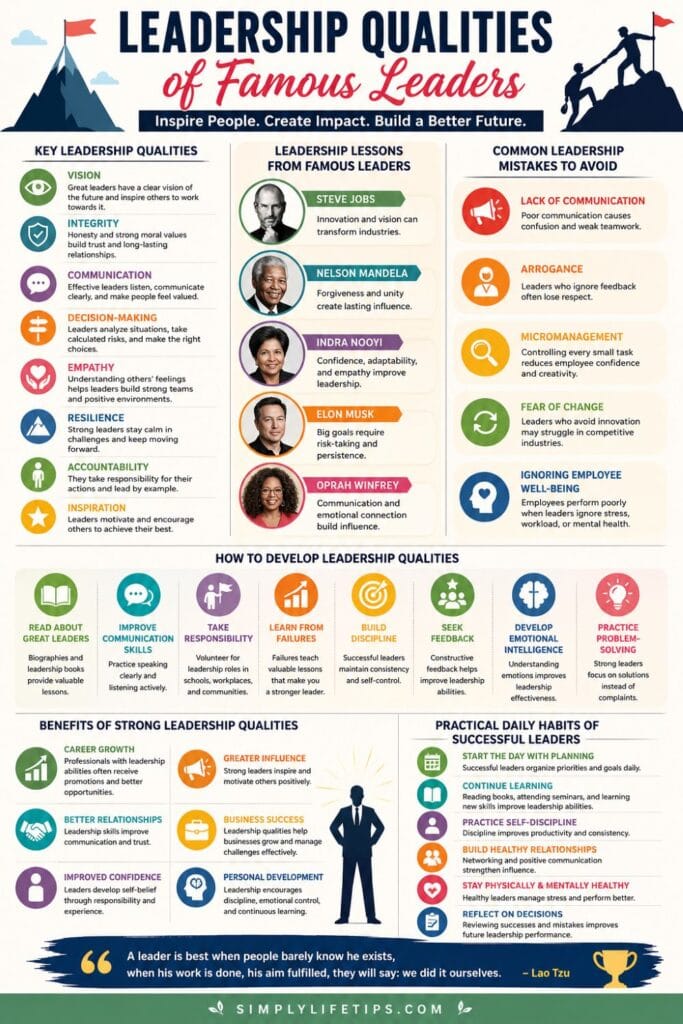
The infographic clearly shows that strong leadership is not built through authority alone. Great leaders combine emotional intelligence, discipline, communication, adaptability, and problem-solving abilities to create a positive influence. Whether you are a student, employee, entrepreneur, manager, or business owner, developing these leadership qualities can improve your confidence, career growth, relationships, teamwork, and overall success in life.
FAQs
What are the most important leadership qualities?
The most important leadership qualities include vision, communication, confidence, integrity, empathy, adaptability, emotional intelligence, and accountability.
Can leadership qualities be learned?
Yes. Leadership qualities can be developed through practice, learning, experience, communication, discipline, and self-improvement.
Why are leadership qualities important in the workplace?
Leadership qualities improve teamwork, productivity, employee satisfaction, communication, and organizational success.
Which famous leaders are known for strong leadership qualities?
Leaders such as Steve Jobs, Nelson Mandela, Indra Nooyi, Oprah Winfrey, and Elon Musk are widely respected for their leadership abilities.
How can students improve leadership skills?
Students can improve leadership skills by participating in activities, improving communication, taking responsibility, practicing teamwork, and learning from experiences.
Conclusion
Leadership qualities are essential for success in personal life, workplaces, businesses, and society. Great leaders inspire people through vision, communication, honesty, empathy, resilience, and responsibility.
Leadership is not limited to powerful positions. Anyone can become a leader by developing positive habits, improving communication, learning continuously, and helping others grow.
The examples set by famous leaders show that true leadership is not about controlling people. It is about inspiring trust, encouraging teamwork, solving problems, and creating positive change.
Strong leadership qualities can improve careers, relationships, confidence, teamwork, and long-term success. The journey to becoming a better leader starts with small daily improvements, consistent learning, and the willingness to guide others positively.
Which leadership quality do you think is the most important for success in today’s world?
If this resonated with you, share it with someone who needs it.
PVM
Harvard Business Review Leadership Articles
Forbes Leadership Strategy Insights

Mathukutty P V is a Blogger, YouTuber, and Content Writer and the founder of Simply Life Tips. After taking voluntary retirement in 2017, he embraced a free lifestyle focused on learning, personal growth, and sharing practical wisdom to help others live with more purpose and positivity.


