

Smart vocabulary words can make your English sound more confident, polished, and natural without making you sound overly formal. The best vocabulary isn’t about using difficult words—it’s about choosing the right words at the right time. Whether you’re speaking at work, studying for an exam, attending an interview, or simply chatting with friends, expanding your vocabulary helps you communicate your ideas more clearly.
In this guide, you’ll learn 10 smart vocabulary words, their meanings, example sentences, and practical tips to use them naturally in everyday conversations.
Learn ten of the most common English mistakes
Learning smart vocabulary words
Improving your vocabulary has several advantages beyond simply sounding intelligent.
- Makes your conversations more engaging.
- Helps you express ideas accurately.
- Builds confidence while speaking.
- Improves professional communication.
- Enhances writing and presentation skills.
- Makes a positive impression during interviews and meetings.
The goal isn’t to memorize hundreds of words overnight. Instead, learn a few useful words and start using them regularly.
10 Smart Vocabulary Words
Save this infographic for quick vocabulary revision. These 10 smart vocabulary words are useful for students, professionals, and anyone who wants to sound more confident in English conversations.
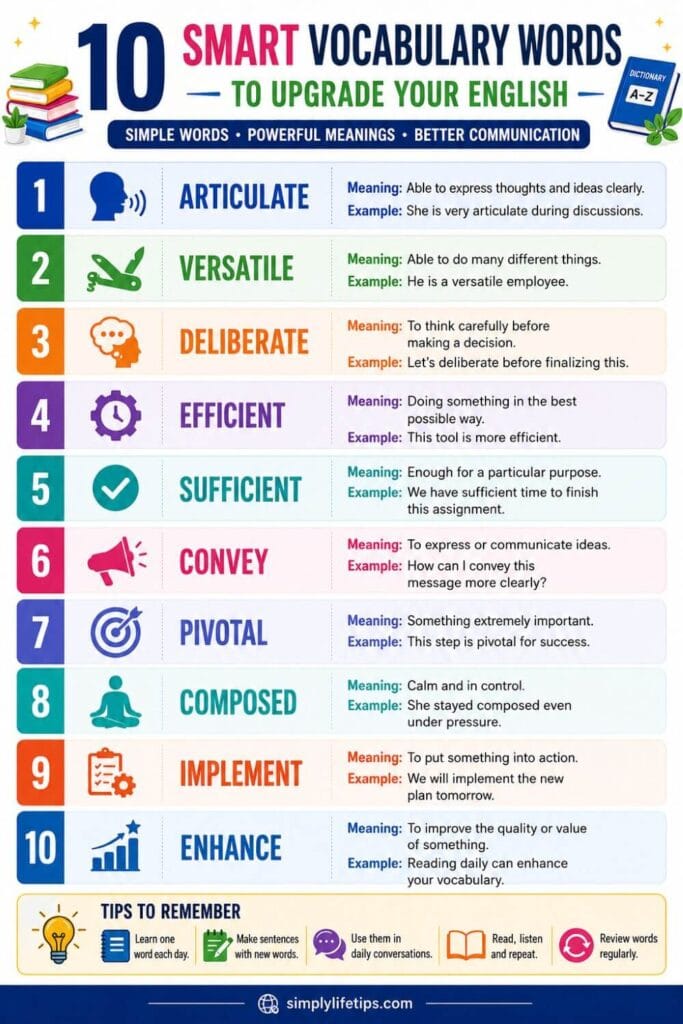
Which of these smart vocabulary words do you already use? Challenge yourself to write two original sentences using any of the words above. The more you use them in real conversations, the more naturally they’ll become part of your everyday English.
1. Articulate
Meaning: Able to express thoughts and ideas clearly and effectively.
Example
“She is very articulate during discussions.”
When to Use It?
Use this word when describing someone who explains ideas confidently and clearly.
More Examples
- The presenter was articulate throughout the meeting.
- An articulate speaker keeps the audience engaged.
- She articulately explained the project.
2. Versatile
Meaning: Able to perform many different tasks or adapt to different situations.
Example
“He is a versatile employee.”
When to Use It?
Perfect for describing people, tools, skills, or products that can be used in multiple ways.
More Examples
- A laptop is a versatile device for students.
- She’s a versatile designer who works with both print and digital media.
- Learning English makes you a more versatile communicator.
3. Deliberate
Meaning: To think carefully before making a decision.
Example
“Let’s deliberate before finalizing this.”
When to Use It?
This word is common in meetings, business discussions, and important decision-making situations.
More Examples
- The committee will deliberate before announcing the results.
- We should deliberate carefully before investing.
- Take time to deliberate instead of rushing.
4. Efficient
Meaning: Doing something in the best possible way with minimal waste of time or effort.
Example
“This tool is more efficient.”
When to Use It?
Use it when talking about systems, methods, technology, or people who work productively.
More Examples
- She developed an efficient workflow.
- Online banking is more efficient than standing in long queues.
- Time management makes you more efficient.
5. Sufficient
Meaning: Enough for a particular purpose.
Example
“We have sufficient time to finish this assignment.”
When to Use It?
Use it whenever you want to express that something is adequate.
More Examples
- There is sufficient evidence.
- We have sufficient food for everyone.
- Practice gives you sufficient confidence.
6. Convey
Meaning: To express or communicate an idea, feeling, or message.
Example
“How can I convey this message more clearly?”
When to Use It?
Useful in presentations, writing, conversations, and professional communication.
More Examples
- The teacher conveyed the lesson effectively.
- Good speakers convey confidence.
- Images can convey emotions without words.
7. Pivotal
Meaning: Extremely important or central to success.
Example
“This step is pivotal for success.”
When to Use It?
Ideal when discussing key decisions, milestones, or turning points.
More Examples
- Education plays a pivotal role in society.
- Communication is pivotal to teamwork.
- The final interview was pivotal to getting the job.
8. Composed
Meaning: Calm, confident, and in control.
Example
“She stayed composed even under pressure.”
When to Use It?
Perfect for describing someone who remains calm during stressful situations.
More Examples
- Stay composed during interviews.
- The captain remained composed throughout the emergency.
- She answered every question in a composed manner.
9. Implement
Meaning: To put a plan, strategy, or idea into action.
Example
“We will implement the new plan tomorrow.”
When to Use It?
Frequently used in business, education, project management, and leadership.
More Examples
- The company implemented new policies.
- Schools are implementing digital learning.
- We should implement these ideas immediately.
10. Enhance
Meaning: To improve the quality, value, or effectiveness of something.
Example
“Reading daily can enhance your vocabulary.”
When to Use It?
This word fits perfectly in conversations about learning, technology, health, and personal development.
More Examples
- Exercise enhances mental health.
- Good lighting enhances photographs.
- Practice enhances speaking confidence.
Tips to Remember These Smart Vocabulary Words
Learning vocabulary becomes much easier when you actively use the words instead of simply reading them.
- Learn one new word each day.
- Write three original sentences using the word.
- Speak the word in daily conversations.
- Keep a vocabulary notebook.
- Review previously learned words every week.
- Read English articles and notice these words in context.
- Watch English videos and listen to their pronunciation.
For example, instead of saying:
- “She explains things well.”
Try saying:
- “She is very articulate.”
Instead of saying:
- “This app works better.”
Say:
- “This app is more efficient.”
These small changes make your English sound smoother and more natural.
Common Mistakes to Avoid
Many learners know vocabulary but rarely use it. Avoid these common mistakes:
- Memorizing words without understanding their context.
- Using advanced words where simple words work better.
- Mispronouncing new vocabulary.
- Forgetting to practice speaking.
- Learning too many new words at once.
Focus on quality rather than quantity. Using ten words correctly is far better than memorizing one hundred words you never use.
Conclusion
Building a strong vocabulary doesn’t require difficult or uncommon words. These smart vocabulary words are practical, easy to remember, and useful in everyday English conversations. Start by learning one word each day, create your own example sentences, and use them naturally in conversations. Over time, these words will become a regular part of your vocabulary, making your English sound clearer, more confident, and more professional.
Frequently Asked Questions
What are smart vocabulary words?
Smart vocabulary words are useful words that improve your communication while still sounding natural in everyday conversations.
How can I remember new vocabulary?
Practice daily, create your own sentences, read regularly, and use new words in conversations.
How many new words should I learn each day?
Learning one to three words daily is realistic and helps with long-term retention.
Are these vocabulary words useful for interviews?
Yes. Words like articulate, composed, efficient, and versatile are commonly used during interviews and workplace communication.
How can I improve my English vocabulary faster?
Read books, watch English content, maintain a vocabulary journal, and actively use newly learned words while speaking and writing.
External Resources
You can improve your strong English vocabulary words to replace “very” without memorizing hundreds of difficult words

Mathukutty P V is a Blogger, YouTuber, and Content Writer and the founder of Simply Life Tips. After taking voluntary retirement in 2017, he embraced a free lifestyle focused on learning, personal growth, and sharing practical wisdom to help others live with more purpose and positivity.



