

Do you want to improve your strong English vocabulary words to replace “very” without memorizing hundreds of difficult words? One of the easiest ways is to stop using the word “very” before every adjective. Native English speakers often replace “very” with a single, more powerful word that sounds natural, polished, and confident.
Whether you’re preparing for interviews, improving your spoken English, writing emails, or simply trying to sound more fluent, these vocabulary upgrades can make an immediate difference.
In this guide, you’ll learn 10 powerful alternatives to common “very” expressions, complete with examples and practical tips.
Learn ten of the most common English mistakes, why they’re incorrect, and the right way to use them with practical examples.
10 English Vocabulary Words to Replace “Very”
Learning new vocabulary becomes much easier when you can see everything in one place. Save or share this infographic to quickly remember powerful alternatives to the word “very.” Reviewing it regularly will help you build stronger English vocabulary and sound more fluent in everyday conversations.
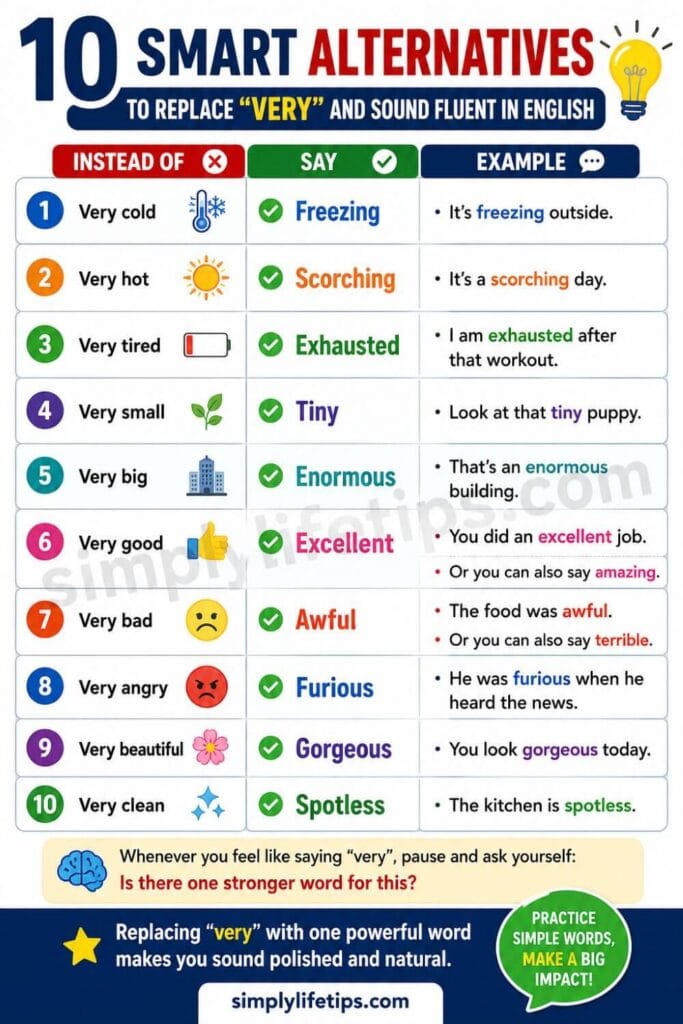
Keep practicing these powerful words until they become a natural part of your everyday speech. The next time you’re about to say “very,” challenge yourself to replace it with a stronger adjective. Small vocabulary improvements like these can make a big difference in your confidence and fluency. If you found this infographic helpful, bookmark this page and share it with other English learners.
Why You Should Avoid Using “Very”
The word very isn’t grammatically incorrect, but overusing it can make your speech and writing repetitive.
For example:
- Very cold
- Very hot
- Very tired
These expressions are understandable, but replacing them with stronger vocabulary makes your English richer and more expressive.
Benefits include:
- Sounding more fluent
- Expanding your vocabulary
- Improving writing quality
- Speaking more naturally
- Performing better in exams and interviews
10 English Words to Replace “Very”
1. Very Cold → Freezing
Instead of saying:
It’s very cold outside.
Say:
It’s freezing outside.
The word “freezing” immediately creates a clearer picture of extremely cold weather.
More examples:
- My hands are freezing.
- It’s freezing this morning.
- The water is freezing.
2. Very Hot → Scorching
Replace:
It’s very hot today.
With:
It’s a scorching day.
The word scorching describes intense heat, especially during summer.
Examples:
- The sun is scorching.
- We walked in the scorching heat.
- It was scorching all afternoon.
3. Very Tired → Exhausted
Instead of:
I’m very tired.
Say:
I’m exhausted.
This word is perfect after physical work, travel, or a long day.
Examples:
- I’m exhausted after the workout.
- She was exhausted after work.
- We felt exhausted after the hike.
4. Very Small → Tiny
Instead of:
It’s very small.
Say:
It’s tiny.
Examples:
- Look at that tiny puppy.
- They live in a tiny apartment.
- She found a tiny mistake in the report.
5. Very Big → Enormous
Replace:
That’s very big.
With:
That’s enormous.
Examples:
- That’s an enormous building.
- They bought an enormous house.
- The elephant looked enormous.
6. Very Good → Excellent
Instead of:
You did very good.
Say:
You did an excellent job.
You can also use amazing in casual conversations.
Examples:
- Your presentation was excellent.
- The service was excellent.
- You did an amazing job.
7. Very Bad → Awful
Replace:
The food was very bad.
With:
The food was awful.
Another useful alternative is terrible.
Examples:
- The weather was awful.
- It was a terrible experience.
- The movie was awful.
8. Very Angry → Furious
Instead of:
He was very angry.
Say:
He was furious.
Examples:
- She was furious after hearing the news.
- My teacher looked furious.
- He became furious during the argument.
9. Very Beautiful → Gorgeous
Instead of:
You look very beautiful.
Say:
You look gorgeous today.
Examples:
- The sunset was gorgeous.
- She wore a gorgeous dress.
- What a gorgeous view!
10. Very Clean → Spotless
Replace:
The kitchen is very clean.
With:
The kitchen is spotless.
Examples:
- The hotel room was spotless.
- His car is spotless.
- The office looks spotless.
Quick Reference – Words to Replace “Very”
| Instead of… | Say… |
|---|---|
| Very cold | Freezing |
| Very hot | Scorching |
| Very tired | Exhausted |
| Very small | Tiny |
| Very big | Enormous |
| Very good | Excellent |
| Very bad | Awful |
| Very angry | Furious |
| Very beautiful | Gorgeous |
| Very clean | Spotless |
How to Remember These Words to Replace “Very”?
Learning vocabulary becomes easier when you use the words in real-life situations.
Try these methods:
- Learn two new words each day.
- Create your own example sentences.
- Use the words while speaking with friends.
- Keep a vocabulary notebook.
- Review your new words every week.
The more frequently you use these words, the more naturally they’ll become part of your everyday English.
Common Mistakes to Avoid
Many learners continue using “very” simply because it’s familiar. Instead of memorizing long vocabulary lists, focus on replacing common phrases you already use.
For example:
❌ Very cold → ✔ Freezing
❌ Very tired → ✔ Exhausted
❌ Very beautiful → ✔ Gorgeous
Making these small changes consistently will greatly improve your spoken English.
Conclusion
Building a strong English vocabulary doesn’t require learning thousands of difficult words. Sometimes, replacing one simple word with a more powerful alternative is enough to make your English sound fluent and natural.
The next time you’re about to say “very,” pause for a moment and ask yourself:
Is there a stronger word I can use instead?
With regular practice, these vocabulary upgrades will become second nature and help you communicate with greater confidence.
FAQs – English Words to Replace “Very”
Is it wrong to use the word “very”?
No. It is grammatically correct, but stronger adjectives often sound more natural and expressive.
How can I improve my English vocabulary quickly?
Read daily, learn new words in context, practice speaking, and replace common expressions with stronger vocabulary.
Are these words suitable for IELTS and job interviews?
Yes. These words demonstrate a wider vocabulary and can improve your spoken and written English.
Should beginners learn advanced vocabulary?
Yes, but focus on practical words you can use every day rather than memorizing difficult lists.
How many new English words should I learn daily?
Learning 3 to 5 useful words each day and using them in conversation is an effective long-term strategy.

Mathukutty P V is a Blogger, YouTuber, and Content Writer and the founder of Simply Life Tips. After taking voluntary retirement in 2017, he embraced a free lifestyle focused on learning, personal growth, and sharing practical wisdom to help others live with more purpose and positivity.



