
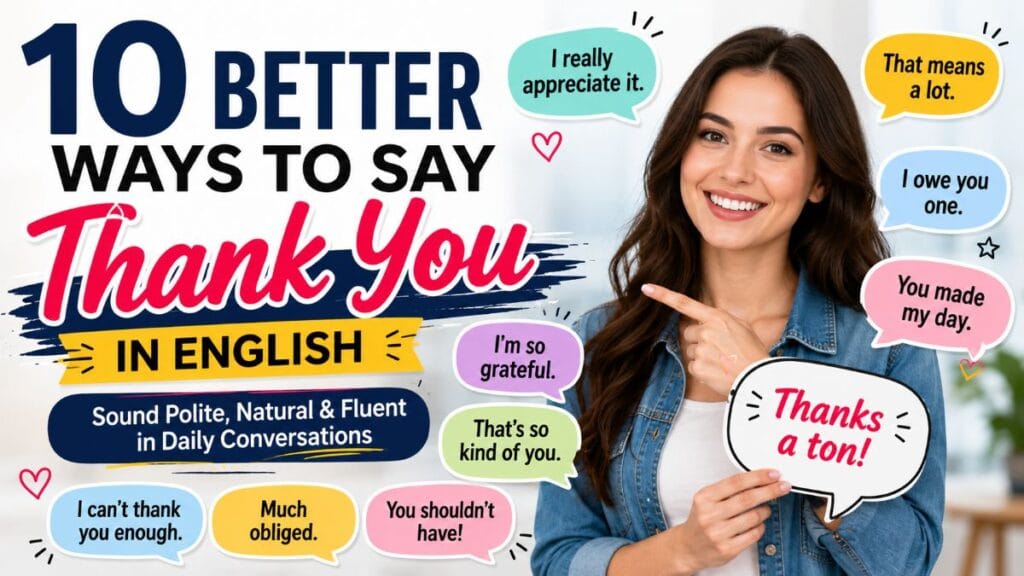
Saying better ways to say thank you is one of the easiest ways to make your English sound more natural and expressive. While “thank you” is always appropriate, native English speakers often choose different expressions depending on the situation, relationship, and emotion they want to convey.
Whether you’re talking to a friend, colleague, teacher, or customer, using the right phrase can make your appreciation sound more genuine.
Learn ten of the most common English mistakes, why they’re incorrect, and the right way to use them with practical examples.
Want to sound more natural when speaking English? In this quick lesson, you’ll discover 10 better ways to say thank you with simple examples you can use every day. These expressions will help you sound more fluent, polite, and confident in conversations at work, school, and with friends.
Why Learn Better Ways to Say Thank You?
Repeating the same phrase in every conversation can make your English sound repetitive. Expanding your vocabulary helps you:
- Sound more fluent.
- Express different levels of gratitude.
- Improve professional communication.
- Build stronger personal relationships.
- Speak more confidently in everyday situations.
The key isn’t replacing “thank you” completely—it’s choosing the expression that best matches the moment.
10 Better Ways to Say Thank You
Sometimes, a simple “thank you” isn’t enough to express exactly how you feel. The infographic below introduces 10 better ways to say thank you in English, along with when to use each expression and practical examples. Save it for quick revision and use these phrases to sound more natural, polite, and confident in your daily conversations.

Which of these expressions do you use the most? Start practicing by replacing a simple “thank you” with one of these alternatives in your next conversation. The more you use these phrases in real-life situations, the more fluent and natural your English will become. Don’t forget to bookmark this guide and share the infographic with friends, classmates, or colleagues who are learning English.
1. I Really Appreciate It
This phrase expresses sincere gratitude and works well in both personal and professional situations.
Example:
You stayed late to help me. I really appreciate it.
Best used when:
- Someone helps you with a task.
- A colleague supports your work.
- A friend does you a favor.
It sounds warm without being overly emotional.
2. That Means a Lot
Use this when someone’s kindness has an emotional impact on you.
Example:
Your support means a lot to me.
This phrase is perfect when someone encourages you during a difficult time or celebrates your success.
Common situations:
- Receiving encouragement.
- Emotional support.
- Thoughtful gestures.
3. I Owe You One
This casual expression means you’ll return the favor someday.
Example:
You saved my day. I owe you one.
Friends and coworkers often use this after receiving unexpected help.
Best for:
- Casual conversations.
- Friendly relationships.
- Small favors.
Avoid using it in very formal business communication.
4. You Made My Day
Use this when someone’s words or actions make you genuinely happy.
Example:
That compliment just made my day.
This phrase is especially common after receiving:
- A compliment.
- Good news.
- A thoughtful surprise.
- Encouraging feedback.
It shows that the person’s action had a positive emotional effect.
5. Thanks a Ton
A friendly, enthusiastic way to express gratitude.
Example:
Thanks a ton for helping me with my presentation.
Although “ton” isn’t literal, it emphasizes that you’re extremely thankful.
Perfect for:
- Friends.
- Classmates.
- Team members.
- Informal workplace conversations.
6. I’m So Grateful
This phrase expresses deep appreciation and sounds heartfelt.
Example:
I’m so grateful for your guidance.
Use it when someone has invested time, knowledge, or support in helping you grow.
Examples include:
- Teachers.
- Mentors.
- Parents.
- Managers.
- Coaches.
7. That’s So Kind of You
A polite way to acknowledge someone’s thoughtful action.
Example:
You got me coffee. That’s so kind of you.
This phrase focuses on the person’s kindness rather than the favor itself.
You can use it when someone:
- Gives you a gift.
- Holds the door open.
- Helps without being asked.
- Offers assistance.
8. I Can’t Thank You Enough
Use this when ordinary thanks don’t feel sufficient.
Example:
You’ve done so much. I can’t thank you enough.
This expression shows deep gratitude for significant help or support.
It’s suitable for:
- Medical staff.
- Family members.
- Close friends.
- Life-changing assistance.
9. Much Obliged
A formal and slightly old-fashioned expression that’s still appreciated in certain settings.
Example:
Much obliged for your assistance.
You’ll mostly hear this in:
- Formal conversations.
- Traditional business settings.
- Historical dramas.
- Polite written communication.
It adds a touch of elegance when used appropriately.
10. You Shouldn’t Have
This isn’t a literal criticism. Instead, it’s a polite response when someone surprises you with a thoughtful gift or gesture.
Example:
Oh, you shouldn’t have!
It actually means:
“That was so thoughtful of you.”
Common situations include:
- Birthday gifts.
- Surprise presents.
- Unexpected treats.
- Special favors.
How to Choose the Right Thank You Expression?
Different situations call for different expressions of gratitude.
| Situation | Best Expression |
|---|---|
| Friend helps you | Thanks a ton |
| Teacher guides you | I’m so grateful |
| Emotional support | That means a lot |
| Big favor | I can’t thank you enough |
| Small favor | I really appreciate it |
| Unexpected gift | You shouldn’t have |
| A casual promise to return a favor | I owe you one |
| Someone brightens your day | You made my day |
| Formal workplace | Much obliged |
| Everyday appreciation | That’s so kind of you |
Common Mistakes to Avoid
Using “I Owe You One” in Formal Emails
This expression is informal. In professional emails, choose:
- I really appreciate your help.
- Thank you for your assistance.
- I’m grateful for your support.
Saying “You Shouldn’t Have” Literally
Remember, this phrase is positive.
It doesn’t mean the gift wasn’t wanted. It politely expresses surprise and appreciation.
Overusing One Expression
Mix your vocabulary naturally. Using different expressions makes your English sound more fluent and authentic.
Practice Challenge
Choose one of these expressions and use it in a sentence today.
For example:
- I really appreciate your advice.
- Thanks a ton for your help.
- That means a lot to me.
- You made my day!
The more you practice these expressions in real conversations, the more naturally they’ll become part of your everyday English.
Conclusion
Learning better ways to say thank you helps you communicate with more confidence, warmth, and fluency. Instead of relying on the same phrase every time, you can match your words to the situation and express genuine appreciation.
Whether you’re speaking with friends, family, teachers, or colleagues, these simple alternatives will make your English sound more natural and engaging. Start using one new phrase each day, and before long, expressing gratitude will feel effortless.
Challenge: Comment below using one of these thank-you alternatives in your own sentence!
Improve your strong English vocabulary words to replace “very” without memorizing hundreds of difficult words
FAQs – Better ways to say thank you
Is it okay to always say “thank you”?
Yes. “Thank you” is always polite. However, using different expressions makes your English sound more natural and expressive.
Which thank-you alternative is best for work?
“I really appreciate it” and “I’m so grateful” are excellent choices for professional conversations.
Is “Thanks a ton” formal?
No. It’s casual and best used with friends, classmates, and coworkers in informal settings.
What does “You shouldn’t have” actually mean?
It is a polite way of thanking someone for an unexpected gift or thoughtful gesture.
How can I remember these expressions?
Practice one phrase each day by using it in conversations, messages, or even while speaking to yourself.
External Resources

Mathukutty P V is a Blogger, YouTuber, and Content Writer and the founder of Simply Life Tips. After taking voluntary retirement in 2017, he embraced a free lifestyle focused on learning, personal growth, and sharing practical wisdom to help others live with more purpose and positivity.



