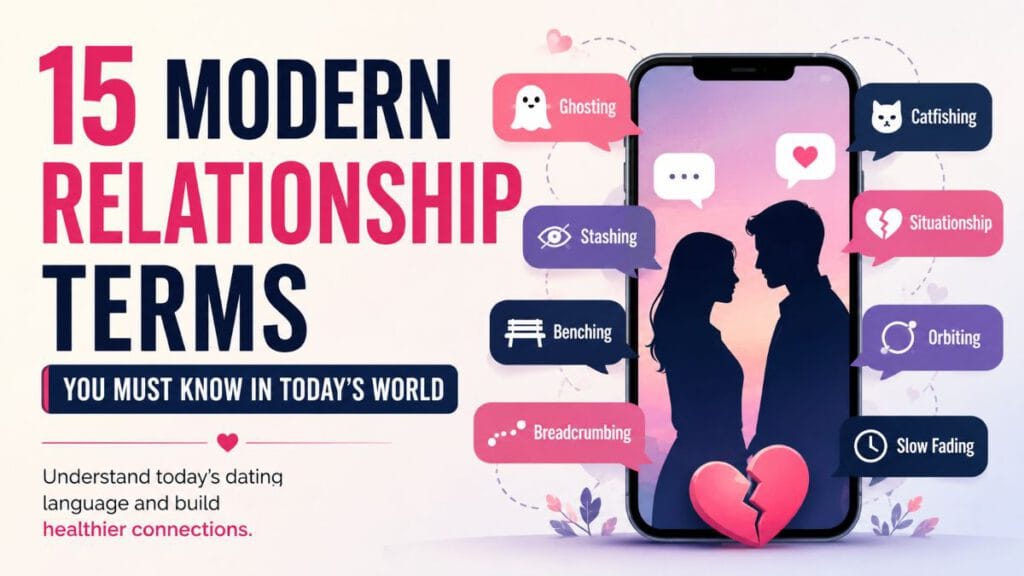
Modern relationship terms help us understand how dating and relationships are changing in today’s digital world. From ghosting and catfishing to breadcrumbing and situationships, these terms describe behaviours and relationship patterns that can sometimes be difficult to recognise.
Whether you are dating, navigating a new relationship, or simply trying to understand today’s relationship language, knowing these terms can help you recognise red flags, set healthy boundaries, and communicate more clearly. This guide explains 15 modern relationship terms through simple definitions, examples, signs, and practical explanations.
15 Modern Relationship Terms
In today’s fast-paced digital world, relationships are no longer limited to traditional dating patterns. Social media, dating apps, and instant messaging have introduced new ways people connect, flirt, and sometimes hurt each other. Understanding modern relationship terms such as catfishing, ghosting, breadcrumbing, and orbiting can help you recognise unhealthy behaviours, communicate your expectations clearly, and protect your emotional well-being.
1. Catfishing
Catfishing is one of the most widely discussed modern relationship terms, describing a deceptive online behaviour where a person pretends to be someone else to attract, manipulate, or emotionally control another person. The “catfish” creates a fake profile using someone else’s pictures, fabricated details, and often a false background story. This is common on dating apps and social media platforms where people seek relationships or emotional connections.
How It Happens:
Catfishing is one of the most widely discussed modern relationship terms, describing a deceptive online behaviour where a person pretends to be someone else to attract, manipulate, or emotionally control another person. A catfisher creates a fake profile using someone else’s pictures, fabricated details, and often a false background story. This is common on dating apps and social media platforms where people seek relationships or emotional connections.
Example:
Imagine Anu meets “Ravi,” a charming engineer from Bangalore, on Instagram. They talk daily, share personal stories, and even plan to meet. But every time Anu suggests a video call or meeting, Ravi finds excuses. After months, she discovers “Ravi” doesn’t exist — the profile used pictures of a model from another country. This is classic catfishing.
Why People Catfish:
People catfish for several reasons — to hide their insecurities, escape reality, seek attention, or sometimes for financial scams. In emotional cases, the catfisher might crave love but fear rejection if they reveal their true identity.
Impact of Catfishing:
Catfishing can cause emotional distress, damage trust, and sometimes lead to financial or other forms of harm.
How to Protect Yourself:
- Avoid sharing personal details too soon.
- Do a reverse image search of profile photos.
- Prefer video calls before building emotional attachment.
- Watch for excuses about meeting in person.
Catfishing reminds us that online relationships require caution. Trust should be earned through honesty, transparency, and real connection — not digital illusions.
2. Ghosting
Ghosting is a popular modern relationship term that describes suddenly ending communication with someone without explanation. The person may stop responding to calls, messages, or other attempts to communicate, leaving the other person unsure about what happened. Ghosting can occur in online dating, friendships, and even professional relationships, but it can be especially painful in romantic relationships.
How Ghosting Happens:
A person may seem interested, spend time chatting, go on dates, and share emotional moments — but then suddenly vanish. The other person is left wondering what went wrong, often replaying past conversations to find clues. This emotional confusion can be extremely hurtful, especially when things appeared to be going well.
Example:
Neha and Arjun met on a dating app and talked every day for three months. They went out a few times, laughed a lot, and seemed genuinely happy together. Then, one day, Arjun stopped responding. No texts, no calls, nothing. Neha checked to see if something had happened, but Arjun had blocked her on all platforms. He had completely ghosted her.
Why People Ghost:
- Avoiding confrontation: Some people fear emotional discussions or breaking up directly.
- Loss of interest: They simply lose attraction but don’t want to explain.
- Emotional immaturity: They don’t know how to handle uncomfortable emotions.
- Multiple options: In online dating, some people may move on to someone new without explaining their decision.
Effects of Ghosting:
Ghosting can leave the person who has been ghosted feeling rejected, confused, and emotionally drained.It creates self-doubt and anxiety because the person never receives closure. Over time, it can affect one’s confidence and trust in future relationships.
How to Handle Ghosting:
- Accept reality: Understand that the silence itself is your answer.
- Don’t chase: Avoid repeatedly messaging or calling the person.
- Reflect, don’t blame yourself: Ghosting says more about them than you.
- Focus on healing: Spend time with supportive friends and do things you enjoy.
Ghosting can be a painful experience, particularly when someone has invested emotionally in a relationship. In many situations, a respectful goodbye or honest explanation is better than disappearing without a word.
Fake Relationship: How to Identify, Understand, and Overcome It
3. Stashing
Stashing is a modern relationship term describing a situation where one partner keeps the other separate from important parts of their life, such as friends, family, or social circles. The relationship may feel meaningful in private, but the lack of acknowledgement or inclusion can leave the other person wondering about their place in the relationship.
What Happens in Stashing:
In a stashing relationship, everything seems fine when you’re together — fun dates, late-night talks, affection, and plans. But when it comes to social visibility, your partner avoids showing any signs of the relationship. They never post pictures with you, tag you online, or invite you to social gatherings. You slowly realise you’re invisible in their world outside of your private moments together.
Example:
Sneha has been dating Rohan for over six months. They go out frequently, spend weekends together, and even talk about the future. But Sneha has never met Rohan’s friends or family. He avoids posting any pictures of them together and changes the topic whenever she brings it up. Sneha starts to wonder — is he serious about her, or is he just stashing her away from his real life?
Why People Stash:
- Fear of commitment: They enjoy the relationship but don’t want long-term responsibility.
- Image management: Some people hide their partner because they think the person doesn’t “fit” their social image or lifestyle.
- Multiple relationships: In some cases, the person might already be seeing someone else.
- Privacy excuse: Some people genuinely prefer to keep relationships private, while others may use privacy as a reason to avoid acknowledging the relationship.
Signs You’re Being Stashed:
- You’ve never met their friends or family.
- They avoid public appearances with you.
- They don’t mention you on social media.
- They change the topic when you ask to meet their circle.
- Your relationship feels like a secret.
How to Deal with Stashing:
- Communicate openly: Ask why they’re hesitant to include you in their personal life.
- Set boundaries: Make it clear that you deserve recognition and respect.
- Observe actions, not excuses: If nothing changes after discussing it, reconsider the relationship.
- Value yourself: Consider whether being kept hidden is consistent with the kind of openness and respect you expect in a relationship.
Stashing can be emotionally draining because it questions your worth in the relationship. A healthy relationship is one where both partners proudly acknowledge each other’s presence — both privately and publicly. Stashing can be emotionally difficult when one partner consistently feels excluded from the other’s life. An open conversation about expectations, privacy, and the level of commitment can help clarify whether both partners want the same kind of relationship.
4. Micro-Cheating
Micro-cheating is a modern relationship term used to describe behaviours that may suggest romantic or emotional interest in someone outside a committed relationship. These behaviours may not involve physical intimacy, but they can create concerns about trust, secrecy, and relationship boundaries. What one couple considers harmless may feel inappropriate to another, so clear communication about boundaries is important.
What Happens in Micro-Cheating:
Micro-cheating can take different forms, such as maintaining secret flirtatious conversations, hiding interactions with another person, or seeking romantic attention outside the relationship. The key concerns are often secrecy, emotional investment, and whether the behaviour violates boundaries that the couple has agreed upon.
Example:
Arjun is in a committed relationship with Priya. However, he constantly messages his colleague, compliments her looks, and hides those chats from Priya. He claims it’s “just friendly”. The secrecy and flirtatious nature of his interactions could be considered micro-cheating, depending on the boundaries Priya and Arjun have established in their relationship.
Common Examples of Micro-Cheating:
- Flirting with others on social media.
- Deleting messages or hiding conversations from your partner.
- Comparing your partner to someone else.
- Staying emotionally connected with an ex.
Why Does Micro-Cheating Happen?
- Emotional boredom: They seek excitement outside the relationship.
- Insecurity: They crave validation and attention from others.
- Lack of boundaries: They don’t recognise what behaviour crosses the line.
- Temptation and opportunity: Social media makes flirting easier and more private.
Effects of Micro-Cheating:
Even though the behaviour may seem minor, micro-cheating can damage trust and create emotional strain in a relationship. The betrayed partner often feels hurt, insecure, and disrespected. If these behaviours continue without discussion, they can contribute to mistrust, conflict, and emotional distance.
How to Avoid Micro-Cheating:
- Communicate boundaries: Clearly define what behaviour is acceptable and what’s not.
- Be transparent: Avoid hiding chats, calls, or interactions with others.
- Focus on your partner: Give attention, appreciation, and emotional energy to your relationship.
- Reflect on motives: Ask yourself why you seek attention elsewhere.
Micro-cheating can be a sign that a couple needs to discuss boundaries, trust, communication, or unmet emotional needs. Rather than assuming that every questionable interaction has the same meaning, partners can talk openly about what they consider appropriate and respectful behaviour.
Teenage Love: Navigating Young Romance With Insight And Empathy
5. Benching
Benching is a modern relationship term describing a dating situation where someone keeps another person interested without offering clear commitment or moving the relationship forward. The term comes from sports, where a player waits on the bench for an opportunity to play. In dating, it describes a similar pattern in which someone remains an option while the other person explores other possibilities.
What Happens in Benching:
In benching, the person you’re interested in gives you just enough attention to keep you emotionally invested but never fully commits. They might flirt, message occasionally, or go on casual dates. This creates hope in the other person while keeping them waiting indefinitely.
Example:
Meera has been dating Kiran for a few months. He texts her often, takes her out occasionally, and shares sweet messages. However, whenever she brings up exclusivity or plans, he makes excuses. Meanwhile, Kiran is actively talking to other people. Meera begins to realise that she may be being benched.
Signs You’re Being Benched:
- Communication is inconsistent: high interest one day, distant the next.
- Plans are vague or never discussed.
- They show interest only when convenient for them.
- You feel like a backup rather than a priority.
- They keep you emotionally engaged but avoid commitment.
Why People Bench Others:
- Fear of commitment: They like attention but are not ready for a serious relationship.
- Multiple options: They may keep several dating possibilities open while exploring other potential partners.
- Validation-seeking: They want the feeling of being desired without effort.
- Emotional convenience: Benching allows them emotional support without responsibility.
Effects of Benching:
Being benched can be emotionally exhausting. It leads to confusion, self-doubt, and prolonged uncertainty. The person on the bench often feels stuck in limbo, questioning their worth and the sincerity of the other person’s feelings.
How to Handle Benching:
- Recognise the pattern: Identify the signs early rather than hoping they’ll change.
- Set boundaries: Communicate your expectations and avoid being strung along.
- Prioritise self-respect: Don’t settle for a half-relationship that drains you emotionally.
- Move on if necessary: If the person is unwilling to commit, it’s healthier to step away.
Benching highlights a modern dating pattern in which unclear communication and inconsistent attention can leave someone waiting for commitment. Understanding the term can help you recognise when a dating situation is not meeting your needs and encourage you to communicate your expectations clearly.
6. Breadcrumbing
Breadcrumbing is a widely used modern relationship term that describes giving someone occasional attention or flirtation that keeps them interested without developing a clear or meaningful relationship. The term comes from the idea of leaving “breadcrumbs” — small signs that suggest a connection but may not lead anywhere. Breadcrumbing can occur in online dating and social media interactions, where occasional messages or reactions can maintain someone’s interest without much personal investment.
What Happens in Breadcrumbing:
A person who breadcrumbs may send sporadic texts, likes, or comments that make the other person feel noticed and wanted, while avoiding serious conversations, concrete dates, or commitment. The inconsistent attention can leave the other person uncertain about whether the relationship is actually developing.
Example:
Raj receives sweet messages from Nisha almost every week, like “I miss you” or “We should meet sometime,” but she never actually follows through on plans. Raj starts to realise she’s breadcrumbing him — giving him just enough attention to stay interested without committing.
Signs You’re Being Breadcrumbed:
- They send occasional flirty messages but rarely meet in person.
- They avoid making concrete plans.
- Conversations feel one-sided — you’re investing more than they.
- Their attention spikes only when convenient for them.
- You’re left feeling confused about where the relationship is headed.
Why Do People Breadcrumb?
- Boosting ego: They enjoy the attention and admiration without responsibility.
- Keeping options open: Breadcrumbing allows them to maintain interest while exploring other relationships.
- Avoiding rejection: They may want to keep someone interested without committing, fearing confrontation.
- Entertainment or validation: Some people may enjoy the attention or the feeling of being desired without wanting a committed relationship.
Effects of Breadcrumbing:
Breadcrumbing can be emotionally draining. The person being breadcrumbed often experiences confusion, anxiety, and disappointment. It creates false hope and prolongs emotional attachment to someone who may never be genuinely invested.
How to Deal with Breadcrumbing:
- Recognise it early: Notice patterns of inconsistent attention and lack of follow-through.
- Set clear expectations: Communicate your desire for commitment or clarity.
- Protect your emotions: Avoid getting emotionally invested in someone who won’t reciprocate fully.
- Move on if needed: Let go of relationships that don’t respect your time or feelings.
Breadcrumbing can create uncertainty and prolong emotional attachment when attention is inconsistent and there is little follow-through. Recognising the pattern can help you set clearer boundaries, communicate what you want, and decide whether the relationship is meeting your needs.
7. Situationship
A situationship is a common modern relationship term describing a romantic or sexual connection that does not have a clearly defined label, commitment, or boundaries. Unlike a traditional relationship, a situationship often exists in a grey area where two people may spend time together, share intimacy, and behave like a couple without clearly defining what they are or where the connection is heading.
What Happens in a Situationship:
In a situationship, both individuals may enjoy each other’s company and engage in activities typical of a relationship, such as going on dates, texting daily, or sharing personal details. However, when questions about exclusivity, long-term plans, or commitment arise, the answers are vague or non-existent. This ambiguity can lead to confusion and emotional stress for at least one person involved.
Example:
Maya and Dev have been seeing each other for months. They go on weekend trips, share meals, and even meet each other’s friends casually. Yet, when Maya asks if they are officially together or what their future looks like, Dev responds with “It’s complicated” or “Let’s just see where things go.” They are in a situationship — enjoying intimacy without commitment.
Signs You’re in a Situationship:
- No clear title or label for the relationship.
- Limited discussion about the future.
- Inconsistent communication and plans.
- Emotional investment is one-sided or unequal.
- You feel uncertain about where you stand.
Why Situationships Happen:
- Fear of commitment: One or both people are not ready for a full relationship.
- Convenience: It provides companionship and intimacy without responsibility.
- Exploration: Some prefer a low-pressure setup to test compatibility before committing.
- Avoiding confrontation: It allows people to enjoy intimacy without having difficult conversations.
Effects of Situationships:
Situationships can be emotionally confusing and sometimes painful. One person may hope for commitment while the other remains non-committal, leading to disappointment or frustration. They can also make it harder for either person to pursue other relationships when the situation remains unclear or emotionally demanding.
How to Navigate a Situationship:
- Communicate clearly: Express your expectations and ask for clarity.
- Observe actions over words: Pay attention to consistent behaviour rather than vague promises.
- Set boundaries: Protect your emotional well-being if the other person is not ready to commit.
- Decide your next step: Choose whether to continue, redefine, or exit the connection based on your needs.
Situationships are increasingly discussed in modern dating culture. While they can offer companionship and enjoyment for some people, unclear expectations can create uncertainty and emotional stress. Understanding the dynamics can help both people communicate their expectations and decide whether the connection meets their needs.
8. Slow Fade
Slow fade is a modern relationship term describing the gradual reduction of communication, attention, and emotional availability until a relationship or connection quietly comes to an end. Unlike ghosting, where communication stops abruptly, a slow fade happens gradually over time and can be harder to recognise.
What Happens in a Slow Fade:
A person begins by responding less frequently to messages, cancelling plans more often, and showing decreasing interest in conversations. Over time, the emotional intimacy diminishes, and the relationship loses momentum until it effectively ends. The other person may feel confused and wonder if something went wrong.
Example:
Rohit and Anika have been dating for several months. Initially, they text every day and spend time together regularly. Gradually, Rohit’s responses become shorter, he cancels dates often, and stops initiating conversations. Eventually, their interactions almost stop entirely, and Anika realises that Rohit has slowly faded out of her life.
Signs of a Slow Fade:
- Replies become shorter and less frequent.
- Plans are repeatedly postponed or cancelled.
- Emotional sharing and intimacy decline.
- The effort from one side feels one-sided.
- You sense growing distance without a formal breakup.
Why Does the Slow Fade Happen?
- Avoiding confrontation: They may dislike awkward breakups or difficult conversations.
- Loss of interest: They are no longer invested but avoid hurting feelings directly.
- Avoiding difficult conversations: It may feel easier to gradually reduce contact than to have a direct conversation about ending the relationship.
- Testing reactions: Some people may reduce contact to see how the other person responds or whether they will make an effort to reconnect.
Effects of a Slow Fade:
The slow fade can be confusing and emotionally painful because there’s no closure. The person being faded may blame themselves, overthink, or feel anxiety and sadness over the unclear status of the relationship.
How to Handle a Slow Fade:
- Communicate openly: Ask directly about changes in behaviour or feelings.
- Observe patterns: Notice if the distance is temporary or a consistent trend.
- Set boundaries: Decide how much effort you’re willing to invest without reciprocity.
- Focus on self-care: Protect your emotional health and consider moving on if the fade continues.
A slow fade can leave someone dealing with uncertainty for longer than a direct conversation would. Recognising a consistent pattern of declining communication can help you ask for clarity, establish boundaries, and decide when it is healthier to move forward.
9. Open Relationship
An open relationship is a modern relationship term describing a consensual relationship in which both partners agree that they may have romantic or sexual connections with other people. Unlike infidelity, which involves breaking agreed relationship boundaries, an open relationship is based on mutual consent, honesty, communication, and clearly understood boundaries.
What Happens in an Open Relationship:
In an open relationship, both partners maintain their primary bond but allow themselves to explore romantic or sexual experiences with others. Rules and boundaries are often established to protect the emotional health of both individuals. These agreements may include limits on sexual activity, emotional involvement, or frequency of outside connections.
Example:
Meera and Ajay are in a committed relationship, but agree to explore other sexual experiences independently. They have regular discussions about boundaries, safe practices, and emotional limits. While they may date or see other people, their primary connection remains strong and based on trust. This is a classic example of an open relationship.
Key Features of an Open Relationship:
- Both partners openly discuss seeing other people.
- There is mutual consent and transparency.
- Clear boundaries and rules exist to prevent misunderstandings.
Why People Choose Open Relationships:
- Freedom and exploration: They enjoy intimacy and variety without abandoning the primary connection.
- Personal growth: Open relationships can encourage self-awareness and understanding of desires.
- Avoiding conventional constraints: Some prefer non-traditional structures that fit modern lifestyles.
- Trust-building: Properly managed, open relationships require and reinforce strong communication skills.
Effects of Open Relationships:
Open relationships may work well for some couples, but they require mutual consent, honesty, clear boundaries, and ongoing communication. Jealousy, misunderstandings, or emotional difficulties can arise when expectations are unclear or agreements are not respected. The experience can differ considerably from one couple to another.
How to Make an Open Relationship Work:
- Communicate constantly: Discuss feelings, boundaries, and concerns regularly.
- Set clear rules: Decide what is acceptable regarding intimacy, time, and emotional involvement.
- Prioritise the primary relationship: Ensure the core bond remains strong.
- Practice honesty and respect: Both partners must be truthful and considerate of each other’s feelings.
Open relationships show that couples may choose different ways to structure commitment and intimacy. Whatever relationship structure people choose, mutual consent, honesty, respect, communication, and clearly understood boundaries remain important.
10. Sexting
Sexting is a modern relationship term that refers to sending sexually suggestive or explicit messages or media through digital communication platforms. It can be part of communication between consenting adults, including couples in long-distance relationships. Because digital content can be copied or shared, sexting requires mutual consent, trust, and careful attention to privacy.
What Happens in Sexting:
Sexting can include playful messages, flirtatious texts, suggestive emojis, or sharing intimate photos and videos. It can be used to maintain closeness or express intimacy when partners are apart. However, sexting without mutual consent or with the intent to manipulate can cause harm.
Example:
A couple in a long-distance relationship, Priya and Sameer, use consensual digital messages to maintain intimacy while they are apart. They have discussed their boundaries and are comfortable with their communication. This illustrates how sexting can be part of consensual communication between adults.
Signs Sexting Is Healthy:
- Both partners give enthusiastic consent.
- Communication is respectful and private.
- It strengthens intimacy rather than causing stress.
- Boundaries are discussed and respected.
Why People Sext:
- Maintaining intimacy: Long-distance couples often use sexting to feel connected.
- Flirtation and fun: Sexting can add excitement and playfulness to a relationship.
- Exploring sexuality: Partners may use it to express desires safely.
- Building anticipation: Sexting can create emotional and sexual anticipation before meeting in person.
Risks of Sexting:
- Privacy concerns: Photos or messages can be shared without consent.
- Emotional consequences: Misinterpretations or pressure can cause stress.
- Legal issues: Sharing explicit content without consent may have legal repercussions.
- Trust issues: Sexting with someone outside a committed relationship may violate the relationship’s agreed boundaries.
How to Sext Safely:
- Always obtain consent before sending explicit content.
- Avoid including identifiable information in photos or videos.
- Use privacy-conscious apps and devices, and understand that no digital platform can guarantee complete privacy.
- Discuss boundaries and comfort levels with your partner.
Sexting reflects the role digital communication can play in modern relationships. When it involves consenting adults and clear boundaries, it can be one way partners maintain intimacy and connection. Respect for consent, privacy, and personal boundaries should always come first.
11. Sapiosexual
Sapiosexual is a modern relationship term used by some people to describe strong attraction to intelligence or intellectual qualities. For someone who identifies as sapiosexual, engaging conversations, curiosity, wit, or the way another person thinks may play an important role in attraction. The term is used in contemporary dating culture to describe a preference for intellectual connection.
What Happens in Sapiosexual Attraction:
Someone who identifies as sapiosexual may feel particularly attracted to people who stimulate them intellectually. Conversations, debates, knowledge, and insight often trigger attraction more than physical intimacy. In dating, sapiosexuals seek partners who challenge their minds, share meaningful ideas, and inspire thought-provoking discussions.
Example:
Riya meets Arjun at a book club. She becomes especially attracted to his knowledge, insightful opinions, and ability to discuss complex topics. His intelligence and intellectual curiosity play an important role in her attraction to him.
Signs Someone is Sapiosexual:
- They prioritise deep conversations over physical attraction initially.
- They are drawn to intelligence, creativity, or curiosity in a partner.
- They enjoy debating, learning, and discussing ideas.
- Intellectual stimulation often sparks romantic or sexual interest.
Why People Identify as Sapiosexual:
- Value mental connection: They seek meaningful interactions rather than surface-level chemistry.
- Preference for intellectual compatibility: Shared interests, curiosity, and stimulating conversations may be important aspects of compatibility for some people.
- Curiosity-driven attraction: Stimulating minds can be more exciting than physical appearances.
- Emotional depth: Some people may value the empathy, thoughtfulness, and insight they experience through meaningful intellectual connection.
Sapiosexuality in Modern Dating:
For people who place a strong value on intellectual attraction, dating may feel more rewarding when conversations are stimulating and there is genuine curiosity about ideas. However, intellectual compatibility is only one aspect of a relationship, and emotional, physical, and practical compatibility may also matter.
How to Navigate Sapiosexual Attraction:
- Engage in environments that promote learning, like workshops, classes, or discussion groups.
- Seek partners who value intellectual curiosity and personal growth.
- Communicate openly about your priorities in attraction and connection.
- Balance intellectual attraction with other aspects, like emotional and physical compatibility.
Sapiosexuality highlights the role that intelligence, curiosity, and meaningful conversation can play in attraction. For some people, intellectual connection is an important part of romantic compatibility, alongside emotional connection, shared values, physical attraction, and other qualities.
12. Kittenfishing
Kittenfishing is a modern relationship term that describes a mild form of online misrepresentation, usually in dating profiles. A person may use outdated or carefully selected photos, exaggerate personal details, or present an idealised version of themselves to appear more attractive. Unlike catfishing, kittenfishing generally does not involve creating a completely false identity.
What Happens in Kittenfishing:
A person kittenfishes by presenting themselves in a way that’s more polished or idealised than reality. This could include using outdated or heavily edited photos, overstating accomplishments, or omitting less attractive traits. It’s often done in online dating profiles to increase the chances of matching or getting attention.
Example:
Rahul lists himself as 30 years old on his dating profile, while he’s actually 33. He posts pictures from three years ago when he looked slimmer and more stylish. Rather than creating a completely false identity, Rahul is presenting an outdated and more idealised version of himself to appear more attractive. This could be considered kittenfishing.
Signs of Kittenfishing:
- Photos are outdated or heavily edited.
- Personal details are slightly exaggerated or vague.
- They avoid video calls or in-person meetings initially.
- Their profile presents an “idealised” version of themselves rather than reality.
Why Do People Kittenfish?
- Boost confidence: They may want to feel more attractive or desirable.
- Increase attention: Online dating is competitive, and small exaggerations can help them stand out.
- Fear of rejection: They may think the real version of themselves isn’t “good enough.”
- Social pressure: Society often emphasises looks, status, and achievements, prompting minor misrepresentations.
Effects of Kittenfishing:
Although kittenfishing may involve relatively small exaggerations, it can still create unrealistic expectations and disappointment when people meet in person. It may also affect trust if the other person feels misled, even if the exaggerations were minor.
How to Handle Kittenfishing:
- Verify profiles through video calls or social media connections.
- Take time to observe consistency between what they say and what you see.
- Communicate openly about honesty and expectations.
- Focus on genuine connection rather than perfection in profiles.
Kittenfishing reflects the challenge of presenting yourself online while remaining authentic. Recognising outdated photos, exaggerated details, and inconsistencies can help people approach online dating with realistic expectations and make more informed decisions about whom they trust.
13. Texationship
A texationship is a modern relationship term describing a connection that develops and is maintained primarily through texting or other forms of digital communication. Two people may text regularly, flirt, share personal thoughts, and develop an emotional connection while having limited in-person interaction. Texationships have become more noticeable as smartphones, messaging apps, and online dating have changed how people connect.
What Happens in a Texationship:
In a texationship, most interaction happens through text messages, social media chats, or messaging apps. The people involved may share daily updates, jokes, personal experiences, or affectionate messages while meeting rarely or not at all. The connection can feel meaningful, but its nature may remain unclear if the two people have little experience together outside the digital space.
Example:
Anita and Sameer talk every day via WhatsApp, sharing memes, flirty comments, and personal thoughts. They text late into the night but have only met once in person. Their relationship exists almost entirely in their phones, making it a classic texationship.
Signs You’re in a Texationship:
- Most interactions occur via text or online platforms.
- There are few or no in-person meetings.
- Emotional intimacy feels limited or one-sided.
- Plans for real-life connection are vague or nonexistent.
- You feel connected digitally but unsure about the actual relationship.
Why Texationships Happen:
- Convenience: Texting is easy and accessible, especially for busy individuals.
- Fear of commitment: For some people, keeping the connection digital may feel safer or less demanding than developing an in-person relationship.
- Long-distance connections: Some rely on texationships to maintain a bond without travel.
- Emotional experimentation: People explore feelings and compatibility without real-world consequences.
Effects of Texationships:
Texationships can be enjoyable and emotionally meaningful, but problems may arise when the two people have different expectations about the connection. Limited in-person interaction can sometimes make it difficult to understand compatibility, intentions, or the future of the relationship.
How to Navigate a Texationship:
- Clarify expectations: Discuss whether both partners want more than digital interaction.
- Plan real-life meetings: Avoid letting the connection remain purely virtual.
- Set boundaries: Decide how much texting or digital attention is healthy.
- Evaluate emotional investment: Ensure that your time and feelings are respected.
Texationships show how digital communication has changed the way people form and maintain connections. Texting can be an important part of a relationship, but discussing expectations and, when appropriate, developing experiences beyond the screen can help both people understand where the connection is heading.
14. Mooning
Mooning is a modern relationship term used to describe the act of secretly admiring someone from afar, often through social media or casual observation, without making direct contact. It involves a form of indirect attention or attraction, usually unreciprocated, and can be playful, flirtatious, or sometimes obsessive depending on the context.
What Happens in Mooning:
In mooning, a person shows interest in someone by constantly checking their social media, liking posts, viewing stories, or following their online activity closely without openly interacting. The admiration is usually private and indirect, hence the “mooning” metaphor — keeping the feelings hidden, like watching the moon from a distance.
Example:
Riya has a crush on Sameer but hasn’t talked to him directly. She frequently checks his Instagram, likes old photos, and watches his stories multiple times a day. Sameer is unaware of her attention. This behaviour is considered mooning.
Signs of Mooning:
- Frequent, silent observation of someone’s social media.
- Liking or reacting to posts without initiating conversation.
- Emotional attachment or interest without direct engagement.
- A sense of curiosity or fascination with the person from a distance.
Why People Moon:
- Fear of rejection: They prefer watching from afar rather than risking direct interaction.
- Shyness or introversion: Some people struggle with starting conversations.
- Infatuation: They enjoy admiring someone without needing reciprocation.
- Digital curiosity: Social media makes it easy to observe without confrontation.
Effects of Mooning:
Mooning may be harmless when it remains casual, but it can become emotionally frustrating if someone becomes overly focused on a person who is unaware of their feelings. It may prevent a genuine connection due to fear of approaching directly.
How to Navigate Mooning:
- Acknowledge your feelings: Understand why you’re drawn to observing rather than engaging.
- Take small steps: Consider initiating a casual conversation or friendly interaction.
- Set boundaries: Avoid over-checking or obsessing over someone’s online activity.
- Move toward healthy interaction: Admiration is natural, but direct communication is key for meaningful connection.
Mooning reflects the modern digital dating world, where people often admire and track others online instead of engaging directly. Recognising this behaviour can help transform silent admiration into genuine, real-world relationships.
15. Orbiting
Orbiting is a modern relationship term that describes a situation where someone who has disappeared from direct contact continues to engage with you indirectly on social media. Unlike ghosting, the person doesn’t message, call, or interact with you privately, but they “orbit” your life by liking posts, viewing stories, or watching your updates without initiating a real conversation. It’s a subtle form of attention that keeps you emotionally connected without actual engagement.
What Happens in Orbiting:
After a breakup or fading connection, the person stays in your digital periphery. They may watch your Instagram stories, like your old posts, or comment occasionally, but never reach out directly. This behaviour can confuse the other person, making them wonder about the intentions behind these indirect signals.
Example:
After breaking up with Arjun, Meera notices he still watches her Instagram stories every day, likes a few old photos, and occasionally reacts to her posts. However, he doesn’t text, call, or try to meet. Arjun is orbiting Meera — staying visible in her life without direct interaction.
Signs of Orbiting:
- Constant social media monitoring without direct communication.
- Likes, comments, or reactions to old posts.
- Watching stories or updates without starting a conversation.
- No real attempt to reconnect offline.
Why People Orbit:
- Curiosity: They want to keep tabs on your life without engaging.
- Emotional attachment: Orbiting allows them to feel connected without responsibility.
- Testing reactions: They may want to see how you’re doing or gauge your interest.
- Avoiding closure: Orbiting lets them remain in your life without facing the discomfort of direct interaction.
Effects of Orbiting:
Orbiting can be emotionally confusing and, in some situations, may feel manipulative. It keeps the other person thinking about them, preventing closure and prolonging emotional attachment. This can lead to frustration, overthinking, or difficulty moving on.
How to Handle Orbiting:
- Recognise the pattern: Understand that indirect attention does not equal real connection.
- Limit exposure: Consider muting, unfollowing, or restricting the person on social media.
- Focus on yourself: Concentrate on your own life rather than their digital presence.
- Seek closure elsewhere: Talk to friends or write down your feelings to process emotions.
Orbiting reflects the digital age’s complexity in relationships, where people can maintain emotional influence without direct engagement. Awareness of orbiting helps maintain emotional boundaries and promotes healthier interactions in modern dating and post-relationship scenarios.
Conclusion
Modern relationship terms give us useful language for understanding how dating and relationships are changing in the digital age. From catfishing and ghosting to breadcrumbing, situationships, and orbiting, these terms can help us recognise relationship patterns and communicate more clearly.
Understanding these behaviours does not mean every situation fits neatly into a label. What matters most is honesty, mutual respect, clear communication, and healthy boundaries. When a relationship leaves you confused or uncomfortable, paying attention to consistent behaviour can help you decide what is right for you.
Which of these modern relationship terms have you encountered, and how do you navigate them in your own dating or relationship experiences?
FAQs About Modern Relationship Terms
What are modern relationship terms?
Modern relationship terms describe behaviours, patterns, and forms of connection that have become common in today’s dating and digital communication culture. Terms such as catfishing, ghosting, breadcrumbing, situationship, and orbiting can help people understand relationship behaviour, recognise red flags, set boundaries, and communicate more clearly.
What is the difference between ghosting and a slow fade?
Ghosting happens when someone suddenly stops communicating without explanation. A slow fade is more gradual, with communication, plans, and emotional availability decreasing over weeks or months until the connection quietly ends.
What is the difference between breadcrumbing and benching?
Breadcrumbing means giving someone occasional attention or flirtation to keep them interested without genuinely committing. Benching is keeping someone interested and emotionally invested as an option while avoiding a full relationship or exploring other possibilities.
What is a situationship?
A situationship is a romantic or sexual connection without a clear relationship label or defined commitment. Two people may spend time together, communicate regularly, and share intimacy while remaining uncertain about the future or exclusivity.
What is the difference between catfishing and kittenfishing?
Catfishing involves pretending to be someone else online, often using a fake identity or stolen photographs. Kittenfishing is generally less extreme and involves exaggerating or slightly misrepresenting personal details, such as using outdated photos or overstating achievements, to appear more attractive.
References: Psychology Today 21 Terms That Explain Modern Dating. January 20, 2025.
PVM

Mathukutty P V is a Blogger, YouTuber, and Content Writer and the founder of Simply Life Tips. After taking voluntary retirement in 2017, he embraced a free lifestyle focused on learning, personal growth, and sharing practical wisdom to help others live with more purpose and positivity.