
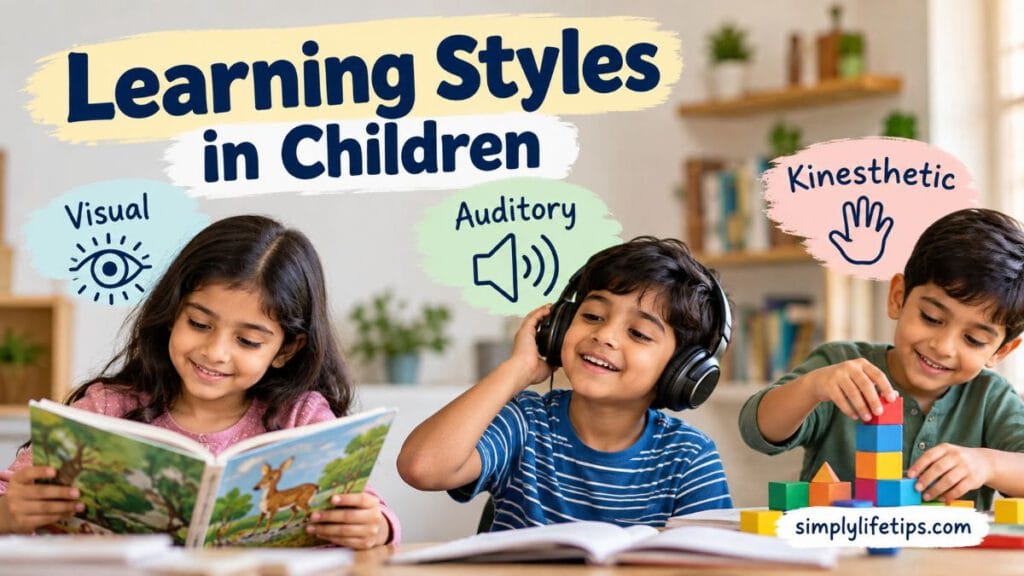
Learning styles in children can help parents understand why children may respond differently to the same lesson, activity, or explanation. Some children enjoy pictures and books, while others prefer listening, talking, moving, building, or trying something themselves.
As parents, it is natural to wonder whether a child has a particular way of learning. Understanding these preferences can be useful, but it is equally important not to put children into fixed categories.
Children are developing continuously. Their interests, abilities, confidence, and learning preferences can change with age and experience.
This article, inspired by ideas shared by Dr. Arun Oommen, looks at learning styles from a practical parenting perspective and explains how parents can support children without limiting them with labels.
What Are Learning Styles in Children?
Learning styles in children generally describe the different ways children may prefer to engage with information and activities.
The commonly discussed approaches include:
- Visual learning – learning through pictures, diagrams, demonstrations, and written information.
- Auditory learning – learning through listening, speaking, stories, and discussion.
- Kinesthetic learning – learning through movement, practical activities, experiments, and hands-on experiences.
These descriptions can help parents think about how to make learning more interesting. However, children should not be treated as if they are capable of learning only through one particular method.
A child can enjoy pictures and still benefit from listening. Another child may enjoy hands-on activities but also need reading and writing practice.
Understanding learning styles in children can help parents offer more varied learning experiences.
Types of Learning Styles in Children
Visual Learning
Children who enjoy visual material may respond well to pictures, diagrams, illustrations, charts, maps, and demonstrations.
For example, when learning about animals, a child may understand the differences between species more easily by looking at pictures rather than listening to a long explanation.
Parents can use drawing, picture books, simple diagrams, and visual demonstrations to make certain topics more engaging.
Auditory Learning
Auditory learning involves listening and communicating. Some children enjoy stories, conversations, songs, explanations, and asking questions.
A parent teaching a new word can say it aloud, explain its meaning, use it in a sentence, and ask the child to create another sentence.
Reading stories aloud is another simple way to combine listening with language development.
Kinesthetic Learning
Kinesthetic learning involves physical activity and hands-on experiences. Some children enjoy building, touching, experimenting, measuring, sorting, or moving while learning.
For example, instead of only explaining measurements, parents can allow a child to measure a table, a book, or ingredients while cooking.
The child is not simply hearing information but actively experiencing the concept.
Should Parents Identify One Learning Style?
Parents may notice that their child prefers certain activities. However, identifying one permanent learning style can become restrictive.
A child who enjoys drawing should not be limited to visual activities. A child who loves practical experiments should still have opportunities to read, write, listen, and discuss.
Instead of asking, “What is my child’s learning style?”, parents can ask:
“What different ways can I use to help my child understand this?”
This small change can create a much broader learning environment.
Why Children Need Different Learning Experiences
Children encounter many different types of tasks at school and at home. They need to read instructions, listen to teachers, communicate ideas, solve problems, write answers, remember information, and apply what they have learned.
For this reason, parents can introduce variety rather than relying on one method.
For example, when teaching a child about plants, you could show a picture, read a short explanation, discuss what plants need, and then grow a small plant together.
The child can observe, listen, discuss, and participate in the activity.
Children may engage with learning in different ways, and the same child may benefit from more than one approach. The infographic below summarizes the three commonly discussed learning styles and practical ways parents can support different learning preferences.
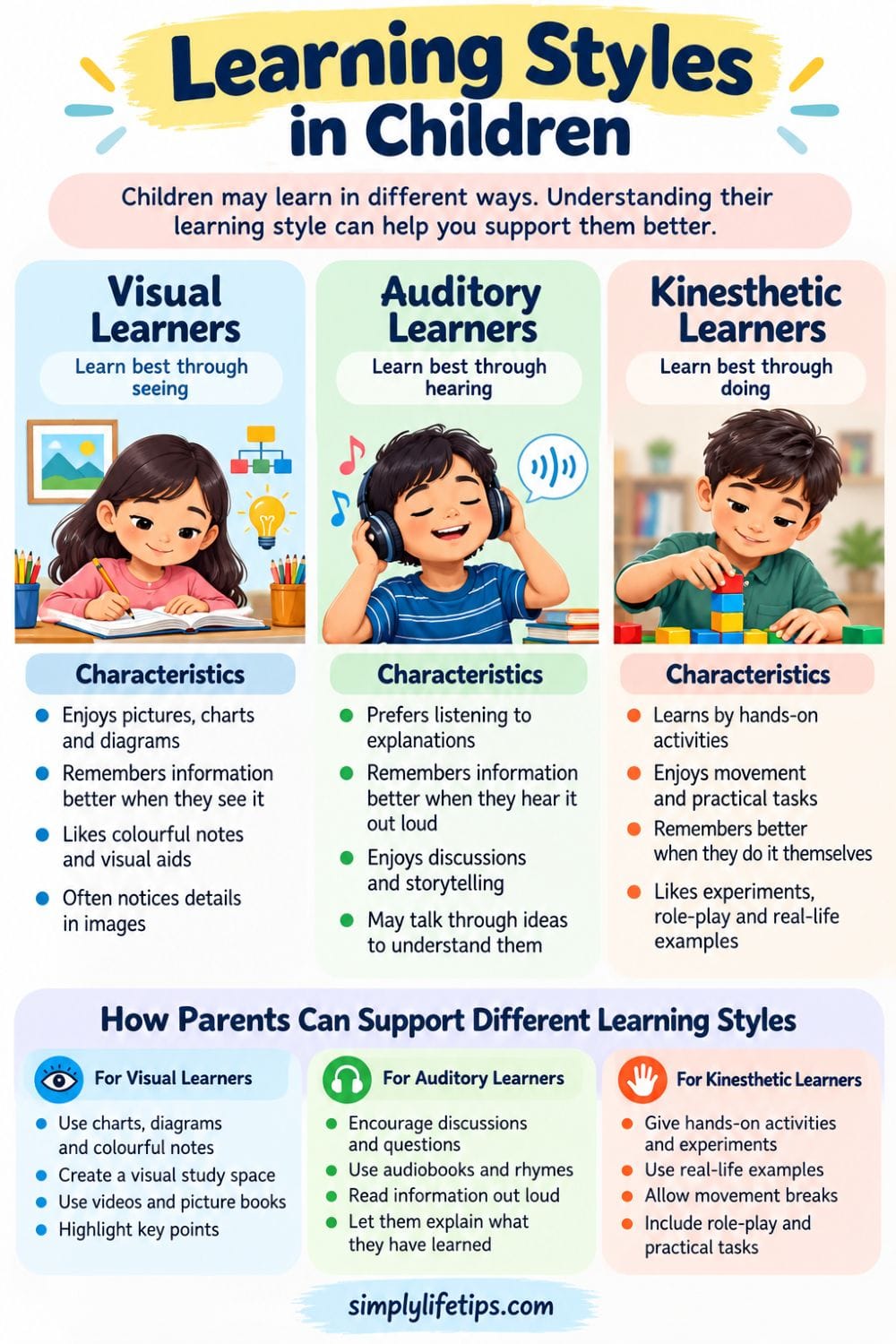
These approaches can offer useful ideas for creating varied learning experiences, but they should not be treated as fixed labels. Children can learn through seeing, listening, doing, reading, discussion, and many other experiences depending on the task and situation.
How Parents Can Support Different Learning Preferences
Supporting learning at home does not require expensive educational equipment.
Use Everyday Activities
Cooking can introduce measurements and mathematics. Shopping can involve counting and comparing prices. Gardening can introduce science and observation.
Ordinary activities can become meaningful learning experiences when parents involve children in the process.
Ask Questions
Instead of always providing answers, ask children what they think.
Questions such as “Why do you think that happened?” or “What do you think will happen next?” encourage children to think rather than simply memorize information.
Allow Children to Explain
Ask your child to explain something they have learned in their own words.
This can help parents understand whether the child has actually understood the concept rather than simply remembered an answer.
Combine Different Methods
If a child is struggling with a topic, try changing the approach.
Use a picture, explain the idea aloud, demonstrate it, or turn it into a practical activity. Sometimes a different approach can make a difficult concept easier to understand.
Parents can also help children build confidence by encouraging effective study habits for students that match their age, interests, and learning needs.
Don’t Compare Children
One of the most important parenting lessons is that children do not all learn in the same way or at the same pace.
One child may enjoy reading, while another may prefer building things. One may ask many questions, while another may quietly observe before responding.
These differences do not automatically indicate that one child is more capable than another.
Comparisons can create unnecessary pressure. Instead, parents can observe their child’s interests and provide opportunities to develop different skills.
Learning Preferences Can Change
A child’s learning preferences are not necessarily fixed.
A young child who enjoys learning through play may later become interested in reading. A child who once avoided writing may become more comfortable after gaining confidence.
Age, experience, subject matter, environment, and personal interests can all influence how children approach learning.
Therefore, parents don’t need to decide early that a child belongs to one learning category.
Encourage Curiosity, Not Labels
Children learn through questions, mistakes, experimentation, conversation, observation, and practice.
If a child is interested in something unusual, encourage the curiosity. If the child makes a mistake, help them understand what happened instead of making them afraid of being wrong.
A curious child is more likely to keep exploring and asking questions.
The goal of parenting is not to find one perfect teaching method. It is to create an environment where children feel comfortable learning in different ways.
As education changes, parents can also think about what children should learn in the age of AI, including creativity, critical thinking, communication, and problem-solving.
Parents can use ideas about learning styles in children as a starting point rather than a fixed system.
When a Child Struggles With Learning
If a child consistently struggles with schoolwork, parents should look beyond learning-style labels.
Difficulty may have many possible explanations, including gaps in previous learning, lack of confidence, unsuitable teaching methods, attention difficulties, language challenges, or other educational needs.
Instead of assuming a child has the “wrong” learning style, parents can talk with the child’s teacher to understand where the difficulty occurs.
Persistent concerns about learning or development may also warrant professional guidance.
Conclusion
Learning styles in children can give parents a useful starting point for thinking about individual preferences, but children are far more flexible than simple labels suggest.
A child may enjoy pictures today, practical activities tomorrow, and a good conversation the next day. Instead of deciding how a child learns, parents can provide opportunities to see, listen, read, discuss, create, experiment, and explore.
The most valuable approach is to understand the individual child, encourage curiosity, avoid unnecessary comparisons, and give them the freedom to develop a wide range of learning skills.
A child’s preference can guide us, but it should never become a limitation.
Frequently Asked Questions
What are the main learning styles in children?
The commonly discussed learning styles are visual, auditory, and kinesthetic. These describe different ways children may prefer to engage with information, but they should not be treated as fixed categories that determine how a child can learn.
How do I know my child’s learning style?
Observe what activities your child enjoys and how they engage with different subjects. However, avoid assigning a permanent label. Give your child opportunities to learn through pictures, listening, reading, discussion, movement, and practical activities.
Should I teach my child according to their learning style?
Parents can use activities that match a child’s interests, but it is better to provide varied learning experiences rather than restricting teaching to one supposed learning style.
Can a child’s learning style change?
Yes. Children’s interests and preferences can change as they grow and gain new experiences. A child may also prefer different approaches for different subjects.
Are learning styles important for children’s education?
Learning preferences can help parents think about ways to make activities engaging, but children benefit from developing a broad range of learning skills rather than being limited to one category.
This article was inspired by ideas shared by Dr. Arun Oommen. You can read the original Facebook post for the source material.

Mathukutty P. V. is the founder of Simply Life Tips. He shares practical advice and useful insights on personal growth, health, well-being, technology, and everyday living. His goal is to help readers build positive habits and make informed decisions. He believes in continuous learning and sharing knowledge to help people live healthier, happier, and more meaningful lives.



