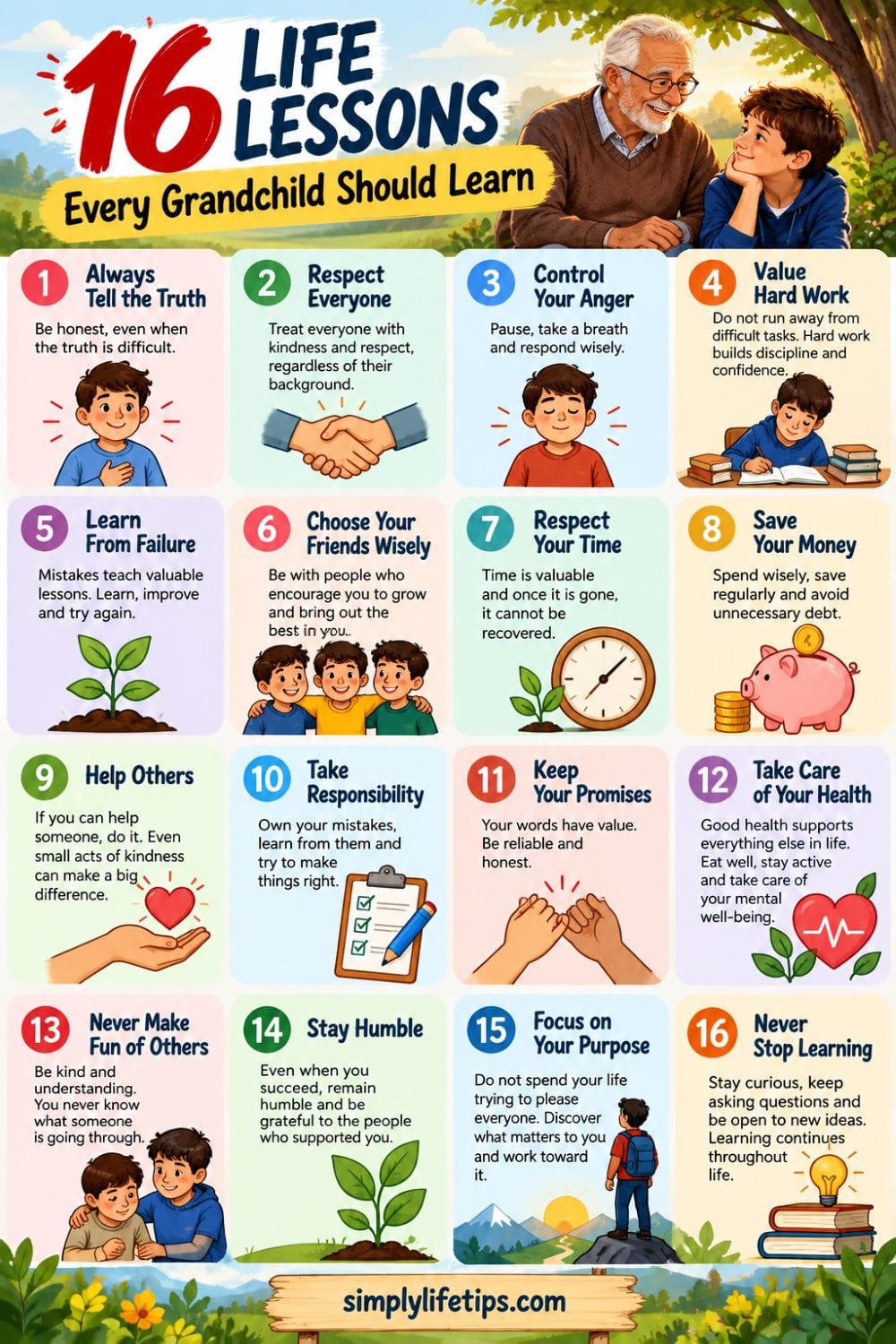
16 life lessons can give a child something more valuable than success alone: wisdom to make better choices, treat people with kindness, handle difficult moments, and keep growing throughout life.
One evening, a grandfather sat with his grandson and began talking about something he considered more valuable than money or possessions.
“My dear grandson, I want to share 16 life lessons with you today,” Grandpa said. “These are lessons that can guide you through every stage of life. Listen carefully, because every lesson has a meaning. But remember, numbers 15 and 16 are especially important. I never want you to forget them.”
“Yes, Grandpa,” the boy replied. “I will listen carefully.”
These 16 life lessons cover honesty, respect, responsibility, relationships, health, purpose, and lifelong learning.
16 Life Lessons Every Grandchild Should Learn
1. Always Tell the Truth
“Always tell the truth,” Grandpa began. “Even when the truth is difficult.”
Lies may sometimes seem like an easy way out of trouble, but they often create bigger problems later. Trust takes a long time to build and only a moment to damage.
Being truthful does not mean being harsh. You can be honest while still being kind and respectful.
A person who learns to tell the truth develops a reputation others can trust.
2. Respect Everyone
“Respect your parents, your grandparents, your teachers, your friends, and every person you meet.”
Respect should not depend on someone’s position, wealth, education, or social status.
A person who treats others with respect shows their character. Even when you disagree with someone, you can disagree without insulting or humiliating them.
Remember, how you treat people who can do nothing for you says a lot about who you are.
Parents can also help children develop character by teaching them life lessons every child should learn, including respect, kindness, and responsibility.
3. Control Your Anger
“Never make an important decision while you are angry.”
Anger can make us say things we do not really mean and do things we may regret later. Taking a few moments to calm down can completely change the way we respond.
When you feel angry, pause before speaking. Take a breath. Walk away if necessary. Think about the consequences before reacting.
Learning to control anger does not mean pretending you are never angry. It means learning how to respond wisely.
4. Value Hard Work
“Never run away from hard work just because something is difficult.”
Many worthwhile things in life require patience and consistent effort. Learning a skill, building a career, maintaining relationships, or achieving a personal goal rarely happens overnight.
The easiest path is not always the right path.
Hard work also teaches discipline. Even when the result is not exactly what you hoped for, the effort can give you experience, confidence, and resilience.
5. Learn From Failure
“Do not be afraid of failure.”
Failure can hurt, but it can also teach lessons that success sometimes cannot.
If you make a mistake, ask yourself:
- What went wrong?
- What could I have done differently?
- What can I learn from this experience?
- What will I do differently next time?
A failed attempt does not have to become a permanent defeat.
The important thing is not to repeat the same mistake without learning from it.
Many of the most meaningful lessons we learn from life experience become clearer as we face challenges, mistakes, and changes.
6. Choose Your Friends Wisely
“Be careful about the people you allow to influence your life.”
Friends can influence the way you think, speak, behave, and make decisions. Good friends encourage you to grow, tell you the truth when you need to hear it, and respect your boundaries.
You do not need a large number of friends. A few genuine relationships can be more valuable than a large circle of superficial connections.
Choose people who bring out the better side of you.
7. Respect Your Time
“Money can be earned again, but yesterday can never be recovered.”
Time is one of the most valuable things you have. Once a moment has passed, you cannot bring it back.
Do not spend all your time worrying about the past or endlessly postponing the things that matter.
Make time for learning, family, friendships, health, meaningful work, and the things that give your life purpose.
Using your time wisely does not mean being busy every minute. Rest and quiet time are valuable too.
8. Save Your Money
“When you earn money, do not spend everything you have.”
Learning how to manage money is an important life skill.
Save regularly. Understand the difference between something you need and something you simply want. Avoid unnecessary debt when possible, and think carefully before making major financial decisions.
You do not have to become wealthy to be financially responsible.
Good money habits can give you greater freedom and help you deal with unexpected situations.
9. Help Others
“If you can help someone, help them.”
Helping others does not always require money.
Sometimes it means listening to someone who is struggling. Sometimes it means sharing your knowledge, offering your time, encouraging a friend, or simply being kind to someone who is having a difficult day.
Small acts of kindness can make a bigger difference than you realize.
Helping others also reminds us that life is not only about what we receive. It is also about what we contribute.
10. Take Responsibility
“Never blame other people for every mistake you make.”
Everyone makes mistakes. What matters is what you do after making one.
If you are responsible for something going wrong, dare to admit it. Apologize when necessary and try to make things right.
Taking responsibility does not make you weak. It shows maturity.
A person who accepts responsibility can learn, improve, and earn the trust of others.
11. Keep Your Promises
“Your words have value. Do not make promises carelessly.”
When you give someone your word, they may depend on it.
Of course, circumstances can sometimes make it impossible to keep a promise. When that happens, communicate honestly rather than simply disappearing or making excuses.
Trust grows when your words and actions match.
If you want people to believe you, become someone whose promises mean something.
12. Take Care of Your Health
“Never treat your health as something you can take for granted.”
A successful career, a large bank account, or a beautiful home cannot replace good health.
Take care of your body through healthy habits, adequate rest, physical activity, and sensible food choices. At the same time, do not ignore your emotional and mental well-being.
Your health supports everything else you want to do in life.
As you grow older, you may understand more clearly why taking care of yourself early is so important.
13. Never Make Fun of Others
“Never laugh at someone’s weakness or struggles.”
You may see only a small part of another person’s life. Someone who appears happy may be dealing with problems you know nothing about.
Making fun of someone’s appearance, mistakes, fears, limitations, or difficult circumstances can leave a lasting wound.
Choose kindness instead.
You never know when someone needs understanding more than judgment.
14. Stay Humble
“Even when you become successful, remain humble.”
Success can change a person’s life, but it should never change their respect for others.
Remember the people who supported you when you were struggling. Remember the teachers who helped you learn, the family members who encouraged you, and the friends who stood beside you.
Do not measure your worth only by your achievements.
A truly meaningful life includes gratitude.
The grandson looked at his grandfather and said, “Grandpa, I understand now. Becoming successful is not enough. We also need to become good human beings.”
Grandpa smiled.
“You understand more than you think. But there are two more lessons I especially want you to remember.”
15. Focus on Your Purpose
“Do not spend your entire life trying to please everyone.”
This is one of the most important of these 16 life lessons.
People will have opinions about how you should live, what career you should choose, what decisions you should make, and what success should look like.
Listen to advice, but do not allow every opinion to control your life.
Take time to understand what matters to you. Set meaningful goals and work toward them patiently.
There will always be someone who thinks you should be doing something different. If you constantly change direction to satisfy everyone else, you may eventually lose sight of your own purpose.
That does not mean ignoring good advice. It means learning to distinguish between useful guidance and unnecessary pressure.
A purposeful life is not necessarily a perfect life. It is a life in which your choices are connected to what you genuinely value.
Discovering what truly matters to you is one of the most important life lessons we can learn as we grow.
The grandson nodded.
“Grandpa, I think this lesson is very important. I should listen to people, but I should also learn to think for myself.”
“Exactly,” Grandpa replied.
16. Never Stop Learning
“And now,” Grandpa said, “we have reached the final lesson—and perhaps the most important one.”
Never stop learning.
Never assume that you know everything.
The world changes. Technology changes. Knowledge changes. Your responsibilities change. Even your understanding of yourself will change as you grow older.
Keep asking questions. Read. Listen. Explore. Learn from other people. Learn from your mistakes. Learn from experiences, including the difficult ones.
Learning does not end when you leave school or university.
Lifelong learning is also recognized by UNESCO, which describes learning as something that can continue throughout life and across different settings.
You can learn from a book, a conversation, a new skill, a mistake, a journey, a failure, or a person whose life is very different from your own.
The important thing is to remain curious.
When you continue learning, you continue growing.
As Grandpa finished, his grandson sat quietly for a moment.
“Today I learned something important,” he said. “Life is not just about becoming successful. It is about becoming kind, humble, responsible, and wise.”
Grandpa smiled.
“That is exactly what I wanted you to understand.”
If you want to keep growing throughout life, explore these practical ideas about never stop learning and updating your knowledge.
What These 16 Life Lessons Teach Us
These 16 life lessons are not rules that guarantee a perfect life. They are reminders that can help us make wiser choices.
Tell the truth. Respect others. Control your anger. Work hard. Learn from failure. Choose good friends. Value your time. Manage your money. Help others. Take responsibility. Keep your promises. Protect your health. Be kind. Stay humble.
Then remember the final two lessons: find your purpose and never stop learning.
Success may bring recognition, money, or achievement. But character determines how you use those things and how you treat the people around you.
The greatest lesson a grandparent can pass to a grandchild may not be how to become successful, but how to become a good human being.
What life lesson would you want your grandparents or parents to pass on to the next generation?
Together, these 16 life lessons offer simple reminders that can help guide important choices throughout life.
Conclusion
The most valuable 16 life lessons are not complicated. They are simple principles that can guide us through childhood, adulthood, relationships, work, failure, success, and the many unexpected stages of life.
Truth, respect, self-control, hard work, responsibility, kindness, humility, purpose, and continuous learning can help shape a life that is meaningful—not merely successful.
And if there is one lesson worth carrying throughout life, it is this: never stop learning, because there is always something new to discover.
Frequently Asked Questions
1. What are the most important life lessons to learn?
Some of the most important life lessons include telling the truth, respecting others, controlling anger, working hard, learning from failure, choosing friends wisely, taking responsibility, staying humble, finding your purpose, and never stopping learning.
2. Why are life lessons important for children?
Life lessons help children develop character and learn how to handle relationships, mistakes, responsibilities, challenges, and decisions as they grow.
3. What can grandparents teach their grandchildren?
Grandparents can share wisdom gained through experience, including lessons about kindness, patience, responsibility, relationships, resilience, money, health, and making thoughtful decisions.
4. Why is it important to learn from failure?
Failure can reveal what went wrong and provide an opportunity to improve. Learning from mistakes helps people develop resilience and make better decisions in the future.
5. Why should we never stop learning?
Learning keeps us curious, adaptable, and open to new ideas. Knowledge and skills can continue to grow throughout every stage of life, long after formal education has ended.

Mathukutty P. V. is the founder of Simply Life Tips. He shares practical advice and useful insights on personal growth, health, well-being, technology, and everyday living. His goal is to help readers build positive habits and make informed decisions. He believes in continuous learning and sharing knowledge to help people live healthier, happier, and more meaningful lives.