
What is narcissistic abuse, and how can you recognise harmful patterns in a relationship? Narcissistic abuse is a commonly used term for repeated patterns of emotional or psychological manipulation, humiliation, blame or controlling behaviour. These behaviours can undermine another person’s confidence, independence and emotional well-being.
The term does not automatically mean that the person responsible has Narcissistic Personality Disorder (NPD). Only a qualified mental-health professional can assess and diagnose this condition.
It does not always begin with arguments or obvious cruelty. Sometimes, a relationship starts with intense affection, constant praise and promises of a wonderful future. Gradually, however, the same relationship may become a source of confusion, fear, self-doubt and emotional exhaustion.
Imagine someone who once felt confident about making decisions but now questions every choice because their partner constantly tells them they are wrong. They may apologise even when they have done nothing wrong, avoid expressing their opinions and worry about upsetting the other person.
Over time, this experience can affect how they see themselves.
Narcissistic abuse can occur in romantic relationships, marriages, families, friendships and workplaces. Understanding its possible warning signs can help people recognise unhealthy patterns, seek appropriate support and make informed decisions about their well-being.
However, it is important not to label someone a narcissist simply because they behave selfishly or disagree with us. The focus should be on repeated harmful behaviour, its impact, and whether the relationship allows both people to feel safe and respected.
Narcissistic abuse can be difficult to recognise, especially when a relationship begins with affection and gradually becomes controlling or emotionally painful. Repeated criticism, gaslighting, humiliation, and boundary violations can undermine a person’s confidence and independence.
The infographic below highlights seven common warning signs, their possible effects on emotional well-being, and practical steps that may help you protect yourself and seek support.
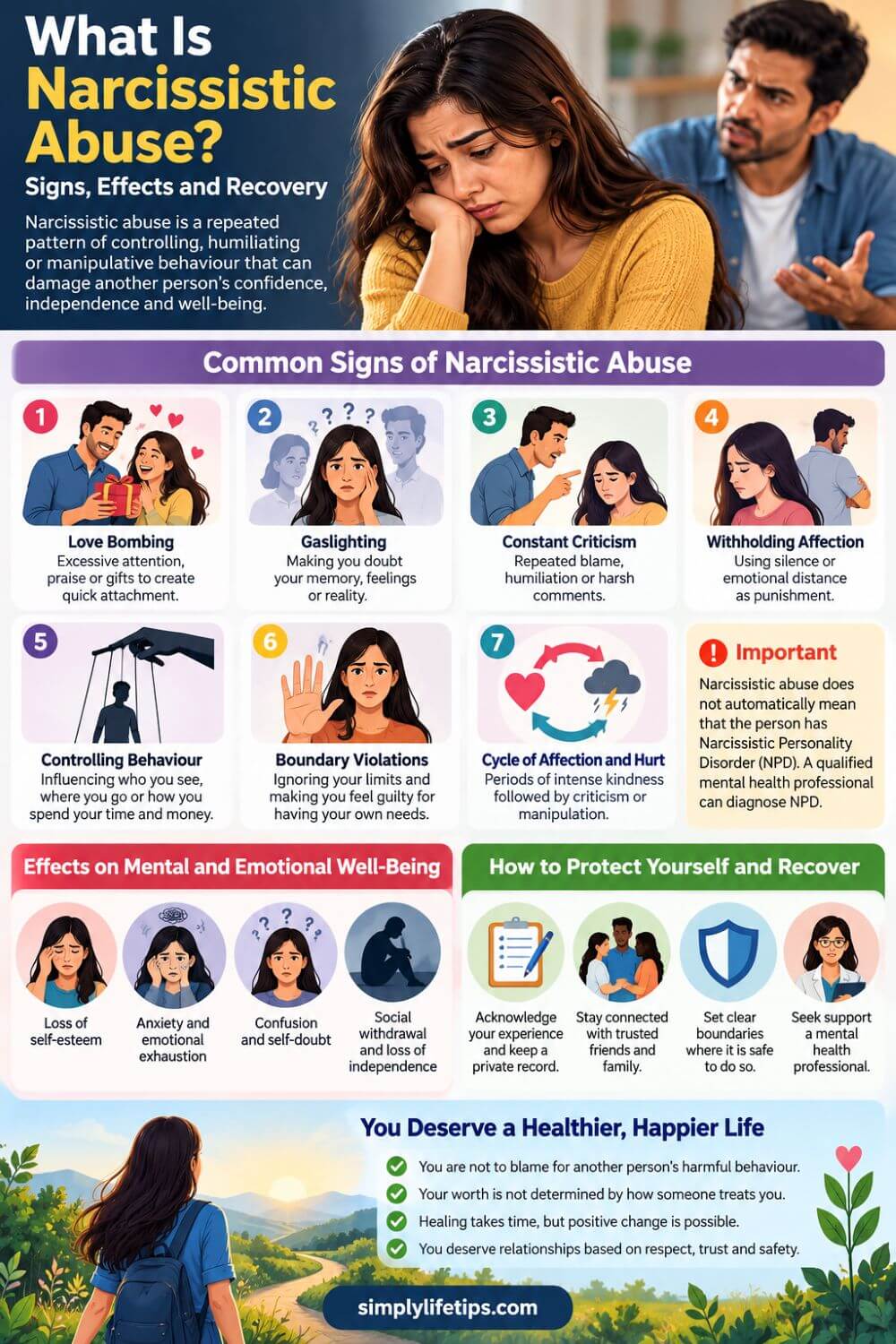
These warning signs can help you recognise potentially harmful patterns in a relationship. However, no single behaviour automatically proves that someone is a narcissist or has Narcissistic Personality Disorder (NPD). What matters is the repeated pattern of behaviour, its impact on your well-being, and whether you can express your needs and maintain your independence without fear.
Let’s explore these signs in more detail, beginning with love bombing and gaslighting.
What Is Narcissistic Abuse?
Narcissistic abuse is a term commonly used to describe emotionally or psychologically harmful behaviour associated with patterns of entitlement, excessive need for admiration, manipulation or control.
The term is not itself a formal mental health diagnosis. Narcissistic Personality Disorder (NPD) is a clinical condition that requires assessment by a qualified mental health professional.
A person does not need an NPD diagnosis for their behaviour to be harmful. Equally, a person with NPD should not automatically be assumed to abuse others.
What matters when evaluating a relationship is the pattern of behaviour rather than an assumed diagnosis.
For example, consider a couple who disagree about how to spend their money. They discuss their concerns, listen to each other and reach a compromise. Although they may feel frustrated, both retain the freedom to express their opinions.
Now imagine a different situation. One partner controls all the money, criticises every purchase made by the other and threatens to withdraw financial support whenever they disagree. The other partner becomes afraid to make even ordinary decisions.
The second situation raises concerns about controlling behaviour and possible emotional or financial abuse.
The difference is not simply that the couple argues. It is the repeated use of power, intimidation or humiliation to control another person.
7 Common Signs of Narcissistic Abuse
Recognising the signs of narcissistic abuse can be difficult because harmful behaviour may develop gradually. Some warning signs become clearer when we look at repeated patterns rather than isolated incidents.
1. Love Bombing and Excessive Attention
Love bombing describes an intense display of affection, attention, praise, or gifts that may be used to create rapid emotional attachment and influence another person.
At the beginning of a relationship, someone may constantly message you, shower you with compliments, and insist that you are the most important person in their life. They may talk about marriage, commitment, or a shared future before you have had enough time to know each other well.
For example, someone you have recently met may say, “I have never loved anyone like you. We should spend every moment together.”
At first, this attention may feel wonderful. However, if the person becomes angry when you need personal space, discourages you from seeing friends, or uses their gifts to demand obedience, the behaviour deserves closer attention.
What to remember: Strong affection is not automatically manipulation. Healthy love respects your pace, independence, and boundaries. The concern arises when affection becomes a tool for control.
2. Gaslighting and Constant Denial
Gaslighting is a form of psychological manipulation in which someone repeatedly attempts to make another person doubt their memory, perceptions, or understanding of events.
Imagine that your partner makes a hurtful comment during an argument. When you bring it up later, they respond, “I never said that. You always imagine things.”
When this happens repeatedly, you may begin to question your own memory. You might even apologise for raising a legitimate concern because you no longer trust your interpretation of what happened.
Other examples include:
- “You are too sensitive. It was only a joke.”
- “That never happened. You are making things up.”
- “Everyone agrees that you are the problem.”
- “You cannot remember anything correctly.”
A simple disagreement about what happened does not automatically constitute gaslighting. The concern is a repeated pattern of denying, distorting, or undermining another person’s experience to gain control.
For a more detailed explanation, read the National Domestic Violence Hotline’s guide to what gaslighting is and how it works.
3. Constant Criticism, Blame and Humiliation
Another possible sign of emotional abuse is repeated criticism that attacks a person’s worth rather than addressing a specific problem.
Constructive feedback focuses on behaviour and offers an opportunity to improve. Humiliation, by contrast, makes someone feel inferior, incapable, or undeserving of respect.
For example, imagine that you forget to complete a household task. A healthy response might be, “Could you please remember to finish this tomorrow?”
A harmful response might be, “You are useless. You never do anything right. I have to do everything myself.”
When such comments become routine, the person receiving them may start believing that they are incapable of doing anything well.
They may also begin taking responsibility for problems that are not entirely theirs.
In some relationships, the person who causes harm refuses to acknowledge their behaviour and instead blames the other person for reacting to it.
For instance, after repeatedly insulting their partner, they might say, “You made me angry, so you forced me to speak that way.”
Anger may explain someone’s emotional state, but it does not excuse humiliating or abusing another person.
4. Withholding Affection and Using Silence as Punishment
Everyone occasionally needs time to calm down after an argument. Taking a break can be healthy when the person communicates that they need some space and intends to return to the discussion.
However, deliberately withholding communication or affection to punish someone is different.
Imagine that you express a reasonable concern about your relationship. Instead of discussing it, the other person refuses to speak to you for several days. They ignore your messages, act as though you do not exist, and resume normal communication only after you apologise.
If this pattern repeatedly occurs whenever you disagree, you may begin suppressing your feelings to avoid being ignored again.
The result can be a relationship in which one person controls when communication is permitted, and the other becomes afraid to speak honestly.
Healthy communication does not require agreement on every issue. It requires a willingness to address concerns respectfully, even when conversations are uncomfortable.
5. Controlling Behaviour and Isolation
A controlling person may attempt to influence who you see, where you go, how you dress, how you spend money, or how you use your time.
At first, the behaviour might be presented as concern or affection.
For example, someone may say, “I worry about you when you go out with your friends. Why can’t you stay home with me instead?”
Occasional concern is normal. The warning sign appears when concern becomes a demand, refusal becomes a reason for punishment, or your social connections gradually disappear.
Other examples include:
- Becoming angry whenever you meet friends or relatives.
- Demanding access to your phone or private messages.
- Monitoring your movements without your agreement.
- Restricting your access to money.
- Making important decisions on your behalf.
- Threatening consequences when you ask for independence.
Over time, isolation can leave someone with fewer people to turn to for advice, practical help or emotional support.
The NHS guidance on domestic abuse explains that abuse can involve emotional control, isolation, financial restrictions and threats, not only physical violence.
6. Repeated Boundary Violations
Personal boundaries help us protect our privacy, time, values and emotional well-being. In a healthy relationship, both people should be able to express their limits without fearing intimidation or retaliation.
For example, you might explain that you need an hour each evening to relax, study or pursue a personal interest.
A respectful response would acknowledge your need and work towards a reasonable arrangement.
An unhealthy response might involve accusations such as, “If you really loved me, you would never need time away from me.”
Similarly, someone might become angry when you decline a request, insist on knowing every detail of your private life or treat your independent decisions as personal rejection.
When boundaries are repeatedly ignored, the person affected may gradually stop expressing their needs.
Learning to establish clear limits is an important part of protecting your independence. You can explore practical strategies in our guide to setting healthy boundaries in relationships.
Remember that boundaries are not a way to control another person. They communicate what you are comfortable with and what actions you will take to protect your well-being.
7. A Repeated Cycle of Affection and Hurt
Some unhealthy relationships involve alternating periods of intense affection and harmful behaviour.
After an argument or humiliating incident, the person may become loving again, offer gifts, apologise or promise that everything will change.
For a while, the relationship may feel peaceful. The person experiencing the harmful behaviour may hope that the positive period will last.
However, if the same pattern of control, criticism or intimidation repeatedly returns without meaningful change, the cycle can become emotionally exhausting.
For example, someone may spend weeks criticising their partner, then apologise and plan a wonderful weekend together. Their partner feels hopeful and believes the relationship is improving. A few days later, the criticism begins again.
This pattern can make it difficult to evaluate the relationship clearly because moments of affection create hope while repeated harmful behaviour causes distress.
An apology can be meaningful, but lasting change requires consistent accountability and different behaviour over time.
How Narcissistic Abuse Can Affect Mental and Emotional Well-Being
Repeated emotional manipulation and controlling behaviour can affect how a person thinks, feels, and responds to everyday situations. The effects vary from person to person, and not everyone experiences the same difficulties.
Loss of Self-Esteem
Constant criticism may gradually weaken confidence.
A person who once felt comfortable expressing opinions may begin believing that their ideas are foolish or that they are incapable of making good decisions.
For example, they might ask several people to approve a simple purchase because they no longer trust their own judgement.
Rebuilding self-esteem involves recognising personal strengths, acknowledging achievements and learning to evaluate criticism realistically.
Rebuilding self-esteem is an important part of recovery after emotional abuse. For practical strategies, read our guide on 5 Ways to Increase Self-Esteem and Improve Relationships.
Anxiety and Emotional Exhaustion
Living in an unpredictable environment can make someone feel constantly alert to the other person’s mood.
They may worry about saying the wrong thing, making a mistake or triggering another argument.
Even when the person causing distress is absent, the fear of a future confrontation may remain.
Over time, this stress can interfere with sleep, concentration, relationships and daily activities.
Confusion and Self-Doubt
When someone repeatedly denies your experiences or blames you for every problem, it can become difficult to distinguish reasonable self-reflection from unfair self-blame.
You might repeatedly ask yourself:
- Am I always the problem?
- Did I misunderstand what happened?
- Am I being too sensitive?
- Can I trust my own judgment?
Self-reflection can help us grow, but it should not require accepting responsibility for another person’s harmful choices.
Social Withdrawal and Loss of Independence
Some people gradually stop meeting friends, participating in hobbies or sharing personal concerns because they fear criticism or conflict.
Imagine someone who once enjoyed meeting friends every weekend but now cancels every invitation to avoid arguments at home.
Over time, their social world may become smaller, making it harder to access emotional support and alternative perspectives.
Maintaining supportive relationships outside a difficult relationship can help preserve a sense of identity and belonging.
Difficulty Trusting Future Relationships
After repeated experiences of manipulation or humiliation, a person may become cautious about trusting others.
They might fear that kindness is temporary, that disagreements will lead to punishment or that expressing personal needs will result in rejection.
Healing does not mean forcing yourself to trust everyone immediately. It means gradually learning to recognise consistency, mutual respect and emotional safety in relationships.
Narcissistic Abuse vs. Ordinary Relationship Conflict
Not every argument, selfish action or communication problem is narcissistic abuse. People can behave poorly, make mistakes and hurt one another without an ongoing pattern of manipulation or control.
The distinction becomes clearer when we consider what happens repeatedly and how each person responds when concerns are raised.
| Ordinary relationship conflict | Potentially abusive pattern |
|---|---|
| Both people can express their concerns. | One person repeatedly silences or intimidates the other. |
| Each person can acknowledge mistakes. | Blame is repeatedly shifted onto one person. |
| Boundaries are discussed and negotiated. | Boundaries are ignored or punished. |
| Disagreements may lead to compromise. | Disagreements lead to threats, humiliation or retaliation. |
| Apologies are followed by efforts to improve. | Apologies repeatedly occur without meaningful change. |
| Both people retain personal independence. | One person increasingly controls the other’s choices. |
These examples are not a diagnostic checklist. They are a way to think more clearly about relationship dynamics.
A single incident may be serious in its own right, particularly when it involves threats or violence. You do not need to wait for a repeated pattern before seeking help.
The key question is whether you can express your needs, make decisions, and disagree without fear of intimidation or punishment.
How to Protect Yourself from Narcissistic Abuse
If you recognise concerning patterns in a relationship, you do not need to make every decision immediately. Start by considering your circumstances, support system, and personal safety.
1. Acknowledge Your Experience
The first step is to take your feelings seriously.
If you repeatedly feel frightened, humiliated, controlled, or unable to express yourself, do not dismiss those experiences simply because the other person says nothing is wrong.
You can acknowledge that a relationship is hurting you without deciding whether the other person has a particular personality disorder.
For example, instead of focusing only on the question, “Are they a narcissist?”, consider asking, “Is this behaviour repeatedly harming me, and can I express my concerns safely?”
This shift keeps your attention on the behaviour and its effects rather than an unverified diagnosis.
2. Keep a Private Record of Incidents
When it is safe to do so, recording important incidents may help you identify patterns and maintain clarity about what happened.
You might note the date, what was said or done, how the situation affected you, and whether similar incidents have occurred before.
For example, you may notice that criticism and threats regularly follow whenever you visit a family member or make an independent financial decision.
A record is not a substitute for professional advice, and you should not put yourself at risk to collect evidence. If the other person monitors your phone or accounts, consider whether keeping such information could compromise your safety.
3. Maintain Supportive Relationships
Isolation can make difficult situations harder to understand and manage.
If possible, stay connected with trusted friends, relatives or other people who treat you with respect. You do not have to share every detail immediately.
A simple conversation such as, “I have been feeling overwhelmed by some problems in my relationship, and I need someone to talk to,” can be a useful beginning.
Supportive people may help you consider your options, recognise patterns and access practical assistance.
For more ideas about maintaining positive connections, read our article on relationship skills that build healthier connections.
4. Establish Boundaries Where It Is Safe
Clear boundaries can help you communicate your needs and identify what behaviour you will not accept.
For example, you might say, “I am willing to discuss this issue, but I will not continue the conversation while I am being insulted.”
However, boundaries are not guaranteed to change another person’s behaviour. Someone who uses intimidation or control may respond negatively when they perceive a loss of control.
If setting a boundary could trigger threats or violence, prioritise safety and seek advice from a qualified professional or domestic-abuse support service rather than confronting the person alone.
5. Seek Professional Support
A qualified mental health professional can help you understand your experiences, manage distress, rebuild confidence and consider your options.
You do not need to prove that someone has NPD before seeking help for the effects of an unhealthy relationship.
Individual counselling may be particularly helpful when you feel confused, anxious, isolated or unable to make decisions confidently.
Where coercion, intimidation or violence is present, seek advice from a professional who understands abuse dynamics before considering joint counselling or mediation. Your safety and freedom to speak openly must come first.
6. Prioritise Safety if There Are Threats or Violence
If the relationship involves physical violence, stalking, threats, financial control or fear for your immediate safety, treat these concerns seriously.
Depending on your circumstances, a safety plan might include identifying a trusted person, arranging access to essential documents and medication, considering a safe place to stay and seeking specialist support.
If your communications are monitored, use a safer device or contact method when possible.
If you are in immediate danger in India, call 112, India’s official emergency number for emergency assistance. You may also seek guidance from local police, qualified professionals, or appropriate domestic-abuse support organisations.
You do not have to decide the future of the entire relationship before asking for help.
7. Rebuild Your Independence Gradually
Recovery often involves reconnecting with the parts of yourself that became neglected during a difficult relationship.
You might begin with small, manageable steps:
- Resume a hobby you previously enjoyed.
- Spend time with supportive friends or relatives.
- Make everyday decisions without seeking unnecessary approval.
- Re-establish routines that support your physical and emotional well-being.
- Set realistic personal goals and celebrate progress.
- Seek professional help if anxiety, sadness, or self-doubt continues to interfere with daily life.
For example, someone who stopped painting because their partner repeatedly mocked their work might begin painting again privately or join a supportive creative group.
The goal is not to prove anything to the other person. It is to rediscover your interests, choices, and sense of personal identity.
Can a Relationship Recover from Narcissistic Abuse?
Whether a relationship can improve depends on the behaviour involved, the willingness of both people to address the problems, and the presence of genuine safety.
Meaningful change requires more than promises or temporary affection. The person causing harm must acknowledge their behaviour, accept responsibility without blaming the other person, and demonstrate consistent changes over time.
For example, if someone repeatedly humiliates their partner, a meaningful change would involve stopping the behaviour, respecting boundaries, taking responsibility for the harm caused, and maintaining those changes even during disagreements.
The other person is not responsible for making these changes happen.
If intimidation, coercion or violence continues, protecting yourself may be more important than trying to repair the relationship.
Some people choose to remain in a relationship while exploring their options. Others choose to leave. Practical realities, financial circumstances, children, safety concerns and access to support can all affect these decisions.
There is no single decision that is right for everyone. What matters is having access to accurate information, appropriate support and the freedom to make informed choices.
Conclusion
Understanding what narcissistic abuse means can help you recognise harmful relationship patterns without rushing to label or diagnose another person.
Repeated humiliation, gaslighting, controlling behaviour, isolation and boundary violations can undermine confidence and emotional well-being. These behaviours deserve attention because everyone has the right to feel safe, respected and heard in their relationships.
If you recognise these patterns in your own life, remember that you do not have to manage everything alone. Speak with someone you trust, seek professional guidance and consider practical steps that protect your independence and safety.
Healing may take time, and progress may not always be straightforward. Small steps towards rebuilding confidence, reconnecting with supportive people and making your own decisions can help you regain a stronger sense of self.
Most importantly, another person’s repeated criticism does not determine your worth. You deserve relationships in which respect is mutual, boundaries are recognised, and disagreements do not become opportunities for humiliation or control.
A healthy relationship should allow you to grow as an individual while building a meaningful connection with another person.
Frequently Asked Questions About What Is Narcissistic Abuse
1. What is narcissistic abuse in simple terms?
Narcissistic abuse is a commonly used term for repeated emotionally or psychologically harmful behaviour involving manipulation, humiliation, blame or control. It can undermine another person’s confidence and independence. The term does not automatically mean that the person responsible has Narcissistic Personality Disorder.
2. What are the most common signs of narcissistic abuse?
Possible warning signs include love bombing used to manipulate, gaslighting, repeated criticism, shifting blame, controlling behaviour, social isolation, and deliberate boundary violations. The overall pattern and its impact matter more than any single behaviour.
3. Is narcissistic abuse the same as emotional abuse?
The terms overlap, but they are not identical. Emotional abuse is a broader term for behaviour that harms or controls another person’s emotional well-being. Narcissistic abuse is commonly used to describe certain manipulative or controlling patterns associated with narcissistic traits. Neither term alone establishes a clinical diagnosis.
4. Can someone experience narcissistic abuse without their partner having NPD?
Yes. Harmful or abusive behaviour can occur regardless of whether the person responsible has a diagnosed personality disorder. A diagnosis is not required for someone to recognise that their relationship is unsafe or emotionally damaging.
5. How can someone recover from narcissistic abuse?
Recovery may involve reconnecting with trusted people, rebuilding self-esteem, maintaining personal boundaries where safe, documenting concerning incidents when appropriate, and seeking professional support. If threats, stalking, or violence are involved, safety planning and specialist assistance should take priority.
References:
- The National Domestic Violence Hotline — What Is Emotional Abuse?
- The National Domestic Violence Hotline — What Is Gaslighting?
- NHS — Getting Help for Domestic Violence and Abuse

Mathukutty P. V. is the founder of Simply Life Tips. He shares practical advice and useful insights on personal growth, health, well-being, technology, and everyday living. His goal is to help readers build positive habits and make informed decisions. He believes in continuous learning and sharing knowledge to help people live healthier, happier, and more meaningful lives.