

Resilient children are not children who never struggle. They are children who gradually learn that difficult experiences can be managed, mistakes can be corrected, disappointment can be survived, and problems can sometimes be solved without an adult taking over.
For parents, this can be surprisingly difficult.
When a child comes home upset about a poor grade, has an argument with a friend, becomes nervous before a competition, or feels rejected by classmates, the instinct to intervene is understandable. We want to remove the pain and make everything right.
But there is an important distinction between protecting a child from genuine harm and protecting a child from every uncomfortable experience.
A child who is always rescued may receive the message that difficult situations are too much for them. A child whose parent stays supportive while allowing appropriate responsibility may gradually develop another message:
“This is difficult, but I can handle it.”
That belief is an important foundation for resilience.
Protection and Belief Send Different Messages
Protection has an important place in parenting. Children need adults to protect them from danger, abuse, serious bullying, unsafe situations, and circumstances they are not developmentally prepared to handle.
The problem arises when protection becomes the automatic response to ordinary challenges.
There is a difference between saying:
“I’ll take care of this for you.”
and saying:
“I’m here with you. What do you think you can do?”
The first provides immediate relief. The second provides an opportunity to develop capability.
Neither approach is appropriate in every situation. Good parenting requires judgment.
The question is not whether parents should help. The question is:
Can I help my child without taking away an opportunity to learn?
The ten situations below show how that difference can show up in everyday family life.
The difference between protection and belief becomes clearer in everyday parenting moments. A child’s disappointing grade, friendship problem, nervousness before a competition, or experience of rejection can all become opportunities to build confidence. The following examples show how a parent’s response can either take over the problem or help a child develop the confidence to handle it.
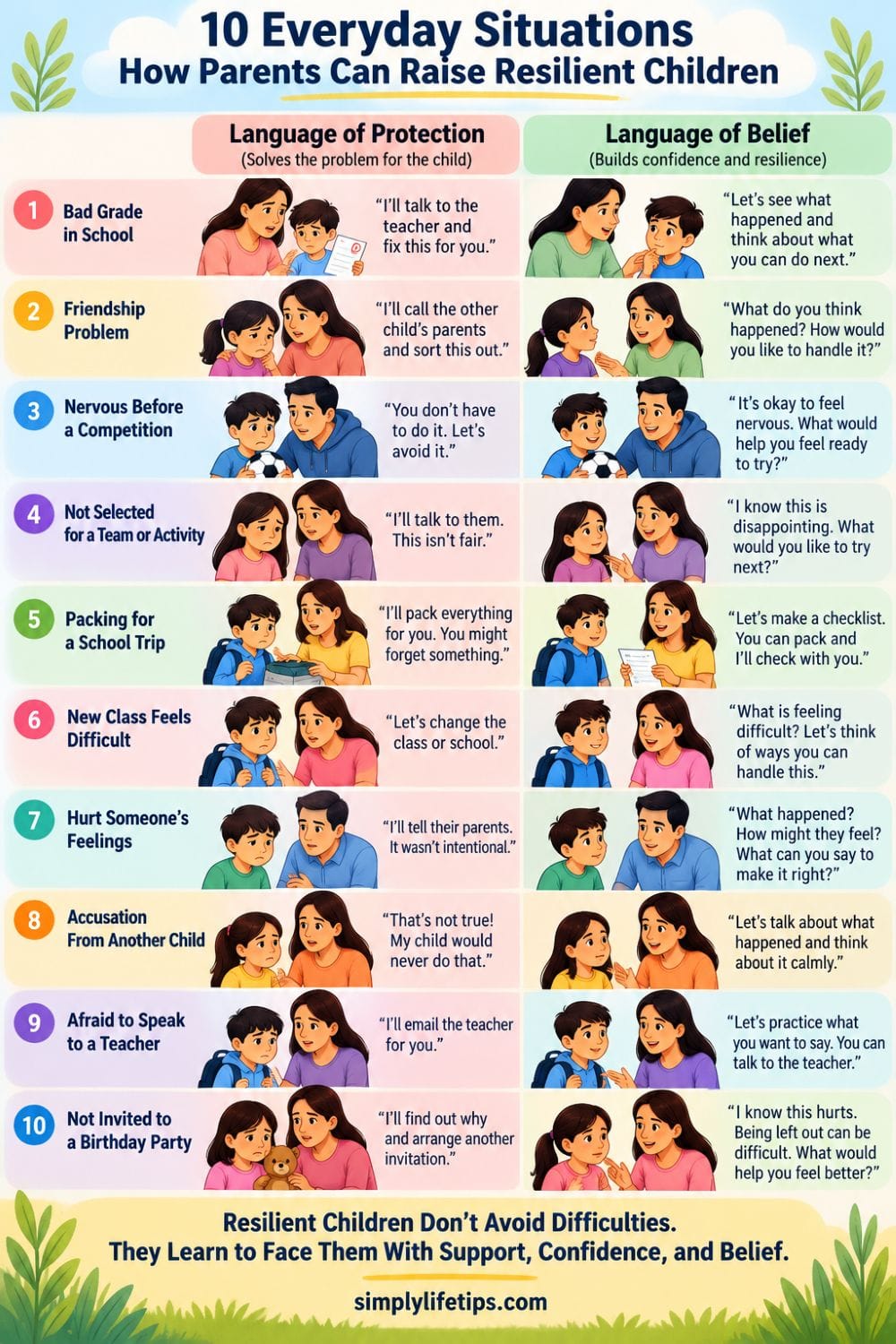
These situations do not mean parents should always step back. Children need protection and guidance when a situation is unsafe or beyond their ability to manage. The goal is to recognize when a child needs direct help and when they would benefit more from encouragement, questions, and the opportunity to try for themselves.
This is how resilient children gradually develop confidence: they experience difficulty while knowing that a trusted adult is available to support them.
In each situation, the language of belief communicates an important message: “I am here for you, and I believe you are capable.” That message becomes particularly powerful when children are given repeated opportunities to discover their own abilities.
1. When a Child Comes Home Upset About a Bad Grade
A disappointing grade can hurt a child, especially when they worked hard or expected a better result.
A parent’s immediate response may be to contact the teacher, explain the circumstances, or try to arrange a solution.
Sometimes that intervention is necessary. But before taking over, parents can first help the child understand what happened.
Instead of immediately fixing the situation, ask:
- What do you think went wrong?
- Was the material difficult?
- Did you understand what the teacher expected?
- What could you do differently next time?
- Would you like help making a plan?
The objective is not to minimize the child’s disappointment. It is to help them move from “I failed” toward “Something didn’t work, and I can learn from it.”
That shift is important for resilient children.
A poor grade can become an experience in reflection, preparation, and persistence rather than a reason to believe they are incapable.
Learning to respond constructively to disappointment can help resilient children develop persistence rather than seeing one poor result as a reflection of their ability.
2. When a Child Has a Falling-Out With a Friend
Friendship problems can be emotionally intense for children.
Parents may be tempted to call the other child’s parents, contact the teacher, or attempt to settle the disagreement themselves.
Before doing that, give the child an opportunity to describe what happened.
Ask what they said, what the other child said, how they felt, and what they would like to happen next.
Children need opportunities to learn that relationships sometimes involve misunderstandings, disagreements, apologies, boundaries, and repair.
Parents can guide the conversation without becoming the negotiator.
A useful question is:
“What do you think you could say to your friend?”
This teaches children that relationships are not necessarily destroyed by conflict. Sometimes problems can be discussed and repaired.
3. When a Child Is Nervous Before a Competition
A child who becomes frightened before a game or competition may suddenly want to withdraw.
Parents often want to remove the source of anxiety: contact the coach, excuse the child, or tell them they do not have to participate.
Sometimes stepping away is appropriate. But nervousness does not always mean a child should quit.
Parents can acknowledge the feeling while allowing the child to decide how to respond.
You might say:
“You’re nervous because this matters to you. What would help you feel ready to try?”
This communicates that nervousness is not necessarily a sign of inability.
The child may still decide not to participate. The important part is that the decision comes after understanding the feeling rather than automatically escaping it.
Over time, children can discover that they are capable of doing difficult things even while feeling nervous.
Experiences like this can help resilient children discover that they can move forward even when they feel nervous.
4. When a Child Is Rejected From an Activity
Not being selected for a school play, team, competition, or other activity can be deeply disappointing.
A parent’s first reaction may be to challenge the decision, contact the organizers, or try to find another opportunity immediately.
Sometimes advocacy is necessary, particularly when a decision is unfair or discriminatory.
But ordinary rejection is also part of life.
Children need opportunities to experience disappointment without interpreting it as a permanent judgment of their worth.
A parent can say:
“I know you really wanted this. What do you think you would like to try next?”
The lesson is not that rejection does not hurt.
It does.
The lesson is that rejection is an experience—not an identity.
A child who learns to recover from disappointment becomes better prepared for the many situations in life where effort does not always produce the desired result.
For resilient children, rejection can become an experience they learn to process rather than something that defines their worth.
5. When a Child Is Packing for a School Trip
Even ordinary responsibilities can become opportunities for independence.
Parents may find themselves checking every item in a child’s schoolbag, packing everything themselves, and repeatedly reminding the child about what could go wrong.
The intention is understandable. Nobody wants a child to forget something important.
But parents can gradually transfer responsibility.
Create a checklist together.
Let the child pack.
Then review the list with them rather than doing the packing yourself.
For younger children, parents may need to provide more assistance. Older children can increasingly take responsibility for remembering their belongings.
The lesson is bigger than packing a bag.
It teaches children:
“I can organize myself, check my responsibilities, and prepare for something important.”
Small responsibilities build the foundation for larger ones.
6. When a New Class Feels Difficult
A new class, school, teacher, or academic environment can feel overwhelming.
A parent may be tempted to immediately move the child to an easier situation.
Sometimes a change is genuinely necessary. But difficulty alone does not always mean the situation is wrong.
Parents can first explore what makes the environment difficult.
Is the academic work challenging?
Is the child having trouble making friends?
Does the child feel embarrassed about asking questions?
Are they simply adjusting to something unfamiliar?
Once the problem is understood, parents can help the child develop strategies.
A difficult beginning can sometimes become an opportunity for growth.
Children need to know that being uncomfortable does not automatically mean being incapable.
At the same time, parents should remain attentive to persistent distress, bullying, anxiety, or other signs that the situation requires more direct intervention.
7. When a Child Hurts Someone’s Feelings
When a child says something hurtful or behaves badly toward a friend or sibling, parents may be tempted to send a quick message to the other child’s parent and explain that the behavior was not intentional.
But children need to learn how to take responsibility for their own actions.
An apology is more meaningful when the child participates in it.
Parents can help them understand:
- What happened?
- What did you say or do?
- How might the other person have felt?
- What could you say to them?
- How can you behave differently next time?
A sincere apology can be uncomfortable.
That discomfort is not necessarily something parents need to remove.
Learning to acknowledge harm, apologize honestly, and repair a relationship is an important social skill.
It also teaches children that making a mistake does not make them a bad person. They can accept responsibility and make things better.
8. When Another Child Accuses Them of Something
Children may sometimes come home angry because another child has blamed them for something.
A parent’s protective instinct may immediately be:
“My child would never do that.”
But parents rarely have the complete story when they hear only one side.
Rather than immediately deciding who is right, encourage the child to explain what happened from beginning to end.
Ask calm questions.
Listen for details.
Help the child consider the situation from another person’s perspective.
This does not mean automatically believing an accusation.
It means teaching children that conflicts should be understood before conclusions are reached.
If the child made a mistake, they need the opportunity to acknowledge it. If they were wrongly accused, they need to learn how to explain their side calmly.
That is a much more useful skill than simply having a parent fight every battle.
9. When a Child Is Afraid to Speak to a Teacher
Some children become extremely nervous about approaching a teacher, asking a question, or explaining a problem.
It may be tempting for a parent to send the email or make the phone call.
Sometimes parents should intervene, especially when there is a serious concern.
But when the situation is appropriate for the child to handle, parents can help them prepare instead.
Practice what the child wants to say.
Write down the question.
Role-play the conversation.
Then encourage the child to speak to the teacher.
The goal is not to eliminate nervousness before action.
It is to teach children that they can act even when they feel nervous.
That lesson can become valuable far beyond school.
10. When a Child Is Not Invited to a Birthday Party
Few things are more painful for a child than feeling left out.
Parents may immediately want to discover why the child was not invited, contact another parent, or try to arrange an alternative invitation.
Before doing so, listen.
Let the child feel disappointed.
Do not rush to say, “It doesn’t matter.”
It matters to the child.
A better response might be:
“I understand why that hurts. Being left out can feel terrible. What would help you feel better today?”
This gives the child permission to experience the emotion without allowing the experience to define their self-worth.
One missed invitation does not determine whether a child is liked, valued, or worthy of friendship.
Children need to learn that social disappointment is painful but survivable.
The Language Parents Use Can Shape Confidence
Across all ten situations, there is a common pattern.
Parents can respond from fear or from confidence.
Fear asks:
“How can I make sure my child never experiences this again?”
Confidence asks:
“How can I help my child learn to handle this?”
The second approach does not mean ignoring a child’s feelings.
In fact, resilient children need parents who acknowledge those feelings.
A child can hear:
“I know this hurts.”
and, at the same time:
“I believe you can work through it.”
That combination is powerful.
The language parents use every day can reinforce this message. These powerful phrases for raising resilient children offer additional examples of supportive language parents can use.
This kind of language helps resilient children develop an internal belief that difficult situations can be approached rather than automatically avoided.
Stepping Back Does Not Mean Stepping Away
There is an important difference between giving a child space and withdrawing support.
A child who is struggling should know that a trusted adult is available.
The parent can listen.
The parent can ask questions.
The parent can help the child consider options.
The parent can intervene when necessary.
But the parent does not always have to become the person who solves the problem.
This is particularly important as children grow.
A toddler needs considerably more direct assistance than a teenager. A young child may need a parent to demonstrate a skill. An older child may only need encouragement and an opportunity to try.
Independence should therefore develop gradually.
Resilient Children Need Both Safety and Responsibility
Resilience is not created by throwing children into difficult situations and telling them to manage on their own.
Children need secure relationships.
They need boundaries.
They need guidance.
They need adults who recognize when a problem is beyond their capacity.
But they also need opportunities to experience manageable difficulty.
Research from the Harvard Center on the Developing Child emphasizes the importance of supportive relationships and opportunities to develop skills as foundations for resilience. Harvard Center on the Developing Child: Resilience
Resilience develops gradually through supportive relationships, emotional awareness, and opportunities to cope with age-appropriate challenges; parents can learn more about these foundations in this guide to raising emotionally resilient kids
This balance matters.
A child should gradually learn:
“My parents will help me when I genuinely need help.”
and:
“My parents also believe I am capable of trying.”
That combination creates security without unnecessary dependence.
Supportive relationships give resilient children a secure foundation from which they can develop skills and face appropriate challenges.
Give Children the Experience of “I Can”
Confidence is not built only through compliments.
It grows through experience.
A child completes a difficult task.
A child apologizes after making a mistake.
A child approaches a teacher despite feeling nervous.
A child loses a competition and tries again.
A child experiences rejection and discovers that life continues.
A child has an argument with a friend and learns how to repair the relationship.
Each experience adds another piece to the child’s internal belief:
I can handle difficult things.
That belief cannot be given entirely by a parent.
Parents can encourage it, model it, and create opportunities for it.
But the child ultimately has to experience it for themselves.
These repeated experiences give resilient children evidence that they are capable of learning, adapting, and trying again.
When Parents Should Step In
Encouraging resilience does not mean allowing children to handle serious problems alone.
Parents should step in when there is:
- physical danger
- abuse
- serious bullying
- exploitation
- persistent emotional distress
- unsafe behavior
- a situation beyond the child’s developmental capacity
- a problem requiring adult intervention
The goal is not to make children independent before they are ready.
The goal is to give them the right amount of support for their stage of development.
Good parenting is not about always stepping in or always stepping back.
It is knowing which response the situation requires.
Conclusion
Resilient children are not created by removing every obstacle from their path.
They develop resilience through ordinary experiences in which they discover that they can cope, adapt, repair mistakes, solve problems, and recover from disappointment.
A poor grade can become a lesson in persistence.
A friendship conflict can become a lesson in communication.
A frightening competition can become a lesson in courage.
A rejection can become a recovery lesson.
A forgotten responsibility can become a lesson in independence.
And a painful social experience can become a lesson in self-worth.
Parents do not have to choose between protection and belief.
They can provide protection where it is genuinely needed while also communicating a powerful message:
“I am here for you. I will help when you need me. And I believe you are capable of learning, trying, and growing.”
That may be one of the most valuable messages a parent can give a child.
Ultimately, resilient children are not defined by how little difficulty they experience, but by how they gradually learn to respond to difficulty.
Frequently Asked Questions
How do parents raise resilient children?
Parents can support resilience by creating secure relationships, allowing age-appropriate challenges, encouraging problem-solving, giving children responsibilities, acknowledging difficult emotions, and helping them learn from mistakes rather than immediately solving every problem.
Should parents let children struggle?
Parents can allow children to experience manageable, age-appropriate struggles. The purpose is not to make children suffer. It is to give them opportunities to develop confidence, problem-solving skills, persistence, and emotional coping skills while knowing that parental support remains available.
How can parents help children deal with failure?
Parents can acknowledge the disappointment without treating failure as a disaster. Encourage children to understand what happened, identify what they can learn, and consider what they might do differently next time.
Should parents solve their children’s problems?
Not always. Parents should intervene when a child is unsafe or facing a situation beyond their ability to manage. For ordinary age-appropriate problems, parents can often guide children with questions and encouragement rather than taking complete control.
What is the difference between protecting a child and believing in a child?
Protecting a child means keeping them safe from genuine harm. Believing in a child means recognizing that they can often handle appropriate challenges with guidance and support. Healthy parenting requires both protection and opportunities for growing independence.

Mathukutty P V is a Blogger, YouTuber, and Content Writer and the founder of Simply Life Tips. After taking voluntary retirement in 2017, he embraced a free lifestyle focused on learning, personal growth, and sharing practical wisdom to help others live with more purpose and positivity.



