

How to raise a good child is a question every parent should ask before worrying about the best school, expensive toys, or a successful career. Most parents want their children to grow up successful, confident, and respected. But there is something even more important than achievement: character. A child may get excellent grades, attend a prestigious school, and build a successful career, but true success also depends on qualities such as honesty, kindness, patience, responsibility, gratitude, and respect for others.
So, what really shapes these qualities? It starts at home. Children learn far more from what parents do than from what parents say. The way we speak to each other, handle disagreements, respond to mistakes, and treat other people becomes a powerful lesson for our children. If you want to know how to raise a good child, start by looking at the example you provide every day.
What Kind of Person Do You Want Your Child to Become?
Before dreaming about giving your child a big house, expensive toys, or the best education, ask yourself one question: What kind of human being do I want my child to become?
Good parenting begins with understanding that children learn not only from our instructions but also from the example we set every day. For more practical guidance, read our guidelines for being good parents
Perhaps you want your child to be successful and kind, confident but humble, independent but responsible, and respected without feeling the need to demand respect. These qualities cannot simply be taught through instructions. Children observe. They notice how parents speak when they are angry, whether adults keep promises, how disagreements are handled, and how other people are treated.
Our everyday behaviour becomes part of our child’s education. That is why parenting is not only about telling children what is right. It is also about showing them what is right through our own actions.
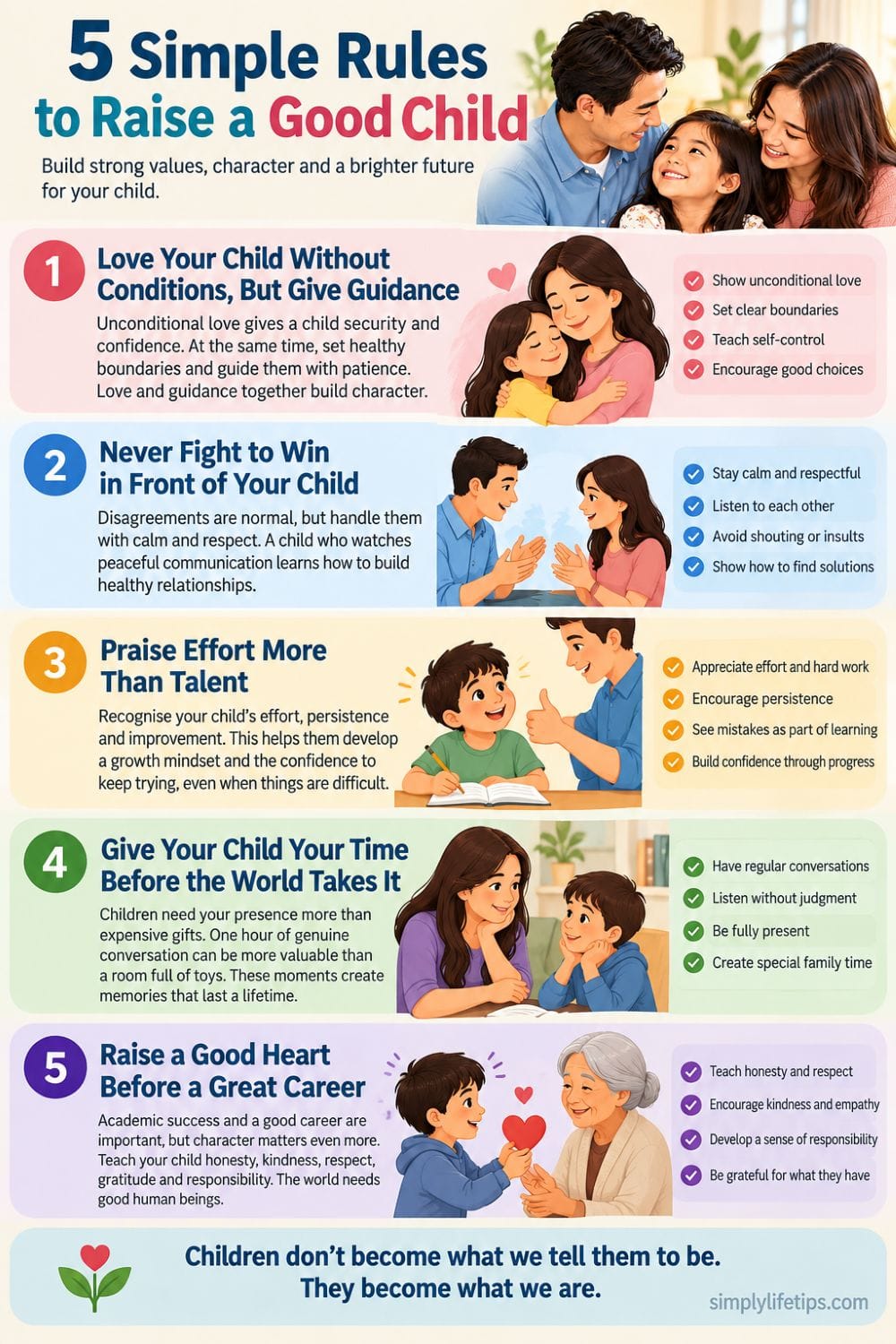
5 Simple Rules to Raise a Good Child
1. Love Your Child Without Conditions, But Give Guidance
Children need to know that they are loved even when they make mistakes. Unconditional love gives a child emotional security and helps them understand that their worth does not depend entirely on their achievements or behaviour.
However, unconditional love does not mean giving children everything they want. A loving parent can still say no. For example, if a child asks for another expensive toy even though they already have several, buying it every time may make the child happy temporarily, but it does not necessarily teach gratitude or self-control. Instead, parents can explain why the child does not need it and encourage them to appreciate what they already have.
This is where love and guidance work together. Children need affection and encouragement, but they also need reasonable boundaries. Learning that they cannot always have everything they want helps them develop patience, responsibility, and self-control. Good parenting is not about making children happy every minute. It is about helping them develop the qualities they will need throughout life.
Love, encouragement, and appropriate boundaries can also help children develop a healthy sense of confidence. Learn more about how to raise confident children
2. Never Fight to Win in Front of Your Child
Disagreements are normal in families. Parents will not always agree with each other, and pretending otherwise is unrealistic. What matters is how those disagreements are handled.
If children regularly see adults shouting, insulting each other, refusing to listen, or trying to win every argument, they may begin to believe that this is how relationships work. Instead, parents can demonstrate that disagreements can be handled with patience and respect. Saying something as simple as, “I don’t agree with you, but I understand why you feel that way. Let’s find a solution,” can demonstrate healthy communication.
Children who observe respectful communication gradually learn how to listen, express their feelings, apologise, compromise, and solve problems. Parents may think their arguments are private matters between adults, but children often notice much more than we realise. Every interaction can become a lesson about relationships.
3. Praise Effort More Than Talent
Children need encouragement, but the way we praise them matters. If a child is constantly praised for being “smart” or “naturally talented,” they may eventually become afraid of situations where they could fail or appear less capable. Instead, parents can recognise effort, persistence, preparation, and improvement.
For example, rather than simply saying, “You’re brilliant at maths,” a parent could say, “You worked hard on those problems and didn’t give up when they became difficult.” The second response acknowledges the child’s effort and persistence. It teaches the child that improvement often comes through practice rather than talent alone.
Encouraging children for their effort and progress is one practical way parents can support confidence and resilience. You can also explore these parenting tips for raising confident children.
Think about a child learning to ride a bicycle. They may fall several times before learning to balance properly. If parents focus only on success, the child may become frustrated whenever something goes wrong. But when parents encourage the effort and persistence involved, the child learns that mistakes are a normal part of learning. This can help children become more willing to try again when something becomes difficult.
4. Give Your Child Your Time Before the World Takes Your Time
Children do not necessarily need parents who are available every minute of the day. They need parents who are genuinely present when they are together. A busy parent may provide excellent education, clothes, gadgets, holidays, and other material comforts, but these things cannot completely replace meaningful connection.
Sometimes, one honest conversation at the end of the day can be more valuable than an expensive gift. Ask your child how their day went, what made them happy, what worried them, or what they learned. More importantly, listen to the answer without immediately judging, correcting, or reaching for your phone.
Childhood passes quietly. A child who once wanted to hold your hand will eventually become an adult with a life of their own. We cannot stop time, but we can make the time we have together meaningful. Family meals, bedtime conversations, weekend walks, or simply sitting together without distractions can create memories that stay with a child for years.
5. Raise a Good Heart Before a Great Career
This may be the most important rule of all. Parents naturally want their children to succeed, and there is nothing wrong with encouraging education, ambition, and professional achievement. But career success should not become the only measure of a successful life.
A child can become highly educated and still need to learn honesty. A child can become financially successful and still need to learn generosity. A child can become powerful and still need humility. A child can become intelligent and still need compassion. These qualities may not appear on a school examination, but they strongly influence the kind of person a child becomes.
Teach your child to return something that does not belong to them. Teach them to apologise when they are wrong and to thank people who help them. Teach them to care about someone who is struggling, even when there is nothing to gain from doing so. The goal is not to prevent your child from becoming successful. It is to help them understand that success and good character can grow together.
Children Learn Values by Watching Us
One of the simplest answers to how to raise a good child is to be the person you want your child to become. If you want honesty, practise honesty. If you want respect, show respect. If you want patience, demonstrate patience. If you want kindness, let your child see you being kind. If you want gratitude, express gratitude.
Children may forget many instructions their parents give them, but they are much less likely to forget the behaviour they repeatedly witness. A parent who tells a child to speak respectfully but regularly insults other people sends two very different messages. The child’s behaviour is likely to be influenced by what they see, not simply by what they hear.
This is why parenting can also become an opportunity for parents to improve themselves. We do not have to be perfect parents. We will lose patience sometimes, make mistakes, and occasionally say the wrong thing. What matters is how we respond afterwards. When a parent admits, “I was wrong. I’m sorry,” the child learns that taking responsibility and apologising are signs of maturity, not weakness.
Parents can also help daughters develop confidence by encouraging them to express themselves, make age-appropriate decisions, and believe in their abilities. Read more about how to raise a confident daughter
The Home Is a Child’s First School
Schools teach mathematics, science, languages, technology, and many other important subjects. But home teaches something even more fundamental: how to live with other people.
A child learns about love through family relationships. They learn about respect through everyday conversations. They learn responsibility through age-appropriate duties. They learn gratitude by watching parents appreciate what they have. They learn kindness by seeing how adults treat people who cannot offer them anything in return.
This does not mean parents have to create a perfect home. Every family has disagreements, stressful days, financial pressures, and difficult moments. What matters is the overall environment and the values children repeatedly experience.
When parents communicate openly, respect one another, acknowledge mistakes, and make time for their children, they provide lessons that go far beyond anything that can be taught in a classroom.
Success Begins With Character
Every parent wants their child to have opportunities. Good education matters. Financial security matters. Skills and qualifications matter. But character gives those achievements direction.
A successful person who lacks integrity can make poor choices. A talented person without responsibility may struggle to build trust. Intelligence without compassion can be used selfishly. That is why raising a good child should not be separated from preparing a child for success.
Education is important, but helping children develop curiosity, independent thinking, and a love of learning is equally valuable. See our guide on how to raise smart children for practical ideas parents can use.
Teach your child to work hard and be kind. Encourage confidence while teaching respect. Help them pursue goals while also appreciating what they already have. Teach them to stand up for themselves while understanding the feelings of others. These lessons can remain valuable long after childhood ends.
Conclusion
How to raise a good child is not about finding one perfect parenting method. It is about the small things parents do repeatedly and the example they provide every day. Love your child, set healthy boundaries, listen to them, give them your time, handle disagreements respectfully, praise their effort, teach responsibility, and show gratitude and kindness through your own actions.
Before asking whether your child attends the best school or has the most expensive opportunities, ask yourself a more important question: What does my child see when they look at me?
Children do not simply learn from what parents tell them. They learn from what parents consistently show them. A home where love, respect, discipline, gratitude, honesty, and kindness are lived every day can give a child something more valuable than material possessions: a strong foundation for life.
FAQs About How to Raise a Good Child
What is the most important part of raising a good child?
Providing a loving and supportive home while consistently modelling good values is one of the most important parts of raising a good child. Children need both emotional security and appropriate guidance.
How can parents teach children good values?
Parents can teach good values through a combination of clear guidance and personal example. Children learn honesty, respect, kindness, responsibility, and gratitude by seeing those qualities practised at home.
Should parents praise effort or intelligence?
Parents can place greater emphasis on effort, persistence, preparation, and improvement. This can encourage children to keep learning and trying when they encounter difficulties.
How much time should parents spend with their children?
There is no universal number of hours that applies to every family. What matters is the quality of interaction. Regular periods of genuine, distraction-free conversation can help strengthen the parent-child relationship.
Does good parenting mean giving children everything they want?
No. Children need love and emotional security, but they also need reasonable boundaries. Learning to handle disappointment, wait for something they want, and respect limits are important parts of growing up.

Mathukutty P V is a Blogger, YouTuber, and Content Writer and the founder of Simply Life Tips. After taking voluntary retirement in 2017, he embraced a free lifestyle focused on learning, personal growth, and sharing practical wisdom to help others live with more purpose and positivity.



