Practising 10 micro-habits for a stress-free life is the most sustainable way to transform your mental well-being because it focuses on small, manageable actions rather than overwhelming lifestyle changes. In our modern world, we are often told that “more is better”—more work, more side hustles, and more complicated self-care routines. However, when it comes to the human nervous system, “less is often more.” Stress isn’t just a feeling; it is a physical response in the body characterised by high cortisol and a racing heart. By integrating micro-habits for a stress-free life, you can effectively rewire your brain to handle the pressures of daily life with grace and calm.
Micro-Habits for a Stress-Free Life Outperform Big Changes
Most people fail at stress management because they try to “fix” everything at once. They promise themselves they will go to the gym for an hour, meditate for thirty minutes, and cook every meal from scratch. While these are great goals, they require a massive amount of willpower. On a stressful day, your willpower is the first thing to disappear. Micro-habits work because they are “too small to fail.” They bypass the “amygdala,” the part of your brain that fears change, allowing you to build a foundation of peace without the friction of a major life overhaul.
Understanding the Science of Stress
To live a stress-free life, we must understand that our bodies are still wired for a prehistoric world. When you receive a stressful email, your brain reacts as if you are being chased by a predator. This triggers the “fight or flight” response. Micro-habits act as a “manual override” for this system. By performing small, calming actions throughout the day, you signal to your brain that the “predator” isn’t real, allowing your body to return to a state of “rest and digest.”
10 Micro-habits for a Stress-Free Life
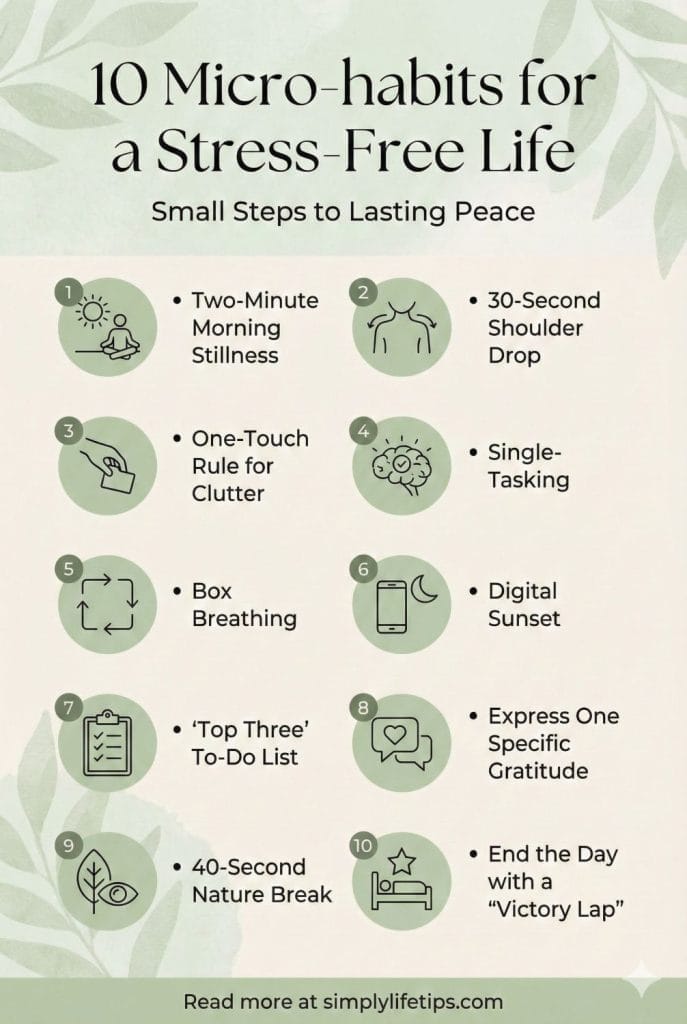
1. The Power of Two-Minute Morning Stillness
How you start your morning determines the “baseline” for your entire day. If you wake up and immediately grab your phone, you are starting in a reactive state. You are consuming other people’s problems, news, and demands before you have even had a glass of water.
How to Practice This: Before your feet even touch the floor, sit on the edge of your bed for exactly 120 seconds. Do not think about your to-do list. Just notice your breathing. Notice the temperature of the room. This tiny window of stillness creates a “buffer zone” between sleep and the demands of the day. It allows you to enter your morning as the leader of your life, not a servant to your notifications. This practice is a cornerstone of a healthy morning routine for success because it builds immediate self-awareness.
2. The 30-Second “Shoulder Drop” Technique
We often carry stress physically without even realising it. Throughout the day, check in with your body. Are your shoulders hunched up toward your ears? Is your jaw clenched? Is your stomach tight?
The Science Behind It: When we are stressed, our muscles tense up to protect us from “impact.” By consciously dropping your shoulders and unclenching your jaw, you send a physical signal back to the brain that there is no immediate danger. This is a form of biofeedback. Do this every time you sit down at your computer or every time you finish a phone call. It takes five seconds but can prevent tension headaches and chronic fatigue.
3. The One-Touch Rule for a Clearer Mind
Clutter is a silent stressor. Every unfinished task or stray item in your living space is a “visual reminder” of something you haven’t done yet. This creates a low-level background anxiety that drains your energy.
The Solution: Adopt the “One-Touch Rule.” If a task takes less than a minute—like putting a bill in a folder, hanging up your jacket, or rinsing a coffee cup—do it the moment you touch the item. Do not put it down to “deal with later.” By completing these tiny tasks instantly, you prevent the “mountain of chores” that often leads to a weekend of stress. A clear space leads to a clear mind, helping you maintain mental resilience.
4. Single-Tasking: The Antidote to Brain Fog
We live in an age of multitasking, but the human brain isn’t actually designed to do two things at once. Instead, it “task-switches” rapidly, which increases errors and doubles your stress levels.
The Micro-Habit: Pick one mundane activity every day and give it your 100% focus. If you are washing the dishes, just wash the dishes. Feel the warmth of the water and the texture of the plates. If you are walking to your car, just walk. Don’t check your phone. This “informal mindfulness” trains your brain to stay in the present moment. When you train your brain to focus on one thing at a time, you become much more efficient and much less anxious.
5. Box Breathing for Instant Physiological Reset
When stress becomes overwhelming, you need a tool that works instantly. Box breathing is a technique used by elite athletes and special forces to stay calm under extreme pressure. It works by regulating the autonomic nervous system.
How to do it:
- Inhale for 4 seconds.
- Hold your breath for 4 seconds.
- Exhale for 4 seconds.
- Hold your breath for 4 seconds. Repeat this cycle four times. It physically forces your heart rate to slow down and moves your brain out of the “red zone.” For a deeper look at how this impacts your health, you can read more about breathing techniques at the Mayo Clinic.
6. The “Digital Sunset” Habit
Your brain needs a transition period between the high-intensity stimulation of the day and the restorative state of sleep. Constant exposure to “blue light” and social media keeps your brain in an “alert” state, making deep sleep nearly impossible.
The Action Plan: Implement a “Digital Sunset” 30 minutes before you intend to sleep. Put your phone in a drawer or another room. Use this time to read a physical book, stretch, or talk to a family member. This habit protects your circadian rhythm and ensures that you wake up feeling refreshed rather than “wired and tired.” Consistent sleep is the ultimate foundation for a resilient mindset.
7. The “Top Three” To-Do List
One of the biggest sources of stress is a never-ending to-do list. When we see twenty items on a list, our brain feels defeated before we even start. This leads to procrastination, which only increases our stress later.
The Strategy: Every evening, write down the three most important things you need to do the next day. These are your “Non-Negotiables.” Once you finish these three, anything else you do is a bonus. This micro-habit changes your relationship with productivity. You move from a state of “I never do enough” to a state of “I am focused and effective.”
8. Express One Specific Moment of Gratitude
Gratitude is more than just a “feel-good” practice; it is a neurological tool. It forces the brain to scan the environment for “positives” rather than “threats.” However, general gratitude (like “I’m grateful for my health”) often loses its power over time.
The Micro-Habit: Think of one specific thing that happened in the last 24 hours that you are grateful for. Maybe it was a perfect cup of coffee, a kind word from a colleague, or a beautiful sunset. This specific focus keeps the practice fresh and effective. According to research from Harvard Health, practising gratitude consistently can significantly improve your overall happiness and reduce stress-related illnesses.
9. The 40-Second Nature Break
Modern life often keeps us trapped indoors under artificial lights. This “nature deficit” is a major contributor to stress. Fortunately, you don’t need a forest to fix this.
The Practice: Research shows that even looking at a plant, or a high-quality image of nature, for 40 seconds can improve focus and lower heart rate. Every few hours, step away from your screen. Look out a window at a tree, or even spend a moment looking at a nature screensaver. This visual “reset” tells your primitive brain that you are in a safe, resource-rich environment, which lowers your stress baseline.
10. End the Day with a “Victory Lap”
We are biologically wired with a “negativity bias.” We tend to remember the one thing that went wrong today and forget the ten things that went right. This is why many people struggle with “bedtime anxiety.”
The Habit: As you lie in bed, mentally identify one small “win” from the day. It could be as simple as “I drank enough water today” or “I was patient with my kids.” By ending your day on a positive note, you prime your brain for better sleep and a more optimistic outlook the following morning.
Overcoming the Barriers to Change
Even with micro-habits, life can get in the way. The key is to remember the “Never Miss Twice” rule. If you forget your morning stillness or your digital sunset, don’t beat yourself up. Shame is just another form of stress. Acknowledge the slip and make sure you do it the next day. The goal is progress, not perfection.
Conclusion
Building 10 micro-habits for a stress-free life is an investment in your future self. You don’t have to change who you are; you have to change the small ways you interact with your day. By taking control of these tiny moments, you prove to yourself that you are the master of your environment, not a victim of it. Over time, these small ripples of calm will turn into a deep ocean of peace that no external stressor can easily disturb.
Which of these 10 micro-habits are you going to start with today to reclaim your peace of mind?
FAQs about Micro-habits for a Stress-Free Life
How long does it actually take for a micro-habit to become permanent?
While many people believe it takes 21 days, modern research suggests it varies between 18 and 254 days, with the average being around 66 days. The beauty of micro-habits is that they are so easy to perform that the “time” doesn’t matter as much because they don’t feel like a chore.
Can micro-habits really replace a full meditation practice?
Micro-habits like “single-tasking” and “morning stillness” are essentially “micro-meditations.” While a 20-minute daily meditation is excellent, micro-habits are often more practical for people with busy schedules and provide similar benefits by keeping the nervous system regulated throughout the day.
What should I do if my job is naturally very high-stress?
In high-stress environments, micro-habits like “Box Breathing” and “Shoulder Drops” are essential survival tools. They don’t change the workload, but they change how your body processes the stress, preventing long-term burnout and physical health issues.
Is it better to do these habits at the same time every day?
Yes, “habit stacking” is a powerful technique. This means attaching a new habit to an existing one. For example, do your “Shoulder Drop” every time you sit down for lunch, or do your “Gratitude” while you are brushing your teeth.
Can children and teenagers benefit from these micro-habits?
Absolutely. Teaching children habits like box breathing or gratitude early in life gives them the emotional tools they need to handle academic and social pressure. It builds a foundation of resilience that will serve them well into adulthood.

Mathukutty P V is a Blogger, YouTuber, and Content Writer and the founder of Simply Life Tips. After taking voluntary retirement in 2017, he embraced a free lifestyle focused on learning, personal growth, and sharing practical wisdom to help others live with more purpose and positivity.