
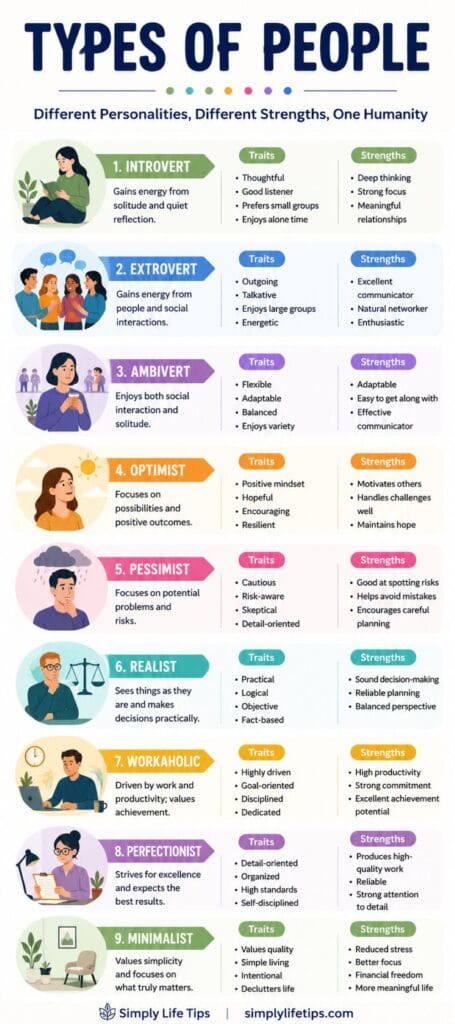
Do you know there are 9 Types of people categorized by their personalities, attitudes, habits, and approaches to life? While every individual is unique, certain personality patterns are common across cultures and societies. Understanding these personality types can help us communicate better, build stronger relationships, and gain valuable self-awareness.
For example, one person may recharge by spending time alone, while another gains energy from social gatherings. One may always look for opportunities, while another focuses on potential risks. Neither approach is completely right or wrong—they are simply different ways of experiencing the world.
Let’s explore nine common types of people and what makes each one unique.
9 Types of People
Understanding the different types of people can help us navigate relationships, improve communication, and develop greater self-awareness. While no one fits perfectly into a single category, many people display dominant personality traits that influence how they think, behave, and interact with others. Some gain energy from social interactions, while others prefer solitude. Some naturally focus on possibilities and positive outcomes, while others pay closer attention to risks and practical realities. Recognizing these personality types allows us to appreciate individual differences, reduce misunderstandings, and build stronger connections in both personal and professional life. The following personality types represent some of the most common ways people approach the world around them.
1. The Introvert
An introvert is someone who gains energy from solitude and quiet reflection. Introverts enjoy meaningful conversations but may feel drained by excessive social interaction.
Common traits include:
- Thoughtful and reflective
- Good listeners
- Prefer smaller groups
- Enjoy alone time
For example, after attending a large event, an introvert may prefer spending time alone reading a book or relaxing quietly to recharge.
Strengths
- Deep thinking
- Strong focus
- Meaningful relationships
- Excellent listening skills
Challenges
- May appear reserved or distant
- Can struggle with large social gatherings
2. The Extrovert
An extrovert gains energy from interacting with people and participating in social activities. They often enjoy meeting new people and sharing ideas openly.
Common traits include:
- Outgoing personality
- Strong communication skills
- Enthusiastic and energetic
- Enjoy teamwork
For example, an extrovert may feel excited after attending a networking event and meeting many new people.
Strengths
- Excellent social skills
- Natural networking ability
- High enthusiasm
Challenges
- May sometimes dominate conversations
- Can become restless when alone for long periods
Do you know the difference between introverts and extroverts?
3. The Ambivert
An ambivert combines qualities of both introverts and extroverts. They can enjoy social situations while also appreciating solitude.
Common traits include:
- Flexible personality
- Balanced social behavior
- Adaptable communication style
- Comfortable in different environments
For example, an ambivert may enjoy a party on Saturday and a quiet day at home on Sunday.
Strengths
- Adaptability
- Balanced perspective
- Effective communication
Challenges
- Sometimes difficult to predict personal preferences
4. The Optimist
An optimist focuses on possibilities, opportunities, and positive outcomes.
Common traits include:
- Positive mindset
- Hopeful outlook
- Encouraging attitude
- Resilience during setbacks
For example, when facing a business failure, an optimist sees it as a learning experience rather than a permanent defeat.
Strengths
- Motivates others
- Handles challenges well
- Maintains hope during difficult times
Challenges
- May underestimate risks or obstacles
5. The Pessimist
A pessimist tends to focus on potential problems and negative outcomes.
Common traits include:
- Cautious thinking
- Risk awareness
- Skepticism
- Attention to possible failures
For example, before starting a project, a pessimist may identify every possible challenge that could arise.
Strengths
- Good at spotting risks
- Helps avoid costly mistakes
- Encourages careful planning
Challenges
- May focus too heavily on negatives
- Can discourage others unintentionally
6. The Realist
A realist evaluates situations based on facts rather than emotions or assumptions.
Common traits include:
- Practical thinking
- Balanced judgment
- Logical decision-making
- Evidence-based approach
For example, a realist planning a vacation considers budget, weather, and logistics before making decisions.
Strengths
- Sound decision-making
- Objective thinking
- Reliable planning
Challenges
- May appear less enthusiastic than optimists
7. The Workaholic
A workaholic places a strong emphasis on work and productivity. Success and achievement often become central priorities.
Common traits include:
- Highly driven
- Goal-oriented
- Strong work ethic
- Dedicated to career growth
For example, a workaholic may continue working late into the evening even after completing regular office hours.
Strengths
- High productivity
- Strong commitment
- Excellent achievement potential
Challenges
- Risk of burnout
- Neglecting personal relationships
- Poor work-life balance
8. The Perfectionist
A perfectionist strives for exceptionally high standards and seeks flawless results.
Common traits include:
- Detail-oriented
- Organized
- Quality-focused
- Highly disciplined
For example, a perfectionist may revise a presentation multiple times before feeling satisfied with it.
Strengths
- Produces high-quality work
- Strong attention to detail
- Reliable performance
Challenges
- Fear of mistakes
- Procrastination due to high standards
- Increased stress levels
A perfectionist constantly strives to get everything right and often sets exceptionally high standards for themselves. Rather than embracing self-acceptance, they may tie their sense of worth to flawless performance, making it difficult to feel satisfied with their achievements. As a result, even small mistakes can feel significant, creating ongoing pressure and self-criticism.
9 Destructive Perfectionist Habits: Ways To Overcome And Thrive
9. The Minimalist
A minimalist believes in simplicity and focuses on what truly matters.
Common traits include:
- Values quality over quantity
- Prefers simplicity
- Avoids unnecessary possessions
- Prioritizes intentional living
For example, a minimalist may choose a smaller wardrobe containing only essential and frequently used items.
Strengths
- Reduced stress
- Better focus
- Improved financial discipline
- Greater appreciation for meaningful experiences
Challenges
- Others may misunderstand their lifestyle choices
- Can become overly restrictive if taken to extremes
Minimalist living is a conscious lifestyle choice that prioritises simplicity, clarity, and purpose.
How do these 9 Types of People Influence Daily Life?
These personality types affect how people make decisions, build relationships, handle challenges, and pursue goals.
An introvert may prefer deep one-on-one conversations, while an extrovert enjoys group discussions. An optimist sees opportunities where a pessimist sees risks. A realist balances both perspectives. A workaholic prioritizes achievement, a perfectionist focuses on quality, and a minimalist emphasizes simplicity.
Most people are not limited to a single category. For instance, someone can be an ambivert, an optimist, and a minimalist at the same time. Personality is often a combination of multiple traits working together.
FAQs – Types of People
Can a person belong to more than one personality type?
Yes. Most people display characteristics from several personality types rather than fitting perfectly into one category.
Which personality type is the best?
There is no best personality type. Each has unique strengths and challenges that can be valuable in different situations.
Can personality types change over time?
Yes. Life experiences, age, responsibilities, and personal growth can influence personality traits.
Are introverts shy?
Not necessarily. Many introverts are confident and socially skilled but simply prefer limited social interaction and need time alone to recharge.
Can a workaholic maintain a healthy lifestyle?
Yes, but it requires intentional work-life balance, proper rest, healthy relationships, and effective stress management.
Conclusion
Understanding these types of people—introverts, extroverts, ambiverts, optimists, pessimists, realists, workaholics, perfectionists, and minimalists—helps us better understand ourselves and those around us. Each personality type brings valuable strengths and unique perspectives to life. Rather than labeling people, the goal should be to appreciate differences, learn from one another, and develop a balanced approach that combines the best qualities of each type.
Which of these personality types describes you the most?
If this resonated with you, share it with someone who needs it.
PVM

Mathukutty P V is a Blogger, YouTuber, and Content Writer and the founder of Simply Life Tips. After taking voluntary retirement in 2017, he embraced a free lifestyle focused on learning, personal growth, and sharing practical wisdom to help others live with more purpose and positivity.