
Powerful life laws are simple principles that explain why people succeed, fail, procrastinate, solve problems, and make decisions. While these laws are not scientific rules, they are practical observations that have helped countless people improve their productivity, thinking, and effectiveness.
Many of the challenges we face every day have already been studied and summarized into simple concepts. By understanding these powerful life laws, you can avoid common mistakes, make smarter choices, and achieve better results in both your personal and professional life.
Why Powerful Life Laws Matter?
Life often feels complicated because we focus on individual situations instead of underlying patterns. Powerful life laws help us recognize these patterns and respond more effectively.
For example, if you understand why work expands to fill available time or why a small percentage of your efforts generate most of your results, you can make significant improvements without working harder.
The following seven powerful life laws provide valuable insights into productivity, success, and decision-making.
7 Most Powerful Life Laws for Success and Better Decisions
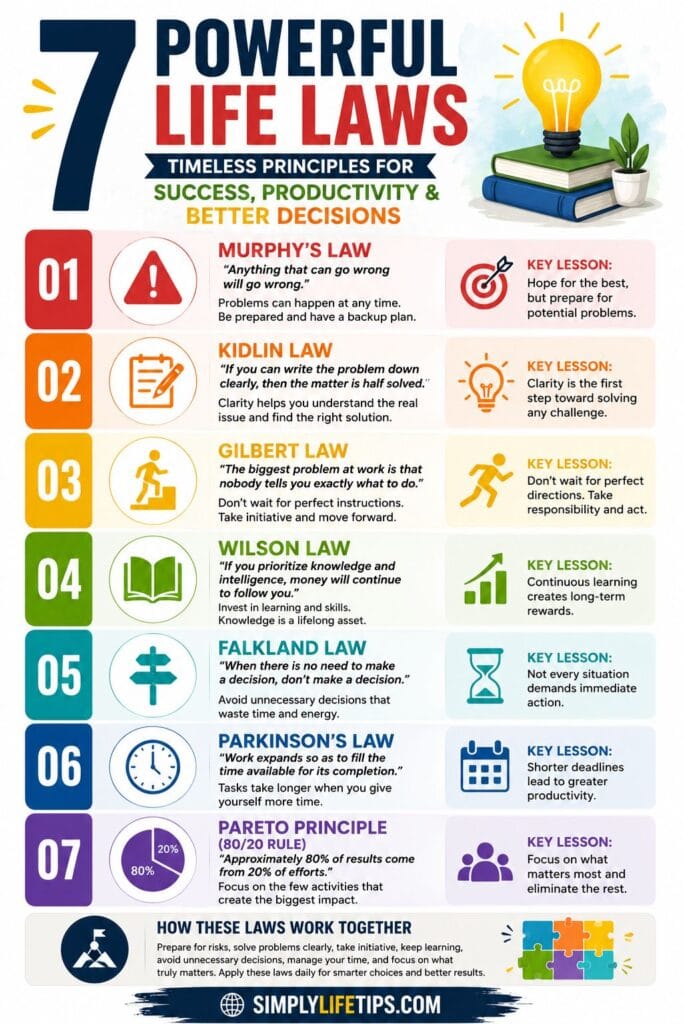
1. Murphy’s Law: Be Prepared for Problems
Murphy’s Law states:
“Anything that can go wrong will go wrong.”
At first glance, this law sounds negative. However, its true purpose is preparation.
Imagine planning an important business presentation. Your laptop suddenly stops working. If you have a backup copy stored online or on a USB drive, the situation becomes manageable.
Successful organizations often build systems around Murphy’s Law by creating backup plans, safety checks, and contingency procedures.
Key Lesson: Anticipate problems before they occur and prepare accordingly.
2. Kidlin Law: Define the Problem Clearly
Kidlin Law states:
“If you can write the problem down clearly, then the matter is half solved.”
Many people struggle because they do not fully understand the real problem they are facing.
For example, someone may say, “My business is failing.” However, after writing down the issue, they may discover that the actual problem is declining customer retention, poor marketing, or weak pricing strategies.
The clearer the problem becomes, the easier the solution becomes.
Key Lesson: Clarity is the foundation of effective problem-solving.
3. Gilbert Law: Take Initiative
Gilbert Law suggests:
“The biggest problem at work is that nobody tells you exactly what to do.”
Many people spend valuable time waiting for perfect instructions. Successful individuals often move forward despite uncertainty.
Consider an employee who notices inefficiencies in a workflow. Instead of waiting for management to fix the issue, they propose improvements and help implement solutions.
Leaders, entrepreneurs, and innovators understand that success often requires action before certainty.
Key Lesson: Don’t wait for perfect guidance; take responsibility and act.
4. Wilson Law: Invest in Knowledge
Wilson Law teaches that:
“If you prioritize knowledge and intelligence, money will continue to follow you.”
Skills and knowledge are assets that continue to generate value over time.
For example, someone who invests time learning digital marketing, communication, leadership, or technology often creates opportunities that would not otherwise exist.
Many successful professionals devote time every day to reading, learning, and developing new skills.
Key Lesson: Continuous learning creates long-term rewards.
5. Falkland Law: Avoid Unnecessary Decisions
Falkland Law states:
“When there is no need to make a decision, don’t make a decision.”
People often waste energy worrying about situations that do not require immediate action.
For example, an investor may panic over short-term market fluctuations and make poor decisions. In many cases, waiting for additional information leads to better outcomes.
Patience is often more valuable than rushed action.
Key Lesson: Not every situation requires an immediate response.
6. Parkinson’s Law: Control Your Time
Parkinson’s Law states:
“Work expands to fill the time available for its completion.”
Have you ever noticed that a task often takes much longer when you give yourself extra time?
A report that could be completed in two hours may consume an entire day if no deadline exists.
Students, professionals, and business owners frequently improve productivity by creating shorter, realistic deadlines.
Examples include:
- Limiting meetings to 20 minutes.
- Setting a one-hour deadline for email management.
- Creating focused work sessions for important projects.
Key Lesson: Tight deadlines encourage focus and efficiency.
7. Pareto Principle (80/20 Rule): Focus on What Matters Most
The Pareto Principle, also known as the 80/20 Rule, states:
“Approximately 80% of results come from 20% of efforts.”
This principle appears in almost every area of life.
Examples include:
- 20% of customers generate 80% of revenue.
- 20% of products produce 80% of profits.
- 20% of habits contribute to 80% of personal growth.
- 20% of blog posts generate 80% of website traffic.
Understanding this principle allows you to focus on activities that produce the highest returns.
Key Lesson: Identify and prioritize the few actions that create the greatest results.
How These Powerful Life Laws Work Together?
Each of these powerful life laws addresses a different aspect of success.
- Murphy’s Law helps you prepare for risks.
- Kidlin Law helps you identify problems clearly.
- Gilbert Law encourages initiative.
- Wilson Law promotes continuous learning.
- Falkland Law teaches patience.
- Parkinson’s Law improves productivity.
- Pareto Principle helps you prioritize effectively.
When combined, these principles create a practical framework for better decision-making and personal growth.
Applying Powerful Life Laws in Everyday Life
Imagine you are trying to grow a blog.
You use Kidlin Law to identify why traffic is low.
You apply the Pareto Principle and discover that a few articles generate most of your visitors.
You use Parkinson’s Law to establish content deadlines.
You follow Wilson Law by learning SEO and content marketing.
You apply Murphy’s Law by regularly backing up your website.
You follow Falkland Law by avoiding unnecessary decisions that waste time.
You embrace Gilbert Law by taking action instead of waiting for perfect conditions.
Together, these powerful life laws help create consistent progress and better results.
FAQs – Powerful Life Laws
What are powerful life laws?
Powerful life laws are practical principles that explain common patterns in human behavior, productivity, decision-making, and success.
Which powerful life law is most useful?
The Pareto Principle and Parkinson’s Law are among the most widely applied because they directly improve productivity and focus.
Is Murphy’s Law negative?
No. Murphy’s Law encourages preparation and risk management rather than pessimism.
How can I apply the Pareto Principle in daily life?
Identify the small number of activities that create the biggest results and focus more time on them.
Why is continuous learning important according to Wilson Law?
Knowledge and skills create long-term opportunities and often lead to greater success over time.
Conclusion
The most successful people often understand patterns that others overlook. These powerful life laws provide valuable insights into productivity, problem-solving, decision-making, and personal growth. By applying Murphy’s Law, Kidlin Law, Gilbert Law, Wilson Law, Falkland Law, Parkinson’s Law, and the Pareto Principle, you can make smarter choices, avoid common mistakes, and focus your energy where it matters most.
Which of these powerful life laws do you already see operating in your life today?
If this resonated with you, share it with someone who needs it.
PVM

Mathukutty P V is a Blogger, YouTuber, and Content Writer and the founder of Simply Life Tips. After taking voluntary retirement in 2017, he embraced a free lifestyle focused on learning, personal growth, and sharing practical wisdom to help others live with more purpose and positivity.