How can you disagree without starting a conflict when emotions are high, and opinions are completely different? Learning to disagree without starting a conflict is one of the most valuable communication skills you can develop. Whether you are discussing politics with friends, making decisions with your spouse, or debating ideas at work, disagreements are inevitable. However, arguments, resentment, and damaged relationships do not have to be.
Many people believe that disagreement automatically leads to conflict. In reality, healthy disagreement can strengthen relationships, improve decision-making, and help people see issues from different perspectives. The key is learning how to express your views respectfully while remaining open to understanding others.
In this guide, you will learn practical ways to disagree without starting conflict, along with real-life examples and actionable tips that you can apply immediately.
Why Learning to Disagree Without Starting a Conflict Matters?
Disagreement is a normal part of human interaction. Every person has unique experiences, beliefs, and perspectives. When people share ideas openly and respectfully, they often discover better solutions and a deeper understanding.
Unfortunately, many discussions quickly become arguments because people focus on winning rather than understanding.
For example, imagine a husband and wife discussing household expenses. One wants to save money while the other wants to spend on a family vacation. If both insist on being right, the conversation may turn into a fight. However, if they listen to each other and seek a compromise, they can find a solution that satisfies both.
Learning to disagree without starting conflict helps you:
- Build stronger relationships
- Increase trust and respect
- Improve problem-solving skills
- Reduce stress and tension
- Enhance emotional intelligence
- Become a better leader and communicator
How to Disagree Without Starting a Conflict?
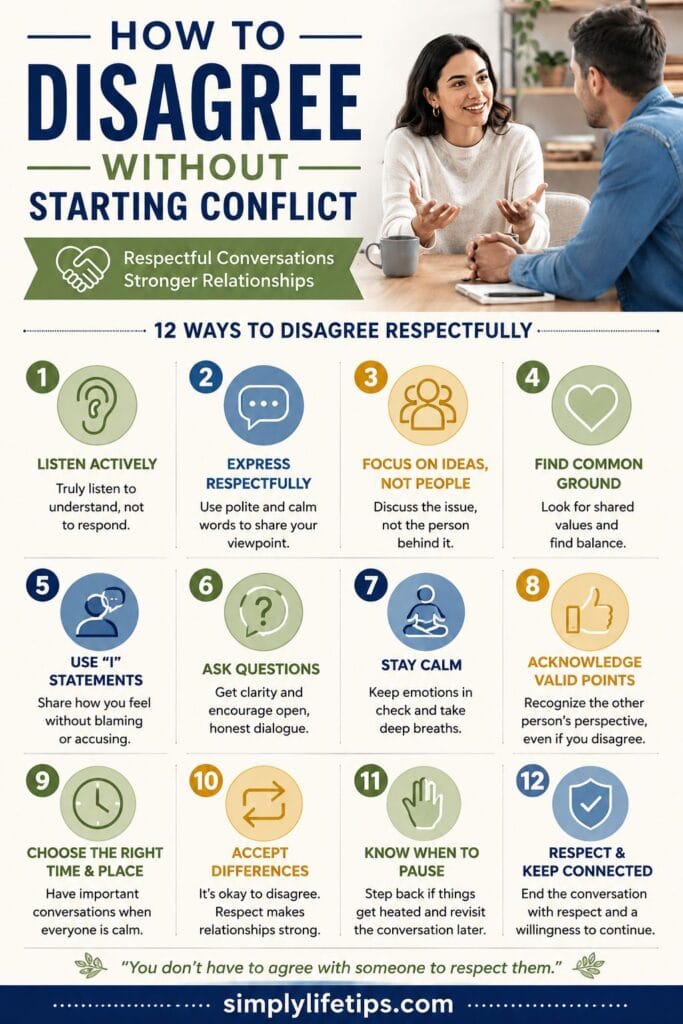
Understand Before You Respond
One of the biggest communication mistakes is listening only to prepare a response.
People often assume they already know what the other person is trying to say. As a result, they interrupt, become defensive, and miss important information.
Instead, focus on understanding before responding.
For example, if a coworker proposes a strategy that you disagree with, ask questions such as:
- “Can you explain your reasoning?”
- “What benefits do you see in this approach?”
- “What concerns are you trying to address?”
These questions show respect and create an environment where productive discussion can occur.
Tip
Before sharing your opinion, summarize what the other person said. This demonstrates that you genuinely listened.
Listen Actively to Disagree Without Starting a Conflict
Active listening is one of the most effective tools for preventing conflict.
When people feel heard, they are less likely to become defensive.
Active listening involves:
- Maintaining eye contact
- Avoiding interruptions
- Paying attention to emotions
- Asking clarifying questions
- Reflecting what was said
For example, instead of immediately rejecting a friend’s opinion, you might say:
“I understand why you feel that way because of your experience.”
This simple statement can dramatically reduce tension.
Example
A manager who listens carefully to employee concerns often resolves workplace disagreements more effectively than one who immediately dismisses opposing viewpoints.
Learn 10 essential active listening phrases that help you communicate more effectively, strengthen relationships, and create deeper understanding in every conversation.
Use Respectful Language
The words you choose can either calm a discussion or ignite an argument.
Harsh language often shifts attention away from the issue and toward personal feelings.
Avoid phrases such as:
- “You’re wrong.”
- “That’s ridiculous.”
- “You don’t know what you’re talking about.”
Instead, use language like:
- “I see things differently.”
- “That’s an interesting perspective.”
- “Here’s another way to look at it.”
Respectful language allows people to remain open-minded rather than defensive.
Example
Instead of saying, “Your idea won’t work,” try saying, “I have some concerns about how this might work in practice.”
The message remains the same, but the delivery is far more constructive.
Focus on the Issue, Not the Person
To disagree without starting conflict, separate ideas from identities.
Attacking a person’s character almost always escalates tension.
Compare these two responses:
Personal Attack:
“You are irresponsible.”
Issue-Focused Response:
“I think this decision may create some challenges.”
The first statement attacks the individual. The second addresses the situation.
When discussing difficult topics, focus on facts, actions, and solutions rather than personal traits.
Use “I” Statements Instead of “You” Statements
“I” statements help communicate feelings without assigning blame.
For example:
Instead of:
“You never listen to me.”
Say:
“I feel unheard when I’m interrupted.”
The difference is significant.
“You” statements often make people feel accused, while “I” statements encourage understanding.
Example
In relationships, couples who use “I” statements tend to resolve disagreements more effectively because discussions remain focused on feelings rather than accusations.
Acknowledge Valid Points
You do not have to completely agree with someone to recognize their valid points.
Acknowledgment demonstrates respect and creates common ground.
Examples include:
- “That’s a good observation.”
- “I can understand your concern.”
- “You make a valid point.”
For example, if you disagree with a colleague’s proposal, you might acknowledge the strengths of their idea before explaining your concerns.
People are more willing to listen when they feel respected.
Control Your Emotions
Emotional reactions often turn small disagreements into major conflicts.
When emotions rise:
- Take a deep breath.
- Pause before responding.
- Speak slowly.
- Focus on facts.
- Avoid reacting impulsively.
Example
Imagine receiving criticism during a meeting. An immediate emotional response may worsen the situation. Taking a moment to process the feedback allows for a more thoughtful and productive discussion.
Staying Calm Under Pressure: How to Control Emotions and Think Clearly
Emotional control is one of the most powerful ways to disagree without starting a conflict.
Ask Questions Instead of Making Assumptions
Assumptions are dangerous because they are often incorrect.
Instead of assuming motives, ask questions.
For example:
Rather than saying:
“You don’t care about this project.”
Ask:
“What are your priorities regarding this project?”
Questions encourage dialogue. Assumptions create defensiveness.
Tip
Approach disagreements with curiosity rather than judgment.
Curiosity opens doors. Judgment closes them.
Choose the Right Time and Place
Timing can significantly affect the outcome of a discussion.
Even a respectful disagreement may become a conflict if someone is:
- Stressed
- Tired
- Angry
- Distracted
For example, discussing an important family issue late at night after a difficult day may not be productive.
Choosing an appropriate time demonstrates consideration and increases the likelihood of a positive conversation.
Accept That Not Everyone Will Agree
Many conflicts occur because people believe agreement is necessary.
In reality, healthy relationships can exist despite significant differences.
Friends may disagree about politics.
Family members may disagree about life choices.
Coworkers may disagree about business strategies.
The goal is not always agreement.
The goal is mutual respect.
Sometimes the best response is:
“I respect your opinion, even though I see things differently.”
This mindset helps you disagree without starting conflict while preserving relationships.
Know When to End the Discussion
Not every disagreement needs a final winner.
If a conversation becomes repetitive or emotionally charged, stepping away may be the healthiest choice.
You can say:
- “Let’s continue this later.”
- “I appreciate hearing your perspective.”
- “I think we understand each other’s viewpoints.”
Ending a discussion respectfully can prevent unnecessary damage to a relationship.
Example
Professional negotiators often take breaks during difficult discussions because distance and reflection can improve decision-making.
Common Mistakes That Turn Disagreements Into Conflicts
Avoid these common communication mistakes:
- Interrupting others
- Raising your voice
- Using sarcasm
- Making personal attacks
- Bringing up past mistakes
- Assuming bad intentions
- Refusing to listen
- Trying to win at all costs
For example, a simple disagreement about household responsibilities can quickly escalate when old arguments are introduced.
Stay focused on the current issue.
Benefits of Learning to Disagree Without Starting a Conflict
People who master respectful disagreement often experience:
- Better relationships
- Greater trust
- Improved teamwork
- Stronger leadership skills
- Better emotional control
- Increased confidence
- More productive discussions
Whether at home or at work, the ability to handle differences respectfully can positively impact every area of life.
FAQs – Disagree Without Starting a Conflict
Why is it important to disagree without starting a conflict?
Disagreeing respectfully helps maintain relationships, encourages productive discussions, and reduces unnecessary stress and tension.
Can disagreement strengthen relationships?
Yes. Healthy disagreements can improve understanding, build trust, and help people solve problems more effectively.
What is the best way to disagree respectfully?
Listen carefully, remain calm, use respectful language, and focus on understanding rather than winning.
How do I stay calm during a disagreement?
Pause before responding, control your breathing, focus on facts, and avoid reacting emotionally.
What should I do if the other person becomes angry?
Stay calm, avoid escalating the situation, acknowledge their feelings, and consider pausing the conversation if necessary.
Conclusion
Learning to disagree without starting conflict is an essential life skill that can improve relationships, strengthen communication, and reduce unnecessary tension. Disagreements are a natural part of life, but they do not have to become arguments. By listening actively, speaking respectfully, controlling emotions, and focusing on understanding rather than winning, you can express different opinions without damaging relationships. The ability to disagree respectfully is not a sign of weakness—it is a sign of maturity, confidence, and emotional intelligence.
“Respectful disagreement builds bridges, while hostile disagreement builds walls.”
What strategy helps you disagree without starting a conflict in your daily conversations?
References
- Carnegie, Dale. How to Win Friends and Influence People.
- Goleman, Daniel. Emotional Intelligence.
- Covey, Stephen R. The 7 Habits of Highly Effective People.
- Stone, Douglas, Patton, Bruce, and Heen, Sheila. Difficult Conversations.
If this resonated with you, share it with someone who needs it.
PVM

Mathukutty P V is a Blogger, YouTuber, and Content Writer and the founder of Simply Life Tips. After taking voluntary retirement in 2017, he embraced a free lifestyle focused on learning, personal growth, and sharing practical wisdom to help others live with more purpose and positivity.