

Learning how to reprogram your subconscious mind before sleep can help you develop healthier habits, strengthen positive thinking and prepare for personal growth. The thoughts you revisit, the behaviours you repeat and the routines you follow can influence how you respond to everyday situations.
Your evening routine offers a valuable opportunity to slow down, reflect on your experiences and prepare for the following day. Instead of going to bed worrying about unfinished tasks or tomorrow’s challenges, you can use a few quiet minutes to review your goals, practise gratitude and identify positive actions you want to take.
Although your mind cannot be magically reprogrammed overnight, consistent bedtime practices can support self-awareness, encourage constructive thinking and help you develop more helpful behavioural patterns over time.
The good news is that you don’t need complicated techniques or hours of practice. Just 10–15 minutes each evening can give you a simple starting point.
Let’s explore five practical ways to make your bedtime routine more meaningful and support positive changes in your daily life.
Before exploring practical techniques for changing established thought patterns and behaviours, it helps to understand how the subconscious mind works.
What Does It Mean to Reprogram Your Subconscious Mind?
To reprogram your subconscious mind, it helps to understand how automatic thoughts, learned beliefs and repeated behaviours influence your everyday responses. Many of these patterns develop through repeated experiences, familiar surroundings and habits that become part of your daily routine.
For example, imagine that you often tell yourself, “I’m not good enough” whenever you face a difficult task. Over time, this thought may affect your confidence and encourage you to avoid new challenges. By recognising this pattern, questioning whether it is accurate and practising a more balanced response, you can gradually develop a healthier way of thinking.
The same principle applies to everyday habits. If you automatically check your phone whenever you feel bored, you can learn to recognise the trigger and practise a different response, such as reading a few pages of a book or returning to an unfinished task.
You cannot reprogram your subconscious mind overnight, erase memories or control every thought. It is better understood as a gradual process of becoming aware of automatic patterns and developing more helpful ways of thinking and behaving through consistent practice.
The goal is not to force yourself to think all the time positively. It is to recognise unhelpful patterns, strengthen constructive responses and make choices that support the life you want to build.
A 2024 systematic review found that habit formation varies considerably between individuals and behaviours, highlighting the importance of consistent practice rather than expecting instant results. Read the systematic review on habit formation.
Why Is Your Evening Routine Important?
Your evening routine can influence how you end the day and prepare for the next one. After a busy day, your mind may still be occupied with unfinished tasks, personal worries, work-related problems or plans for tomorrow. Taking a few minutes to slow down and reflect can help you approach bedtime with greater clarity.
A simple evening routine also allows you to review your behaviour and identify areas where you would like to improve. For example, if you spent too much time scrolling through social media, you can consider what triggered that behaviour and decide how to manage your phone use the following day. Similarly, reviewing an important goal can help you identify one practical action to take tomorrow.
Another benefit is consistency. When you repeat a few helpful activities at roughly the same time each evening, they can gradually become familiar habits. Planning tomorrow, writing a short journal entry, or practising gratitude can become natural parts of your bedtime routine.
Your evening routine does not need to be complicated or time-consuming. Even 10–15 minutes of purposeful reflection and preparation can help you finish the day more thoughtfully and begin the next with a clearer intention.
These five ways to reprogram your subconscious mind before sleep can make your evening routine more purposeful.
5 Ways to Reprogram Your Subconscious Mind Before Sleep
These five ways to reprogram your subconscious mind before sleep can make your evening routine more purposeful.
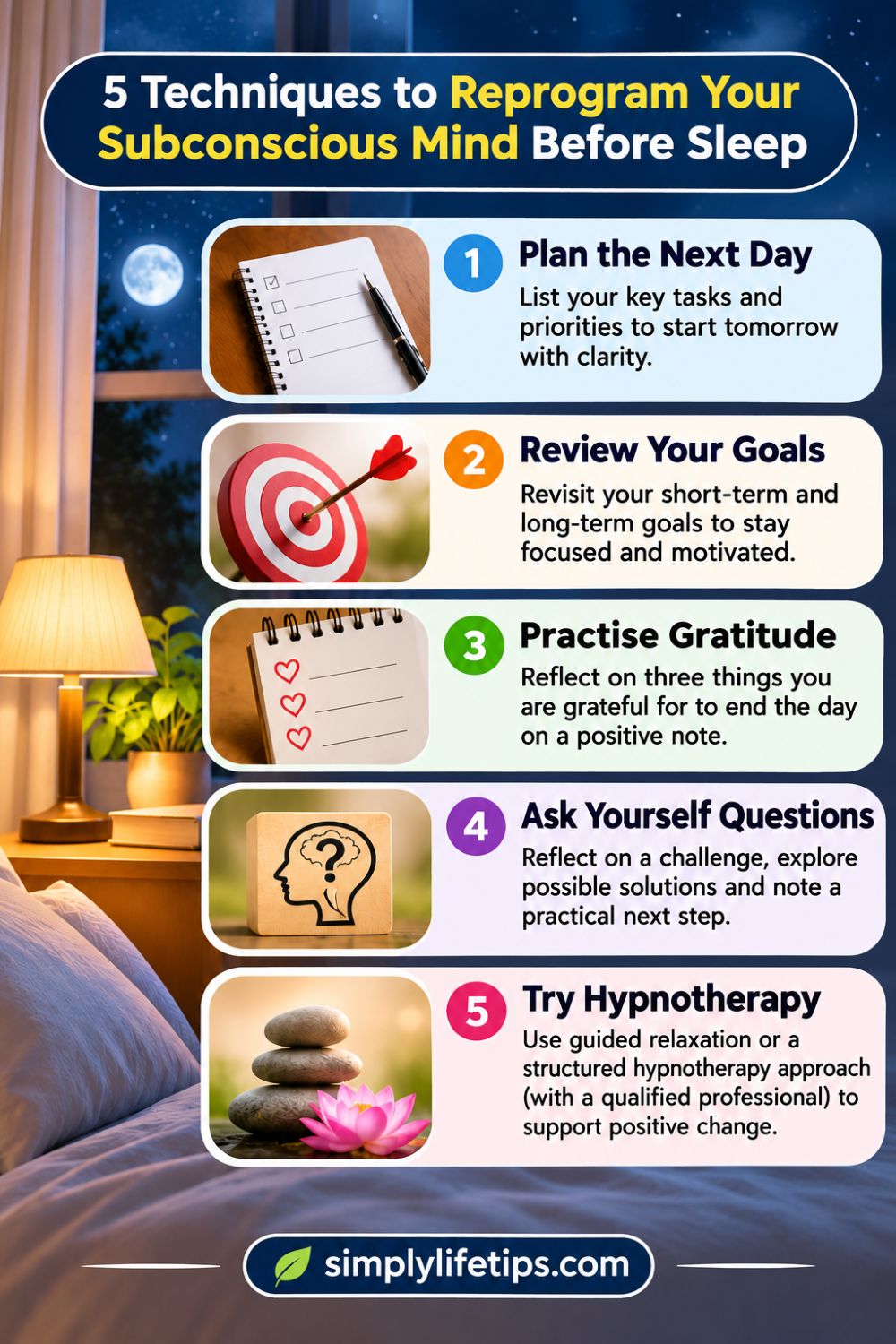
Each technique offers a different way to reflect on your day, prepare for tomorrow and develop healthier patterns. Let’s look at how you can practise them in your daily routine.
1. Plan Your Day Before You Go to Bed
Planning your day before bed is a simple way to prepare for a more organised and productive morning. Instead of waking up wondering what to do first, spend a few minutes deciding which tasks deserve your attention and how you will approach them.
Start by writing down the most important things you want to accomplish the following day. Choose two or three realistic priorities rather than creating an unnecessarily long to-do list. Decide when you will wake up, which task you will tackle first and how you will manage your available time.
For example, if you want to develop a regular writing habit, you could plan to spend 30 minutes writing after your morning coffee. Keep your notebook or laptop ready and decide which topic you will work on. Having a clear starting point can make it easier to begin rather than postpone the task.
You can also prepare simple things in advance, such as arranging your clothes, organising your workspace or keeping important items ready. These small actions reduce morning decisions and help you follow your plan.
Planning tomorrow does not guarantee success, but it can reduce uncertainty and make your intentions more actionable. A few minutes of preparation each evening can help you approach the next day with greater clarity and purpose.
2. Review Your Goals Every Night
Reviewing your goals before going to bed can help you stay focused on what matters and remind you of the changes you want to make in your life. Instead of simply thinking about success, take a few minutes to revisit your goals and consider the actions needed to achieve them.
You can write your goals in a journal, read them from a notebook or look at a vision board. Choose a quiet moment to reflect on your progress and identify one practical step you can take the following day.
For example, if your goal is to develop a successful blog, you might review your content plan, identify an article you need to complete and decide when you will work on it tomorrow. If your goal is to improve your health, you could plan a short walk, prepare a healthy meal or decide to follow a regular sleep schedule.
You don’t need to review a long list of ambitions every night. Focus on a few meaningful goals and connect each one with a realistic action. Repeatedly reviewing your intentions and taking consistent steps can help you maintain motivation and develop habits that support long-term progress.
Remember, reviewing goals is not a substitute for action. Use this time to clarify your priorities and prepare yourself to follow through the next day.
Research on implementation intentions suggests that making specific plans about when, where and how to perform an action can improve the likelihood of remembering to carry it out. This makes practical planning more useful than simply thinking about what you want to achieve. Read the research on implementation intentions.
3. Practise Gratitude
Practising gratitude before going to bed is a simple way to end your day by recognising the people, experiences and moments you appreciate. Even when you have faced difficulties, taking a few minutes to notice something positive can help you develop a more balanced outlook on life.
You don’t need a lengthy exercise. Spend a few minutes thinking about three things you are grateful for. They could be the support of a family member, a helpful conversation with a friend, good health, a personal achievement or simply a peaceful moment during a busy day.
For example, you might write:
- I am grateful to my family for supporting me today.
- I appreciate the opportunity to learn something new.
- I am thankful that I completed an important task.
You can also express your appreciation directly by thanking someone, sending a thoughtful message or telling a family member how much you value them.
Make your gratitude specific and genuine rather than forcing yourself to feel positive. You don’t have to ignore problems or pretend that every day is perfect. The purpose is to recognise what is meaningful alongside the challenges you experience.
By making gratitude part of your evening routine, you can develop a regular opportunity to reflect on what matters to you. You can also read our guide on the power of gratitude for more practical ideas.
4. Ask Yourself Questions Before Sleep
Before going to bed, take a few quiet minutes to think about a question or challenge that has been occupying your mind. Instead of carrying worries into the night, write down the issue and consider what you can do to address it. This simple reflection can help you organise your thoughts and approach problems more calmly.

For example, if you are struggling to complete an important project, ask yourself:
- What is the main difficulty I am facing?
- What have I already tried?
- What information or support do I need?
- What is one practical step I can take tomorrow?
Write down any ideas that come to mind, even if they are not complete solutions. You can also leave the question in your journal and revisit it the following morning with a fresh perspective.
Sometimes, after taking a break from a problem, you may notice a possible solution more easily. However, this does not mean that your subconscious mind automatically solves every problem while you sleep. Meaningful solutions usually require reflection, information and practical effort.
You can use this technique for different areas of life, including work, relationships, personal goals and everyday decisions. The aim is to replace vague worrying with clear questions and manageable next steps.
Remember: Don’t pressure yourself to find an answer immediately. Ask a useful question, record your thoughts and take one practical step when you are ready.
5. Hypnotherapy
Hypnotherapy is a therapeutic approach that uses guided relaxation, focused attention and suggestion to help people explore thoughts, feelings and behavioural patterns. It may be useful for certain concerns, such as managing stress, addressing specific fears and supporting behaviour change, depending on the individual and the approach used.

Unlike ordinary bedtime affirmations or positive thinking, hypnotherapy is best approached as a structured therapeutic technique. A qualified and appropriately trained hypnotherapist can guide you through the process and help you work towards specific goals.
Some people also use guided relaxation or hypnosis recordings at home. If you choose this approach, use reputable material designed for relaxation or a specific personal-development goal. Follow the instructions while you are awake and comfortably settled rather than relying on recordings playing throughout the night.
It is important to understand that hypnotherapy does not give someone complete control over their subconscious mind, erase unwanted memories or guarantee instant behavioural change. Its effectiveness varies, and it is not a replacement for appropriate medical or mental-health treatment.
Remember that hypnotherapy is only one approach to reprogram your subconscious mind. You can also develop healthier thought patterns through repeated behaviours, self-awareness and consistent daily practice.
If you are considering hypnotherapy for a psychological or health concern, consult a qualified healthcare professional to determine whether it is suitable for you.
Conclusion
Learning how to reprogram your subconscious mind before sleep is not about changing your thoughts overnight or expecting instant success. It is about using a few quiet minutes each evening to develop self-awareness, review your goals and prepare for better choices.
Simple practices such as planning the next day, reviewing your goals, practising gratitude, reflecting on challenges and exploring guided relaxation can make your evening routine more meaningful. When repeated consistently, these activities can support healthier habits and more deliberate behaviour.
You don’t need to follow all five techniques every night. Start with one or two that suit your needs and make them part of your regular bedtime routine. Be patient with yourself, take practical action and allow positive changes to develop gradually.
A better tomorrow often begins with the small decisions you make today.
What do you usually do before going to sleep? Do you plan the next day, review your goals or practise gratitude? Share your bedtime routine in the comments.
Frequently Asked Questions
1. How can I reprogram my subconscious mind before I sleep?
You cannot completely reprogram your mind overnight. However, bedtime reflection, goal planning, gratitude and consistent habits can help you develop greater self-awareness and more constructive behavioural patterns over time.
2. What is the best way to reprogram your subconscious mind?
There is no single best method. Reviewing your goals, practising constructive self-talk, identifying unhelpful habits, journaling and using mindfulness can support gradual personal change.
3. How long does it take to change subconscious habits?
The time varies depending on the behaviour, individual and circumstances. Repeating a manageable behaviour in a consistent setting can help it become more automatic. Patience and regular practice are important.
4. Does listening to affirmations while sleeping reprogram the subconscious mind?
There is no strong scientific evidence that playing affirmations throughout the night automatically reprogram the subconscious mind. You can instead practise realistic affirmations while awake and connect them with meaningful actions.
5. Is hypnotherapy effective for changing behaviour?
Hypnotherapy may help with certain concerns when delivered by a suitably qualified professional. Its effectiveness depends on the individual and the issue being addressed. It is not a guaranteed method for changing every habit or belief.
References
- Chen, X., Wang, Y., Liu, L., Cui, J., Gan, M., Shum, D. H. K., & Chan, R. C. K. (2015). The effect of implementation intention on prospective memory: A systematic and meta-analytic review. Psychiatry Research, 226(1), 14–22. https://doi.org/10.1016/j.psychres.2015.01.011
- Singh, B., Murphy, A., Maher, C., & Smith, A. E. (2024). Time to Form a Habit: A Systematic Review and Meta-Analysis of Health Behaviour Habit Formation and Its Determinants. Healthcare, 12(23), 2488. https://doi.org/10.3390/healthcare12232488

Mathukutty P. V. is the founder of Simply Life Tips. He shares practical advice and useful insights on personal growth, health, well-being, technology, and everyday living. His goal is to help readers build positive habits and make informed decisions. He believes in continuous learning and sharing knowledge to help people live healthier, happier, and more meaningful lives.