
Misconceptions About Confidence affect millions of people and often prevent them from reaching their full potential. Many individuals believe confidence is something people are born with, while others assume it means being fearless, outspoken, or constantly successful. These beliefs create unnecessary pressure and can stop people from developing genuine self-confidence.
The truth is that confidence is not a personality trait reserved for a lucky few. It is a skill that can be developed through experience, learning, and consistent action. Understanding the misconceptions about confidence can help you build a healthier and more realistic view of yourself and your abilities.
10 Misconceptions About Confidence
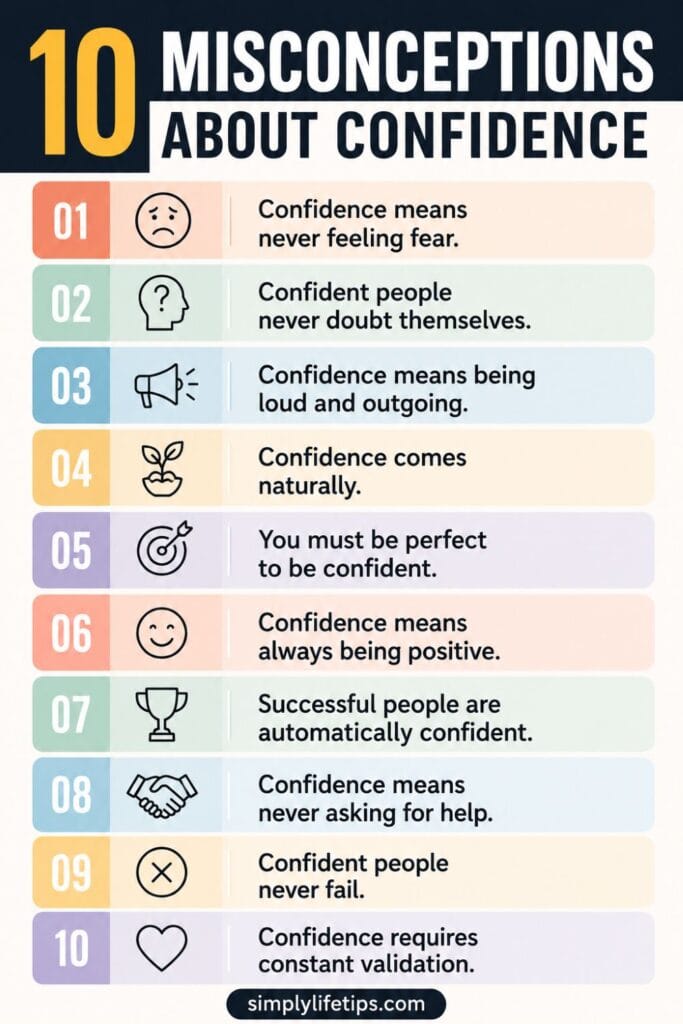
Confidence Means Never Feeling Fear
One of the biggest misconceptions about confidence is that confident people never experience fear.
In reality, everyone experiences fear, uncertainty, and self-doubt. The difference is that confident people act despite those feelings. They understand that fear is a natural part of growth.
For example, a confident speaker may still feel nervous before addressing a large audience. A confident entrepreneur may worry before launching a new business. Their confidence comes from moving forward despite their concerns.
Real confidence is not the absence of fear; it is the ability to act despite it.
7 Proven Ways To Turn Fear Into Confidence | (Backed by Neuroscience)
Confident People Never Doubt Themselves
Many people assume that self-doubt is a sign of weakness or lack of confidence.
Even highly successful individuals experience moments of uncertainty. Athletes question their performance, leaders question their decisions, and artists question their work.
The key difference is that confident people do not allow temporary doubts to define their identity. They acknowledge their concerns, evaluate them objectively, and continue moving forward.
Confidence and self-doubt often exist together.
Confidence Means Being Loud and Outgoing
Another common misconception about confidence is that only extroverted people are confident.
Confidence has nothing to do with how much a person talks. Some of the most confident individuals are calm, quiet, and thoughtful.
An introverted manager who leads a team effectively demonstrates confidence just as much as an energetic public speaker. Confidence is about self-belief, not volume.
People express confidence in different ways based on their personalities.
Confidence Comes Naturally
Many people believe confident individuals are simply born that way.
While some people may appear naturally confident, most confidence is developed through practice and experience. Skills improve through repetition, and confidence grows alongside competence.
A person who confidently drives a car today was once nervous behind the wheel. A successful professional likely struggled during their early career.
Confidence is usually built, not inherited.
You Must Be Perfect to Be Confident
Perfectionism often destroys confidence rather than strengthening it.
People who wait until they are perfect before taking action often remain stuck. Confident individuals understand that mistakes are part of learning.
For example, someone learning a new language will make pronunciation errors. Someone starting a business will face setbacks. Growth happens through imperfect action.
Confidence grows when people accept progress instead of demanding perfection.
Confidence Means Always Being Positive
Some people believe confident individuals never have negative thoughts or bad days.
This is unrealistic. Everyone experiences disappointment, frustration, and emotional struggles.
Confidence does not mean ignoring reality. Instead, it means trusting your ability to handle challenges and recover from setbacks.
A confident person can acknowledge difficulties while maintaining faith in their ability to overcome them.
Successful People Are Automatically Confident
Success and confidence are related, but they are not the same thing.
Many successful individuals struggle with insecurity despite their achievements. Likewise, many confident people have not yet achieved major success.
Confidence comes from self-belief and resilience, not from external accomplishments alone.
Relying solely on success to create confidence can be dangerous because confidence disappears whenever setbacks occur.
Confidence Means Never Asking for Help
Some people think asking for help makes them appear weak.
In reality, seeking guidance often reflects confidence and maturity. Confident individuals recognize that they do not know everything and are willing to learn from others.
Strong leaders regularly seek advice from mentors, colleagues, and experts. They understand that collaboration often leads to better outcomes.
Knowing when to ask for help is a sign of wisdom, not weakness.
Confident People Never Fail
Failure is often misunderstood as evidence of low confidence.
In truth, confident people fail frequently because they are willing to take risks and try new things. Every meaningful achievement involves setbacks and lessons.
Thomas Edison reportedly tested thousands of unsuccessful approaches before creating a practical light bulb. Many successful entrepreneurs experienced multiple business failures before achieving success.
Confidence encourages action, and action naturally involves occasional failure.
Confidence Requires Constant Validation
Many people depend on praise, approval, and recognition from others to feel confident.
This type of confidence is fragile because it relies on external opinions. Genuine confidence comes from an internal sense of self-worth.
A confident person appreciates compliments but does not depend on them. They maintain their self-respect even when others disagree or criticize them.
The strongest confidence comes from within.
Confidence Is a Destination
Perhaps the most damaging misconception about confidence is the belief that one day you will become permanently confident.
Confidence is not a final destination. It is an ongoing process that changes throughout life.
People may feel confident in one area and uncertain in another. New challenges often require new confidence-building experiences.
The goal is not to achieve perfect confidence forever. The goal is to continue growing despite uncertainty.
7 Easy Habits To Increase Confidence
How to Build Genuine Confidence?
Developing authentic confidence requires consistent effort and self-awareness.
- Take action even when you feel nervous.
- Focus on progress instead of perfection.
- Learn from mistakes rather than fearing them.
- Develop skills through practice.
- Celebrate small wins.
- Stop comparing yourself to others.
- Accept constructive feedback.
- Build a strong sense of self-worth.
- Set realistic goals.
- Keep challenging yourself with new experiences.
Over time, these habits create lasting confidence that is based on experience rather than appearances.
FAQs – Misconceptions About Confidence
What is the biggest misconception about confidence?
The biggest misconception is that confident people never feel fear or self-doubt. In reality, they experience these emotions but choose to act anyway.
Can confidence be learned?
Yes. Confidence is a skill that develops through practice, experience, and repeated action.
Are introverts less confident than extroverts?
No. Confidence is not determined by personality type. Introverts and extroverts can both be highly confident.
Why do successful people sometimes lack confidence?
Success does not automatically create self-belief. Confidence comes from internal self-worth rather than external achievements alone.
How can I become more confident?
Start by taking small actions outside your comfort zone, improving your skills, learning from mistakes, and focusing on progress rather than perfection.
Conclusion
Understanding the misconceptions about confidence can transform the way you view yourself and your potential. Confidence is not about being fearless, perfect, loud, or successful all the time. It is about trusting yourself enough to keep moving forward despite challenges, mistakes, and uncertainty. When you stop believing the myths and start embracing the reality of confidence, you create the foundation for personal growth, stronger relationships, and greater success in every area of life.
What misconception about confidence have you believed for the longest time?

Mathukutty P V is a Blogger, YouTuber, and Content Writer and the founder of Simply Life Tips. After taking voluntary retirement in 2017, he embraced a free lifestyle focused on learning, personal growth, and sharing practical wisdom to help others live with more purpose and positivity.