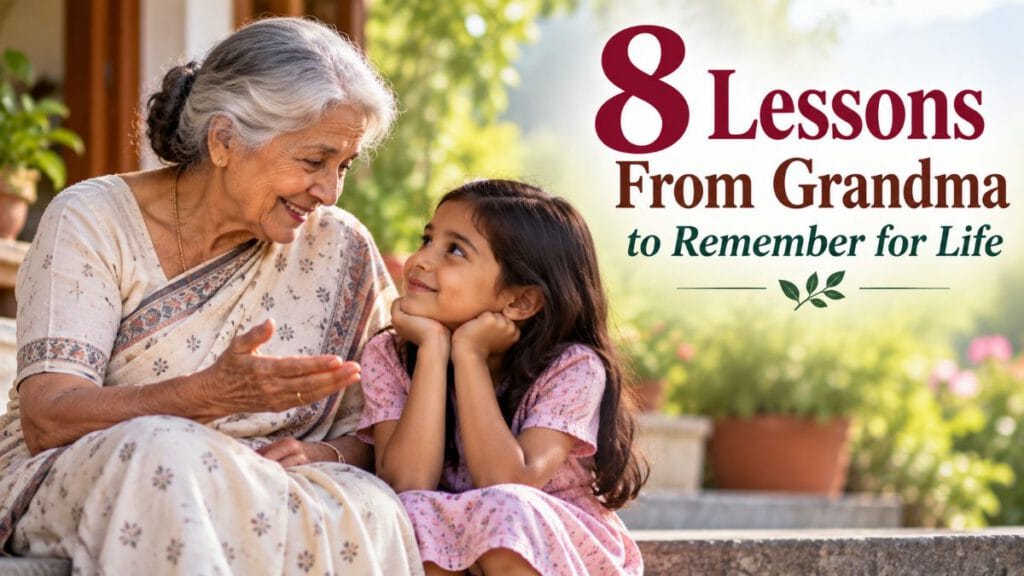
Lessons from Grandma often stay with us long after the conversation is over. They may sound simple when we first hear them, but some of those words become more meaningful as we grow older and experience life for ourselves.
One evening, a grandchild sat beside Grandma and asked a question that made her smile.
“Grandma, what are the most important things you want me to remember throughout my life?”
Grandma thought for a moment.
She had lived through happy days and difficult ones. She had seen people succeed, make mistakes, rebuild their lives, and learn from experience. She knew that life could not be reduced to a few simple rules, but she also knew that certain values could help a person navigate life’s ups and downs.
She looked at her grandchild and said, “There are eight things I want you to remember.”
8 Life Lessons From Grandma
1. Speak Slowly and Calmly
“First, speak slowly.”
The grandchild looked surprised. “Why does that matter, Grandma?”
“Because words have power,” she replied.
When we are angry or excited, we often speak faster than we think. Words come out before we have had time to consider how they might affect another person.
A calm voice can change the direction of a conversation.
Imagine two people disagreeing. One raises their voice, and the other responds in the same way. Within minutes, a small disagreement can become a serious argument.
But when one person slows down and speaks calmly, there is a better chance that both will listen.
Speaking slowly does not mean being afraid to express yourself. It means giving your thoughts enough time to become words you will not regret later.
“Remember,” Grandma said, “you can apologize for something you said, but you cannot always take those words back.”
Speaking calmly is an important part of speaking well and communicating clearly, especially when emotions are high.
2. Observe Before You Judge
“Second, observe and try to understand.”
Grandma knew that appearances could be misleading.
Someone may look unhappy but actually be dealing with a difficult situation. Someone who seems distant may simply be tired or worried. A person who makes a mistake may know something about the situation that you do not.
That is why it is wise to pause before making judgments.
Suppose a friend does not answer your message. Your first thought might be that they are ignoring you.
But what if they are dealing with a family problem?
What if they are unwell?
What if they simply have not seen the message?
The situation has not changed, but your understanding of it has.
“Do not judge the whole story from the first page,” Grandma said.
Taking time to observe and understand can prevent many unnecessary misunderstandings.
Learning the art of conversation can also help us listen more carefully, ask better questions, and understand other people’s perspectives.
3. Speak Less and Say Something Meaningful
“Third, learn when to speak and when to remain silent.”
In a world where everyone has an opinion about everything, knowing when not to speak can be a valuable quality.
Talking more does not necessarily mean communicating better.
Sometimes one thoughtful sentence can be more meaningful than ten minutes of unnecessary conversation.
Before speaking, it can help to ask yourself whether your words are necessary, helpful, or kind.
This does not mean keeping quiet when something important needs to be said. Important conversations should happen. Problems should be addressed.
The lesson is simply to choose your words carefully.
Grandma smiled.
“Your words are like seeds. Once you plant them, you may not be able to control what grows from them.”
4. Take Care of Your Health
“Fourth, never take your health for granted.”
When we are young and healthy, it is easy to believe that good health will always be there.
We may sacrifice sleep for work, ignore stress, eat poorly, avoid exercise, or postpone medical care because something else seems more important.
But health affects almost every part of life.
Money can buy many things, but it cannot automatically give us the energy to enjoy them.
Taking care of your health does not have to mean following a complicated routine. It can begin with ordinary habits:
- Eat nutritious food.
- Stay physically active.
- Get enough sleep.
- Make time to relax.
- Manage stress in healthy ways.
- Pay attention to your mental well-being.
- Seek professional medical advice when necessary.
“Your body and mind are the home you live in every day,” Grandma said. “Take care of them.”
5. Never Stop Learning
“Fifth, never stop educating yourself.”
Grandma believed that learning should not end with school or college.
Life itself keeps teaching us.
We learn from books, conversations, mistakes, travel, work, relationships, and experiences. Sometimes our biggest lessons come from situations we never expected to face.
A person who keeps learning can continue growing at any age.
You do not need to return to a classroom to learn something new. You could read a book, learn a language, develop a new skill, understand technology better, or explore a subject simply because it interests you.
Even learning from a mistake counts.
A mistake becomes particularly valuable when we understand what it taught us and use that knowledge to make a better decision next time.
“Never say you are too old to learn,” Grandma said. “As long as you are curious, there is always something new to discover.”
As I have written in Never Stop Learning, learning does not end when formal education ends; it can remain a lifelong journey.
6. Learn to Control Your Ego, Desires, and Anger
“Sixth, learn to control yourself.”
This may be one of the hardest lessons to practice.
We all experience anger, desire, frustration, and pride. These emotions are part of being human.
The problem begins when we allow them to make our decisions for us.
Think about what happens during an argument. Someone says something hurtful. We immediately want to respond with something even more hurtful.
But if we pause, we create a small space between the emotion and the response.
That small space can make a big difference.
We may decide not to send the angry message.
We may choose to walk away and return to the conversation later.
We may realize that admitting a mistake is more important than protecting our pride.
Self-control does not mean pretending that emotions do not exist. It means learning how to respond to them wisely.
“Winning an argument is not always a victory,” Grandma said. “Sometimes controlling your anger is the greater victory.”
7. Smile More and Worry Less
“Seventh, smile more and do not spend your life worrying about things you cannot control.”
Worry can make a small problem feel enormous.
There is nothing wrong with thinking carefully about a problem. In fact, identifying a problem and planning what to do about it can be useful.
But repeatedly worrying without taking action rarely changes the situation.
When something is within your control, focus on what you can do.
When something is outside your control, learn to accept that you cannot manage everything.
This is not always easy.
Life will bring uncertainty, disappointment, and unexpected problems. Nobody can avoid them completely.
But we can decide how much mental space we allow them to occupy.
A smile will not solve every problem. Neither will positive thinking.
But a calmer mind can make it easier to see possible solutions.
“Do not let tomorrow’s worries steal all of today’s happiness,” Grandma said.
8. Make Time for Your Family
“Finally, never forget the people who love you.”
Family relationships can change over time. Children grow up. Parents become older. Grandparents may not always be there.
That is why time matters.
It is easy to say, “I am too busy today. I will call tomorrow.”
Sometimes tomorrow becomes next week.
Then next month.
And eventually, we may wish we had made more time.
Making time for family does not always require a special occasion. It can be as simple as sharing a meal, making a phone call, listening to someone, visiting an older relative, or sitting together without constantly looking at a screen.
Of course, every family is different. Healthy relationships also require respect, boundaries, and understanding.
But the basic lesson remains important: do not take the people who care about you for granted.
When life becomes difficult, supportive relationships can provide comfort and encouragement when we need them most.
Good communication is essential in family relationships, and effective communication in parenting can help parents and children listen to one another, understand each other’s feelings, and build stronger family bonds.
Here is a quick visual summary of these lessons from Grandma.
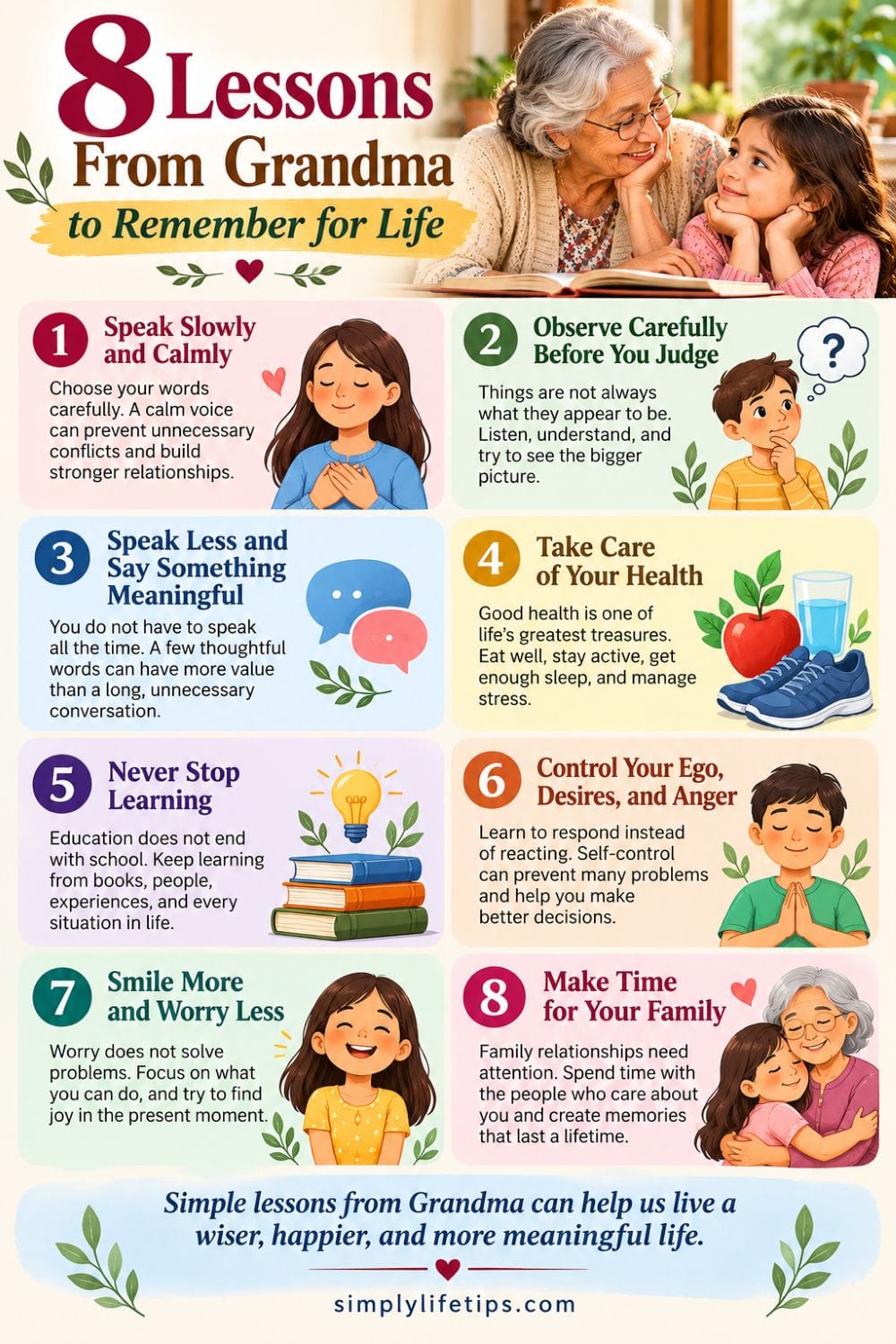
Grandma’s Eight Lessons in Simple Words
The grandchild listened quietly.
“Grandma, these sound simple.”
“They are,” Grandma replied. “But simple does not mean easy.”
She counted them once more:
- Speak slowly and calmly.
- Observe before judging.
- Speak less and make your words meaningful.
- Take care of your physical and mental health.
- Never stop learning.
- Control your ego, desires, and anger.
- Smile more and worry less about what you cannot control.
- Make time for your family and the people who matter.
“These are not instructions for living a perfect life,” Grandma explained. “You will still make mistakes. You will sometimes lose your temper. You will worry. You will make poor decisions. That is part of being human.”
She paused.
“What matters is whether you learn from those experiences.”
The Wisdom We Understand Later
Some advice becomes meaningful only with age.
When we are young, a grandmother’s reminder to be patient may sound ordinary. Years later, after experiencing difficult relationships and complicated situations, we may finally understand what she meant.
The same is true of many lessons from Grandma.
We may not appreciate the importance of health until we face a health problem.
We may not understand the value of family until we need their support.
We may not recognize the damage caused by anger until we regret words spoken in frustration.
And we may not appreciate lifelong learning until we realize how much the world continues to change.
Wisdom is sometimes not about discovering something completely new. It is about finally understanding the value of something we were told long ago.
A Final Word From Grandma
Grandma looked at her grandchild and smiled.
“Life will not always be easy. You will have beautiful days and difficult ones. You will meet good people, make mistakes, experience disappointment, and discover unexpected opportunities.
Do not try to control everything.
Take care of your health. Keep learning. Be careful with your words. Think before judging others. Do not allow anger or ego to control your decisions. Worry about what you can change and let go of what you cannot.
And most importantly, make time for the people who matter.
One day, you may realize that the ordinary moments you shared with them were among the most precious moments of your life.”
The grandchild smiled.
“Grandma, I will remember.”
Perhaps that is the greatest gift of a grandparent—the ability to pass experience from one generation to another through a few simple words.
The lessons from Grandma may not make life perfect, but they can remind us to live with greater patience, awareness, self-control, curiosity, and love.
And sometimes, that is more than enough.
Conclusion
The most valuable life lessons are not always complicated. Sometimes they come from someone who has simply lived long enough to understand what truly matters.
Speak with patience. Observe with understanding. Choose your words carefully. Protect your health. Keep learning. Control your reactions. Worry less about what you cannot change. And make time for the people you love.
These are simple lessons from Grandma, but they can become powerful when we practice them every day. These lessons from Grandma may seem simple, but they can become powerful when we practice them every day.
What is the most valuable lesson your Grandma or another elder ever taught you?

Mathukutty P V is a Blogger, YouTuber, and Content Writer and the founder of Simply Life Tips. After taking voluntary retirement in 2017, he embraced a free lifestyle focused on learning, personal growth, and sharing practical wisdom to help others live with more purpose and positivity.