

How to Discipline Your Mind is a challenge many students, professionals, and even successful people face at some point in life. A brilliant mind can have great ideas and ambitions, but without focus, self-control, and consistent habits, those abilities can easily be wasted. The good news is that mental discipline is not something you are simply born with—it can be developed through practice.
Ryan, a bright student who dreamed of becoming a doctor, learned this lesson the hard way. He believed intelligence would be enough to help him succeed, but constant distractions and a lack of discipline kept him from reaching his potential. After a painful failure, Ryan discovered that learning to control his attention, follow a routine, and practise consistently could change the direction of his life.
His story offers four practical lessons that can help anyone learn how to discipline the mind, overcome distractions, and stay focused on meaningful goals. Ryan’s story shows that how to discipline your mind is a skill that can be developed.
How to Discipline Your Mind: The Story of Ryan
Ryan’s Struggle with Focus
Ryan was a brilliant student with a big dream—he wanted to become a doctor. However, whenever he sat down to study, his attention quickly drifted toward his phone, Facebook, YouTube, or random daydreams.
He often told himself, “I’ll study later.” But later kept getting postponed.
His parents and teachers repeatedly encouraged him to take his studies seriously, yet Ryan believed that being smart would eventually lead to success. He did not understand that intelligence could only take him so far without focus and discipline.
Ryan was about to learn an important lesson: having a goal is not enough. You also need the discipline to work toward it consistently.
The Painful Wake-Up Call
Ryan placed his hopes on a scholarship exam. Winning it would make his journey toward becoming a doctor easier and give him greater confidence in his abilities.
But when the results were announced, Ryan was heartbroken. He had failed.
Several of his friends, who had studied consistently and followed disciplined routines, succeeded. Ryan’s disappointment forced him to look honestly at his own habits. He realised that intelligence alone was not enough. Without focus, consistent effort, and self-discipline, even a talented person can struggle to reach their goals.
For the first time, Ryan understood that success was not simply about being smart. It was about learning to use his abilities with purpose and consistency.
The Mentor Who Changed His Life
Determined to change, Ryan turned to Coach Miller, a respected teacher who helped students develop better study habits and improve their focus.
Ryan honestly described his problem. “Coach, I can’t control my mind. It keeps jumping from one thing to another.”
Coach Miller smiled and decided that Ryan needed more than advice. He wanted Ryan to experience the importance of focus for himself.
Instead of giving him a long lecture, Coach Miller took Ryan to the playground and prepared a simple exercise that would teach him a lesson he would never forget.
The Bow and Arrow Lesson
On the playground, Coach Miller gave Ryan a toy bow and arrow and asked him to aim at the centre of a target. Ryan took aim, but his attention kept shifting, and he missed badly.
“What were you looking at?” Coach Miller asked.
Ryan replied, “The trees, the field, and the target.”
Coach Miller nodded. “That is the problem. You are trying to pay attention to everything at once. A good archer focuses on the target. Your mind works in much the same way. If you allow your attention to jump between your phone, social media, entertainment, and other distractions, it becomes difficult to make steady progress toward your goal.”
Ryan listened carefully.
Coach Miller continued, “You cannot always stop distractions from appearing, but you can learn where to direct your attention. When you know what matters most, bring your focus back to that task.”
The simple lesson made Ryan understand that disciplining his mind was not about never having distracting thoughts. It was about noticing them and choosing to return his attention to what mattered.
That moment became a turning point in Ryan’s life.
Four Rules on How to Discipline Your Mind
Coach Miller’s advice to Ryan was not just useful for students. These simple principles can also help professionals, entrepreneurs, and anyone who wants to develop better focus and self-control.
Here are four practical rules for learning how to discipline your mind and stay focused on your goals.
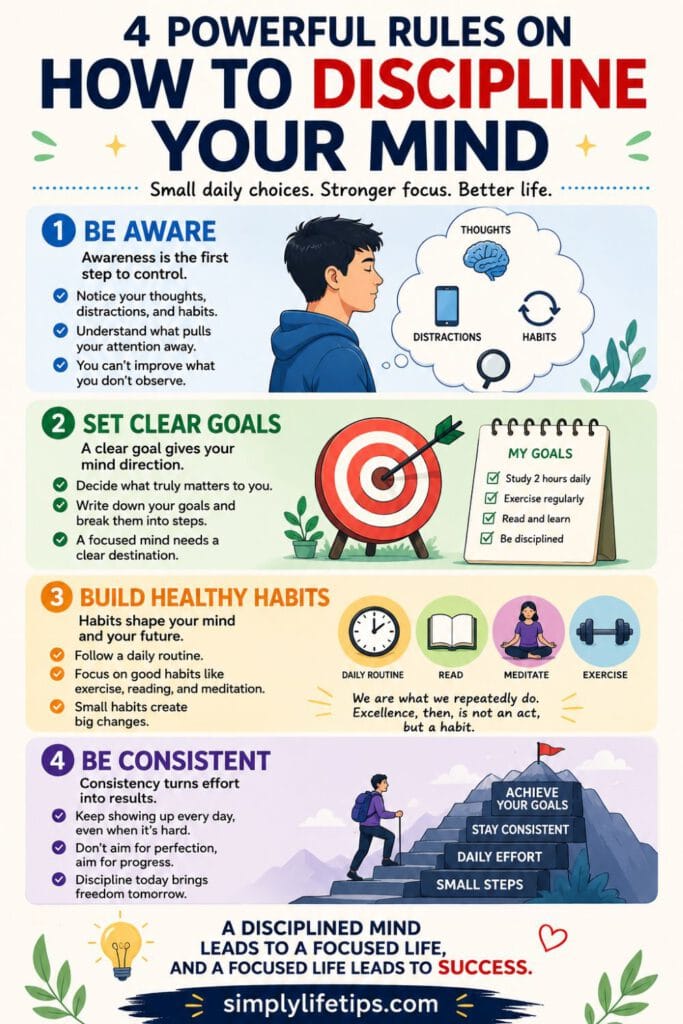
These four practical steps explain how to discipline your mind in everyday life.
1. Control Your Thoughts
Learning how to discipline your mind begins with awareness. Your mind naturally moves from one thought to another. The first step in disciplining it is becoming aware of where your attention goes. When you notice your thoughts drifting away from the task at hand, gently bring your attention back rather than becoming frustrated with yourself.
Example: If you sit down to study and suddenly feel like checking Instagram, remind yourself, “This is my study time. Social media can wait.” Then return to your book or assignment. Repeating this process helps you practise directing your attention rather than automatically following every distraction.
Tip: Spend five minutes each day practising mindful breathing or quiet meditation. The goal is not to stop every thought, but to notice when your attention wanders and practise bringing it back.
2. Make a Routine
A disciplined mind works better with structure. When you have a clear routine, you spend less time deciding what to do next and more time actually doing it. A consistent schedule can help your brain recognise when it is time to study, work, relax, or rest.
Example: Ryan set aside specific hours each evening for studying. In the beginning, following the schedule felt difficult. After practising it consistently, starting his study session became easier and more automatic.
Tip: Begin with manageable periods of focused work. Try studying for 25–30 minutes, followed by a short break. As your concentration improves, gradually increase your focused study time.
3. Keep Distractions Away
Your surroundings can strongly influence your ability to concentrate. Studying with constant phone notifications, television noise, or social media within easy reach makes it harder to maintain focus.
Example: Ryan began switching off his phone and keeping it away from his study area while working. Without constant notifications competing for his attention, he found it easier to stay focused on his studies.
Tip: Create a distraction-free study or work space. Keep only the materials you need nearby, silence unnecessary notifications, and avoid opening social media during your focused work sessions. Simple changes to your environment can make concentration much easier.
4. Practice Every Day
The best way to learn how to discipline your mind is through consistent practice. Learning how to discipline your mind is not a one-day achievement. Like any skill, mental discipline becomes stronger through regular practice. Consistency is more important than trying to make a dramatic change overnight.
Example: At first, Ryan could study for only 20 minutes before his attention wandered. Instead of giving up, he practised every day and gradually increased the amount of time he could concentrate.
Tip: Do not expect perfection. If you lose focus or miss a day, simply begin again the next day. Small, consistent efforts can gradually build stronger habits and better self-control.
These four principles—controlling your thoughts, creating a routine, removing distractions, and practising daily—can help students, professionals, and anyone working toward an important goal develop greater mental discipline.
Ryan’s Transformation
Ryan began applying the four rules to his daily life. He created a study routine, kept his phone away while studying, and reminded himself of his goal whenever his attention wandered.
The changes were not immediate. Some days were easier than others, but Ryan continued practising instead of giving up.
Gradually, he became better at staying focused. He could study for longer periods without constantly checking his phone or getting distracted. His confidence also grew as he began to see the results of his consistent effort.
When the next major exam arrived, Ryan was prepared. He passed with excellent results and even topped his class.
More importantly, Ryan had learned that discipline was not about forcing himself to work constantly. It was about making better choices, staying consistent, and returning to his goal whenever distractions pulled him away. Ryan gradually discovered how to discipline his mind.
The Result of a Disciplined Mind
A year later, Ryan proudly stepped onto the stage to receive a scholarship. As he accepted the award, he remembered the simple lesson Coach Miller had taught him.
“The mind is like a wild horse. If you train it, it can carry you toward your destination.”
Ryan finally understood that discipline had not changed his intelligence—it had helped him use his abilities more effectively.
His journey taught him that success is built through focused effort, consistent habits, and the willingness to keep going even when progress feels slow.
Ryan had discovered a powerful truth: a disciplined mind can turn a meaningful goal into a realistic possibility.
Watch: How to Discipline Your Mind | Motivational Story
Watch the motivational story below to see how Ryan learns to overcome distractions, develop self-discipline, and stay focused on his goal.
Conclusion
The story of Ryan shows that intelligence alone does not guarantee success. Learning how to discipline your mind means developing the ability to focus on what matters, manage distractions, follow healthy routines, and keep practising even when progress feels slow.
Whether you are a student preparing for an exam, a professional working toward career goals, or someone trying to build better habits, mental discipline can help you make better use of your abilities.
You do not need to change everything at once. Start with one small habit, practise it consistently, and gradually build from there. A disciplined mind is not created overnight—it is developed through small choices repeated every day.
Related Articles
- Control Emotions Before They Control You – A Moral Story Everyone Should Read
- Peace of Mind Story for Kids – The Secret of Living in the Present
- The Blessings of Parents: Moral Story
FAQs on How to Discipline Your Mind
What is the first step to disciplining the mind?
Start with awareness. Notice when your attention is drifting, identify the distraction, and deliberately bring your focus back to the task or goal that matters.
Why is disciplining the mind important?
A disciplined mind helps you stay focused on your goals, manage distractions, and use your time and abilities more effectively.
How can I stop my mind from wandering while studying?
Create a quiet study environment, follow a routine, remove unnecessary distractions, and gently bring your attention back whenever it wanders.
Can discipline be learned, or is it natural?
Discipline is a skill that can be developed through consistent practice, small habits, and repeated effort.
How long does it take to discipline the mind?
There is no fixed timeline. Progress depends on the person and the habit being developed. Consistent practice over several weeks can help make new behaviours more natural.

Mathukutty P V is a Blogger, YouTuber, and Content Writer and the founder of Simply Life Tips. After taking voluntary retirement in 2017, he embraced a free lifestyle focused on learning, personal growth, and sharing practical wisdom to help others live with more purpose and positivity.


