Human Brain in the Age of Artificial Intelligence is one of the most fascinating subjects of our time. Artificial intelligence can write articles, generate artwork, compose music, diagnose diseases, drive vehicles, and process vast amounts of information within seconds. With every new breakthrough, an important question emerges: Will artificial intelligence eventually replace the human brain?
The answer may surprise many people.
Every AI system ever created originated from a remarkable organ weighing only about 1.4 kilograms—the human brain.
Every civilization, scientific discovery, medical breakthrough, work of art, and technological revolution began as an idea inside a human mind. Long before artificial intelligence existed, the human brain was already solving problems, imagining the future, and reshaping the world.
Within this extraordinary structure lies the ability to compose symphonies, build civilizations, discover scientific laws, write poetry, create masterpieces, fall in love, and contemplate the origins of the universe. It is not merely a biological computer processing information. It is a storyteller weaving meaning from experiences, a dreamer imagining possibilities, an inventor creating new realities, a philosopher questioning existence, an artist discovering beauty, and a survivor overcoming adversity.
Containing approximately 86 billion neurons connected through trillions of neural pathways, the human brain remains one of the most complex and mysterious structures known to science. Despite centuries of research, neuroscientists still cannot fully explain how this remarkable organ generates consciousness, emotions, creativity, imagination, and self-awareness.
This article is inspired by reflections shared by Dr. Arun Oommen, Neurosurgeon, whose thought-provoking Facebook post highlighted the extraordinary abilities of the human brain that continue to distinguish humanity in the age of artificial intelligence.
While AI may calculate faster, search faster, and process more information than any individual human, there are remarkable powers of the human mind that remain beyond the reach of machines.
Artificial Intelligence is changing the workplace faster than ever, but the soft skills AI can’t replace are becoming even more valuable.
Every scientific breakthrough, technological innovation, and artificial intelligence system began as an idea inside a human mind. Understanding the extraordinary capabilities of the human brain helps us appreciate why it continues to inspire awe even in the AI era.
Key Takeaways
- The human brain remains one of nature’s most extraordinary creations despite rapid advances in AI.
- Consciousness, emotions, creativity, empathy, intuition, and love continue to distinguish humans from machines.
- Human imagination allows people to envision possibilities long before they become reality.
- The brain can learn from a single experience and adapt to unexpected situations.
- Purpose, resilience, and moral judgment continue to shape civilizations.
- AI is a powerful tool created by human intelligence, not a replacement for it.
- The future belongs to those who combine technology with uniquely human strengths.
Human Brain in the Age of Artificial Intelligence – 15 Extraordinary Powers
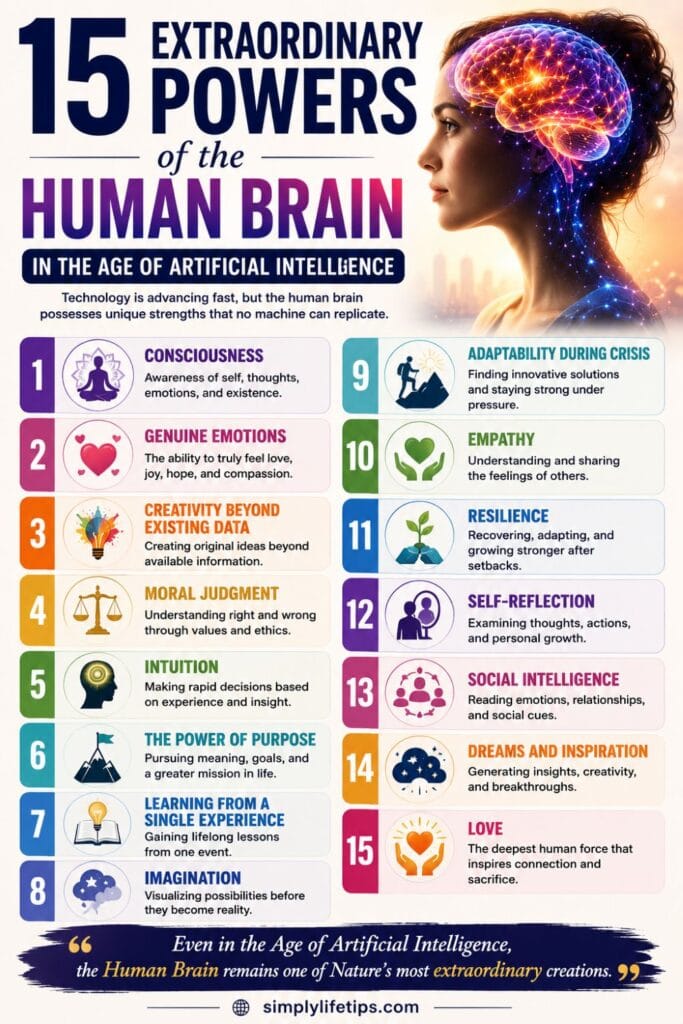
Want to understand why the human brain remains extraordinary despite the rapid rise of AI? Let’s explore each of these remarkable abilities in detail.
1. Consciousness: The Greatest Mystery of Human Existence
Among all the extraordinary abilities of the human brain, consciousness may be the most remarkable.
Artificial intelligence can analyze information, recognize patterns, and generate responses with astonishing speed. Yet it cannot truly experience life.
Humans can feel the warmth of sunlight on their skin. They can smile at the laughter of a child. They can experience the joy of achievement and the pain of losing a loved one.
Most importantly, humans possess an awareness of their own existence.
We know that we exist.
This simple realization remains one of the greatest mysteries in science. Despite decades of research, neuroscientists still cannot fully explain how billions of neurons create the subjective experience of being “you.”
The human brain does not merely process reality. It experiences reality.
2. Genuine Emotions: The Heart of Human Intelligence
Artificial intelligence can identify emotional patterns and even mimic empathy through language.
However, simulation is not experience.
The human brain generates genuine emotions such as love, joy, hope, pride, grief, compassion, and disappointment. These emotions influence our decisions, shape our relationships, and give meaning to our lives.
Consider a mother caring for her sick child throughout the night. Her actions are not driven by calculations or efficiency. They are motivated by love, concern, and emotional connection.
Human emotions inspire courage, sacrifice, generosity, and kindness. They transform intelligence into humanity.
3. Creativity Beyond Existing Data
One of the most remarkable powers of the human brain is creativity.
Artificial intelligence creates by analyzing patterns within existing data. Human creativity often begins where data ends.
Albert Einstein once imagined what it would be like to travel alongside a beam of light. There was no dataset providing the answer. There were no previous examples to follow.
His imagination and curiosity eventually contributed to the Theory of Relativity and changed physics forever.
Every invention, scientific breakthrough, artistic masterpiece, and revolutionary idea first existed as a thought inside a human brain.
True creativity begins when people dare to explore possibilities that have never existed before.
4. Moral Judgment: Understanding Right and Wrong
Many of life’s most important decisions cannot be solved through calculations alone.
- Should a doctor reveal a painful truth to a patient?
- Should a soldier risk personal safety to save others?
- Should someone choose forgiveness instead of revenge?
- These decisions require values, ethics, wisdom, and compassion.
Artificial intelligence can analyze possible outcomes, but it cannot genuinely understand morality or human responsibility.
The ability to distinguish right from wrong remains one of humanity’s greatest strengths.
5. Intuition: The Hidden Intelligence of Experience
Human intuition often works faster than conscious reasoning.
- A firefighter may sense that a building is about to collapse before visible signs appear.
- A skilled surgeon may recognize a subtle warning sign that others overlook.
- These insights emerge from years of accumulated experience stored within the brain.
Long before conscious analysis catches up, the human mind may already recognize patterns and generate conclusions.
This hidden intelligence often protects lives and guides important decisions.
6. The Power of Purpose
Artificial intelligence performs tasks.
Humans pursue meaning.
People climb mountains, write books, launch charities, build businesses, raise families, and dedicate themselves to causes greater than their own interests.
Purpose gives direction to life.
Throughout history, major discoveries, social movements, and humanitarian achievements have been driven by people who believed they could contribute to something meaningful.
Algorithms do not dream of changing the world.
Humans do.
7. Learning from a Single Experience
One of the most astonishing features of the human brain is its efficiency as a learner.
A child who touches a hot stove once often remembers the lesson for a lifetime.
Humans frequently learn valuable lessons from a single experience, whether it involves success, failure, danger, or opportunity.
Many AI systems require enormous datasets and repeated examples to achieve similar results.
The brain’s ability to rapidly learn and adapt remains extraordinary.
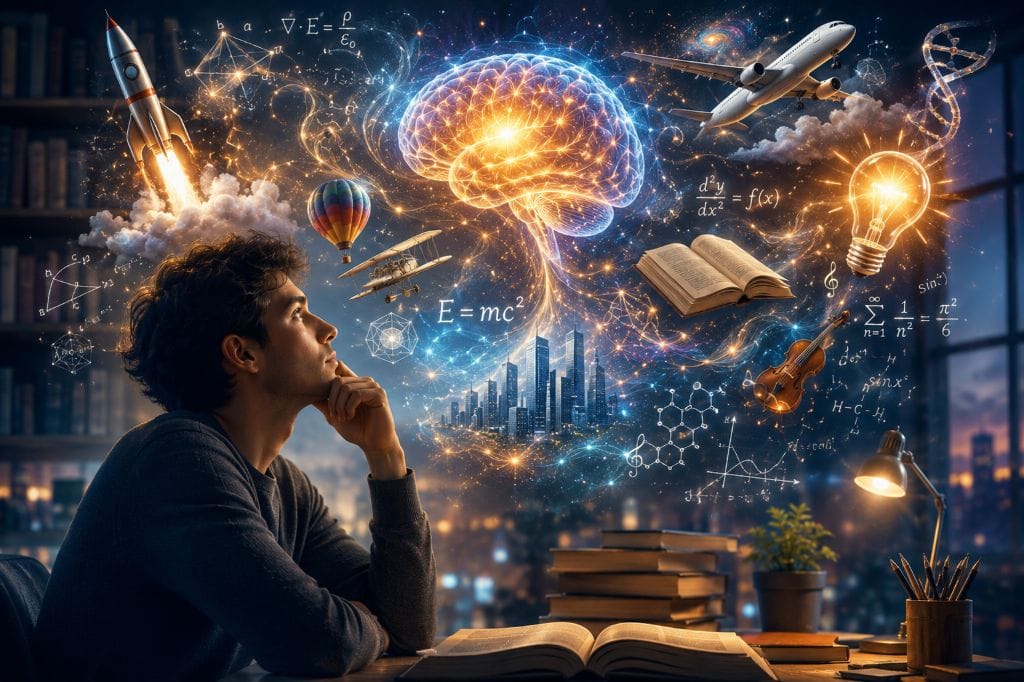
Before airplanes crossed the skies, before rockets reached space, and before scientific discoveries changed the world, they existed only as ideas in someone’s mind. Imagination is the foundation of innovation and one of the most extraordinary powers of the human brain.
8. Imagination: The Beginning of Every Discovery
Before every invention, there was imagination.
Before airplanes existed, someone imagined human flight.
Before smartphones existed, someone imagined carrying a powerful computer in a pocket.
Before humans landed on the Moon, someone imagined traveling beyond Earth.
Imagination allows people to explore possibilities long before they become reality.
Human progress begins in the mind before it appears in the world.
9. Adaptability During Crisis
The human brain performs remarkably well when facing uncertainty.
During emergencies and unexpected situations, people often develop solutions that were never anticipated.
A powerful example is the Apollo 13 mission. When serious technical failures threatened the lives of astronauts, engineers had no ready-made solution.
Using limited resources and creative thinking, they developed innovative strategies that helped bring the astronauts home safely.
This adaptability remains one of humanity’s greatest strengths.
10. Empathy: The Foundation of Human Connection
Empathy is more than recognizing another person’s emotions.
It is the ability to place ourselves in their position and understand their experiences.
When a friend experiences loss, our presence often matters more than perfect words.
When someone struggles, empathy motivates us to offer comfort and support.
Families, friendships, communities, and societies are built upon emotional understanding.
This deeply human ability remains difficult for machines to replicate.
11. Resilience: Rising After Adversity
History is filled with people who overcame extraordinary challenges.
J.K. Rowling faced repeated rejection before becoming one of the world’s most successful authors.
Countless entrepreneurs, scientists, athletes, and leaders experienced setbacks before achieving success.
Resilience allows people to recover, adapt, and continue moving forward despite adversity.
The human brain possesses an extraordinary ability to transform hardship into growth.
12. Self-Reflection: The Ability to Examine Ourselves
Humans possess a unique ability to think about their own thoughts.
We ask questions such as:
- Why did I react that way?
- What can I learn from this experience?
- How can I improve?
- What kind of person do I want to become?
This capacity for self-reflection enables personal growth, wisdom, and emotional maturity.
It allows people to continually evolve throughout their lives.
13. Social Intelligence: Understanding the Unspoken
Human communication extends far beyond words.
- A smile.
- A raised eyebrow.
- A moment of silence.
- A subtle change in tone.
These signals often communicate more than language itself.
The human brain naturally interprets countless social cues every day, helping people build trust, friendships, partnerships, and communities.
Social intelligence remains one of the most sophisticated capabilities of the human mind.
14. Dreams and Inspiration: The Brain That Never Truly Sleeps
Some of humanity’s greatest discoveries have emerged from dreams and moments of inspiration.
Researchers have documented scientific insights, artistic breakthroughs, and creative solutions arising during sleep.
One famous example involves the discovery of the benzene ring structure, which was reportedly inspired by a dream-like vision.
Even during sleep, the brain remains active. It reorganizes memories, strengthens learning, discovers hidden relationships between ideas, and sometimes produces insights that are unavailable during conscious thought. Many researchers believe that sleep plays a critical role in creativity and problem-solving.
It reorganizes memories, identifies new connections, links ideas together, and processes experiences in ways that often lead to fresh insights.
Many people awaken with solutions to problems that seemed impossible the night before.
Artificial intelligence processes information.
The human brain dreams.
And sometimes those dreams change the world.
15. Love: Humanity’s Greatest Strength
Perhaps the greatest power of the human brain is love.
Love inspires parents to sacrifice for their children.
It motivates partners to support one another during difficult times.
It encourages strangers to perform extraordinary small acts of kindness.
Throughout history, love has inspired social movements, humanitarian efforts, and acts of courage that transformed lives.
No computer has ever truly loved.
No algorithm has ever cared.
No machine has ever been inspired by love to change the course of history.
Love remains one of the deepest expressions of what it means to be human.
FAQs – Human Brain in the Age of Artificial Intelligence
Can artificial intelligence replace the human brain?
No. AI can perform specific tasks exceptionally well, but it lacks consciousness, emotions, empathy, imagination, and genuine self-awareness.
What makes the human brain unique?
The human brain possesses consciousness, creativity, intuition, empathy, moral judgment, resilience, imagination, and the ability to create meaning and purpose.
Can AI experience emotions?
AI can simulate emotional responses but cannot genuinely feel emotions such as love, grief, joy, or compassion.
Why is imagination important?
Imagination enables humans to envision possibilities beyond current reality, leading to inventions, discoveries, and innovation.
How can humans thrive in the AI age?
By using AI as a tool while strengthening uniquely human qualities such as creativity, critical thinking, emotional intelligence, communication, and ethical decision-making.
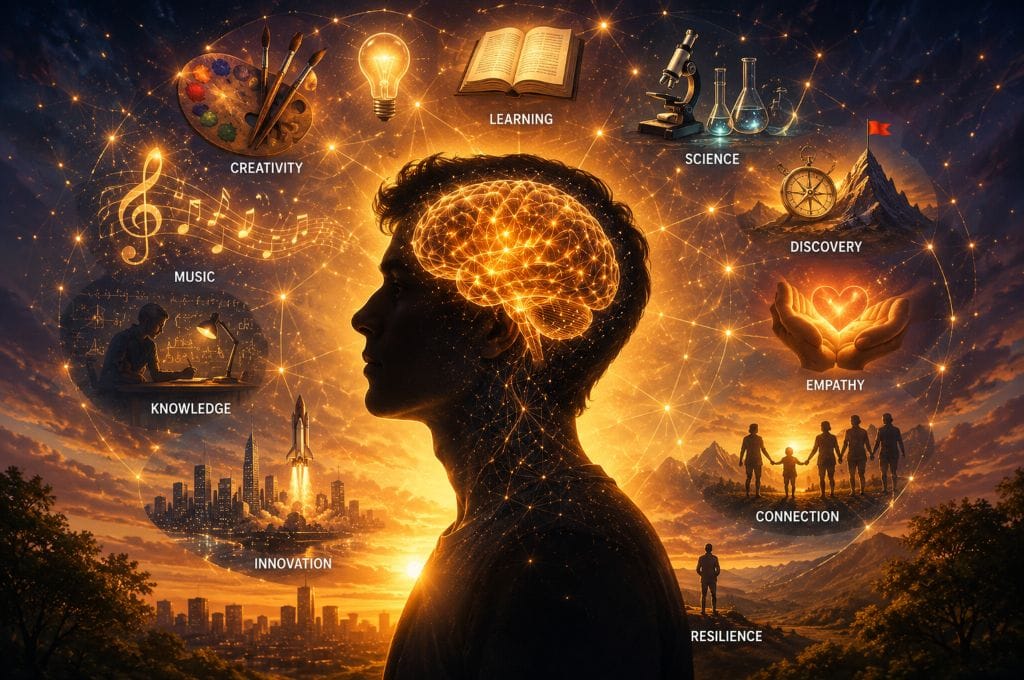
From consciousness and creativity to empathy, resilience, and love, the human brain possesses extraordinary abilities that no machine can fully replicate. These qualities have shaped civilizations, driven innovation, and given meaning to human existence throughout history.
Conclusion
The Human Brain in the Age of Artificial Intelligence remains one of the greatest wonders in existence.
Artificial intelligence may continue to become faster, smarter, and more capable. It may calculate more quickly, search more efficiently, and process more information than any individual human.
Yet intelligence alone does not define humanity.
Our consciousness allows us to experience life. Our imagination allows us to create new realities. Our empathy enables us to connect with others. Our resilience helps us overcome adversity. Our intuition guides us through uncertainty. Our love gives meaning to our existence.
AI is not the rival of the human brain.
It is one of its creations.
Every algorithm, every neural network, and every breakthrough in artificial intelligence began as an idea inside a human mind.
The human brain can contemplate the origins of the universe, dream of futures that do not yet exist, create beauty from imagination, find meaning in suffering, and transform ideas into reality.
Artificial intelligence may be one of humanity’s greatest inventions, but it remains a creation of the human mind.
Even in the age of artificial intelligence, the human brain remains one of nature’s most extraordinary creations and perhaps the most remarkable technology the universe has ever produced.
Author’s Note
This article was inspired by reflections shared by Dr. Arun Oommen, Neurosurgeon, in a Facebook post discussing the extraordinary abilities of the human brain in the age of artificial intelligence. The content has been independently rewritten, expanded, and adapted for educational purposes.
If this inspired you, pass it on to someone who could benefit from it.
PVM

Mathukutty P V is a Blogger, YouTuber, and Content Writer and the founder of Simply Life Tips. After taking voluntary retirement in 2017, he embraced a free lifestyle focused on learning, personal growth, and sharing practical wisdom to help others live with more purpose and positivity.