
Your subconscious mind influences many of the automatic thoughts, habits, and responses that shape your everyday life. Learning how to train your subconscious mind can help you become more aware of these patterns and deliberately build healthier ways of thinking and behaving.
The idea of “training” the subconscious mind is often presented as a quick path to success, but meaningful change is usually much more practical than that. It involves repetition, attention, learning, habits, environment, and consistent action.
If you want to develop better habits, strengthen your confidence, improve your focus, or work toward an important goal, understanding how automatic patterns develop can give you a useful starting point.
Learning how to train your subconscious mind can help you become more aware of automatic thoughts, habits, and behavioral patterns.
Before learning how to train your subconscious mind, it helps to understand how the subconscious mind works and how automatic mental processes can influence everyday behavior.
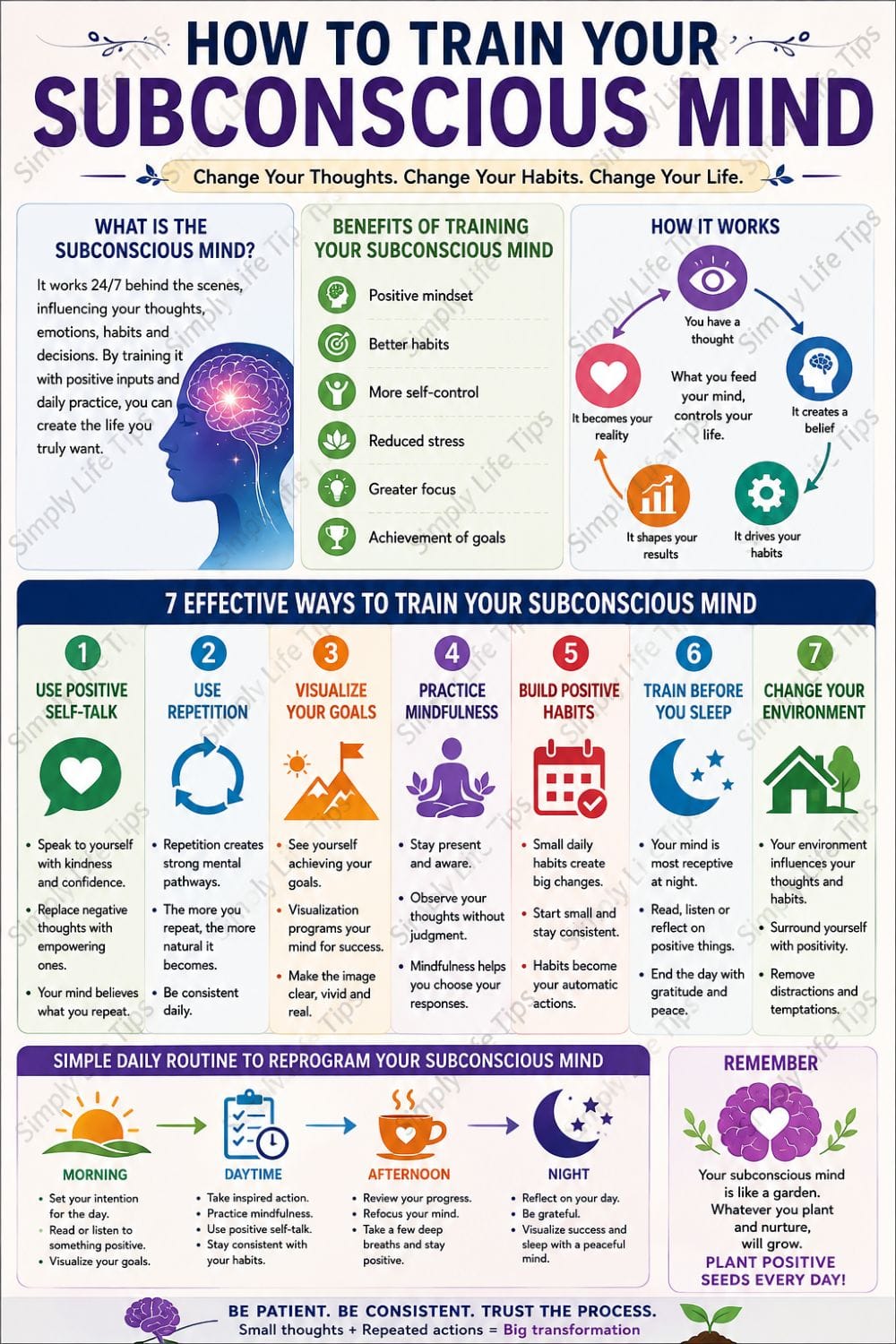
The infographic below summarizes seven practical ways to train your subconscious mind and build healthier patterns through consistent daily practice.
What Is the Subconscious Mind?
The term subconscious mind is commonly used to describe mental processes that happen outside our immediate conscious awareness.
You do not consciously control every mental process occurring throughout the day. Some responses become automatic through learning and repetition.
Think about driving a familiar route. When you first learned to drive, you had to consciously pay attention to steering, changing gears, braking, traffic signs, and other details. With experience, many of these actions became much more automatic.
Habits can work in a similar way.
You may automatically:
- Reach for your phone when you are bored
- Follow the same morning routine
- Check notifications when you hear an alert
- Become nervous in a familiar stressful situation
- Put off an uncomfortable task
- Choose a familiar response during an argument
These behaviors do not necessarily require a deliberate decision every time.
This is why learning how to train your subconscious mind is closely connected with understanding habits and automatic behavior.
Can You Train Your Subconscious Mind?
Yes, you can gradually influence automatic patterns through learning and repeated experience.
However, it is important to be realistic about what this means.
Understanding how to train your subconscious mind requires realistic expectations about how habits and automatic behaviors develop.
You cannot simply give your subconscious a command today and expect your personality, habits, beliefs, and behavior to completely change tomorrow.
Training your subconscious mind is better understood as a gradual process.
Repeated behaviors can become increasingly automatic when they are associated with particular cues or situations, which is one reason habits can feel effortless over time.
When you repeatedly practice a new behavior or way of responding, you give your brain opportunities to learn that pattern.
For example, suppose you normally reach for your phone whenever you have a difficult task.
You could begin practicing a different response:
Difficult task → pause → take a breath → work for five minutes → then reassess.
At first, this requires conscious effort. With consistent practice, the new response can become easier and more familiar.
Because repeated behaviors can become increasingly automatic, understanding how habits are formed can help you recognize the patterns you want to strengthen or change.
How to Train Your Subconscious Mind
There is no single technique that works like a magic switch. Instead, several practical strategies can work together to help you develop more useful automatic patterns. When learning how to train your subconscious mind, the most useful approach is to focus on awareness, repetition, and consistent action.
1. Become Aware of Your Automatic Patterns
The first step in learning how to train your subconscious mind is noticing what you currently do automatically.
Research on the psychology of habit shows that habits can develop when people repeatedly perform behaviors in recurring contexts, eventually making those behaviors more efficient and automatic.
You cannot deliberately change a pattern that you have never noticed.
Spend a few days observing yourself.
Ask:
- What do I do automatically when I feel stressed?
- What do I do when I become bored?
- Which thoughts repeatedly appear in my mind?
- What situations trigger procrastination?
- Which habits happen without much thought?
- How do I react when something goes wrong?
For example, you might discover that every time you feel overwhelmed at work, you open social media.
The problem may not simply be social media. The important discovery is the pattern:
Feeling overwhelmed → escaping into social media.
Once you recognize the pattern, you can begin changing it.
2. Choose One Pattern to Change
Trying to change everything simultaneously can make the process unnecessarily difficult.
Choose one behavior.
For example:
“I want to stop automatically checking my phone whenever I become bored.”
Or:
“I want to respond more calmly when something doesn’t go according to plan.”
Or:
“I want to develop the habit of starting important work instead of postponing it.”
A specific target gives you something measurable to practice.
3. Replace an Unwanted Habit
Simply telling yourself “I won’t do this anymore” may not be enough.
A better strategy is to decide what you will do instead.
For example:
Old pattern:
Stress → check phone.
New pattern:
Stress → take three slow breaths → write down the next task → work for five minutes.
The replacement behavior needs to be practical.
If the new behavior is extremely difficult, you may find yourself returning to the old pattern.
4. Use Repetition
Repetition is one of the most important principles when learning how to train your subconscious mind.
Habit formation does not follow a universal timetable; research shows considerable variation in how long different behaviors take to become more automatic, making consistent practice more important than focusing on a specific number of days.
A behavior practiced once is simply an experience.
A behavior practiced repeatedly has more opportunity to become familiar.
Consider learning a musical instrument.
Playing a scale once does not make you proficient. Repeated practice gradually makes the movements more familiar.
Habits can develop through a similar process.
If you want to establish a new habit, repeat the desired behavior consistently rather than waiting for motivation to appear.
5. Pay Attention to Your Self-Talk
Your internal dialogue can influence how you interpret situations and how you respond to challenges.
Consider two statements:
“I always fail at this.”
and
“This is difficult, but I can improve by practicing.”
The second statement doesn’t pretend that everything is easy. It creates a more constructive interpretation.
Instead of unrealistic affirmations, try realistic and actionable self-talk.
For example:
- “I can learn this.”
- “I don’t have to be perfect.”
- “I can take the next step.”
- “I can improve with practice.”
- “A mistake is feedback, not the end.”
The goal isn’t to convince yourself that you are capable of everything.
The goal is to develop a more useful response to challenges.
6. Visualize the Behavior You Want
Visualization can be used as a mental rehearsal technique.
Instead of simply imagining the final result, imagine yourself performing the behavior required to reach it.
Suppose your goal is to exercise regularly.
Don’t only picture yourself becoming fit.
Imagine:
- Putting on your exercise clothes
- Starting your workout
- Continuing when you feel like stopping
- Finishing the session
- Returning to the routine the following day
This makes visualization more closely connected with action.
For example, a student preparing for an examination might visualize sitting at the desk, putting the phone away, studying a difficult chapter, taking a short break, and returning to the work.
The emphasis is on the process, not just the dream.
Train Your Subconscious Mind With Positive Habits
Your daily habits provide repeated experiences that can influence automatic behavior.
Small actions can therefore be more useful than occasional bursts of motivation.
Consider someone who wants to read more.
Instead of saying:
“I will read 50 books this year.”
They might create a smaller routine:
“After dinner, I will read for 15 minutes.”
The consistent cue and behavior make the habit easier to repeat.
The same principle can be applied to:
- Exercise
- Meditation
- Writing
- Studying
- Saving money
- Healthy eating
- Sleep routines
- Personal development
The objective is not to make dramatic changes overnight.
It is to make desirable behavior easier to repeat.
A consistent morning routine can also make positive behaviors easier to repeat because you begin the day with a predictable sequence of actions.
Change Your Environment
Your environment can make certain behaviors easier or harder.
If your phone is beside you while you work, checking it requires almost no effort.
If your phone is in another room, the behavior becomes less convenient.
This gives you a simple principle:
Don’t rely entirely on willpower. Design your environment to support the behavior you want.
Change Your Environment
Your environment can have a powerful influence on your everyday behavior. The things you see, the objects you keep nearby, the people around you, and the routines you follow can all make certain behaviors easier or harder.
If you constantly depend on willpower to make the right choice, you may eventually become tired of making that decision. A better approach is to design your surroundings so that the behavior you want becomes easier to repeat.
For example, if you want to develop a reading habit but your television and phone are always competing for your attention, simply telling yourself to “read more” may not be enough. Making a few changes to your environment can reduce distractions and give the desired behavior a better chance of becoming part of your routine.
Want to read more?
Keep your book beside your bed, on your desk, or somewhere you normally spend time in the evening.
If the book is hidden inside a cupboard, you have to remember to take it out before you can read. If it is already visible and within reach, starting becomes much easier.
You can also create a simple routine such as:
Get into bed → put your phone aside → read for 10–15 minutes.
You don’t have to begin by reading for an hour. Start with a small amount that feels easy to repeat. Over time, reading can become a familiar part of your evening routine.
Want to exercise in the morning?
Prepare your workout clothes, shoes, water bottle, and anything else you need the night before.
When everything is ready, you remove several small decisions from your morning. Instead of waking up and thinking about what to wear or where your shoes are, you can simply get dressed and begin.
For example:
Wake up → drink water → put on workout clothes → exercise for 10 minutes.
The first goal isn’t necessarily an intense workout. The goal is to make starting the behavior easier.
Once the routine becomes familiar, you can gradually increase the duration or intensity.
Want to reduce social-media use?
Make unnecessary scrolling slightly more difficult.
Turn off notifications that aren’t important. Move distracting apps away from your home screen. Keep your phone out of reach while working, studying, reading, or spending time with family.
You could also create specific periods when your phone stays away from you.
For example:
Work for 30 minutes → keep the phone away → take a short break → return to work.
The idea isn’t that you must completely eliminate social media. Instead, you are changing the environment so that checking your phone is no longer the automatic response every time you feel bored or distracted.
Want to eat healthier?
Make healthier choices convenient and readily available.
If fruit is washed and easily accessible, you are more likely to grab it when you’re hungry. If healthier meals are prepared in advance, you have an easier option when you don’t feel like cooking.
You can also make less desirable choices less convenient.
For example, rather than keeping snacks directly beside your desk, store them somewhere that requires you to get up to reach them.
This creates a small pause between the urge and the behavior.
Want to spend less money?
Your environment can influence financial habits too.
Remove unnecessary shopping notifications, unsubscribe from promotional emails that encourage impulse purchases, and avoid saving payment information on websites where you frequently make unplanned purchases.
You can also create a simple rule:
Pause before buying → ask whether you really need it → wait 24 hours for non-essential purchases.
That small change can interrupt an automatic buying pattern and give you time to make a more deliberate decision.
Want to spend more time with your family?
Make the desired behavior part of your physical environment and daily routine.
For example, keep phones away from the dining table and create a regular period when everyone spends time together without unnecessary digital distractions.
A simple environmental change can communicate an important message: this time is reserved for connection.
Want to write every day?
Keep your notebook or computer ready before you begin.
If you’re a blogger, for example, you might keep a list of potential article ideas in one easily accessible place. When you sit down to write, you don’t have to start by wondering what topic to choose.
Your environment could support this sequence:
Sit at your desk → open your topic list → choose one idea → write for 15 minutes.
This reduces the friction between deciding to write and actually writing.
Why environmental changes matter
Every behavior requires some level of effort.
When a desired behavior is easy to start, you reduce the friction that stands between intention and action. When an unwanted behavior becomes slightly more difficult, you create an opportunity to pause and make a conscious choice.
For example:
Book on the bedside table → easier to read.
Phone in another room → harder to scroll.
Workout clothes prepared → easier to exercise.
Healthy food ready → easier to make a healthy choice.
Shopping notifications disabled → fewer purchasing triggers.
These changes may seem small, but small changes can become meaningful when they are repeated every day.
The goal isn’t to create a perfect environment. It is to create an environment that makes the behaviors you want to develop easier, more visible, and more convenient.
In this way, you don’t have to rely entirely on motivation. You are building surroundings that support the habits you want to practice.
Train Your Subconscious Mind for Success
If your goal is success, don’t focus only on the outcome. Learning how to train your subconscious mind for success is less about simply thinking positively and more about repeatedly practicing behaviors that support your goals.
If you want to train your subconscious mind for success, start by learning how to set meaningful goals and then connect those goals with specific daily actions.
Define the behaviors that produce the outcome.
For example:
Goal: Become a successful blogger.
Instead of repeatedly thinking:
“I want my blog to become successful.”
Create repeated behaviors such as:
- Research topics regularly
- Publish useful content consistently
- Improve SEO knowledge
- Update older content when necessary
- Study search intent
- Analyze performance
- Build relationships with readers
- Continue learning
The subconscious-mind approach becomes much more practical when the desired identity is connected to repeated behavior.
You are not simply telling yourself:
“I am successful.”
You are repeatedly practicing the behaviors associated with becoming better at what you do.
It is useful to dream big, but meaningful progress comes from connecting those ambitions with realistic actions you can repeat consistently.
Train Your Subconscious Mind to Be More Positive
Positive thinking does not mean pretending that problems do not exist. One part of learning how to train your subconscious mind is becoming more intentional about how you respond to negative thoughts.
A healthier approach is learning to respond to difficult situations without automatically assuming the worst.
Imagine making a mistake.
An automatic response might be:
“I’m useless. I always mess everything up.”
A more constructive response could be:
“I made a mistake. What can I learn from it, and what should I do next?”
The second response acknowledges reality while avoiding unnecessary self-criticism.
Over time, practicing this type of response can help you approach challenges differently.
Another simple practice that can support a positive mindset is to practice gratitude by regularly noticing the people, experiences, and things you genuinely appreciate.
Practice Mindfulness
Mindfulness can help you notice thoughts and emotions before automatically reacting to them.
For example, you may notice:
“I’m feeling anxious, and I have the urge to avoid this task.”
Instead of immediately avoiding the task, pause.
Take a breath.
Notice the feeling.
Then decide what to do.
That small pause creates an opportunity to choose a response rather than simply following an automatic pattern.
You can start with just a few minutes of mindful observation each day.
Use Questions to Direct Your Thinking
Questions can be useful because they encourage you to search for possible answers.
Instead of repeatedly asking:
“Why can’t I succeed?”
Try:
“What is one thing I can improve today?”
Instead of:
“Why am I always procrastinating?”
Try:
“What is making this task difficult to start?”
Instead of:
“How will I ever achieve this goal?”
Try:
“What is the smallest useful step I can take today?”
These questions shift attention from helplessness toward problem-solving.
Create a Simple Daily Subconscious Mind Routine
You don’t need an elaborate routine. This simple routine gives you a practical way to apply what you’ve learned about how to train your subconscious mind throughout the day.
A simple daily practice could take about 10 minutes.
Morning
Spend two minutes identifying your most important task.
Ask yourself:
“What is the one action that would make today productive?”
During the day
Notice one automatic behavior.
Ask:
“What triggered this?”
Then decide whether you want to repeat or change the response.
Evening
Spend a few minutes reviewing your day.
Ask:
- What went well?
- What didn’t go well?
- What did I learn?
- What behavior do I want to repeat tomorrow?
- What behavior do I want to change?
This creates a simple cycle:
Awareness → Practice → Review → Adjustment → Repetition
That is a much more practical way to think about training the subconscious mind.
Good daily habits also include improve your sleep, because getting adequate rest can support your ability to think clearly, regulate emotions, and maintain healthy routines.
A 30-Day Subconscious Mind Training Plan
If you’re wondering how to train your subconscious mind consistently, a structured 30-day practice can give you a simple framework to follow.
Week 1: Awareness
Don’t try to change everything.
Simply observe your automatic thoughts and behaviors.
Keep a small journal.
Record:
- Trigger
- Automatic response
- Emotion
- Result
For example:
Trigger: Difficult writing task
Response: Check phone
Emotion: Frustration
Result: Lost 30 minutes
By the end of the week, you may begin to see recurring patterns.
Week 2: Choose a Replacement
Select one pattern.
Create an alternative response.
For example:
When I feel like avoiding my work, I will work for five minutes before taking a break.
Make the replacement specific.
Week 3: Repeat
Practice the new response every time the relevant trigger appears.
Don’t expect perfection.
If you return to the old behavior, simply notice what happened and try again.
Week 4: Reinforce
Review your progress.
Ask:
- What changed?
- Which triggers remain difficult?
- Which new behavior feels easier?
- What should I continue?
- What needs adjustment?
Then continue practicing.
Thirty days isn’t a magical deadline. It is simply a useful period for focused practice. If you’re serious about learning how to train your subconscious mind, consistency is more important than trying to make dramatic changes in a few days.
Common Mistakes When Training Your Subconscious Mind
Learning how to train your subconscious mind is a gradual process. Many people become frustrated because they expect dramatic changes immediately or rely on a single technique to solve deeply established patterns.
Understanding the common mistakes can help you approach the process with more realistic expectations.
Expecting instant transformation
One of the biggest mistakes is expecting your mind to change after a few days of positive thinking, visualization, or affirmations.
Established habits and automatic responses usually develop through repeated experiences. Changing them can also require repeated practice.
For example, if you have spent years automatically reaching for your phone whenever you feel bored, you shouldn’t expect that behavior to disappear after one day of trying to stop it.
Instead, focus on practicing a different response.
You might decide:
When I feel bored, I will wait five minutes before checking my phone.
If you repeat this consistently, you give yourself an opportunity to develop a different response to the same trigger.
Progress may be gradual, but gradual progress is still progress.
Trying to change too many habits at once
Another common mistake is attempting to completely transform your life overnight.
You might decide to:
- Wake up at 5 a.m.
- Exercise every day
- Stop eating unhealthy food
- Read for an hour
- Meditate
- Stop using social media
- Learn a new skill
- Write every day
Although these are all worthwhile goals, trying to establish everything simultaneously can become overwhelming.
A better approach is to choose one or two behaviors and give them your attention.
For example, if you want to become more productive, start by developing a simple habit of identifying your most important task each morning.
Once that behavior becomes familiar, you can add another habit.
One well-practiced habit can be more useful than ten abandoned resolutions.
Depending only on affirmations
Affirmations can be useful as reminders of your intentions, but repeating positive statements isn’t a substitute for action.
For example, saying:
“I am a successful writer.”
doesn’t replace actually writing.
A more practical approach is to connect your statement with behavior:
“I am becoming a better writer by practicing every day.”
Then support that statement with action.
Write a paragraph.
Research a topic.
Improve an old article.
Learn something new.
The combination of intention + repetition + action is much more practical than relying on words alone.
Ignoring your environment
Your surroundings can constantly reinforce the behavior you’re trying to change.
For example, if your phone is always beside you while you’re working, notifications and easy access can make distraction more likely.
If unhealthy snacks are always sitting on your desk, they are more convenient when you’re hungry.
If your workout clothes are difficult to find every morning, starting your exercise routine may require additional effort.
Instead of relying entirely on willpower, change your environment.
Put your phone away while working.
Keep healthier foods easily accessible.
Prepare your exercise clothes the night before.
Keep your book somewhere visible.
These small adjustments can make desirable behaviors easier and unwanted behaviors less convenient.
Focusing only on the end result
Another mistake is becoming so focused on the final goal that you overlook the daily behaviors required to reach it.
Imagine that your goal is to become physically fit.
Thinking about the final result can provide motivation, but your daily actions are what move you toward it.
You need to:
- Exercise regularly
- Eat appropriately for your goals
- Get adequate rest
- Stay consistent
- Adjust your routine when necessary
The same applies to career, relationships, education, business, and personal development.
A goal provides direction, but daily behavior creates progress.
Instead of asking only:
“When will I achieve my goal?”
also ask:
“What can I do today that moves me one step closer?”
Beating yourself up after setbacks
Setbacks are part of changing established patterns.
You may have a good week and then return to an old habit. That doesn’t mean that all your previous effort was wasted.
For example, suppose you’re trying to reduce unnecessary phone use. You might successfully avoid distractions for several days and then spend an entire evening scrolling.
Instead of thinking:
“I failed. I can never change.”
pause and examine what happened.
Ask yourself:
“What triggered the old pattern?”
Maybe you were tired, stressed, bored, or dealing with a difficult task.
Then ask:
“What can I do differently next time?”
Perhaps you need to put your phone in another room when you’re tired, take a short break when you’re overwhelmed, or create a clearer boundary around your evening screen time.
A setback can provide useful information about the pattern you’re trying to change.
Comparing your progress with someone else
Everyone has different habits, experiences, environments, and challenges.
Someone else may appear to change quickly while you need more time to establish a new routine.
Comparing your progress can create unnecessary frustration.
Instead, compare your current behavior with where you started.
Ask:
- Am I more aware of my triggers?
- Am I responding differently in some situations?
- Is the new behavior becoming easier?
- Have I reduced the frequency of the unwanted behavior?
- What have I learned about myself?
Small improvements are worth recognizing.
Giving up because the change isn’t perfect
Another mistake is believing that you must follow your new routine perfectly.
You don’t.
If your goal is to exercise five days a week and you manage three days, that isn’t necessarily failure. You can examine what prevented you from exercising and adjust your plan.
The objective is to build a pattern that you can maintain over time.
Consistency does not mean perfection.
It means returning to the behavior and continuing to practice it.
Forgetting that action matters
Learning about the subconscious mind can be interesting, but information alone doesn’t change your daily behavior.
You can read dozens of books, watch countless videos, create vision boards, and repeat affirmations, but eventually you have to put the ideas into practice.
If you want to become more disciplined, practice discipline.
If you want to become healthier, develop healthier routines.
If you want to become more productive, practice focusing on important work.
If you want to become more confident, gradually do things that challenge you.
The subconscious mind isn’t something you need to fight. Instead, become aware of your automatic patterns and repeatedly practice the behaviors you want to strengthen.
The better approach
Rather than expecting a dramatic transformation, think of subconscious mind training as a process:
Notice → Choose → Practice → Repeat → Review → Adjust
Notice the pattern.
Choose a better response.
Practice it.
Repeat it consistently.
Review what happens.
Adjust when necessary.
Over time, this approach can help you develop more intentional habits and responses without expecting overnight transformation.
Does Training Your Subconscious Mind Really Work?
The answer depends on what you mean by “train.”
If you mean that you can say a few affirmations before bed and completely rewrite your mind overnight, there is no good reason to expect that.
If you mean that repeated learning, practice, habits, attention, and environmental changes can gradually influence automatic patterns, that is a much more reasonable way to understand the idea.
Your brain learns from experience.
Everyday behavior provides opportunities to reinforce existing patterns or practice alternatives.
That is why small, consistent actions matter.
Conclusion
Learning how to train your subconscious mind is not about discovering a secret formula that instantly changes your life. It is about becoming more aware of automatic patterns and deliberately practicing the thoughts, behaviors, and habits you want to strengthen. The key to learning how to train your subconscious mind is not trying to change everything overnight, but consistently practicing the patterns you want to strengthen.
Start with one pattern.
Notice it.
Understand what triggers it.
Choose a better response.
Practice that response repeatedly.
Then review your progress and adjust.
You don’t need to transform your entire life in one day. A small behavior repeated consistently can become an important part of the person you are becoming. Ultimately, learning how to train your subconscious mind is about practicing better patterns consistently and giving yourself time to change
What is one subconscious habit or automatic pattern you would like to change?
FAQs
Can you really train your subconscious mind?
You can gradually influence automatic thoughts, habits, and behavioral patterns through repeated learning, practice, awareness, and changes to your environment. However, there is no instant method that completely rewrites the subconscious mind.
How long does it take to train your subconscious mind?
There is no fixed amount of time. Changing an established pattern depends on the behavior, how long you have practiced it, and how consistently you practice a new response. Focus on gradual improvement rather than a specific deadline.
What is the best way to train your subconscious mind?
There isn’t one best technique for everyone. A practical approach is to identify automatic patterns, choose a specific behavior to change, practice a replacement behavior repeatedly, and create an environment that supports the change.
Can positive thinking change your subconscious mind?
Positive thinking alone is unlikely to transform deeply established patterns. Realistic self-talk can support change when combined with repeated behavior, learning, and deliberate practice.
How can I train my subconscious mind for success?
Start by identifying the behaviors that support your goals. Practice those behaviors consistently, use constructive self-talk, visualize the process rather than only the outcome, reduce distractions, and review your progress regularly.

Mathukutty P. V. is the founder of Simply Life Tips. He shares practical advice and useful insights on personal growth, health, well-being, technology, and everyday living. His goal is to help readers build positive habits and make informed decisions. He believes in continuous learning and sharing knowledge to help people live healthier, happier, and more meaningful lives.