

The subconscious mind influences many everyday habits, thoughts, emotions and reactions. It helps explain why we perform familiar activities almost automatically, repeat certain behaviours and respond to situations without consciously planning every action.
Have you ever checked your phone without thinking, followed your usual morning routine or reacted emotionally to a familiar situation? These experiences show how learned patterns can influence everyday life.
Understanding the subconscious mind can help you recognise these patterns and develop healthier habits. Let’s explore how it works and how you can use this understanding to make positive changes.
What Is the Subconscious Mind?
The subconscious mind is a commonly used term for mental processes that happen outside our immediate conscious awareness. These processes include learned habits, memories, familiar responses and automatic behaviours.
The subconscious mind is not a separate physical part of the brain. Modern psychology uses more specific concepts, such as automaticity, implicit learning and unconscious processing, to explain these mental activities.
Consider learning to drive. Initially, you need to concentrate on the steering wheel, pedals, mirrors and traffic. With regular practice, many driving actions become familiar and require less conscious attention.
The same happens when you learn to type, ride a bicycle or follow a daily routine. Repeated experiences help the brain develop skills and responses that become easier to perform.
How Does the Subconscious Mind Work?
Many mental processes operate without requiring our constant attention. Learning, repetition and familiar associations contribute to the development of automatic behaviours.
Three everyday examples help explain this.
1. Learning and repetition
When you practise an activity repeatedly, your brain becomes more familiar with the steps involved.
For example, a person learning to play a musical instrument may initially struggle to remember each movement. With regular practice, those movements become more familiar and easier to perform.
2. Automatic responses
Repeated behaviours can become associated with particular situations or feelings.
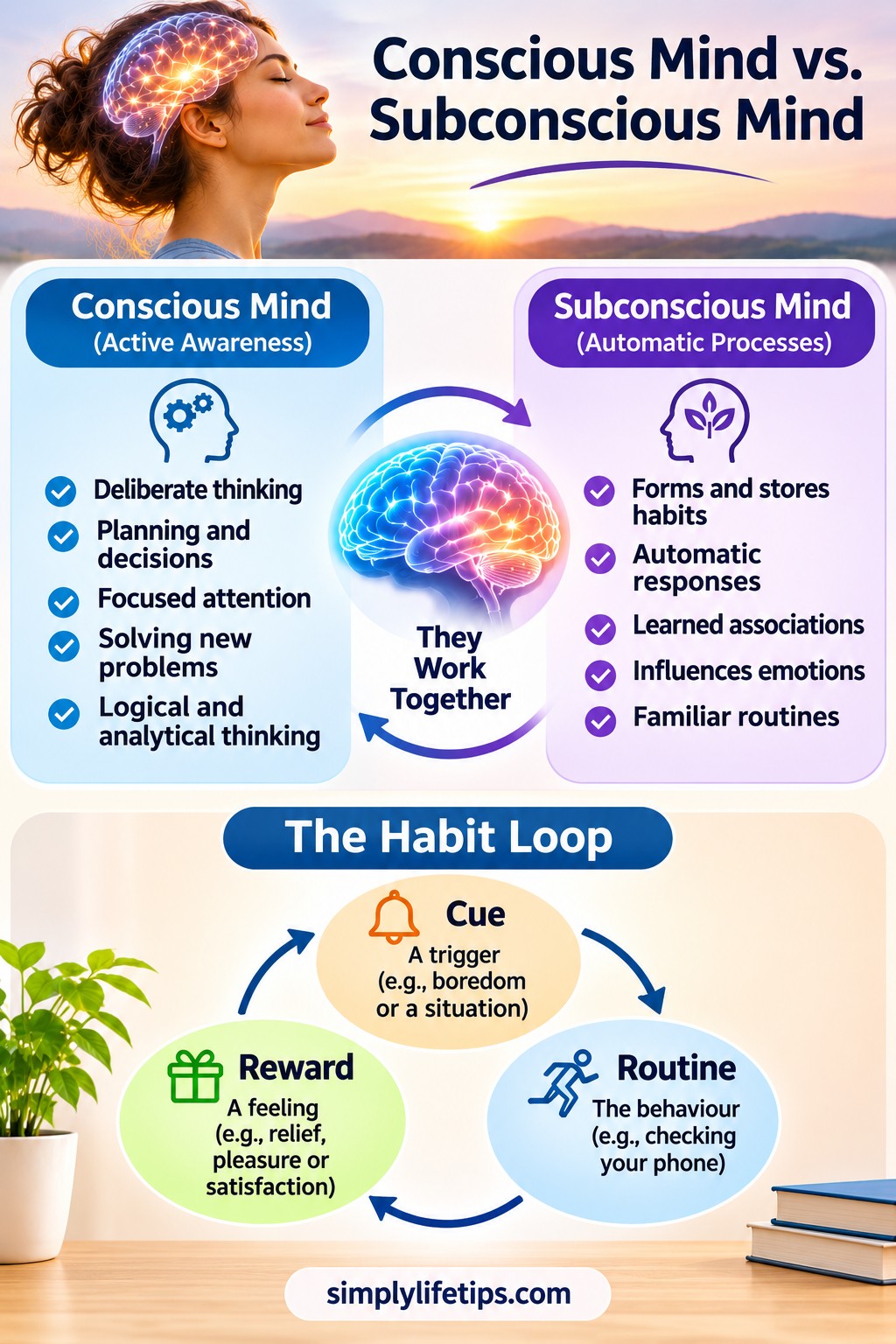
Imagine checking your phone whenever you feel bored. After repeating this behaviour many times, boredom may become a cue that prompts you to reach for your phone.
Recognising this pattern is the first step towards choosing a different response.
3. Learned associations
Past experiences can create associations between sounds, smells, places and emotions.
A familiar song may remind you of an important event, while the smell of a favourite dish may bring back childhood memories. These reactions can happen quickly, sometimes before you consciously understand why you feel a particular way.
Conscious Mind vs. Subconscious Mind
The conscious mind and subconscious mind are often described as two separate systems. However, human thinking is more complex than this simple distinction.
A useful way to understand the difference is to consider whether you are actively aware of a mental process.
Conscious awareness involves:
- Deliberate thinking and planning.
- Focused attention.
- Solving unfamiliar problems.
- Making considered decisions.
Processes outside immediate awareness include:
- Familiar habits and learned responses.
- Automatic actions.
- Familiar associations.
- Skills that require less deliberate attention after practice.
For example, when planning your day, you consciously consider your priorities and schedule. When following a familiar morning routine, you may perform several activities without thinking through every individual step.
Both conscious awareness and automatic processes contribute to everyday behaviour. They work together rather than operating as two completely independent minds.
How the Subconscious Mind Influences Habits
Habits are learned behaviours that can become easier to perform when familiar situations or cues appear.
Consider someone who checks social media whenever an important task feels difficult.
The pattern may look like this:
Difficult task → Discomfort → Checking the phone → Temporary relief → Delayed work
The person may not consciously decide to avoid work every time. The response may have become familiar through repetition.
Environmental cues also play an important role in habits. For example, keeping your phone beside you while working may encourage frequent checking. Placing it in another room can reduce that cue and make focused work easier.
Once the pattern is recognised, it becomes easier to practise a different response:
Difficult task → Pause → Put the phone away → Work for five minutes
Changing an established habit is not always easy, but understanding what triggers a behaviour gives you a practical starting point.
A 2024 systematic review published in Healthcare found considerable variation in the time needed for health-related habits to become automatic. This means there is no universal timetable for changing a habit.
Read the research on habit formation.
Can You Reprogram Your Subconscious Mind?
The expression “reprogram your subconscious mind” is popular in personal development. It is best understood as a metaphor for changing learned thoughts, habits and behavioural patterns.
You cannot simply give your mind a command and expect your habits or personality to change overnight.
Meaningful change usually involves awareness, repeated practice, realistic expectations and adjustments to your surroundings.
For example, suppose you regularly think, “I am not good at public speaking.” This belief may make you nervous and discourage you from accepting speaking opportunities.
You could practise a more balanced thought:
“Public speaking is difficult for me right now, but I can improve with preparation and practice.”
Then take practical steps. Prepare a short presentation, practise aloud and gradually gain experience.
The aim is not to force positive thinking. It is to develop helpful beliefs and behaviours that encourage constructive action.
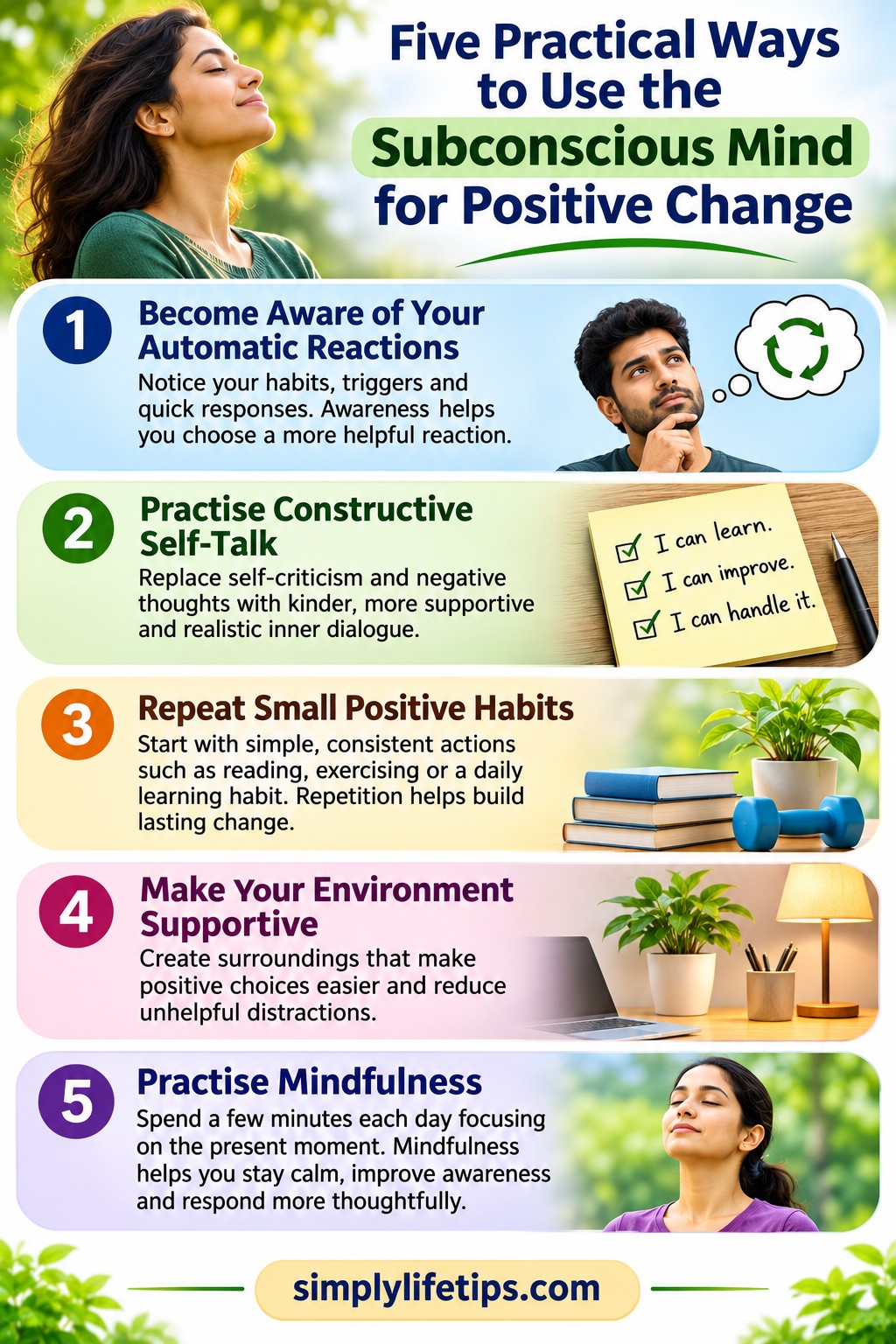
5 Ways the Subconscious Mind Shapes Your Habits
You do not need complicated techniques to begin changing unhelpful habits. Start with manageable actions that you can repeat.
1. Become aware of your automatic reactions
Notice what you tend to do when you feel bored, stressed, angry or uncertain.
For example, if you automatically reach for your phone whenever you feel uncomfortable, identify what triggers that behaviour.
Awareness helps you recognise patterns that might otherwise go unnoticed.
2. Practise constructive self-talk
The way you speak to yourself can influence how you approach challenges.
Instead of saying, “I always fail,” try saying, “This attempt did not work, but I can learn from it.”
Choose realistic statements that encourage improvement rather than exaggerated affirmations.
3. Repeat small positive habits
Choose one manageable behaviour and connect it to an existing routine.
For example:
- Walk for ten minutes after breakfast.
- Read a few pages before going to bed.
- Write for fifteen minutes after your morning tea.
- Review your priorities before starting work.
Consistent practice can help a behaviour become more familiar over time.
4. Make your environment supportive
Your surroundings can make certain behaviours easier or more difficult.
If you want to read more, keep a book near your bed. If you want to reduce phone distractions, switch off unnecessary notifications or leave your phone away from your workspace.
If you want to exercise regularly, keep your walking shoes near the door. If you want to spend less time on social media, remove distracting apps from your home screen.
Small environmental changes can make it easier to follow useful routines.
5. Practise mindfulness
Mindfulness involves paying attention to your thoughts, feelings and experiences in the present moment.
Imagine receiving a message that makes you angry. Instead of replying immediately, pause, notice your emotions and take a few slow breaths.
The emotion may not disappear, but the pause allows you to choose your response more thoughtfully.
For more practical activities, explore 10 Subconscious Mind Exercises to Try Daily.
The Subconscious Mind and Personal Success
Your mindset can influence how you approach challenges, but thoughts alone cannot guarantee success. Skills, effort, opportunities, resources and circumstances also matter.
Consider someone who wants to build a successful blog. Thinking about success is not enough. The person needs to research topics, write useful content, understand readers, improve their skills and publish consistently.
Developing a regular writing routine can make these actions easier to maintain.
Automatic routines can support consistent action, while conscious decisions help you review your progress and adjust your plans.
Common Myths About the Subconscious Mind
Popular discussions sometimes make exaggerated claims about subconscious mind power. It is important to approach these ideas realistically.
Myth 1: Your subconscious mind can give you anything you want.
Reality: Thoughts alone cannot guarantee wealth, health, relationships or success. Goals require practical action and suitable circumstances.
Myth 2: One affirmation can completely change your life.
Reality: Positive statements may encourage a constructive attitude, but lasting behavioural change requires consistent practice and action.
Myth 3: You can reprogram your mind overnight.
Reality: Changing established habits and responses usually takes time. Progress varies between individuals and behaviours.
Myth 4: You have no control over automatic behaviour.
Reality: Automatic responses can influence your actions, but awareness, conscious decisions and environmental changes can help you develop alternative responses.
Conclusion
The subconscious mind is a commonly used term for mental processes that operate outside our immediate conscious awareness. These processes influence familiar habits, learned responses, memories and everyday behaviour.
Understanding them can help you recognise unhelpful patterns and develop healthier ways of thinking and acting.
You do not need to control every thought or expect overnight transformation. Start by noticing your automatic reactions, practising constructive self-talk and repeating small, useful behaviours.
Consistent effort and practical action can gradually help you build habits that support a more meaningful life.
What is one automatic habit you would like to change? Start by identifying its trigger and choosing one small action you can practise today.
Frequently Asked Questions
1. What is the subconscious mind?
The subconscious mind is a commonly used term for mental processes that happen outside immediate conscious awareness. It is often associated with habits, learned patterns, automatic responses and familiar behaviours.
2. What is the power of the subconscious mind?
It refers to how automatic mental processes and learned patterns can influence thoughts, emotions and everyday behaviour. It does not mean that thoughts can magically control external events.
3. Can you reprogram your subconscious mind?
You cannot literally rewrite a separate part of your brain like computer software. However, you can work towards changing habits and behavioural patterns through awareness, repeated practice and deliberate action.
4. How does the subconscious mind affect behaviour?
Learned patterns and automatic responses can influence how you react to familiar situations. Recognising these patterns can help you understand your behaviour and practise more constructive responses.
5. Can positive thinking change your subconscious mind?
Positive thinking may support motivation and a constructive attitude. However, thoughts alone do not guarantee lasting change. Combining realistic self-talk with practical action and consistent effort is more useful.
References and Further Reading
- Singh, B., Murphy, A., Maher, C., and Smith, A. E. (2024). Time to Form a Habit: A Systematic Review and Meta-Analysis of Health Behaviour Habit Formation and Its Determinants. Healthcare, 12(23), 2488.
- Wood, W. (2024). Habits, Goals, and Effective Behavior Change. Current Directions in Psychological Science, 33(4).
- Albarracín, D., Fayaz-Farkhad, B., and Granados Samayoa, J. A. (2024). Determinants of behaviour and their efficacy as targets of behavioural change interventions. Nature Reviews Psychology, 3, 377–392.

Mathukutty P. V. is the founder of Simply Life Tips. He shares practical advice and useful insights on personal growth, health, well-being, technology, and everyday living. His goal is to help readers build positive habits and make informed decisions. He believes in continuous learning and sharing knowledge to help people live healthier, happier, and more meaningful lives.