How to handle disrespect is one of the most valuable life skills you can develop. No matter how kind, professional, or respectful you are, there will always be moments when someone tries to belittle you, ignore your boundaries, or undermine your worth. The real question is not whether disrespect will happen, but how you choose to respond when it does.
How to Handle Disrespect?
Disrespect is something we all face at some point in life, whether it comes from family, friends, colleagues, or even strangers. The way you respond to disrespect determines not only how others see you but also how much peace you keep within yourself. Handling disrespect wisely means staying calm, protecting your dignity, and not letting negative behavior control your emotions. Instead of reacting with anger or hurt, you can choose to set healthy boundaries, communicate assertively, and walk away when necessary. For example, if a coworker talks down to you in front of others, instead of shouting back, you could calmly say, “I’d appreciate it if we discuss this respectfully”—showing strength without losing your composure. By handling disrespect with grace and firmness, you maintain your self-respect and inspire others to treat you better.
Ways to Handle Disrespect?
Respect is never optional—it’s both earned and expected. “5 Ways to Handle People Who Don’t Respect You” offers practical strategies to help you recognise disrespect and stand tall with confidence. In just 12 minutes, this empowering video guides you through spotting subtle and overt signs of disrespect, setting clear boundaries, and responding with calm strength rather than anger. Whether it happens at work, in your relationships, or within your social circle, you’ll discover how to reclaim your power and protect your self-worth. Remember, respect begins with how you treat yourself, and this video shows you how to command it—not with aggression, but with self-assurance, clarity, and composure. Don’t settle for less than you deserve—watch now and take the first step toward commanding the respect you are worthy of.
5 Powerful Ways to Handle Disrespect
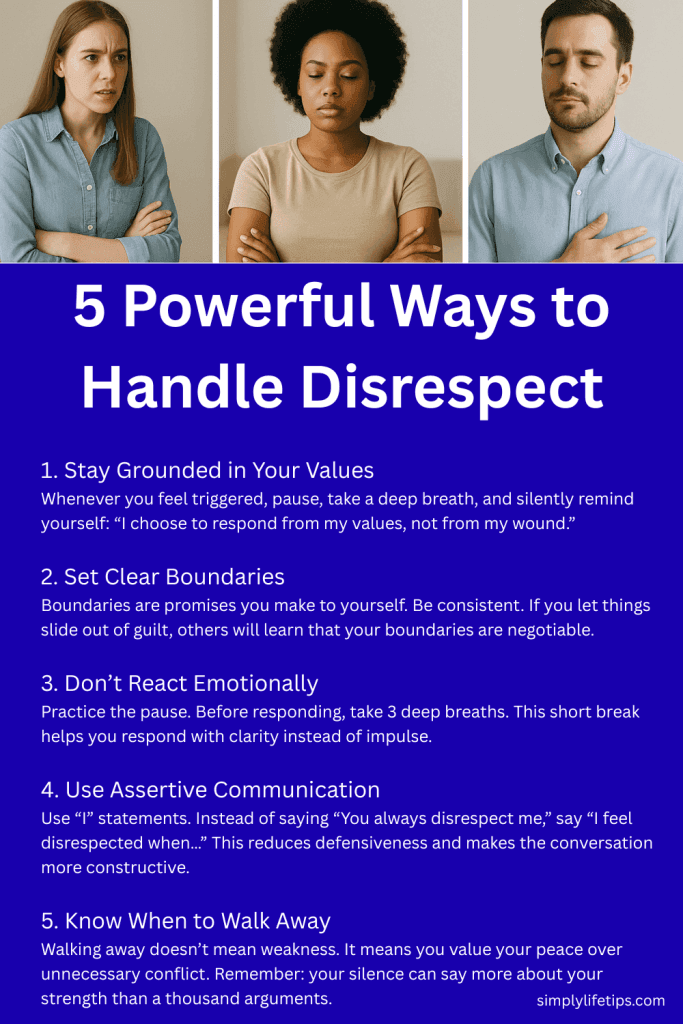
Here are five powerful ways to handle people who don’t respect you—with examples, tips, and strategies you can apply in real life.
1. Stay Grounded in Your Values
When someone disrespects you, the instinct is to react—raise your voice, defend yourself, or “put them in their place.” But reacting impulsively gives away your power.
Instead, remind yourself of your values. Do you stand for kindness, integrity, patience, or courage? If yes, then let those values guide your response.
Example:
Imagine a colleague making a sarcastic remark in front of others. Instead of firing back, you calmly respond with:
“I’d prefer we keep this conversation professional.”
You haven’t stooped to their level. You’ve upheld your value of professionalism.
Tip:
Whenever you feel triggered, pause, take a deep breath, and silently remind yourself: “I choose to respond from my values, not from my wound.”
2. Set Clear Boundaries
One of the most practical lessons in handling disrespect is learning to set boundaries. Disrespectful people often push limits until they find where your line is drawn. If you don’t define it, they’ll keep crossing it.
Example:
If someone keeps interrupting you, you can say:
“I’d like to finish my point before moving on.”
It’s not rude—it’s clear.
Tip:
Boundaries are promises you make to yourself. Be consistent. If you let things slide out of guilt, others will learn that your boundaries are negotiable.
3. Don’t React Emotionally
Disrespect hurts. It can sting, especially when it’s public or comes from someone close. But here’s the truth: how they treat you is more about them than about you.
If you react emotionally—yelling, crying, or over-explaining—you give them control over your peace. Instead, create space between their behaviour and your response.
Example:
When someone mocks you, instead of snapping back, you calmly reply:
“I’ll respond when this conversation is respectful.”
This shifts the power back to you.
Tip:
Practice the pause. Before responding, take 3 deep breaths. This short break helps you respond with clarity instead of impulse.
4. Use Assertive Communication
Being silent forever is not the answer. Respectful but firm communication is key in dealing with repeated disrespect. Assertive communication is calm, clear, and confident—it doesn’t attack, but it doesn’t retreat either.
Example:
If a friend constantly cancels plans at the last minute, you might say:
“I value our time together, but when plans keep changing, it makes me feel unimportant. Can we work on being more consistent?”
This addresses the issue without aggression.
Tip:
Use “I” statements. Instead of saying “You always disrespect me,” say “I feel disrespected when…” This reduces defensiveness and makes the conversation more constructive.
5. Know When to Walk Away
Sometimes, the most powerful response is silence and distance. Not every battle is worth fighting. If someone repeatedly disrespects you, despite your efforts, walking away protects your dignity. The Power Of Silence: Simple Steps For Empowering Minds
Example:
If a colleague continuously undermines you, and conversations or boundaries don’t change anything, you may choose to limit interactions or escalate it to HR rather than tolerating endless negativity.
Tip:
Walking away doesn’t mean weakness. It means you value your peace over unnecessary conflict. Remember: your silence can say more about your strength than a thousand arguments.
Conclusion
Learning how to handle disrespect is not about changing others—it’s about mastering yourself. You don’t have to match negativity with negativity. You don’t have to prove your worth to people who refuse to see it.
Instead, you:
- Stay grounded in your values.
- Set clear boundaries.
- Respond calmly, not emotionally.
- Use assertive communication.
- Walk away with dignity when needed.
At the end of the day, self-respect is the foundation of all respect. When you honour your own worth, you stop shrinking for others, and you stop fighting battles that don’t deserve your energy.
So, the next time disrespect comes your way, pause, breathe, and ask yourself: “What response aligns with my values?” That choice—not their behaviour—is what truly defines you.
How do you usually handle disrespect, and which of these five strategies will you try the next time you face it?
5 FAQ: How to Handle Disrespect?
1. What is the best way to handle disrespect?
The best way to handle disrespect is to stay calm, set clear boundaries, and respond assertively without reacting emotionally. This protects your peace while showing strength and self-respect.
2. Should I confront someone who disrespects me?
Yes, but do it calmly and assertively. Use “I” statements like, “I feel disrespected when…” instead of blaming. If the behaviour continues, know when to walk away.
3. How do I stop taking disrespect personally?
Remind yourself that disrespect often reflects the other person’s insecurities, not your worth. Practice self-awareness and create emotional distance so you don’t internalise their behaviour.
4. Can setting boundaries stop people from disrespecting me?
Absolutely. Boundaries teach others how to treat you. When enforced consistently, they filter out people who don’t value you and strengthen your relationships with those who do.
5. When is it better to walk away from disrespect?
Walk away when someone repeatedly ignores your boundaries, disrespects you despite clear communication, or drains your energy. Walking away isn’t weakness—it’s self-respect in action.
PVM

Mathukutty P V is a Blogger, YouTuber, and Content Writer and the founder of Simply Life Tips. After taking voluntary retirement in 2017, he embraced a free lifestyle focused on learning, personal growth, and sharing practical wisdom to help others live with more purpose and positivity.