

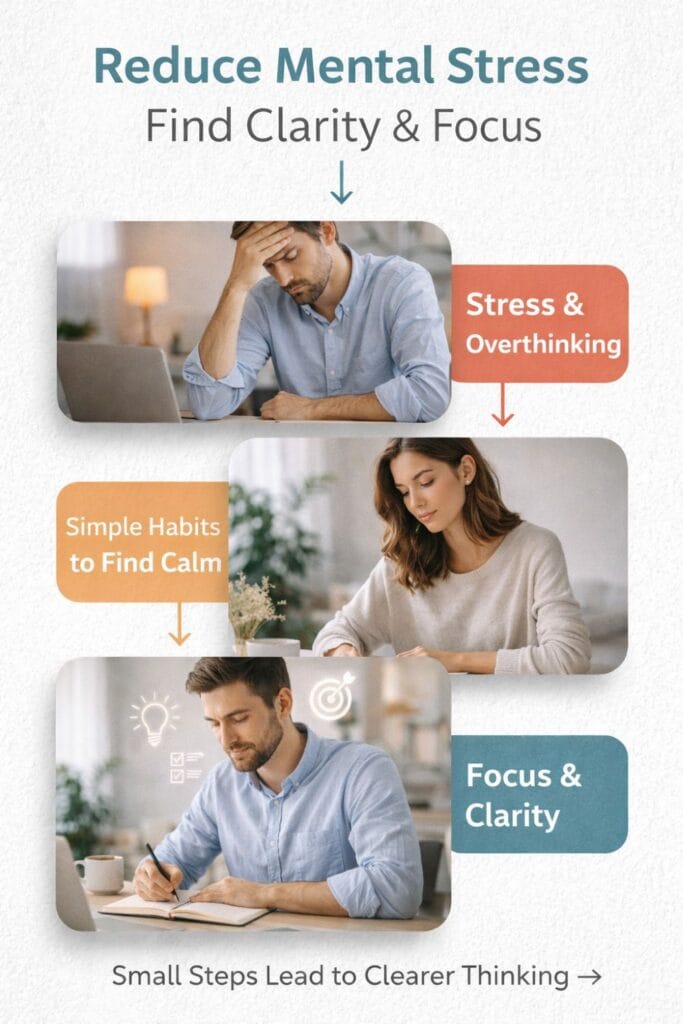
Reduce mental stress is not just about relaxation—it is about clearing a constantly overloaded mind. Today, most people are thinking continuously but not arriving at clarity. This leads to a state where they are active throughout the day, yet mentally exhausted and emotionally drained.
This condition is often misunderstood as stress, but in reality, it is mental overload without direction. The mind is busy, but not clear. Thoughts are constant, but not useful. Over time, this affects decision-making, reduces focus, and weakens emotional stability.
If you’ve ever felt tired without doing much physical work, or confused despite thinking a lot, you are not alone. You are experiencing a lack of clarity—not just stress.
This pattern often begins early in life, which is why improving emotional intelligence in children plays a key role in building clarity later.
A Common Everyday Scenario You May Recognize
Imagine starting your day with a clear plan. You sit down to work, but within minutes, your attention shifts. A thought about something unfinished appears. Then a memory from yesterday. Then a worry about tomorrow.
The task is still in front of you—but your mind is elsewhere.
By the end of the day, you feel exhausted, yet nothing feels complete. This is not because you lacked ability. It is because your mind was overloaded with unstructured thinking.
To understand how this pattern develops early in life, you can read this related guide on Teaching Emotional Intelligence to Children, which explains how unmanaged thoughts affect focus and emotional control.
Why Stress Is Not the Core Issue
Most people try to reduce mental stress through distractions—watching videos, scrolling social media, or taking breaks. While these methods provide temporary relief, they do not solve the underlying issue.
The real issue is lack of mental clarity.
When the mind is unclear, even simple situations feel overwhelming. Decisions take longer, emotions become heavier, and focus disappears. In contrast, when the mind is clear, even complex situations feel manageable.
This is why learning how to reduce mental stress is less about avoiding pressure and more about training your mind to think clearly.
For deeper understanding of emotional balance, you can also explore Affirmations For Happiness which supports mental clarity through positive conditioning.
Building daily habits for happiness and clarity helps train the mind to respond calmly instead of reacting emotionally.
How Mental Overload Builds Over Time
Mental overload does not happen suddenly. It develops gradually through continuous exposure to information and lack of mental organization.
Every day, your mind processes:
• Social media updates
• Conversations
• Work-related thoughts
• Personal worries
Without a system to process these inputs, the mind accumulates clutter. This clutter turns into overthinking, confusion, and emotional fatigue.
According to the American Psychological Association, unmanaged mental stress can significantly affect both cognitive performance and emotional well-being, reinforcing the importance of structured mental habits.
The Link Between Clarity and Emotional Stability
When you reduce mental stress by improving clarity, your emotional state also improves. This is because clarity creates space between thought and reaction.
Instead of reacting immediately, a clear mind pauses, evaluates, and responds.
For example, in a stressful situation:
• An unclear mind reacts with frustration
• A clear mind responds with understanding
This shift improves relationships, communication, and overall emotional health.Why You Must Build Clarity Daily
Many people wait for peace to come naturally. But clarity is not automatic—it is developed through consistent practice.
Just like physical fitness requires daily effort, mental clarity requires structured habits.
Occasional motivation does not create lasting results. What works is daily repetition.
To strengthen this habit-building mindset, you may find value in Affirmations For Better Sleep, which shows how consistency improves mental recovery and clarity.
Understanding how better sleep improves mental clarity can significantly reduce mental overload and improve focus.
From Overthinking to Clear Understanding
Overthinking is repetitive and draining. It keeps your mind active but not productive.
Understanding is focused and solution-oriented.
To reduce mental stress effectively, shift your thinking pattern:
Instead of asking “What if this goes wrong?”
Ask “What is the next best step I can take?”
This simple shift reduces confusion and creates direction.
Creating Clear Thinking in Daily Life
Clear thinking is not about thinking more—it is about thinking better.
To reduce mental stress, you must:
• Limit unnecessary information
• Focus on priorities
• Allow time for mental processing
When you reduce mental noise, clarity naturally increases.
This is also why practices like journaling and reflection are powerful—they help organize thoughts and remove internal clutter.
Simple Daily Practices to Reduce Mental Stress

Reducing mental stress does not require complex routines. Simple habits can create powerful results when practiced consistently.
Start your day with a few minutes of silence. This helps set direction. Writing your thoughts allows your mind to release clutter. Focusing on a small number of priorities prevents overwhelm. Taking short pauses during the day resets your mental energy. Reflecting in the evening improves awareness.
These practices train your mind to operate with clarity instead of confusion.
Using tools like affirmations for students to improve focus can strengthen your ability to stay mentally clear and consistent.
Why Consistency Is More Powerful Than Motivation?

Motivation is temporary. Consistency creates lasting change.
Small daily actions build strong mental habits. Over time, these habits create a natural state of calmness and clarity.
For example, spending just 10 minutes daily on mental clarity practices is more effective than doing nothing for days and then trying to compensate.
Consistency is what allows you to reduce mental stress permanently, not temporarily.
When Guidance Makes the Difference
While self-effort is important, guidance provides structure. It helps you avoid confusion and follow a clear path.
A structured approach allows you to move from:
• Overthinking → Clarity
• Confusion → Understanding
• Stress → Stability
This is where coaching or guided systems can accelerate progress significantly.
A Calm Mind Improves Every Area of Life
When you reduce mental stress and build clarity, the impact extends beyond your mind.

You begin to:
• Make better decisions
• Improve your focus
• Strengthen relationships
• Feel more confident
Clarity does not just change how you think—it changes how you live.
FAQS
What is the fastest way to reduce mental stress?
Start with journaling and identifying your top 3 priorities. This instantly reduces mental clutter.
Can overthinking be stopped completely?
Yes, with consistent practice, overthinking can be replaced with structured thinking.
How long does it take to see results?
You may notice improvements within a few days, but lasting clarity takes consistent effort.
Is stress always bad?
No, some stress is normal. The problem is unmanaged mental overload.
Do I need meditation to reduce mental stress?
Meditation helps, but daily structured practices are more effective for long-term clarity.
Conclusion
Reduce mental stress by focusing on what truly matters—building inner clarity. Most people struggle not because life is too difficult, but because their minds are too cluttered.
When your mind is unclear, everything feels overwhelming.
When your mind is clear, everything becomes manageable.
Clarity is not something you wait for. It is something you build daily.
And once you build it, you don’t just feel better—you live differently.
When you build clarity, it also reflects in your actions, shaping behaviors that earn respect in daily life.
So reflect honestly—what affects you more right now: overthinking, emotional stress, or lack of clarity?
For scientific insights on stress and mental health, visit: American Psychological Association
If this resonated with you, share it with someone who needs it.
PVM

Mathukutty P V is a Blogger, YouTuber, and Content Writer and the founder of Simply Life Tips. After taking voluntary retirement in 2017, he embraced a free lifestyle focused on learning, personal growth, and sharing practical wisdom to help others live with more purpose and positivity.



