
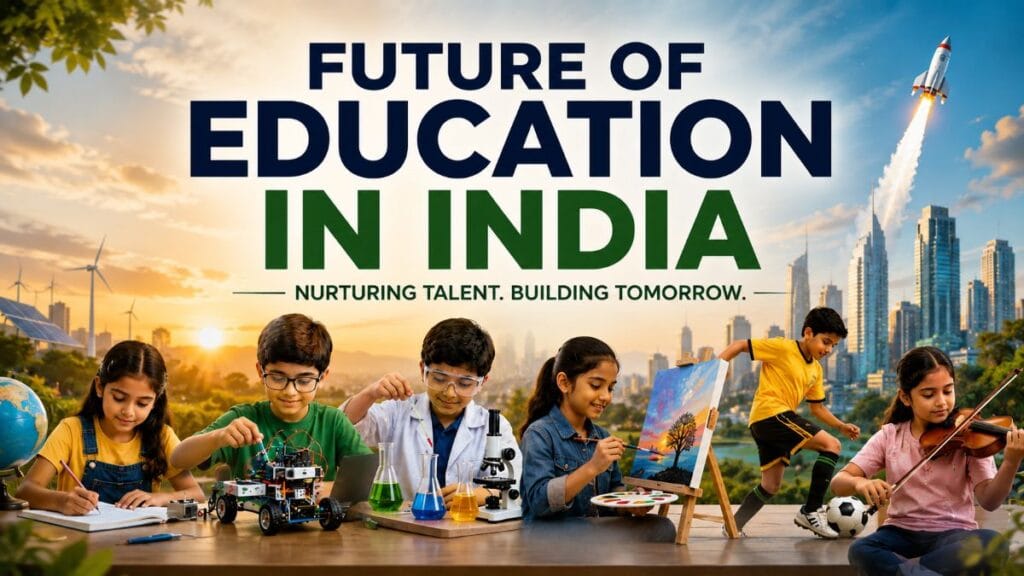
The future of Education in India is one of the most important conversations of our time. As artificial intelligence, automation, and technological innovation transform the world at an unprecedented pace, educators and parents are increasingly asking a critical question: Are our schools preparing children for the future they will live in, or are they still following models designed for the past?
The Future of Education in India
This discussion gained attention for thought-provoking observations from Dr. Arun Oommen, Senior Consultant Neurosurgeon at VPS Lakeshore Hospital, Kochi, who highlighted an important concern about modern education systems. His perspective encourages us to examine whether standardized academic expectations truly reflect the diverse abilities, interests, and learning styles of children.
Every child enters the world with unique talents. Some are natural innovators, some are artists, some are athletes, and some are gifted communicators. Yet many educational systems continue to evaluate success using a largely uniform framework.
As India moves toward becoming a global leader in innovation and technology, it is worth asking whether our education system is nurturing individuality or encouraging conformity.
Every Child Is Born Different
Imagine a young boy who spends his free time taking apart electronic toys and rebuilding them into something new. By the age of twelve, he can create simple robots and solve engineering challenges that many adults would struggle to understand.
Now imagine a young girl whose paintings capture remarkable detail and emotion. Her teachers recognize her artistic brilliance, but much of her time is spent preparing for examinations in subjects that have little connection to her natural talents.
Both children are intelligent.
Both children have enormous potential.
Yet both may be measured by the same academic standards.
Modern neuroscience confirms that no two brains are identical. Every child is born with a unique neurological structure that influences how they learn, process information, and solve problems.
Some children naturally excel at language learning. Others demonstrate extraordinary abilities in mathematics, music, creativity, athletics, leadership, or visual-spatial reasoning.
The future of education in India must begin with recognizing this fundamental truth: children are different, and their educational journeys should reflect those differences.
What Neuroscience Teaches Us About Learning?
Scientific research continues to reveal that intelligence is far more complex than traditional academic measurements suggest.
Different areas of the brain develop at different rates and contribute to different strengths. Some children show exceptional verbal skills, while others possess remarkable visual, analytical, or creative abilities.
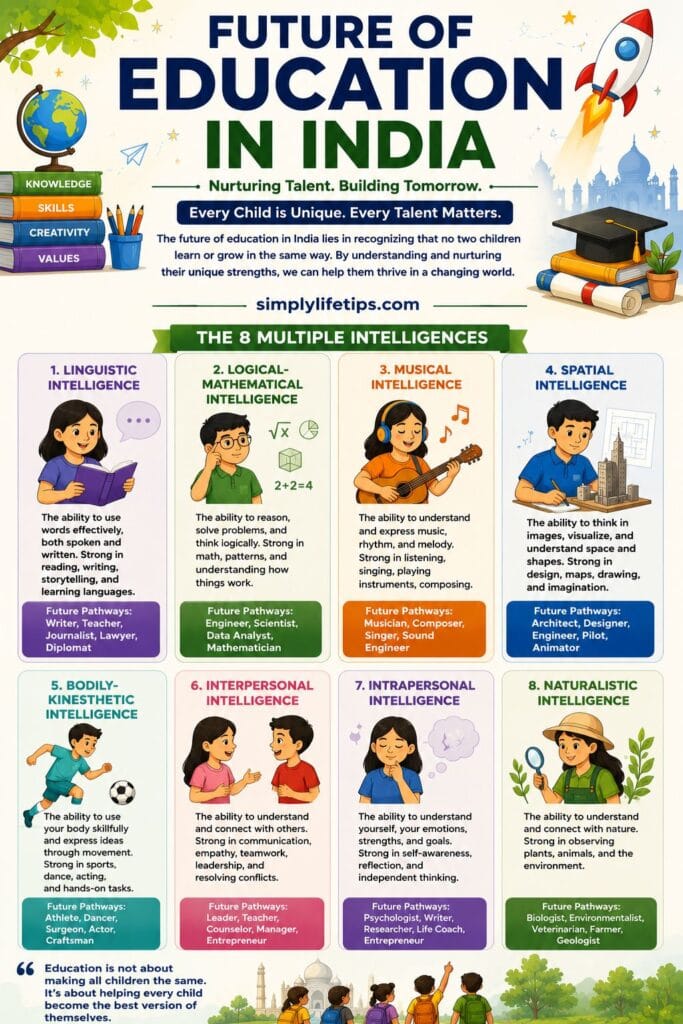
Educational psychologist Howard Gardner introduced the concept of Multiple Intelligences, suggesting that human intelligence extends far beyond language and mathematics.
These include:
- Linguistic Intelligence
- Logical-Mathematical Intelligence
- Musical Intelligence
- Spatial Intelligence
- Bodily-Kinesthetic Intelligence
- Interpersonal Intelligence
- Intrapersonal Intelligence
- Naturalistic Intelligence
Understanding the Different Types of Intelligence
Linguistic Intelligence
Children with linguistic intelligence have a natural ability to understand, use, and express language effectively. They enjoy reading, writing, storytelling, public speaking, and learning new languages. These students often have strong vocabularies and can communicate ideas clearly. Future careers may include journalism, law, teaching, writing, public relations, diplomacy, and content creation.
For example, a child who enjoys writing stories, participating in debates, or learning foreign languages may possess strong linguistic intelligence.
Logical-Mathematical Intelligence
Logical-mathematical intelligence involves reasoning, problem-solving, pattern recognition, and analytical thinking. Children with this intelligence enjoy solving puzzles, conducting experiments, working with numbers, and understanding how systems function.
These learners often excel in mathematics, engineering, computer science, economics, and scientific research. A child who loves coding, chess, or finding solutions to complex problems is likely demonstrating strong logical-mathematical intelligence.
Musical Intelligence
Children with musical intelligence have a heightened sensitivity to rhythm, melody, tone, and sound patterns. They can often recognize musical structures quickly and may learn songs more easily than other forms of information.
Musically intelligent individuals often become singers, composers, musicians, sound engineers, or music teachers. A child who can identify notes accurately, remember melodies after hearing them once, or create original tunes may possess exceptional musical intelligence.
Spatial Intelligence
Spatial intelligence is the ability to think in images, visualize objects, understand dimensions, and mentally manipulate shapes and spaces. Children with this intelligence often enjoy drawing, designing, building models, solving mazes, and visualizing complex structures.
This intelligence is particularly valuable in careers such as architecture, engineering, graphic design, filmmaking, aviation, and surgery. For example, a child who can easily assemble complex building blocks or imagine how an object looks from different angles may have strong spatial intelligence.
Bodily-Kinesthetic Intelligence
Children with bodily-kinesthetic intelligence learn best through movement and physical activity. They have excellent control over body movements and often excel in sports, dance, acting, crafts, or hands-on activities.
Athletes, surgeons, dancers, craftsmen, and physical therapists often possess high bodily-kinesthetic intelligence. A child who learns quickly through practical experience rather than reading instructions may demonstrate this form of intelligence.
Interpersonal Intelligence
Interpersonal intelligence refers to the ability to understand, communicate with, and relate to other people effectively. Children with this intelligence often display leadership qualities, empathy, teamwork, and strong communication skills.
These individuals may excel as teachers, managers, counselors, sales professionals, social workers, politicians, or entrepreneurs. For example, a student who naturally resolves conflicts among friends or motivates classmates often possesses strong interpersonal intelligence.
Intrapersonal Intelligence
Intrapersonal intelligence is the ability to understand oneself, including one’s emotions, motivations, strengths, and weaknesses. Children with this intelligence tend to be self-aware, reflective, and capable of independent thinking.
Writers, philosophers, psychologists, researchers, and leaders often demonstrate strong intrapersonal intelligence. A child who regularly reflects on personal goals, understands emotions well, and learns from experiences may possess this valuable form of intelligence.
Naturalistic Intelligence
Children with naturalistic intelligence have a deep connection with nature and a strong ability to recognize patterns in the natural world. They enjoy observing plants, animals, weather systems, and environmental changes.
This intelligence is often seen in environmental scientists, farmers, biologists, conservationists, veterinarians, and geologists. For example, a child who can identify different bird species, understands ecosystems, or enjoys caring for plants may have strong naturalistic intelligence.
These multiple forms of intelligence remind us that educational success cannot be measured by a single standard. The future of education in India may depend on recognizing and nurturing the unique strengths that each child brings to the classroom.
For example, a future entrepreneur may display strong leadership and interpersonal skills. A future architect may possess exceptional spatial intelligence. A future musician may demonstrate extraordinary auditory processing abilities.
When educational systems place excessive emphasis on a narrow set of academic indicators, many forms of talent remain underdeveloped.
The Legacy of Industrial-Era Education
Most modern school systems were designed during the industrial era.
Their primary goal was to produce large numbers of workers with standardized knowledge and skills. Uniformity, consistency, and compliance were highly valued because they met the needs of industrial economies.
However, the world of today is very different.
Employers increasingly seek individuals who can:
- Think critically
- Solve complex problems
- Innovate
- Adapt to change
- Collaborate effectively
- Demonstrate emotional intelligence
- Learn continuously
Success in the 21st century depends less on memorization and more on creativity, adaptability, and lifelong learning.
The future of education in India must reflect these changing realities.
The Three-Language Debate and Educational Priorities
One of the most discussed educational topics in recent years has been the implementation of the three-language policy.
Supporters argue that multilingualism promotes cultural understanding, cognitive flexibility, and communication skills. There is substantial evidence that learning additional languages can offer cognitive and social benefits.
However, critics raise a different concern.
The issue is not whether languages are valuable. The issue is whether every child should be required to invest significant time and effort in mastering multiple languages, regardless of their interests, talents, or career aspirations.
A student passionate about diplomacy, journalism, literature, or international relations may eagerly embrace multilingual learning.
A student interested in robotics, coding, medicine, scientific research, sports, or design may prefer to devote more time to those areas.
The debate highlights a broader question about educational flexibility and individual choice.
The Hidden Cost of Standardization
Every educational requirement comes with an opportunity cost.
Time spent on one activity cannot be spent on another.
When students devote hundreds of hours to preparing for examinations in multiple compulsory subjects, those same hours cannot be invested in:
- Coding projects
- Scientific research
- Artistic development
- Music practice
- Sports training
- Entrepreneurship
- Innovation challenges
For example, a student with exceptional programming ability could use additional time to develop software applications, participate in hackathons, or learn emerging technologies.
A gifted musician could spend those hours refining performance skills.
An aspiring scientist could conduct experiments and develop research projects.
The future of education in India must consider not only what students learn but also what opportunities they may lose when educational systems become overly rigid.
Why Academic Pressure Continues to Grow?
Today’s students face far more pressure than previous generations.
In addition to regular schoolwork, many students must manage:
- Competitive examinations
- Tuition classes
- Homework
- Projects
- Extracurricular activities
- Career planning
Adding additional mandatory requirements may increase cognitive and emotional burdens without necessarily improving long-term outcomes.
Children who struggle in one particular area should not automatically be viewed as less capable.
A student who struggles with language learning may possess extraordinary mathematical reasoning.
A student with dyslexia may demonstrate exceptional creativity and innovation.
Educational success should not be defined by a single pathway.
A Lesson From Nature
Imagine a school for animals.
A monkey, an eagle, a rabbit, an elephant, and a fish are all given the same examination: climb a tree.
The monkey succeeds.
The eagle succeeds.
The rabbit struggles.
The elephant fails.
The fish is judged incapable.
Yet the fish is not unintelligent.
The assessment simply fails to recognize its strengths.
Human education sometimes makes a similar mistake. When every child is expected to achieve success using the same criteria, many unique talents remain invisible.
The future of education in India should focus on discovering strengths rather than merely measuring conformity.
Why Child-Centered Education Matters?
Child-centered education does not mean lowering standards.
It means recognizing that excellence can take different forms.
A child-centered approach encourages schools to:
- Identify individual strengths
- Support diverse talents
- Provide flexible learning pathways
- Promote curiosity and creativity
- Encourage critical thinking
- Develop real-world skills
Such an approach prepares students not only for examinations but also for life.
When children learn in ways that align with their strengths and interests, engagement, confidence, and achievement often improve significantly.
The Future of Education in India Will Be Personalized
Technology is making personalized learning more achievable than ever before.
Artificial intelligence, adaptive learning platforms, and data-driven educational tools can help teachers understand how individual students learn best.
Future classrooms may focus less on standardization and more on customization.
Instead of asking every child to learn the same thing at the same pace, schools may increasingly tailor learning experiences to individual needs and aspirations.
The question of the future may not be:
“How many languages does this child know?”
A more meaningful question could be:
“What unique contribution can this child make to society?”
The answer to that question may ultimately determine the success of future educational systems.
FAQs – Future of Education in India
What is the future of education in India?
The future of education in India is expected to focus more on personalized learning, critical thinking, creativity, technology integration, and skill development rather than rote memorization.
Why is child-centered education important?
Child-centered education recognizes that every child learns differently and helps students develop their unique strengths, interests, and talents.
What are the benefits of learning multiple languages?
Multilingual learning can improve communication skills, cultural awareness, cognitive flexibility, and global opportunities.
Does neuroscience support personalized learning?
Yes. Neuroscience shows that children possess different cognitive strengths and learning profiles, supporting more individualized educational approaches.
What skills will be most valuable in the future?
Critical thinking, creativity, adaptability, emotional intelligence, collaboration, problem-solving, and technological literacy are expected to be among the most valuable future skills.
- The Hidden Dangers of Technology in Education
- The Power Of Digital Education For Children: Shaping The Future Of Learning
Conclusion
The future of education in India will depend on how effectively we balance academic standards with individual potential. Every child is born with unique talents, interests, and ways of learning. The goal of education should not simply be to create uniform outcomes but to help each child discover and develop their strengths.
Inspired by the observations of Dr Arun Oommen’s post, this discussion reminds us that educational success cannot be measured solely by standardized requirements. A truly progressive education system recognizes diversity in human abilities and creates opportunities for every child to thrive.
The future belongs not to systems that make all children the same, but to systems that help every child become the best version of themselves.
If education is meant to prepare children for the future, should schools focus more on standardization or on nurturing each child’s unique potential?
If this resonated with you, share it with someone who needs it.
PVM

Mathukutty P V is a Blogger, YouTuber, and Content Writer and the founder of Simply Life Tips. After taking voluntary retirement in 2017, he embraced a free lifestyle focused on learning, personal growth, and sharing practical wisdom to help others live with more purpose and positivity.



