
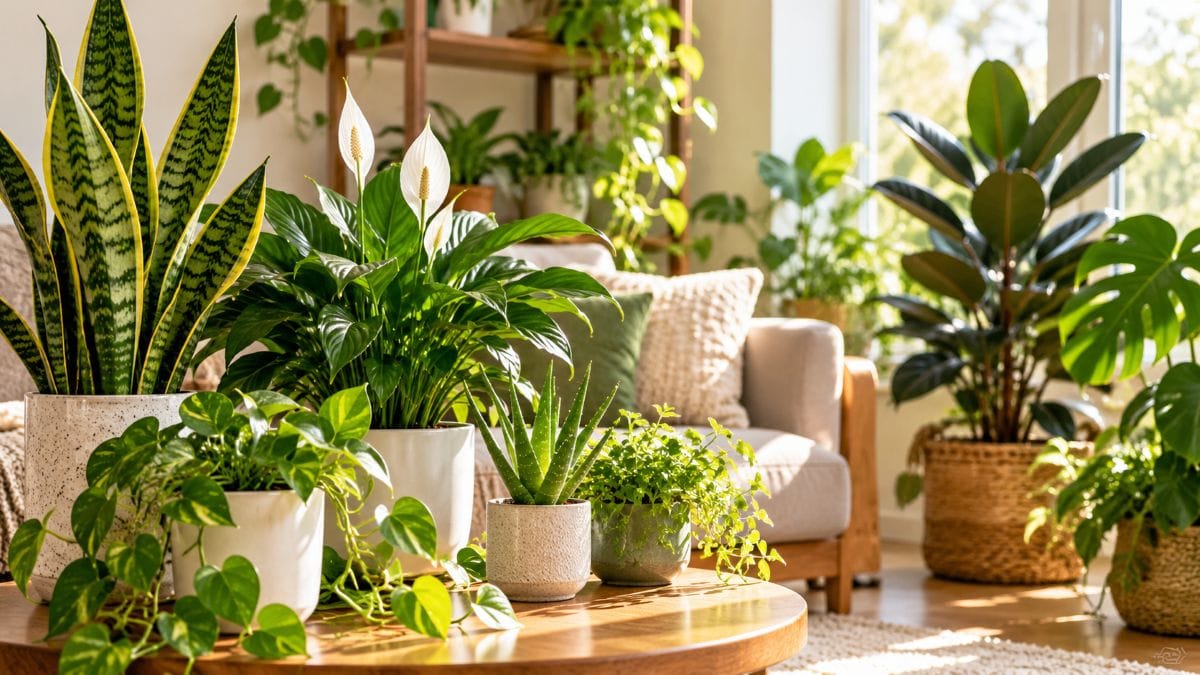
The benefits of indoor plants may go far beyond making a room look fresh and attractive. Research suggests that spending time around living plants and interacting with them may influence stress, blood pressure, mood, attention, and overall well-being. A plant sitting quietly in the corner of a room may seem like nothing more than decoration, but caring for it gives us an opportunity to slow down, step away from screens, and interact with something living.
Think about the simple act of repotting a plant. You handle the soil, examine the roots, touch the leaves, and concentrate on what you are doing. For a few minutes, your attention moves away from emails, social media, work, and other daily concerns. Interestingly, researchers have studied this kind of activity and found measurable differences in how people respond physically and psychologically.
The evidence does not mean that placing a few plants around your home will prevent disease or replace medical treatment. However, it does suggest that bringing some greenery into the spaces where we live and work may be a simple way to create a more pleasant and potentially less stressful environment.
The benefits of indoor plants may extend beyond decoration, as research suggests that interacting with plants can influence stress, mood, and aspects of psychological well-being.
What Research Says About Indoor Plants and Stress
A study published in the Journal of Physiological Anthropology examined how people responded to interacting with an indoor plant compared with performing a computer-based mental task. One group of participants transplanted a houseplant, while another group completed the computer task. Researchers then measured physiological responses, including blood pressure, as well as the participants’ psychological responses.
After interacting with the plant, participants showed lower diastolic blood pressure and reported feeling more comfortable, soothed, and relaxed compared with those who completed the computer task. The findings suggest that interacting with plants may influence both psychological and physiological responses to stress.
This does not mean that every indoor plant will lower blood pressure or that plant care can treat hypertension. Rather, the study provides evidence that interacting with plants may produce measurable changes in how people respond to a stressful activity. The study, published in the Journal of Physiological Anthropology, is available on PubMed.
10 Benefits of Indoor Plants
1. Indoor Plants May Help Reduce Stress
Stress affects both the mind and the body. When we experience stress, the body can respond through changes in heart rate, blood pressure, muscle tension, and other physiological processes. Spending a few minutes caring for a plant can interrupt the cycle of constant mental stimulation and give your mind something different to focus on.
One of the most interesting benefits of indoor plants is their potential to create a calmer experience during everyday activities.
Plant care is also a relatively slow activity. Watering a plant, removing a damaged leaf, checking the soil, repotting it, or simply observing new growth requires attention but usually doesn’t demand the same mental pressure as work or digital tasks. For someone who spends much of the day in front of a computer, these small activities can provide a welcome change.
This does not mean that indoor plants should be considered a medical treatment for chronic stress. People experiencing persistent or severe stress may need professional support and other evidence-based approaches. However, plant care can be a simple addition to everyday routines that encourages moments of calm.
2. Plants Can Make Indoor Spaces Feel More Relaxing
The environment around us can influence how we feel. A room filled with natural light, comfortable furniture, and living plants may create a very different impression from a space dominated by screens, artificial materials, and electronic equipment. Plants introduce natural shapes, textures, and greenery that can make an indoor environment feel more connected to nature.
This may partly explain why people often enjoy having plants at home or in their workplace. Looking after a living plant also creates a small sense of responsibility and connection. You notice when a new leaf appears, when a plant needs water, or when it begins to flower. These observations can become small but enjoyable moments during an otherwise busy day.
These possible benefits of indoor plants may help explain why many people find rooms containing living plants more pleasant and relaxing.
A systematic review examining the effects of indoor plants on human functions found evidence relating indoor plants to several physiological and psychological outcomes, although the strength of evidence differs between outcomes and individual studies. You can read the systematic review here.
3. Caring for Plants Gives You a Break From Screens
Modern life has made screens almost impossible to avoid. Many people begin the day by checking their phone, spend several hours working on a computer, and then return to another screen for entertainment in the evening. Even during breaks, it is common to reach for a smartphone rather than step away from technology.
Plant care offers a completely different type of activity. Instead of scrolling or typing, you touch soil, examine leaves, look for new growth, and perform simple physical movements. You are still doing something, but your attention is directed toward the physical world rather than another digital environment.
For example, after working at a computer for several hours, you could spend five minutes checking your plants. You might water a plant that needs it, remove a dry leaf, turn a pot toward the light, or simply observe how the plants are growing. That short interruption can provide a useful transition between periods of concentrated screen-based work.
4. Indoor Plants May Support Attention and Concentration
Another interesting area of research concerns the relationship between natural elements and attention. Researchers have examined whether introducing plants and other natural features into indoor environments can influence concentration, productivity, and mental functioning.
It would be too strong to say that placing a plant beside your computer will automatically make you more productive. Individual responses vary, and many other factors influence concentration, including sleep, workload, noise, lighting, stress, and the type of work being performed.
However, a more natural and pleasant environment may help some people feel comfortable and engaged with their surroundings. For students, people working from home, and anyone who spends long periods at a desk, adding a few plants can therefore be a simple environmental change worth trying. The important point is to view plants as one small part of a healthy environment rather than as a treatment for attention disorders or cognitive problems.
Research into the benefits of indoor plants has also examined whether natural elements in indoor environments can influence attention and concentration.
5. What About Plants and Memory?
This is where some claims circulating online need careful examination. You may come across social-media posts claiming that houseplants prevent dementia or dramatically improve memory. The available evidence does not justify making such strong conclusions.
Researchers have investigated gardening, plant-rich environments, and cognitive function, and some small studies have reported interesting findings. For example, research involving people with dementia has explored whether indoor gardening activities may influence cognitive and behavioral outcomes.
Although some research has explored the relationship between plants, gardening, and cognitive function, the benefits of indoor plants for memory should not be exaggerated.
One small pilot study involving people with dementia reported improvements in some measures following an indoor gardening intervention, including cognitive and behavioral measures. However, the study was limited in size and design. Such findings are useful for further research, but they cannot establish that houseplants prevent dementia.
That distinction is important. A preliminary finding is not the same as proof that a particular activity prevents a disease. If you are caring for someone experiencing memory problems, appropriate medical assessment and dementia care remain essential. Indoor gardening can potentially be a pleasant activity within a broader care plan, but it should not be presented as a treatment for dementia.
6. Indoor Plants and Healthy Aging
Healthy aging involves much more than avoiding illness. Staying physically active, maintaining social connections, keeping the mind engaged, eating a balanced diet, sleeping well, and continuing to enjoy meaningful activities can all contribute to quality of life as we grow older.
For older adults, some of the benefits of indoor plants may come from the simple routine of caring for something living each day.
For older adults who enjoy caring for plants, gardening can be a simple way to stay active, connected with nature, and engaged in a meaningful activity. Plant care can naturally fit into this kind of lifestyle. Looking after plants may involve standing, walking, reaching, bending, observing changes, remembering watering routines, and carrying out small tasks. For someone who enjoys gardening, these activities can provide gentle physical movement as well as a sense of purpose.
The emotional side can be just as important. Watching a plant produce a new leaf or flower can provide a small daily source of satisfaction. For people who spend considerable time at home, having something living to care for can make the environment feel more engaging and give structure to part of the day.
Small everyday habits can also contribute to physical activity, mental well-being, and quality of life as we grow older. Our article on small habits that support healthy aging explores other simple practices that can contribute to a healthier and more active lifestyle.
7. Plants May Encourage More Interaction With Nature
Not everyone has easy access to a garden, forest, or large outdoor green space. People living in apartments or busy urban areas may spend most of their time indoors, particularly during bad weather or when mobility is limited.
One of the simple benefits of indoor plants is that they can bring a small connection with nature into homes where access to outdoor green spaces may be limited.
Houseplants provide a small connection with the natural world without requiring a large garden. Even a single pot on a windowsill can introduce something living into an otherwise artificial environment. Over time, you may begin noticing changes that you would otherwise miss: a new leaf, a flower bud, a change in color, or new growth after pruning.
For people who already enjoy gardening, this connection can be particularly meaningful. Caring for plants gives us an opportunity to slow down and observe something that develops gradually rather than expecting everything to happen immediately.
8. Can Indoor Plants Clean the Air?
Air purification is one of the most widely repeated claims about houseplants, but this subject requires some caution. Laboratory research has shown that certain plants can remove particular volatile organic compounds, or VOCs, under controlled conditions. This contributed to widespread interest in the idea that houseplants could improve indoor air quality.
However, laboratory conditions are not the same as an ordinary home. The number of plants, room size, ventilation, pollutant concentration, and other factors can make a major difference. It would therefore be misleading to suggest that a few houseplants can clean household air to the same extent as proper ventilation or an appropriately selected air purifier.
Plants can still be a pleasant addition to an indoor environment, but they should not be used as a substitute for addressing sources of indoor pollution or maintaining adequate ventilation. If indoor air quality is a concern, identifying the source of pollutants and improving ventilation are more important steps.
The potential health benefits of indoor plants are often discussed alongside claims about indoor air quality, but these claims need to be considered carefully.
9. Real Plants or Artificial Plants?
Artificial plants can certainly make a room look attractive, and they can be useful for people who cannot maintain living plants. They require no watering and are not affected by changes in light, temperature, or humidity.
But real plants provide an additional experience because they are living organisms that require attention and care. You can water them, touch the leaves, repot them, observe new growth, and watch them respond to their environment. These interactions are particularly relevant when discussing research into the psychological effects of plants.
If you enjoy caring for plants and your home provides suitable conditions, real plants can therefore offer more than decoration. The activity of caring for them may itself be part of the benefit.
If you are interested in the psychological benefits of indoor plants, choosing real plants allows you to interact with something living rather than simply adding artificial decoration.
The bedroom requires a little more thought because light, temperature, humidity, and personal preferences vary. Choose plants according to the conditions available rather than selecting a plant simply because it is popular online.
Best Indoor Plants for Your Home
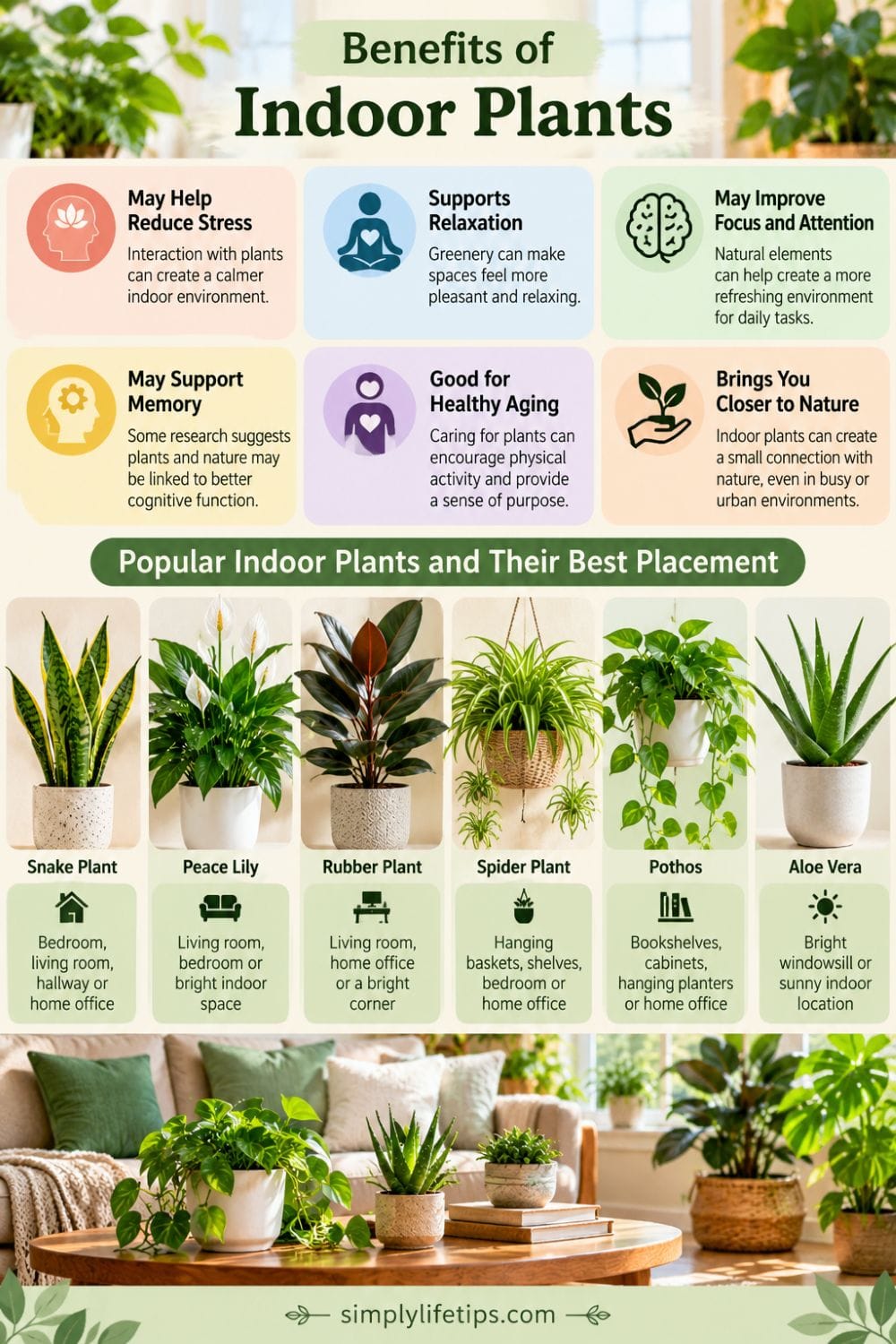
You do not need a large collection of plants to enjoy the benefits of bringing greenery indoors. The best choice depends on the amount of natural light, available space, temperature, humidity, and how much time you want to spend caring for plants. Here are a few popular options that can work well in different parts of the home.
Snake Plant
Snake plants are popular because they are relatively easy to care for and can tolerate periods of dry soil. Their upright leaves also make them suitable for corners and other areas where floor space is limited. A snake plant can work well in a bedroom, living room, hallway, or home office, provided the available conditions suit the plant.
Peace Lily
Peace lilies are attractive plants with dark green foliage and distinctive white flowers. They generally prefer bright, indirect light and adequate moisture, making them a good choice for a living room, bedroom, or other indoor space with suitable natural light. They are also one of the plant types people commonly search for when looking for indoor plant benefits.
Rubber Plant
Rubber plants can become impressive indoor specimens when given suitable conditions. Their large, glossy leaves add a strong natural element to a room. A living room, home office, or bright corner can be a good location, provided the plant receives appropriate light.
Spider Plant
Spider plants are another popular choice for indoor gardening. Their long, arching leaves and small plantlets make them visually interesting, and they can work particularly well in hanging baskets, shelves, bedrooms, or home offices where their foliage can spread naturally.
Pothos
Pothos is useful when you want a plant that can grow along a shelf or hang from a basket. Its trailing growth makes it particularly suitable for bookshelves, cabinets, hanging planters, and home-office spaces. It is also a popular choice for people who are relatively new to indoor gardening.
Aloe Vera
Aloe vera is a practical option for a bright windowsill or sunny indoor location because it generally prefers plenty of light and does not require frequent watering. Allow the growing medium to dry appropriately between waterings rather than keeping it constantly wet.
Herbs
Indoor herbs such as mint, basil, and coriander can add greenery while also providing something useful for the kitchen. A sunny kitchen windowsill can be an excellent location, although different herbs have different light and watering requirements.
10. Where Should You Keep Indoor Plants?
You do not need to fill every room with plants to enjoy having greenery around you. In fact, starting with one or two suitable plants may be better than buying many plants and discovering that you do not have enough time or suitable conditions to care for them.
The living room is often a convenient place because it may have more space and natural light. A home office can also benefit from a small plant that provides a visual break during long periods of computer work. A reading area with a few plants may create a pleasant environment for quiet time, while a kitchen can accommodate suitable herbs if the available light and growing conditions are adequate.
Choose Plants According to Your Home
The best indoor plant is not necessarily the one with the longest list of supposed health benefits. It is the plant that can thrive in the conditions you can provide and that you will actually enjoy caring for.
When choosing plants to enjoy the benefits of indoor plants, consider the amount of light, available space, watering requirements, and the amount of care you can realistically provide. A healthy plant that suits your home is much more useful than an unsuitable plant chosen simply because it is popular online.
You Don’t Need Expensive Plants
One of the most appealing aspects of indoor gardening is that you do not need a large budget to get started. A small plant, a suitable container, appropriate growing medium, and basic care may be enough. You do not need to spend a lot of money to experience some of the everyday benefits of indoor plants.
You can also propagate certain plants from cuttings instead of continually buying new ones. Watching a cutting develop roots and eventually become an established plant can itself be a rewarding experience.
For someone who already enjoys gardening, bringing a few plants indoors can be a natural extension of an existing hobby. It does not have to become an expensive collection. A few healthy plants that you genuinely enjoy caring for may provide more satisfaction than a room full of plants that become difficult to maintain.
What the Research Really Tells Us
The evidence surrounding the benefits of indoor plants is promising, but it needs to be interpreted realistically. Research supports the idea that interacting with plants can influence psychological and physiological responses, including feelings of relaxation and some measures associated with stress.
Overall, the research suggests that the benefits of indoor plants are worth exploring, particularly in relation to stress, relaxation, and the experience of indoor environments.
Researchers are also continuing to investigate the relationship between plants, attention, cognition, gardening, and healthy environments. Some small studies are interesting, particularly those involving older adults and people with cognitive impairment, but they should not be turned into claims that houseplants prevent dementia or protect the brain from disease.
Indoor plants are not a cure for stress, dementia, depression, or other medical conditions. Their potential value may be much simpler and more practical. They can encourage us to pause, step away from screens, interact with something living, and create a more pleasant environment.
Conclusion
The benefits of indoor plants may begin with something very simple: creating a little more contact with nature in the places where we spend our everyday lives. Research suggests that interacting with plants can have measurable effects on stress and psychological well-being, while other studies continue to explore possible relationships with attention, cognition, and healthy aging.
You do not need dozens of plants to experience the everyday pleasure of growing something. Start with one suitable plant and place it somewhere you will see it regularly. Water it when necessary, care for it, observe its growth, and use those few moments as an opportunity to step away from your screen.
The benefit of indoor plants may not come from the plant alone. It may also come from the activity of caring for something living and from the small pauses that plant care creates in an otherwise busy day.
FAQs About Benefits of Indoor Plants
Are indoor plants good for stress?
Research suggests that interacting with indoor plants may reduce some physiological and psychological measures associated with stress and can promote feelings of comfort and relaxation. Plant care can also provide a simple break from demanding digital activities.
What are the main benefits of indoor plants?
Potential benefits include creating a more pleasant indoor environment, encouraging interaction with nature, supporting relaxation, and providing an enjoyable activity away from screens. Research is also investigating possible effects on attention and cognitive well-being.
Can indoor plants prevent dementia?
There is currently not enough evidence to say that indoor plants prevent dementia. Some small studies have explored gardening and cognitive outcomes among people with dementia, but these findings are preliminary and require further research.
Do indoor plants clean the air?
Some plants can remove certain pollutants under controlled laboratory conditions. However, ordinary houseplants should not be considered a replacement for adequate ventilation or an effective air purifier in a typical home.
How many indoor plants should I have?
There is no scientifically established number of plants required to obtain health benefits. Start with one or two plants that suit your home’s light, temperature, space, and your ability to care for them. The enjoyment of caring for plants is more important than having a particular number.

Mathukutty P V is a Blogger, YouTuber, and Content Writer and the founder of Simply Life Tips. After taking voluntary retirement in 2017, he embraced a free lifestyle focused on learning, personal growth, and sharing practical wisdom to help others live with more purpose and positivity.


