

Surround yourself with positive people, because the people you spend time with can quietly influence your thoughts, habits, attitudes, and the way you see your life. Their influence may not always be obvious, but repeated conversations, behaviors, and attitudes can gradually shape what feels normal to you.
Think about spending time at a fish market. Even if you never touch a fish, you may leave carrying its smell. Spend time in a perfume shop, and you may walk out carrying its fragrance. People can similarly influence us. Their influence does not remain on our clothes; it can gradually become part of how we think, speak, behave, and respond to life.
This does not mean you should expect everyone around you to be cheerful, successful, or positive all the time. Everyone has difficult days, makes mistakes, and experiences disappointment. The important thing is to recognize the patterns you are repeatedly exposed to and understand how they may affect you.
How the People Around You Influence You
Human behavior is influenced by repeated exposure. When you regularly spend time with people who complain about everything, make excuses, criticize others, or constantly focus on problems, those patterns can gradually become familiar.
You may begin noticing problems before possibilities. You may become more comfortable making excuses or start expecting things to go wrong before you have even tried.
The influence usually happens quietly. Nobody needs to tell you to think negatively. Repeated conversations and behaviors can gradually make a particular way of thinking feel normal.
The same principle applies to positive behavior. Spending time with people who take responsibility, work toward their goals, remain curious, and look for solutions can expose you to healthier patterns of thinking.
Research on social relationships also shows that our connections with other people can play an important role in overall well-being. American Psychological Association
Surround Yourself With Positive People
When you surround yourself with positive people, you expose yourself to constructive attitudes and behaviors. Positive people are not necessarily happy every moment or free from problems. Instead, they often try to deal with difficulties constructively rather than allowing every setback to define their outlook.
For example, consider two people facing the same problem at work. One spends most of the day complaining about the situation and blaming other people. The other acknowledges the problem and starts looking for possible solutions.
If you regularly spend time with the second person, you may gradually become more solution-oriented yourself. You may begin asking, “What can I do about this?” instead of simply asking, “Why is this happening to me?”
That small change in thinking can make a meaningful difference.
Negative Habits Can Spread Too
Positive influence is only one side of the equation. Negative habits and attitudes can also become familiar when we are repeatedly exposed to them.
Imagine spending a great deal of time with people who constantly postpone important tasks. They may have a reason for every delay and always promise to start tomorrow. After hearing those explanations repeatedly, procrastination may begin to seem less serious.
Similarly, if every conversation revolves around criticism, gossip, or complaints, you may find yourself participating in those conversations more often than you once did.
This does not mean that spending time with someone automatically changes your personality. Personal choices still matter. However, your environment can influence the behaviors and attitudes you repeatedly practice.
Positive People Can Encourage Personal Growth
People who work hard, keep learning, and take action can encourage you to do the same.
You may know someone who does not wait for perfect circumstances before starting something important. They take a small step, learn from mistakes, and continue moving forward.
Being around such a person can change your perception of progress. You may stop waiting for motivation and begin taking action even when you do not feel completely ready.
This is one reason relationships can play an important role in personal growth. Sometimes another person’s example teaches more effectively than advice.
Learning is another area where your environment matters. If the people around you regularly read, ask questions, learn new skills, and remain curious, their attitude can encourage you to keep learning too. You can explore more about the value of lifelong learning in Never Stop Learning: Always Update Your Knowledge.
When you surround yourself with positive people, their habits, attitudes, and approach to everyday challenges can gradually influence the way you think and behave. The infographic below highlights how the people around you can shape your habits, mindset, and personal growth over time.
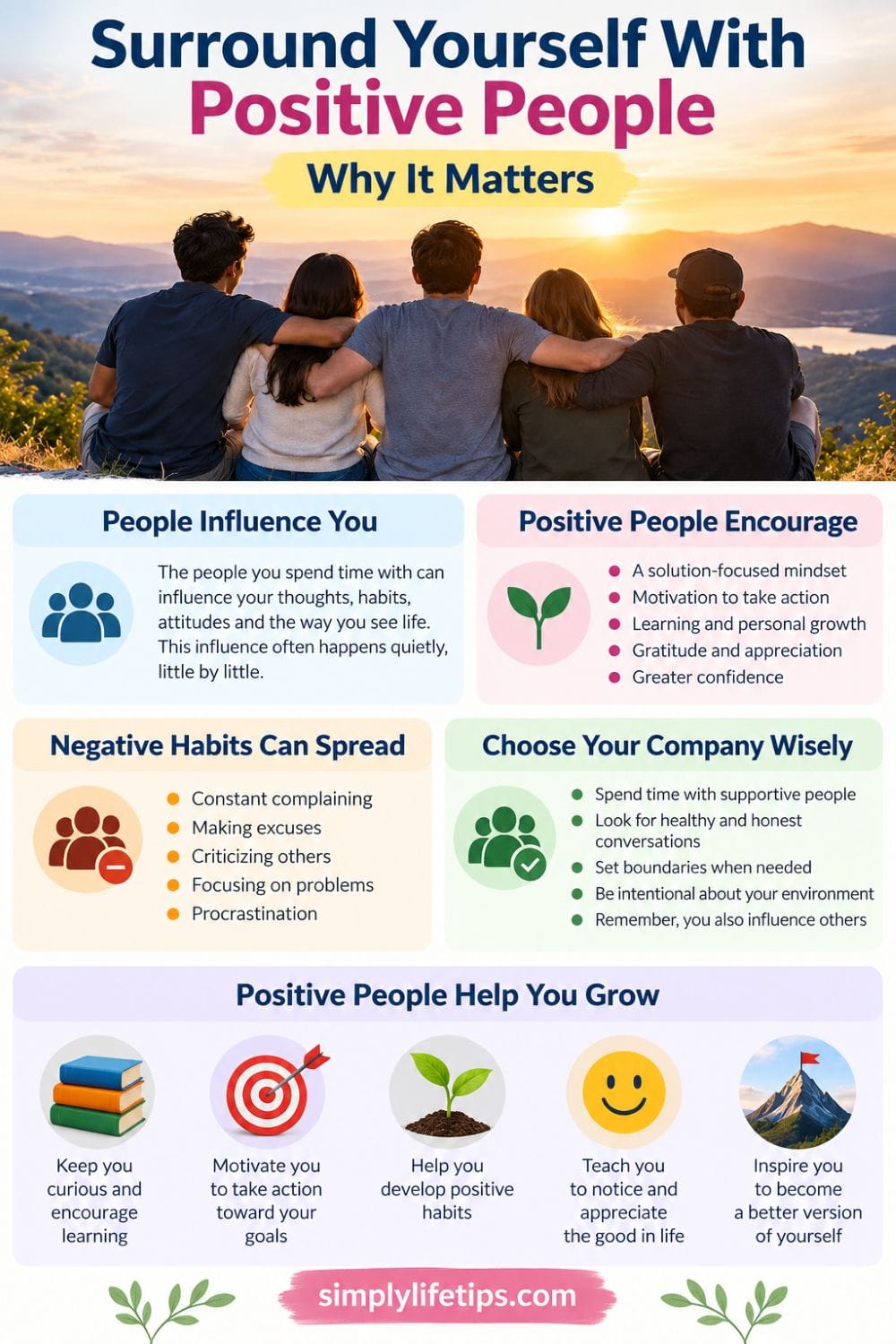
Seeing these influences clearly can help you become more intentional about the company you keep. You do not need to avoid everyone who thinks differently from you. Instead, pay attention to the relationships that consistently encourage you to learn, grow, take responsibility, and become a better version of yourself.
Example: Your Work Environment
Consider two different workplaces.
In the first, employees constantly complain, blame one another, resist learning, and focus mainly on what cannot be done.
In the second, people discuss problems honestly but also look for solutions, share knowledge, accept responsibility, and encourage one another.
Even if your own personality does not change immediately, the environment can affect what you repeatedly hear and practice.
Over time, the second environment may make learning, responsibility, and problem-solving feel more natural.
This is why it is useful to pay attention not only to individual people but also to the culture of the environment in which you spend much of your time.
Example: Friends and Excuses
Friendships can have a particularly strong influence because of the amount of time people often spend together.
Suppose you have an important personal goal. Every time you talk about taking action, your friends respond with reasons why you should wait. Eventually, delaying the goal may feel comfortable.
Now imagine spending time with people who encourage you to take one small step rather than waiting for perfect conditions.
The difference is not that one group is perfect and the other is terrible. The difference is the pattern of influence.
Your closest relationships can either reinforce your existing habits or encourage you to develop better ones.
Gratitude Can Change Your Perspective
Grateful people can also influence the way you see your own life.
Someone who regularly appreciates simple things—a good meal, a helpful friend, a peaceful evening, an opportunity to learn, or time with family—may encourage you to notice things you previously took for granted.
Gratitude does not mean ignoring genuine problems. It means recognizing that difficulties are not the only things worth noticing.
A grateful environment can encourage a broader perspective and help you appreciate what is already present instead of constantly focusing on what is missing.
Small daily habits also contribute to the way we experience life over time. You can learn more about this connection through 15 Small Habits for Healthy Aging.
Pay Attention to How People Make You Feel
One of the simplest ways to understand someone’s influence is to notice how you feel and behave after spending time with them.
Ask yourself:
- Do I feel encouraged or constantly discouraged?
- Do I feel motivated to take action?
- Do I become more confident or more doubtful?
- Do our conversations help me grow?
- Do I feel peaceful or emotionally exhausted?
- Am I becoming more responsible?
- Do I find myself making more excuses?
- Do I like the person I am becoming around this environment?
These questions are not about judging people. They are about understanding influence.
Sometimes the effect of a relationship becomes clearer when you observe yourself rather than focusing only on the other person.
This is another reason to surround yourself with positive people who respect your growth and encourage healthy choices.
You Do Not Have to Avoid Everyone Negative
Choosing your company wisely does not mean cutting every negative person out of your life.
People experience grief, frustration, disappointment, anger, fear, and failure. A person who complains occasionally is not necessarily a negative influence. Someone going through a difficult period may need understanding rather than avoidance.
The more important distinction is between temporary negativity and persistent patterns that repeatedly affect your own thinking and behavior.
Healthy boundaries can sometimes be more appropriate than completely ending a relationship. You can care about someone without adopting every habit or attitude they have.
This is especially important when dealing with emotional reactions. Understanding how our own responses are influenced by our surroundings can help us become more aware of what we absorb from other people. For a deeper look at emotional reactions, see Anger and the Brain: What Happens When We Get Angry?.
Your Environment Shapes What Feels Normal
People are only one part of your environment.
The content you consume, conversations you participate in, social media accounts you follow, videos you watch, and information you repeatedly expose yourself to can also influence your thinking.
If most of your daily input consists of anger, criticism, comparison, and fear, that environment can affect your outlook.
If you regularly consume useful information, learn new things, and interact with people who encourage growth, your mental environment can be very different.
This does not mean you should create a life where you never encounter anything negative. Real life does not work that way. It means you should become more intentional about what receives your attention.
Protect Your Mental Environment
Your mental environment deserves the same attention as your physical environment.
Choosing to surround yourself with positive people is one part of creating a healthier mental environment.
You probably would not knowingly fill your home with things that create unnecessary problems. Similarly, it is worth considering what you repeatedly allow into your mind.
That may mean spending more time with people who encourage constructive conversations. It may mean reducing unnecessary exposure to constant negativity on social media. It may also mean choosing books, podcasts, articles, and other sources that encourage learning rather than simply creating anxiety or outrage.
You do not have to control everything around you. But you can make thoughtful choices about what you repeatedly consume and who receives your time and attention.
Ask Yourself: Who Am I Becoming?
One of the most important questions you can ask yourself is:
Who am I becoming because of the people I spend my time with?
We often ask ourselves what is wrong with our lives. We ask why we lack motivation, why certain habits are difficult to change, or why we keep repeating the same mistakes.
Sometimes another question is equally important:
What am I surrounding myself with?
Your relationships do not completely determine who you become. Your decisions, values, circumstances, and actions matter too. But the people around you can influence what you repeatedly see, hear, practice, and consider normal.
Choose Your Company Wisely
The old advice to choose your company wisely is not about believing that some people are better than others. It is about recognizing that time and attention are limited.
Every relationship has some influence. Some relationships challenge you to grow. Some encourage you when life becomes difficult. Some teach you through example. Others may repeatedly pull you toward habits and attitudes you are trying to leave behind.
You do not need to find perfect people. Instead, look for relationships that allow you to become a better version of yourself while also allowing you to contribute something positive to others.
What Happens When You Surround Yourself With Positive People?
When you surround yourself with positive people, you may begin noticing changes in several areas of your life.
You may become more willing to take action instead of constantly waiting.
You may become more open to learning from mistakes.
You may become more aware of opportunities rather than focusing only on obstacles.
You may develop greater appreciation for what you already have.
You may also become more conscious of your own behavior because the people around you demonstrate different ways of responding to everyday situations.
These changes rarely happen overnight. Like most habits, they develop gradually through repeated exposure and practice.
The Influence Works Both Ways
There is another side to this idea that is easy to overlook.
You are not only influenced by the people around you. You also influence them.
Your attitude can affect your family, friends, coworkers, and others who spend time with you.
If you constantly complain, someone else may absorb that attitude. If you take responsibility, keep learning, show gratitude, and encourage others, your behavior may have a positive effect on them.
This means that the question is not only, “Who should I surround myself with?”
It is also:
“What kind of person am I being for the people around me?”
That question makes the idea much more meaningful.
Conclusion
Surround yourself with positive people who encourage growth, responsibility, gratitude, learning, and meaningful action. You do not need perfect relationships or a life completely free from negativity. What matters is becoming aware of the influences you repeatedly allow into your life.
Pay attention to the people you listen to, the conversations you participate in, the content you consume, and the habits that gradually become normal.
Like the scent you carry after leaving a fish market or perfume shop, the influence of your environment can stay with you long after you have left the room.
Choose your company wisely, protect your mental environment, and remember that influence works both ways.
The most important question may not be, “Are the people around me positive?”
It may be:
“Who am I becoming because of the people around me—and who are they becoming because of me?”
FAQs about Surround Yourself With Positive People
Why should you surround yourself with positive people?
Surrounding yourself with positive people can expose you to constructive attitudes, healthy habits, encouragement, and solution-focused thinking. Their behavior can influence how you approach challenges and personal growth.
Can negative people influence your behavior?
Yes. Repeated exposure to constant complaining, excuses, criticism, or pessimistic thinking can make those patterns increasingly familiar. Awareness and healthy boundaries can help reduce unwanted influence.
Does surrounding yourself with positive people mean avoiding everyone negative?
No. Everyone experiences difficult emotions and challenging periods. The goal is not to avoid people who struggle but to maintain healthy boundaries and relationships that support your growth.
How do you know whether someone positively influences you?
Pay attention to how you think, feel, and behave after spending time with them. Consider whether you feel encouraged to learn, act, improve, and take responsibility, or whether you consistently feel discouraged and drained.
Can your environment change who you become?
Your environment can influence your habits, expectations, attitudes, and behavior, although it does not completely determine who you become. Your own choices and actions remain important.

Mathukutty P. V. is the founder of Simply Life Tips. He shares practical advice and useful insights on personal growth, health, well-being, technology, and everyday living. His goal is to help readers build positive habits and make informed decisions. He believes in continuous learning and sharing knowledge to help people live healthier, happier, and more meaningful lives.