
Your relationship with your father can change as you grow older, but the need for respect, communication, and emotional connection never disappears. The relationship with a father can remain meaningful throughout life when both sides make an effort to stay connected.
As children become adults, life becomes busy. Careers, marriage, children, responsibilities, and personal goals can gradually change the way fathers and children communicate. Less frequent contact is not necessarily a problem. What can hurt is when distance turns into indifference.
Many fathers do not openly talk about their feelings. They may stay quiet when calls become less frequent, when their advice is dismissed, or when their children contact them only when they need something. But silence does not mean they do not notice.
A father is more than a provider, problem-solver, or protector. He is a person with feelings, worries, memories, regrets, and hopes. He may want nothing more than to know that his children still value having him in their lives.
Sometimes, it is not one major argument that damages a relationship. Small attitudes repeated over time can slowly create emotional distance. Understanding these attitudes can help you protect the bond you share with your father and build a stronger, more meaningful family relationship.
What Makes a Relationship With Father Strong?
Building a strong relationship with your father takes more than occasional conversations. It grows through regular communication, respect, appreciation, and meaningful time together.
It is built through simple things:
- Respecting each other’s opinions
- Making time for one another
- Communicating honestly
- Showing appreciation
- Listening without immediately judging
- Being present during difficult times
- Maintaining a connection even when life gets busy
A healthy father-child relationship also allows both people to grow. Adult children do not have to follow every piece of advice their father gives. Fathers also need to understand that their children will make their own choices.
The foundation is mutual respect.
The influence of a father can extend beyond childhood, affecting how children develop, learn, and relate to others. Read more about a father’s impact on child development.
7 Attitudes That Can Hurt a Father’s Heart
The relationship with your father can be strengthened through love, respect, communication, and time, but certain attitudes can slowly create emotional distance. Indifference, silence, dismissing his advice, public disrespect, contacting him only when you need something, failing to make time for him, and forgetting that he is human can all hurt a father’s heart. These behaviors may seem small when viewed individually, but repeated over time, they can make a father feel ignored, unappreciated, or forgotten. Recognizing these seven attitudes can help children understand the emotional impact of their actions and make a conscious effort to build a stronger and more caring relationship with their father.
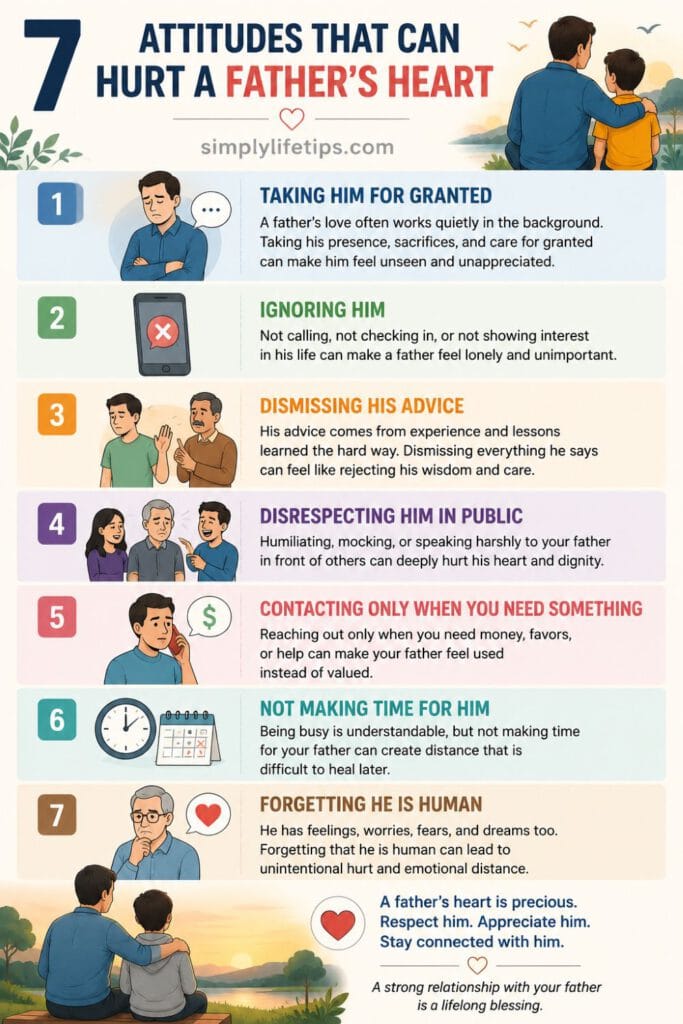
These seven attitudes may seem ordinary, especially when life becomes busy, but their repeated effect can create emotional distance. Understanding how they affect a father can be the first step toward showing greater respect, appreciation, and care.
1. Indifference Can Hurt a Father Deeply
One of the most painful attitudes in a relationship with your father is indifference. When a child begins behaving as though their father no longer matters, the emotional impact can be much greater than the child realizes.
A father may not ask, “Why don’t you call me anymore?” He may not complain when messages go unanswered. He may simply remain quiet. But he notices.
There is a difference between being busy and making someone feel unimportant. An adult child may genuinely have a demanding job, family responsibilities, and very little free time. Most fathers understand that. What hurts is the feeling that there is no longer a place for them in their child’s life.
A short phone call or simple message can communicate something powerful: “Dad, you still matter to me.”
2. Silence Can Create Emotional Distance
Silence is another attitude that can gradually weaken a father-child relationship. Not calling, not checking in, not asking how he is doing, and not sharing the ordinary moments of life can slowly create distance between a father and child.
A father may never beg for attention, but that does not mean he does not feel its absence. Imagine a father who once received regular calls from his child. Over the years, the calls become less frequent, and eventually, he hears from his child only occasionally.
He may say, “He’s busy.” Perhaps he is. But somewhere inside, the father may still wish to hear his child’s voice.
Communication does not always require a long conversation. A simple “How are you, Dad?” or “How was your day?” can make a meaningful difference. Small conversations can help maintain an emotional connection even when physical distance separates a father and child.
3. Dismissing His Advice Can Feel Like Rejection
Another attitude that can hurt a father’s heart is dismissing everything he says. A father will not always be right. His advice may sometimes be outdated, overly cautious, or simply different from what his adult child wants to hear. Children have the right to make their own decisions.
But disagreeing respectfully is very different from treating a father’s experience as worthless. Much of a father’s advice comes from years of work, mistakes, responsibilities, failures, and lessons learned the hard way.
The wisdom passed from one generation to another can become an important part of a father-son bond. Explore Father-Son Bond: A Heartfelt Story of Generational Wisdom
For example, when a father advises his child to save money, think carefully before making an important decision, or avoid a mistake he once made, he may not be trying to control the child’s life. He may simply be trying to protect someone he loves.
You do not have to follow every piece of advice. But listening respectfully can be an important part of maintaining a healthy relationship with your father.
4. Public Disrespect Can Damage the Relationship
Respect matters everywhere, but public disrespect can be particularly painful. A child who is polite to strangers but humiliates, mocks, or speaks harshly to their own father may be forgetting something important about character.
How we treat people close to us often reveals more about us than how we treat people we are trying to impress. A father should not be insulted simply because he is older, speaks differently, makes mistakes, or does not understand every aspect of modern life.
At the same time, respect should go both ways. Fathers also have a responsibility to treat their children with dignity. A healthy father-child relationship does not require fear or blind obedience. It requires mutual respect.
If you disagree with your father, you can disagree without embarrassing him. If he makes a mistake, you can correct him without humiliating him. Courtesy costs very little, but it can protect something far more valuable: the trust and dignity within a family.
Words can sometimes hurt just as deeply as actions. Learn more about things you should never say to your father and how respectful communication can protect the relationship.
5. Only Appearing When You Need Something
One of the clearest attitudes that can hurt a father’s heart is contacting him only when you need something. It may be money, a favor, a ride, advice, help with a problem, or a rescue when something goes wrong. A father may gladly help because providing support is often one of the ways fathers express love. But a relationship should not make someone feel useful only when there is a problem to solve.
Imagine a child who does not call for months but suddenly calls when money is needed. After the problem is solved, communication disappears again. Over time, the father may quietly begin to wonder, “Does my child want me, or does my child only need me?” The difference is significant.
Call when everything is fine. Visit when there is no emergency. Have a meal together without asking for anything. A father is more than a provider, problem-solver, or safety net. He is someone who wants to be part of your life.
6. Forgetting to Give Him Your Time
As parents grow older, time can become one of the most meaningful gifts children can give them. When we are young, we often assume our parents will always be there. There will always be another birthday, another festival, another family gathering, another weekend, and another opportunity to visit. But life does not make such promises.
A father may value a simple visit more than an expensive gift. Sitting together over tea, sharing a meal, taking a short walk, calling on an ordinary evening, or asking about an old story from his childhood can mean much more than we realize. These moments may seem small to a busy adult, but they can become precious memories for an aging parent.
Money can buy many things, but it cannot buy yesterday’s time. That is why spending meaningful time together is so important in a relationship with your father. The time you give him today may become one of the memories you treasure tomorrow.
7. Forgetting That Your Father Is Human
Perhaps the biggest mistake is forgetting that a father is human. Children sometimes see their fathers mainly as providers and protectors—the person who worked, paid the bills, solved problems, and stayed strong during difficult times. But behind that role is a human being with fears, regrets, disappointments, hopes, and tired days.
Many fathers were raised with the expectation that they should remain strong and keep their worries to themselves. They may say, “I’m fine,” even when life feels heavy. They may worry about their children’s future, carry regrets they rarely discuss, or feel tired but continue helping others.
Recognizing your father’s humanity does not mean treating him as weak. It means remembering that he also needs kindness, patience, appreciation, and companionship. Sometimes, the strongest thing a child can say is simply, “Dad, how are you really doing?”
A Father Is More Than a Provider
A father’s role in a family is often associated with providing, protecting, guiding, and taking responsibility. But reducing a father to these roles misses an important truth: a father is also a person who wants to feel valued and appreciated.
A father’s role often involves sacrifices that children may not fully notice until they are older. You can also read about the silent sacrifices of a father and why recognizing them matters.
He may not need expensive gifts, constant attention, or dramatic displays of affection. Often, he simply wants to know that his presence still matters. A phone call can say it. A visit can say it. A meal together can say it. A genuine “Thank you, Dad” can say it.
These small gestures may seem ordinary, but they can mean far more than we realize. Sometimes, showing a father that he is loved and appreciated does not require anything grand. It simply requires being present and making him feel that he still has an important place in your life.

How to Build a Better Relationship With Father
Improving the relationship with father does not always require a major conversation or dramatic change. Often, small and consistent actions can strengthen the bond between a father and child and bring back a sense of closeness that may have faded over time.
Call Without Needing Anything
Do not wait until you need money, advice, or help before calling your father. Call simply to hear his voice and ask how he is doing. A five-minute conversation can sometimes mean more than an expensive gift because it shows that you are thinking about him even when you do not need anything.
Make Time for Him
If you live nearby, make an effort to visit. If you live far away, regular phone or video calls can help you stay connected. Quality time does not have to involve an elaborate plan. Sharing a simple meal, having a cup of tea, or taking a short walk together can create meaningful moments.
Listen to His Stories
You may have heard some of your father’s stories many times, but listen anyway. Those stories are part of his life and experiences. Asking about his childhood, first job, family memories, or important moments from his past can also help you understand him as a person rather than seeing him only as your father.
Show Appreciation
Tell your father what you appreciate about him. It could be something he did for you during childhood, a sacrifice he made for the family, or simply the support he continues to provide. Sometimes a sincere “Thank you, Dad” is all that is needed to remind him that his efforts have not gone unnoticed.
Respect His Independence
Your father has his own preferences, opinions, experiences, and choices. A strong father-child relationship allows both generations to maintain their individuality. Respect does not mean controlling one another, and it does not require agreeing with everything the other person says.
Be Present When He Needs You
Just as a father may have supported his children through difficult moments, adult children can also be present when their parents need companionship, encouragement, or practical help. Being there does not always mean solving a problem. Sometimes, simply listening, sitting beside him, or letting him know that you are available can be enough.
Respect Does Not Mean Blind Agreement
It is important to make one distinction: respecting your father does not mean agreeing with everything he says. Parents can make mistakes, fathers can make mistakes, and adult children can make mistakes too. A healthy relationship with your father allows people to disagree without cruelty or disrespect.
You may choose a different career, make different financial decisions, have different opinions, or live differently from your father. None of these choices automatically mean that you are disrespecting him. You can listen to his advice, appreciate his experience, and still make your own decisions.
The goal is not blind obedience. The goal is to preserve dignity, communicate with respect, and allow each person to make their own choices. A strong father-child relationship does not require two people to think alike; it requires them to treat each other with understanding and respect.
A strong father-child relationship is not built through control alone; love, patience, understanding, and respectful communication also matter. See How a Strong Father Leads With Love, Patience, and Understanding
Make Time for Your Father While You Can
Life becomes busy very quickly. We tell ourselves we will call tomorrow, visit next week, or spend more time together when work becomes less demanding. But tomorrow is never guaranteed.
If your father is still here, make space for him now. Call him without needing anything. Visit him without waiting for a special occasion. Ask about his day, listen to one of his old stories—even if you have heard it before—and thank him for something he did that you never properly acknowledged.
Sometimes, a simple expression of love can create a powerful moment between a father and child. Read Expressing Love: A Father’s Emotional Realisation Through His Son’s Honest Words for a heartfelt example.
These gestures may take only a few minutes, but they can remain in a father’s heart for years. More importantly, the time you spend together today can become a memory you will cherish tomorrow. Don’t wait for a special occasion to show your father that he matters.
Conclusion
A relationship with your father can be one of the most meaningful relationships in a person’s life, but like any relationship, it needs attention, respect, communication, and time.
The attitudes that hurt a father’s heart are often not dramatic acts of cruelty. They can be ordinary patterns of indifference, silence, disrespect, neglect, and taking his presence for granted. A father may not always tell you when he feels hurt. He may continue to smile, continue to help, and continue to say that everything is fine. But that does not mean your words and actions do not affect him.
A father is not only a provider. He is part of the foundation of a family and, for many people, an important part of their life story. He has his own feelings, memories, worries, hopes, and needs.
Respect him while he is here. Call him while you can. Spend time with him while you have the opportunity. Say thank you before it becomes something you wish you had said.
Respect is not expensive, but neglect can cost us something we can never get back: time.
What is one small thing you can do today to strengthen your relationship with your father?
FAQs – Relationship With Father
What Makes a Good Relationship With Father?
A good relationship with a father is built on mutual respect, honest communication, appreciation, emotional connection, and quality time. Adult children do not have to agree with everything their father says, but respectful communication helps maintain a strong bond.
How Can I Improve My Relationship With My Father?
Start with small, consistent actions. Call him without needing anything, spend time together, listen to him, show appreciation, and make an effort to stay connected even when life becomes busy.
Why Is the Father-Child Relationship Important?
The father-child relationship can provide emotional connection, family support, and a sense of belonging. A positive relationship can remain meaningful even after children become adults.
Does Respecting Your Father Mean Following All His Advice?
No. Respect does not require blind agreement. You can make your own decisions while listening to your father and communicating your differences with patience and dignity.
What Can Hurt a Father’s Feelings?
Indifference, prolonged silence, public disrespect, dismissing his advice, contacting him only when you need help, failing to spend time with him, and forgetting that he also has emotions can hurt a father’s feelings.

Mathukutty P V is a Blogger, YouTuber, and Content Writer and the founder of Simply Life Tips. After taking voluntary retirement in 2017, he embraced a free lifestyle focused on learning, personal growth, and sharing practical wisdom to help others live with more purpose and positivity.