
The Leadership Brain helps explain why some leaders create fear and obedience while others build trust, confidence, and stronger people. Imagine two leaders facing the same team, the same deadline, and the same difficult situation. One makes everyone nervous. People become afraid to speak, mistakes are hidden, and new ideas disappear. The other faces the same challenge but creates a very different atmosphere, where people feel comfortable speaking honestly, taking responsibility, sharing ideas, and trying again after failure.
What creates this difference? Leadership is not simply about a job title, an office, or the number of people working under you. It is about how you think, how you respond under pressure, how you communicate, and what happens to other people when they are around you.
This is where the idea of the Leadership Brain and brain-based leadership becomes interesting. Our brain plays a role in how we make decisions, manage emotions, learn from experience, respond to challenges, and interact with other people. Understanding these connections can give us useful insights into how better leadership can be developed.
The goal is not to turn leadership into a medical subject. It is to explore a simple but powerful idea: before we can lead other people well, we need to learn how to lead ourselves.
What Is the Leadership Brain?
The Leadership Brain is not a single part of the brain that makes someone a leader. There is no special “leadership button” inside the head. Instead, effective leadership depends on several abilities working together, including clear thinking, decision-making, emotional control, listening, attention, self-awareness, learning, adaptability, empathy, communication, handling stress, and building relationships.
This is why leadership can look very different from one person to another. A good leader does not have to be the loudest person in the room or have the strongest personality. Sometimes the most effective leader is the person who listens carefully, remains calm when others are under pressure, asks thoughtful questions, and helps the team move forward.
In this sense, brain-based leadership is not about having a particular type of brain. It is about understanding how the way we think, respond, learn, and interact with others can influence the way we lead.
The Neuroscience of Leadership Starts With Self-Control
One of the most important leadership lessons is also one of the simplest: before we can lead other people effectively, we need to learn how to manage our own reactions. A leader who becomes angry at every disagreement, reacts impulsively to criticism, or makes decisions in the heat of the moment can quickly create tension within a team. By contrast, someone who can pause, think, and choose an appropriate response is more likely to create confidence and stability.
A part of the brain called the prefrontal cortex is involved in important abilities such as planning, attention, decision-making, problem-solving, and controlling responses. It also plays a role in how we manage emotional responses. Prefrontal Cortex and Cognitive Control — PMC
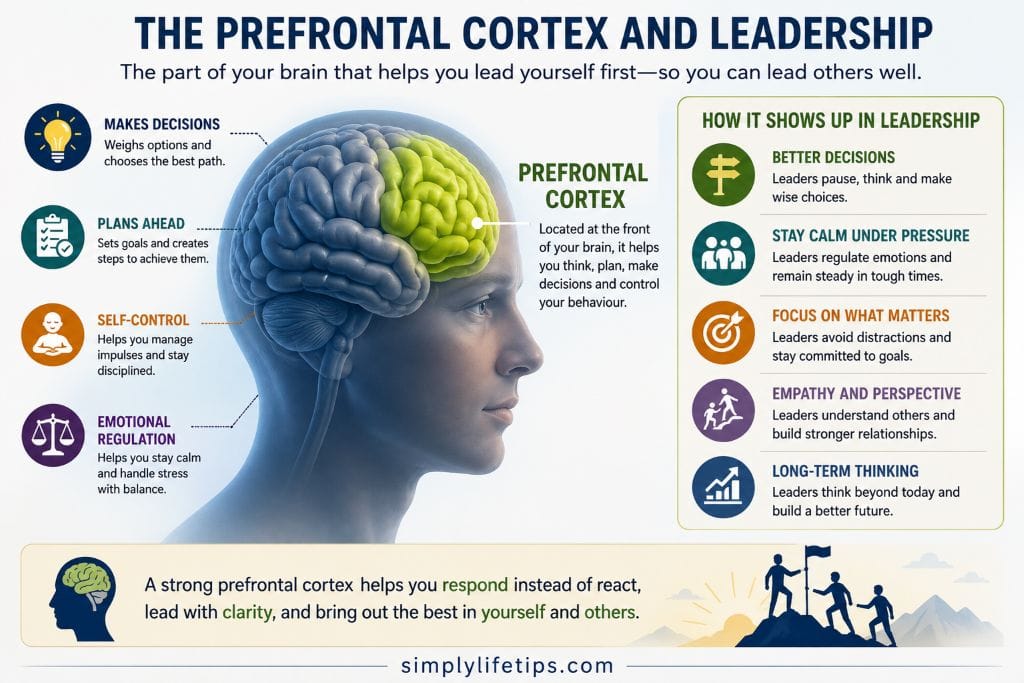
You do not need to understand all the neuroscience to apply this idea to everyday leadership. When something goes wrong, taking a moment before responding can help you move from an immediate reaction toward a more thoughtful response. That pause might be only a few seconds, but it can change the direction of a difficult conversation.
This is one of the foundations of the Leadership Brain. Effective leadership is not about having no emotions; it is about recognising what you are feeling and choosing how you respond. A leader who can remain reasonably calm during disagreement, criticism, or uncertainty gives others a better chance to remain calm and focused too.
The ability to lead yourself becomes especially important when the situation is difficult. When pressure rises, people often look to the leader for direction. Your response can either increase the tension or help the team regain its focus.
Why Are Leaders Tested During Difficult Times?
When everything is going well, leadership can look easy. The real test begins when things go wrong—a project fails, a customer complains, a colleague disagrees, a deadline is missed, or a team member makes a serious mistake. Unexpected pressure can quickly reveal how a leader thinks and responds.
At such moments, people often look to the leader for direction. If the leader panics, becomes aggressive, or reacts without thinking, that tension can spread through the team. People may become reluctant to speak honestly or offer ideas. On the other hand, when a leader remains reasonably calm and focuses on finding a solution, the team has a better chance of staying focused too. These moments reveal how the Leadership Brain responds under pressure.
This does not mean a leader should pretend everything is fine. A good leader can acknowledge the seriousness of a situation while still looking for a constructive way forward. Instead of asking, “Who is responsible for this disaster?” a leader might say, “This is a serious problem. Let’s understand what happened and decide what we can do next.” The first approach encourages problem-solving, while the second can create fear and defensiveness.
Staying calm does not mean ignoring a problem or avoiding difficult decisions. It means creating enough space to think clearly before responding. Developing the power of calmness can therefore become an important leadership strength, especially when other people are looking to you for stability and direction.
What Happens When a Leader Walks Into the Room?
Here is a useful question for anyone who wants to become a better leader: What happens to people when I enter the room? Do they become quiet because they are afraid to speak? Do they avoid sharing problems or wait for instructions before thinking for themselves? Or do they feel confident enough to ask questions, share ideas, and take responsibility?
The answer can tell you more about your leadership than your job title ever will. A leader’s influence is not measured only by what they say or how many people report to them. It is also reflected in how people think, communicate, and behave when they are around that leader.
A good leader does not need to make everyone feel comfortable all the time. There will be moments when difficult feedback, firm decisions, and accountability are necessary. But even in those situations, people should feel respected enough to speak honestly and learn from their experiences.
Ultimately, the Leadership Brain is not just about how a leader thinks. It is also about the environment that the leader helps create for everyone around them.
Brain-Based Leadership Is About More Than Intelligence
Being intelligent does not automatically make someone a good leader. A person can be highly educated and still struggle to listen, while someone who is extremely successful may find it difficult to accept criticism. Even a brilliant professional can make poor decisions when emotions take over.
The Leadership Brain is not simply about collecting knowledge or having a high level of intelligence. It is about using what you know wisely, especially when working with other people. Good leadership requires listening, understanding different perspectives, making thoughtful decisions, and knowing when to learn from someone else.
For example, imagine a manager who knows exactly how a project should be completed but refuses to listen to the team. Another manager may know slightly less about the technical details but asks questions, listens carefully, learns from others, and creates an environment where people feel comfortable contributing their expertise. Over time, which manager is more likely to build a strong and capable team?
Leadership is therefore not simply about knowing more than everyone else. It is about helping people think, communicate, solve problems, and work better together. That is one of the key ideas behind brain-based leadership: combining clear thinking with self-awareness, communication, and an understanding of people.
Serotonin and Leadership: What We Should Understand
Serotonin is a chemical messenger involved in several functions in the body and brain. It has been studied in connection with mood, behaviour, memory, and social behaviour. Serotonin — NCBI Bookshelf
But there is an important point to remember: serotonin is not a “leadership chemical.” We should not assume that increasing serotonin automatically makes someone a better leader. Human behaviour is far more complicated than the activity of a single chemical, and research suggests that serotonin and social behaviour can influence each other in complex ways, depending partly on the surrounding circumstances.
So why mention serotonin when talking about leadership? Because leadership is ultimately about people. The way we respond to others, manage emotions, handle social situations, and communicate is influenced by complex interactions between our brain, body, experiences, and environment.
The useful lesson is not, “Change one brain chemical and become a great leader.” A more practical lesson is to take care of your overall well-being so you are better able to think clearly, communicate effectively, and respond thoughtfully. Regular physical activity, adequate sleep, balanced nutrition, meaningful relationships, and sensible stress management can all support general well-being.
A healthy lifestyle does not automatically make someone a great leader, but taking care of yourself can give you a better foundation for practising the behaviours that effective leadership requires.
Trust Is More Powerful Than Fear
A boss may be able to make people obey, but a true leader works to earn trust and commitment. Fear can sometimes produce short-term compliance, but trust can encourage people to take responsibility, communicate openly, and remain committed even when the situation becomes difficult.
Imagine an employee who discovers a serious problem. If the workplace is built around fear, that person may hide the problem because they are worried about being blamed. In a workplace where honest communication is encouraged, the same employee may report it early, giving the team a chance to address the issue before it becomes more serious.
A good leader creates an environment where people feel able to say, “I think something is wrong,” “I made a mistake,” “I have another idea,” “I don’t agree,” or “I need help.” These statements do not weaken leadership. In many situations, they strengthen it because they allow problems to be identified and ideas to be discussed before decisions are made.
A leader who never hears bad news may not have a perfect team. They may have a team that is afraid to tell the truth. Trust-based leadership gives people the confidence to speak honestly while still maintaining accountability and responsibility.
Boss vs True Leader
The difference between a boss and a true leader becomes clear in the way they communicate, handle mistakes, build relationships, and influence the people around them. A boss may rely on authority, while a true leader earns trust and helps people reach their potential. The comparison below highlights these differences.
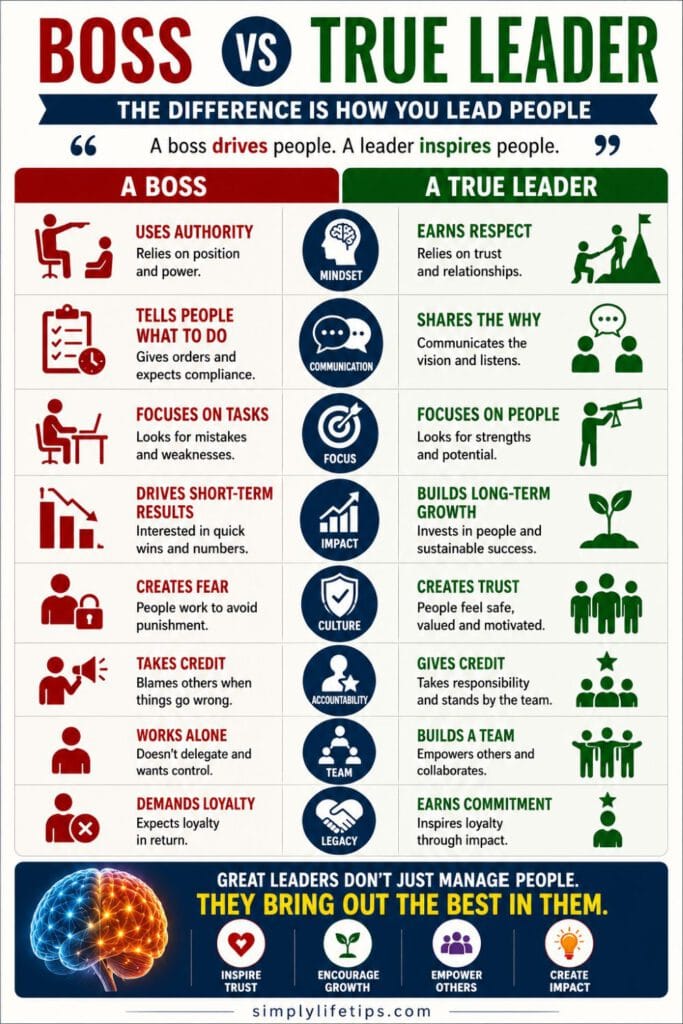
The goal is not to say that every boss is a bad leader or that every leader avoids authority. Good leadership still requires clear expectations, accountability, difficult decisions, and responsibility. The real difference is how that authority is used. A strong leader can be firm while still respecting people, building trust, and encouraging them to grow.
A boss may rely on authority to get people to follow instructions, while a true leader works to earn trust and build commitment. A boss may focus on finding who is responsible when something goes wrong, whereas a leader is more likely to focus on understanding the problem and finding a solution.
This does not mean that good leaders should avoid authority. Leadership still requires clear expectations, difficult decisions, standards, and accountability. The important difference is how that authority is used. A strong leader can be firm without humiliating people, correct mistakes without destroying confidence, and hold people accountable while still helping them grow.
The real question is not whether a leader has authority, but what they do with it.
Leadership Is Also About How You Handle Mistakes
Everyone makes mistakes. The more important question is what happens next. When an employee makes an important error, a leader can immediately criticise the person, or take a step back and ask, “What happened? What caused the problem? What can we learn, and what needs to change?”
This approach does not remove responsibility. Instead, it adds learning to accountability. The mistake still needs to be addressed, but the focus shifts from simply finding someone to blame toward understanding what happened and preventing the same problem from happening again.
This matters because a workplace where every mistake leads to humiliation can eventually become a workplace where people hide their mistakes. When problems are hidden, leaders may lose the opportunity to correct them early and learn from them.
A mature leader therefore combines accountability with respect. They can make it clear that a mistake matters without destroying a person’s confidence. In this way, effective leadership helps people learn from setbacks while maintaining the standards the team needs.
Emotional Regulation Is a Leadership Skill
You do not have to eliminate emotions to become a better leader. Anger, disappointment, fear, frustration, and excitement are normal human experiences. The important question is not whether you have emotions, but how you respond when those emotions become strong.
For example, imagine a leader who is angry about a decision. An immediate response might be, “This is ridiculous. Nobody here knows what they are doing.” A more thoughtful response could be, “I am frustrated. Let me understand why this decision was made before I respond.” The emotion has not disappeared, but the behaviour has changed.
That is emotional regulation in everyday language. It means recognising what you are feeling and creating enough space to choose an appropriate response instead of simply reacting. This can be one of the most valuable leadership skills because a leader’s reactions can influence the people around them.
The ability to recognise an emotion and choose how to respond is also an important part of developing a stronger Leadership Brain. It connects closely with emotional maturity, which involves understanding and managing emotions without allowing them to control our behaviour or relationships.
Leadership and Resilience
Leadership often involves uncertainty. You will not always know what will happen next, and there will be times when you make the wrong decision, a project fails, people disagree with you, or a carefully prepared plan simply does not work. Learning how to deal with these situations is an important part of becoming a stronger leader.
That is why resilience matters. A resilient leader is not someone who never feels stress, disappointment, or frustration. Instead, resilience is the ability to face difficulty, learn from the experience, recover, and continue moving forward without allowing one setback to define the future.
This connects with the idea of a resilient brain. Our brains can adapt through experience and learning, and research into neuroplasticity shows that experience can influence how the brain functions and changes over time. Neuroplasticity — NCBI Bookshelf
Learning how to recover from pressure and setbacks is therefore valuable not only for personal well-being but also for leadership. Our guide to Building a Resilient Brain explores practical ways to understand and strengthen resilience.
Neuroplasticity and Leadership: Can Leadership Be Learned?
One of the most encouraging ideas connected with the Leadership Brain is neuroplasticity. In simple terms, neuroplasticity refers to the brain’s ability to adapt through experience and learning. It does not mean that we can magically reprogram the brain overnight, but it does suggest that repeated experiences and learning can influence how the brain functions and adapts. Neuroplasticity — NCBI Bookshelf
This matters for leadership because many leadership behaviours can be practised and improved. Neuroplasticity provides a useful way to understand why learning, repetition, and experience can play a role in developing new behaviours. With practice, behaviours such as listening carefully, managing reactions, accepting feedback, and communicating thoughtfully can become more familiar.
For example, you can practise listening before offering an answer. You can practise patience when a conversation becomes difficult. You can learn to give feedback without humiliating someone, accept criticism without immediately becoming defensive, and ask questions instead of assuming you already know the solution. You can also practise giving other people responsibility rather than trying to control every decision yourself.
Over time, these behaviours can become more natural. That does not mean everyone can become an identical type of leader or that leadership development happens automatically. It means that leadership is not necessarily a fixed personality trait that you either have or do not have.
You do not have to be “born a leader.” Leadership can develop through experience, reflection, learning, feedback, and consistent practice. The Leadership Brain becomes stronger not through a single technique, but through the everyday choices we make in how we think, respond, communicate, and work with others.
How to Train Your Leadership Brain?
You do not need a complicated programme to develop better leadership habits. Small, consistent changes in the way you think, communicate, and respond to difficult situations can gradually make a difference. The goal is not to become a completely different person, but to become more intentional in the way you lead yourself and others.
1. Pause Before You React
When something upsets you, take a moment before responding. Ask yourself, “What am I feeling? What actually happened? What response will help?” That short pause can give you enough space to move away from an impulsive reaction and choose a more constructive response.
2. Listen More Than You Speak
A leader who always thinks they have the answer may miss important information. Instead of immediately giving advice, ask questions such as, “What do you think?”, “What are we missing?” or “What would you suggest?” Listening does not make a leader weak; it shows that other people’s experience and ideas have value.
3. Give Feedback Without Humiliation
When someone makes a mistake, address the behaviour without attacking the person’s character. Instead of saying, “You are careless,” you could say, “This part needs more attention. Let’s understand what went wrong.” The goal of feedback should be improvement, not humiliation.
4. Learn to Accept Criticism
Leadership becomes difficult when a leader believes they are always right. When someone offers criticism, listen before becoming defensive. Some criticism may be unfair, while other feedback may reveal something you need to improve. Learning how to handle criticism can help leaders respond thoughtfully and identify what is genuinely useful.
5. Admit When You Are Wrong
A leader does not become smaller by saying, “I was wrong.” In many situations, admitting a mistake can actually increase trust. When leaders acknowledge their mistakes, they show that honesty and learning are more important than protecting their ego.
6. Give Other People Opportunities
If you try to do everything yourself, people can become dependent on you. Give others appropriate responsibilities, allow them to make decisions, and support them when they face difficulties. The goal is not to create people who always need you; it is to help develop people who can eventually take responsibility and lead without you.
Developing your Leadership Brain does not require changing everything at once. Small, consistent habits can improve the way you think, communicate, respond to pressure, and support the people around you. The infographic below brings together the key leadership skills and practical habits discussed in this article.
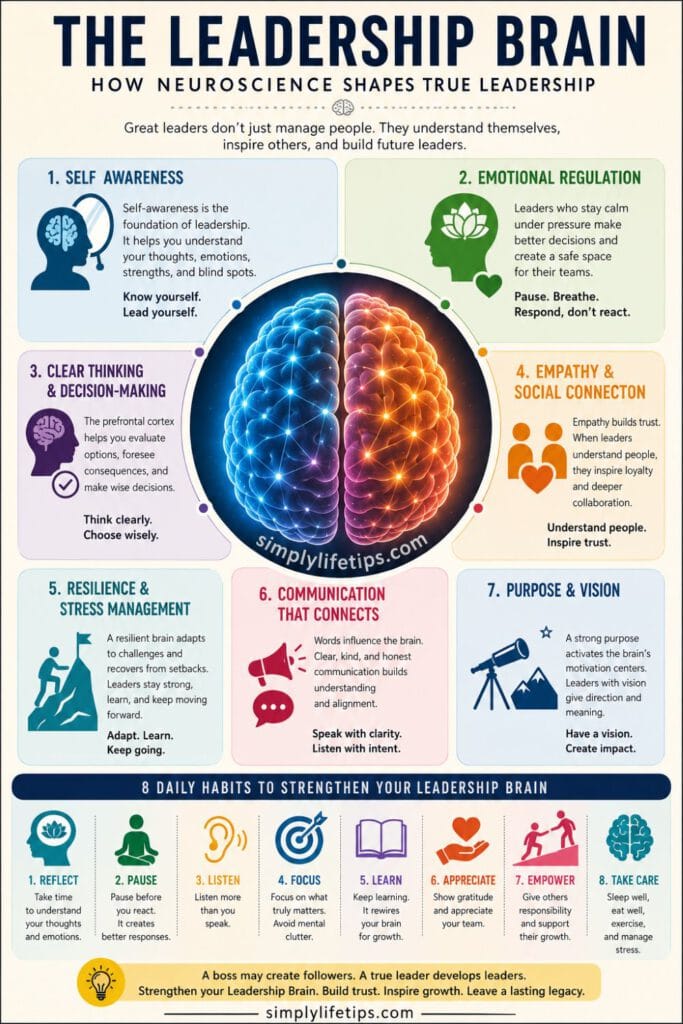
The most effective leadership habits are usually simple enough to practise every day. Pause before reacting, listen carefully, keep learning, appreciate other people’s contributions, and give people opportunities to grow. Over time, these small actions can help turn leadership from a position of authority into a positive influence on others.
Whole Brain Leadership: Look Beyond One Skill
The phrase whole brain leadership is sometimes used to describe a broader approach that recognises different ways of thinking, problem-solving, and responding to situations. For everyday leadership, the basic idea is useful even without following a particular model. A strong leader needs more than analytical thinking; they also need self-awareness, creativity, communication, empathy, practical judgment, adaptability, relationship skills, and emotional balance.
For example, one leader may be excellent at analysing numbers and planning projects but struggle to communicate with the people around them. Another may be very good at inspiring others but find planning and organisation difficult. Effective leadership requires bringing different abilities together and knowing when each one is needed.
That is why the Leadership Brain should be understood as a broad concept rather than a single brain function. Good leadership involves thinking clearly, understanding people, adapting to changing situations, and using different skills together to move a team toward a shared goal.
The Leadership Brain in Everyday Life
You do not need to be a CEO to practise leadership. A teacher can lead students, a doctor can guide a medical team, a manager can support employees, a parent can guide a family, and a coach can help athletes develop. A senior employee can influence colleagues, while a community volunteer can bring people together around a shared purpose.
Leadership can appear anywhere people influence, guide, support, or develop one another. That means you can practise leadership every day, often in situations that have nothing to do with a formal job title.
Instead of simply asking, “Am I a good leader?” it may be more useful to ask yourself: Do people become more confident after talking with me? Do they feel comfortable telling me the truth? Do I listen to different opinions? Do I help people learn from mistakes? Do I give credit to others? Do I encourage people to become more independent?
These questions can reveal the kind of influence you have on the people around you. In the end, leadership is not only about where you stand in an organisation; it is also about what happens to people because of the way you lead.
The Best Leaders Create More Leaders
One of the strongest signs of effective leadership is what happens when the leader is no longer present. If everything stops because one person has left, that may suggest that the person was controlling the team rather than developing it. A strong leader, by contrast, works to create capable people who can think, make appropriate decisions, and take responsibility for their work.
Good leaders teach, guide, encourage, delegate, and provide useful feedback. They give people opportunities to take responsibility instead of keeping every important decision for themselves. Over time, the people they develop can become capable of leading others.
That is a powerful leadership legacy. A boss may create followers who depend on their direction, while a true leader develops people who can continue the work and eventually help others grow as well.
Your Leadership Is Revealed by Your Presence
Think about the people you have worked with, studied under, or learned from. Some may have held impressive positions or achieved remarkable success, while others may never have had a formal leadership title. Yet you may still remember one particular person because they believed in you and helped you see possibilities in yourself.
Perhaps they encouraged you when you doubted yourself, gave you responsibility when others would not, or corrected your mistakes without humiliating you. Sometimes it may have been as simple as saying, “I believe you can do this.” Moments like these can stay with people for years.
This is why leadership is not only about achieving targets or completing projects. It is also about influencing the people who are travelling with you and helping them become more confident and capable. The way people feel and grow in your presence can become one of the clearest measures of your leadership.
Build Your Leadership Brain One Day at a Time
You do not need to change everything at once. Start with one behaviour and practise it consistently. Listen more carefully, pause before responding to criticism, give someone genuine encouragement, or admit when you have made a mistake. You can also ask for feedback, give another person appropriate responsibility, or help someone develop a skill.
Small actions repeated over time can shape behaviour. This is where neuroplasticity provides an encouraging reminder: learning and experience can influence the brain’s ability to adapt. Developing leadership is therefore not about becoming a completely different person overnight; it is about making better choices repeatedly and learning from the experience.
The goal is not to become a perfect leader. It is to become a more thoughtful, capable, and trustworthy leader than you were yesterday.
The Real Legacy of a Leader
People may forget your job title, your position, or even some of the achievements you worked hard to accomplish. But they are more likely to remember how you made them feel and what changed in them because of your leadership. Did they feel trusted and valued? Did they become more confident, discover abilities they did not know they had, or learn to take greater responsibility?
That is the deeper meaning of leadership. A leader’s greatest achievement may not be the results they personally produced, but the people they helped develop along the way. When people become stronger, more capable, and confident enough to lead others, the influence of that leader continues even after they are no longer there.
That is a leadership legacy worth leaving behind.
Conclusion
The Leadership Brain is not about finding one special part of the brain that creates great leaders. It is about understanding the connection between how we think, how we manage ourselves, how we respond to pressure, how we communicate, and how we influence the people around us.
The neuroscience behind leadership can give us useful insights, but leadership remains deeply human. A good leader does not need to be perfect. They need to be willing to learn, listen to others, accept mistakes, manage their reactions, build trust, and help people become stronger and more capable.
A boss may control a team, while a true leader develops one. A boss may create followers who depend on their direction, while a true leader creates people who are capable of taking responsibility and eventually leading others.
Perhaps the most important question is not, “How many people follow me?” but “How many people became stronger because I led them?”
That is the heart of the Leadership Brain. Lead with purpose, build trust, encourage growth, and give people the opportunity to become their best. The greatest legacy of a leader is not simply the followers left behind, but the leaders they helped create.
Understanding the Leadership Brain gives us a practical way to think about leadership without reducing human behaviour to a single brain region or chemical. In the end, effective leadership is about using what we learn to become better at working with, supporting, and developing other people.
Who is the best leader you have ever known, and what did that person teach you about leadership?
Frequently Asked Questions About the Leadership Brain
What is the Leadership Brain?
The Leadership Brain is a simple way of describing the thinking, emotional, social, and learning abilities that support effective leadership. It is not a specific part of the brain.
What is brain-based leadership?
Brain-based leadership means applying what we understand about the brain and human behaviour to practical leadership. It can include areas such as decision-making, emotional regulation, learning, stress management, communication, and social connection.
Does the prefrontal cortex make someone a good leader?
No. Leadership does not come from one brain region. The prefrontal cortex is involved in several abilities important to everyday behaviour, including planning, decision-making, attention, and aspects of emotional regulation.
Does serotonin make someone a better leader?
No. Serotonin is involved in many functions, including aspects of behaviour and social interaction, but leadership cannot be explained by one brain chemical.
Can leadership skills be learned?
Yes. Many leadership behaviours can be developed through practice, experience, feedback, reflection, and learning. Neuroplasticity describes the brain’s ability to adapt in response to experience and learning.
Disclaimer: This article is intended for general education and personal-development purposes. It discusses neuroscience and leadership in simple terms and is not intended to provide medical, psychological, or professional advice. The information should not be used to diagnose or treat any health condition. For personal medical or mental health concerns, consult a qualified healthcare professional.

Mathukutty P. V. is the founder of Simply Life Tips. He shares practical advice and useful insights on personal growth, health, well-being, technology, and everyday living. His goal is to help readers build positive habits and make informed decisions. He believes in continuous learning and sharing knowledge to help people live healthier, happier, and more meaningful lives.