
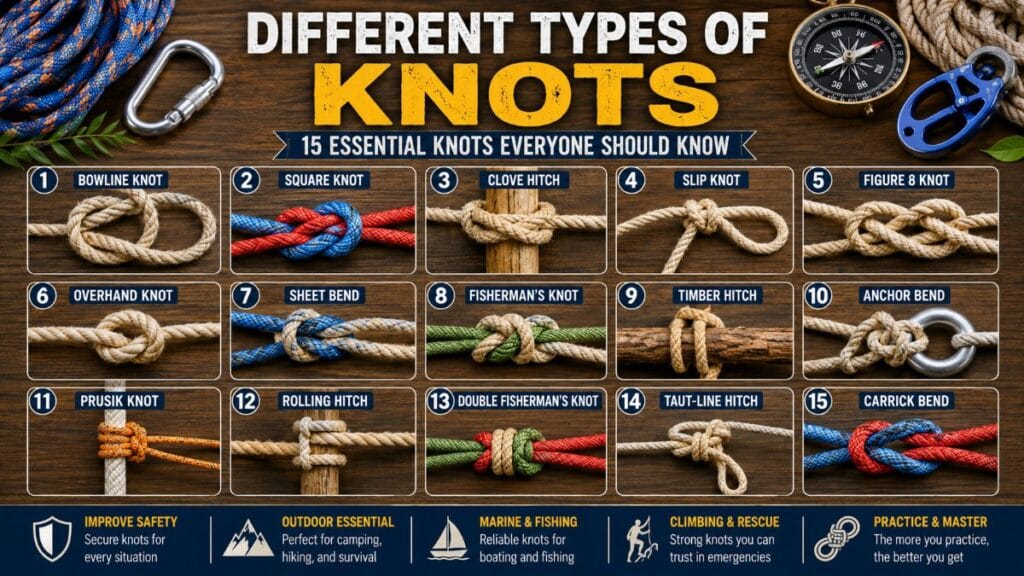
Have you ever wondered why experienced sailors, campers, climbers, rescue workers, and fishermen use different types of knots instead of relying on just one? The answer is simple—every knot is designed for a specific purpose. Some knots create secure loops, others join two ropes together, while some are perfect for fastening ropes around poles or adjusting tension. Learning the different types of knots is a valuable life skill that improves safety, saves time, and helps you complete countless outdoor and everyday tasks with confidence.
Whether you’re preparing for a camping adventure, learning survival skills, securing heavy objects, or simply expanding your practical knowledge, understanding the different types of knots can make your work much easier. In this guide, you’ll learn about 15 essential knots, their uses, advantages, and where each knot performs best.
Different Types of Knots Infographic
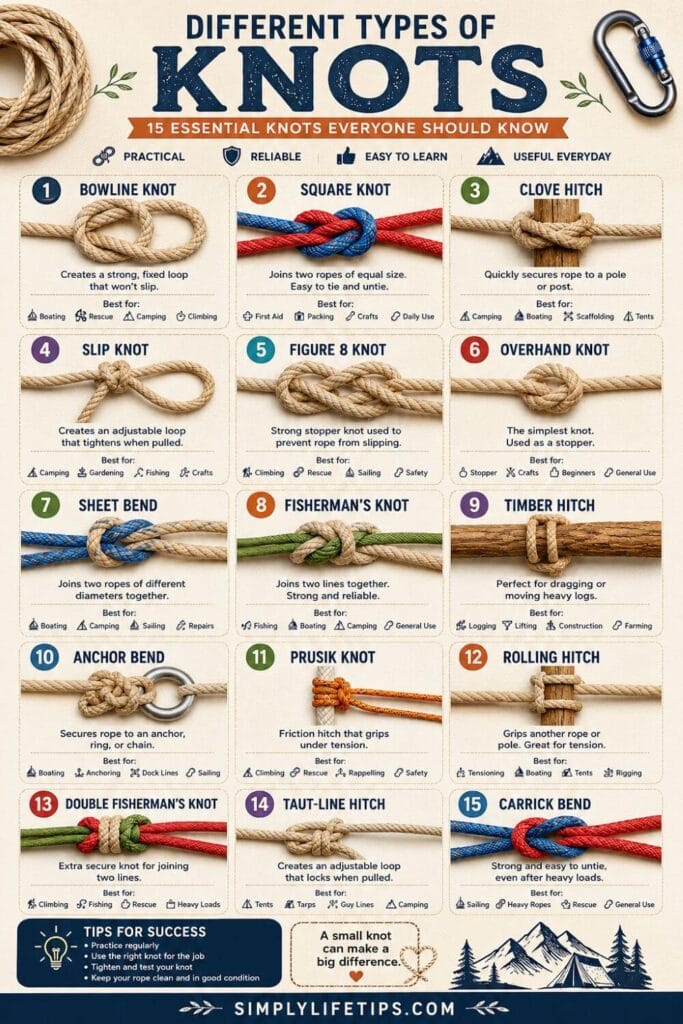
Learning the different types of knots becomes much easier when you can see them visually. While written explanations help you understand how each knot works, an infographic allows you to quickly identify knot structures, compare their designs, and remember their purposes more effectively. Whether you’re a camper, climber, sailor, fisherman, scout, or outdoor enthusiast, recognizing the right knot can save time and improve safety.
The infographic below showcases 15 essential types of knots along with their primary uses. From creating secure loops and joining ropes to fastening equipment and adjusting tension, each knot serves a unique purpose. Use this visual guide as a quick reference whenever you need to select the right knot for a specific task.
Key Takeaways – Different Types of Knots
Understanding the different types of knots is an important practical skill that can benefit you in countless situations. Each knot in this infographic has been developed to solve a specific problem, whether it’s securing a load, joining ropes, creating a loop, or providing safety during outdoor activities.
Beginners may want to start with simple knots such as the Overhand Knot, Square Knot, and Clove Hitch before progressing to more advanced options like the Prusik Knot, Double Fisherman’s Knot, and Carrick Bend. Regular practice will help you become more confident and ensure you can tie each knot correctly when needed.
Keep this infographic bookmarked or saved for future reference. With a solid understanding of these different types of knots, you’ll be better prepared for camping trips, fishing adventures, sailing activities, climbing expeditions, emergencies, and everyday rope-related tasks. The more you practice, the easier it becomes to choose the right knot quickly and effectively.
What are the different types of Knots?
Different types of knots are unique methods of tying ropes, cords, or strings to perform specific tasks. Some knots create fixed loops, others connect two ropes, while certain knots grip objects securely or adjust easily under tension. Every knot has its own strengths and limitations, making it important to choose the right one for the right job.
The different types of knots have been developed over centuries by sailors, mountaineers, fishermen, rescue professionals, and craftsmen. Today, these knots remain essential in boating, climbing, camping, construction, fishing, gardening, emergency response, and many household activities.
Importance of Learning Different Types of Knots
Understanding the different types of knots offers practical benefits that extend far beyond outdoor recreation. The right knot can secure equipment safely, prevent accidents, protect valuable belongings, and even save lives during emergencies.
Campers use knots to pitch tents and hang food bags. Sailors depend on reliable knots to control sails and secure boats. Climbers trust specialized knots for personal safety, while fishermen rely on strong knots to prevent losing fish. Even homeowners regularly use knots for tying packages, securing furniture during transportation, or hanging decorations.
The more different types of knots you learn, the more prepared you’ll be for everyday challenges and outdoor adventures.
Different Types of Knots
Bowline Knot
Among the different types of knots, the Bowline Knot is one of the most trusted and versatile. It creates a fixed loop at the end of a rope that remains secure under heavy loads without tightening around the object. One of its greatest advantages is that it can usually be untied easily, even after supporting significant weight.
The Bowline Knot has earned the nickname “The King of Knots” because of its reliability and versatility. Sailors use it to secure boats, rescue workers create dependable loops during emergency operations, and campers often use it to fasten ropes around trees or poles.
Unlike sliding loops, the Bowline maintains its original size regardless of the load placed on it. This makes it ideal whenever a permanent loop is required.
Common Uses
- Sailing and boating
- Rescue operations
- Camping
- Tree climbing
- Securing equipment
Square Knot (Reef Knot)
The Square Knot, also called the Reef Knot, is one of the easiest types of knots to learn. It joins two ropes of equal diameter and is best suited for light-duty applications.
Although the Square Knot is simple and convenient, it should never be used where safety is critical because it may slip if unequal force is applied. Instead, it excels in tying bandages, wrapping packages, securing bundles, and performing various household tasks.
Because beginners can learn it quickly, the Square Knot is often one of the very first knots taught in scouting and outdoor education.
Common Uses
- First aid bandages
- Gift wrapping
- Bundling objects
- Household chores
Clove Hitch
The Clove Hitch is one of the fastest types of knots for attaching a rope around a pole, post, or tree. It requires only a few simple movements, making it extremely popular among campers, scouts, and construction workers.
One of its biggest advantages is speed. The knot can be tied and adjusted quickly without complicated techniques. However, when the load constantly changes, it may loosen, so experienced users often reinforce it with an additional knot.
Despite this limitation, the Clove Hitch remains one of the most practical knots for temporary fastening.
Common Uses
- Tent setup
- Securing ropes to poles
- Scaffolding
- Temporary mooring
- Camping
Slip Knot
The Slip Knot creates an adjustable loop that tightens when pulled. Unlike permanent loops, this knot changes size depending on how much tension is applied.
Among the different types of knots, the Slip Knot is particularly useful when temporary adjustments are needed. Gardeners use it for tying plants, campers use it for quick setups, and crafters frequently include it in decorative projects.
Because the loop slides freely, it is not suitable for life-support situations but works well for many everyday applications.
Common Uses
- Gardening
- Crafts
- Camping
- Temporary fastening
- Decorative rope work
Figure Eight Knot
The Figure Eight Knot is one of the safest and strongest types of knots available. It is primarily used as a stopper knot to prevent ropes from slipping through holes or climbing equipment.
Rock climbers trust this knot because it distributes weight evenly and remains highly secure under heavy loads. Rescue teams and mountaineers also depend on various Figure Eight variations during technical rope work.
Unlike a simple overhand knot, the Figure Eight is much easier to inspect visually, making it one of the safest choices in climbing.
Common Uses
- Rock climbing
- Rope rescue
- Sailing
- Industrial safety
- Mountaineering
Overhand Knot
The Overhand Knot is the simplest of all the different types of knots. Although basic, it serves as the foundation for many advanced knots.
Most commonly, it functions as a stopper knot to keep rope ends from unraveling or slipping through openings. It is also frequently incorporated into decorative rope designs and more complex knot structures.
Because it is so easy to learn, beginners usually master this knot within minutes.
Common Uses
- Stopper knot
- Decorative knots
- Basic rope work
- Teaching beginners
Sheet Bend
The Sheet Bend is specifically designed to join two ropes of different diameters securely. Unlike the Square Knot, which performs best with ropes of equal thickness, the Sheet Bend maintains excellent holding power even when rope sizes differ.
Campers, sailors, and rescue professionals often rely on this knot whenever two different ropes must be connected safely. It also performs well with ropes made from different materials.
The Sheet Bend is considered one of the most practical joining knots and remains widely used around the world.
Common Uses
- Joining ropes
- Camping
- Sailing
- Emergency repairs
- Outdoor survival
Fisherman’s Knot
The Fisherman’s Knot is one of the most reliable types of knots for joining two thin ropes, fishing lines, or cords. As its name suggests, it has been used by anglers for centuries because it provides a secure connection that rarely slips under steady tension. Although originally developed for fishing, this knot has become popular in camping, hiking, and general rope work where dependable line connections are required.
One of the greatest strengths of the Fisherman’s Knot is its simplicity. It consists of two overhand knots tied around each other’s standing ends. When pulled tight, the knots slide together and lock firmly. It performs especially well with nylon fishing lines and synthetic cords that may cause other knots to slip.
While it is excellent for lightweight applications, climbers usually prefer the Double Fisherman’s Knot for life-support situations because it offers greater security.
Common Uses
- Joining fishing lines
- Connecting thin ropes
- Camping gear
- Outdoor survival
- General rope work
Timber Hitch
The Timber Hitch is one of the oldest types of knots and is specifically designed for moving logs, poles, and other cylindrical objects. It tightens naturally as weight is applied, making it ideal for hauling heavy timber without slipping.
Unlike many knots, the Timber Hitch becomes stronger under load yet unties easily once the weight is removed. This feature has made it a favorite among loggers, arborists, builders, and outdoor enthusiasts for generations.
Although simple to tie, the Timber Hitch should not be used for lifting people or supporting critical loads. It is intended primarily for pulling and dragging heavy objects.
Common Uses
- Moving logs
- Forestry work
- Construction
- Arborist work
- Heavy hauling
Anchor Bend
Among the different types of knots used in boating, the Anchor Bend is one of the strongest and most dependable. Despite its name, it is technically a hitch rather than a bend because it secures a rope to an anchor, chain, or ring.
The Anchor Bend grips firmly under continuous tension, making it ideal for marine environments where ropes are constantly exposed to water, wind, and movement. Sailors trust this knot because it resists slipping even during rough conditions.
Although commonly associated with boats, the Anchor Bend is also useful whenever a rope must be attached securely to a fixed metal object.
Common Uses
- Boat anchors
- Dock lines
- Marine rigging
- Heavy-duty fastening
- Outdoor equipment
Prusik Knot
The Prusik Knot is one of the most important types of knots used in climbing and rescue operations. It is a friction hitch that grips a rope firmly when loaded but slides smoothly when the tension is released.
This unique characteristic allows climbers to ascend ropes safely while maintaining a reliable backup system. Rescue professionals also use the Prusik Knot during rope rescues because it can be tied quickly using a smaller loop of cord.
Although it appears simple, the Prusik Knot requires proper practice to ensure it grips effectively on the rope being used.
Common Uses
- Rope climbing
- Mountain rescue
- Tree climbing
- Emergency backup
- Mountaineering
Rolling Hitch
The Rolling Hitch is another highly practical knot among the different types of knots because it grips another rope, pole, or cylindrical object while resisting movement in one direction. It is particularly useful for adjusting tension without completely untying the rope.
Campers often use the Rolling Hitch to tighten guy lines, while sailors rely on it for adjusting rigging. Builders and rescue teams also use it whenever temporary tension adjustments are needed.
The knot performs best when the pulling force remains consistent in one direction.
Common Uses
- Tightening tent lines
- Boat rigging
- Load adjustment
- Rope tensioning
- Construction work
Double Fisherman’s Knot
The Double Fisherman’s Knot is considered one of the strongest types of knots for joining two ropes permanently. It is essentially an improved version of the standard Fisherman’s Knot, with additional wraps that significantly increase its holding strength.
Rock climbers frequently use this knot to create closed loops of climbing cord, known as Prusik loops. It performs exceptionally well under heavy loads and remains secure even with slippery synthetic ropes.
Because it tightens firmly after being loaded, it can sometimes be difficult to untie. For this reason, it is generally used in situations where a permanent connection is acceptable.
Common Uses
- Climbing ropes
- Rescue equipment
- Permanent rope loops
- Mountaineering
- Safety systems
Taut-Line Hitch
The Taut-Line Hitch is one of the most useful types of knots for campers because it creates an adjustable loop that slides easily when loose but locks securely when tension is applied.
Unlike fixed knots, the Taut-Line Hitch allows users to tighten or loosen ropes without untying them. This makes it ideal for tents, tarps, clotheslines, and other outdoor shelters where rope tension changes throughout the day due to wind or weather.
Its combination of adjustability and security makes it one of the first knots many campers learn.
Common Uses
- Tent guy lines
- Tarps
- Clotheslines
- Adjustable tie-downs
- Camping shelters
Carrick Bend
The Carrick Bend is one of the strongest types of knots for joining two large or heavy ropes. Sailors have relied on this knot for centuries because it distributes force evenly while remaining surprisingly easy to untie after carrying heavy loads.
Unlike many joining knots that jam tightly under pressure, the Carrick Bend maintains excellent strength while allowing relatively easy removal once the load has been released.
Because of these characteristics, it remains popular in marine operations, rescue work, and heavy lifting.
Common Uses
- Joining heavy ropes
- Marine work
- Rescue operations
- Large hauling projects
- Industrial applications
How to Choose the Right Types of Knots?
Choosing among the different types of knots depends entirely on the task you need to perform. If you require a permanent loop that will not tighten, the Bowline Knot is one of the best choices. For climbing and rescue work, the Figure Eight Knot and Double Fisherman’s Knot provide outstanding security. When connecting two ropes of different sizes, the Sheet Bend offers excellent reliability.
Campers often rely on the Taut-Line Hitch for adjustable tent ropes, while sailors frequently use the Anchor Bend to secure boats. Gardeners may prefer the Slip Knot for temporary fastening, whereas loggers depend on the Timber Hitch for moving heavy timber.
Understanding the strengths of the different types of knots allows you to choose the safest, strongest, and most efficient knot for every situation.
Common Mistakes When Tying Different Types of Knots
Even the strongest types of knots can fail if they are tied incorrectly. One of the most common mistakes is choosing the wrong knot for the job. For example, using a Square Knot where a Sheet Bend is needed may result in the ropes slipping apart under uneven loads.
Another frequent mistake is failing to “dress” the knot properly. Dressing means arranging each part of the knot neatly before tightening it. Poorly dressed knots may weaken significantly or loosen unexpectedly.
People also make the mistake of using worn or damaged ropes. A perfectly tied knot cannot compensate for a rope that has become weak through age, abrasion, or exposure to chemicals. Always inspect your rope before tying any knot.
Finally, never assume a knot is secure without testing it. Applying gradual tension before placing a knot into full service helps identify mistakes before they become dangerous.
Benefits of Learning Different Types of Knots
Learning the different types of knots provides practical knowledge that can be used throughout your life. Whether you enjoy outdoor adventures, work in construction, participate in water sports, or simply want to improve your problem-solving skills, understanding how to tie the right knot is extremely valuable. Every knot has a specific purpose, and mastering these techniques helps you work more safely and efficiently.
Improves Safety
One of the biggest advantages of learning the different types of knots is improved safety. A properly tied knot reduces the risk of ropes slipping, loads falling, or equipment failing. Climbers, sailors, rescue professionals, and construction workers depend on secure knots because their safety often relies on them. Even during simple household tasks, using the correct knot helps prevent accidents.
Makes Camping and Outdoor Activities Easier
Camping becomes much easier when you know the different types of knots. You can pitch tents securely, tighten guy lines, hang food bags away from wildlife, build emergency shelters, and fasten tarps quickly. Knowing the right knot means spending less time struggling with ropes and more time enjoying the outdoors.
Useful for Boating and Sailing
Boaters and sailors use different types of knots every day. Knots such as the Bowline, Clove Hitch, and Anchor Bend help secure boats, attach anchors, and control rigging. These reliable knots are designed to withstand changing weather conditions and constant movement on the water.
Enhances Fishing Skills
Fishing requires strong and dependable knots that won’t loosen while fighting a fish. The Fisherman’s Knot and Double Fisherman’s Knot are trusted by anglers because they create secure connections between fishing lines and leaders. Learning these knots helps prevent lost catches and damaged equipment.
Increases Confidence in Emergencies
Knowing the different types of knots prepares you for emergency situations. Whether you need to secure equipment during a storm, perform a basic rescue, or improvise a shelter, your knot-tying skills can prove extremely valuable. Confidence comes from knowing you have practical solutions when unexpected situations arise.
Saves Time and Effort
Using the correct knot the first time eliminates unnecessary frustration. Instead of repeatedly retying ropes that slip or loosen, you can confidently choose the knot designed for that specific task. This improves efficiency and reduces wasted time.
Develops Practical Life Skills
Learning the different types of knots is a lifelong skill that benefits people of all ages. Students, outdoor enthusiasts, homeowners, gardeners, and professionals can all apply knot-tying techniques in everyday situations. It’s a practical ability that remains useful throughout life.
Tips for Learning Different Types of Knots
Learning the different types of knots is easier when you practice consistently. Begin with simple knots before progressing to more advanced techniques.
Start with Basic Knots
Learn the Overhand Knot, Square Knot, and Clove Hitch first. These basic knots provide a strong foundation for understanding more advanced knots.
Practice Regularly
Keep a short piece of rope at home and practice tying each knot several times. Repetition builds muscle memory and helps you remember the correct tying sequence.
Learn the Purpose of Each Knot
Instead of memorizing knots randomly, understand why each knot exists. Knowing when to use a Bowline instead of a Sheet Bend or a Figure Eight instead of an Overhand Knot makes the learning process much more meaningful.
Test Every Knot
Always tighten and test your knot before trusting it with heavy loads or important tasks. A quick inspection ensures the knot is dressed correctly and securely tied.
Use Quality Rope
Practicing with a soft, medium-diameter rope makes learning much easier. Avoid stiff or worn-out ropes that make knot tying more difficult.
Frequently Asked Questions
What are the different types of knots?
Different types of knots are specialized rope-tying techniques used to create loops, join ropes, secure objects, adjust tension, or prevent ropes from slipping. Each knot is designed for a specific purpose.
Which different types of knots are best for beginners?
Beginners should start with the Overhand Knot, Square Knot, Bowline Knot, Clove Hitch, and Figure Eight Knot because they are simple, versatile, and commonly used.
Which knot is strongest?
The Double Fisherman’s Knot and Figure Eight Knot are among the strongest types of knots used for climbing, rescue operations, and other heavy-duty applications.
Why is it important to learn different types of knots?
Learning the different types of knots improves safety, increases outdoor skills, makes daily tasks easier, and prepares you for emergencies where secure rope handling is essential.
How can I master different types of knots?
Practice each knot repeatedly with a rope, follow step-by-step diagrams or videos, and apply them in real-life situations such as camping, gardening, or boating until tying them becomes second nature.
Conclusion
Understanding the different types of knots is an essential skill that combines knowledge, safety, and practicality. Every knot serves a unique purpose, whether it is creating a secure loop, joining ropes, fastening objects, or adjusting rope tension. By learning these 15 essential knots, you’ll be better prepared for camping, boating, climbing, fishing, construction work, gardening, and countless everyday tasks.
From the dependable Bowline Knot to the adjustable Taut-Line Hitch and the incredibly strong Double Fisherman’s Knot, each knot has earned its place because of its reliability and usefulness. Practice these different types of knots regularly, and you’ll develop a valuable skill that can make outdoor adventures safer, household projects easier, and emergencies more manageable.
Related Articles
- Different Types of Watches | A Complete Guide to Watch Styles and Their Uses
- Types of Shoes | The Ultimate Guide to Popular Shoe Styles and Their Uses
- Types of Bridges | 5 Amazing Bridge Designs and How They Work
If this resonated with you, share it with someone who needs it.
PVM

Mathukutty P V is a Blogger, YouTuber, and Content Writer and the founder of Simply Life Tips. After taking voluntary retirement in 2017, he embraced a free lifestyle focused on learning, personal growth, and sharing practical wisdom to help others live with more purpose and positivity.



