
Types of bridges have played a crucial role in human civilization for thousands of years. They connect communities, make transportation easier, support trade, and help people cross rivers, valleys, lakes, and other obstacles safely. Engineers design different types of bridges to meet specific needs, environmental conditions, and traffic requirements. Some bridges carry vehicles and pedestrians, while others transport water or allow ships to pass underneath. Understanding the various types of bridges helps students appreciate the creativity, science, and engineering behind these remarkable structures.
5 Amazing Types of Bridges
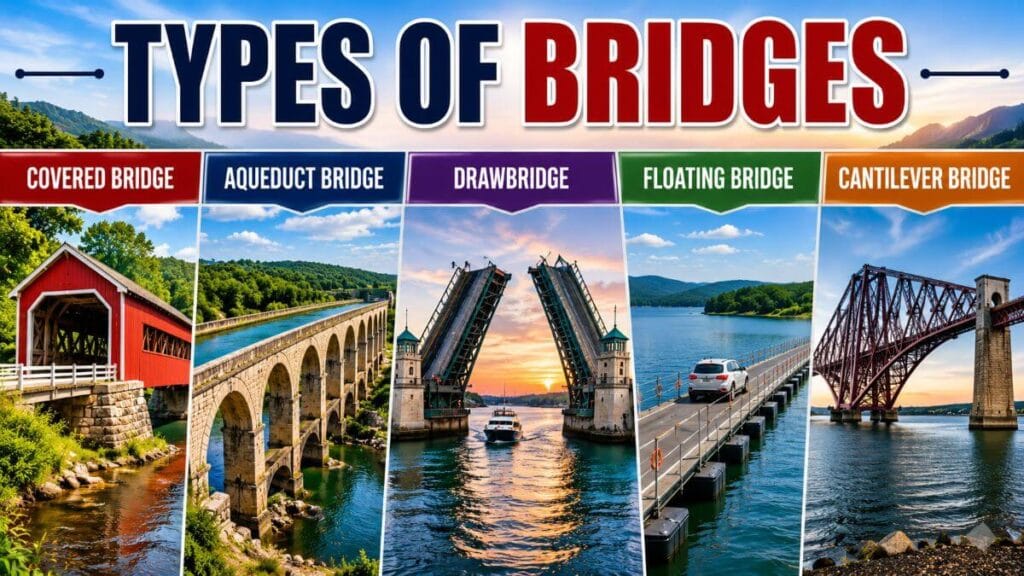
Bridges are among the most important structures in modern civilization, allowing people, vehicles, trains, and even water to cross natural and man-made obstacles safely. While many people think all bridges are similar, engineers have developed different types of bridges to solve unique challenges related to geography, traffic demands, and environmental conditions. Some bridges are designed to carry water, some can move to allow ships to pass, and others can span long distances without central supports. The infographic below provides a quick overview of five fascinating types of bridges and their primary uses before we explore each one in greater detail.

As illustrated in the infographic, each bridge type serves a specific purpose and showcases a unique engineering solution. Covered bridges protect wooden structures from weather damage, aqueduct bridges transport water across obstacles, drawbridges accommodate both road and marine traffic, floating bridges provide crossings over deep water, and cantilever bridges support heavy loads across long spans. Understanding these different types of bridges helps us appreciate how engineers combine creativity, science, and technology to connect communities and improve transportation networks around the world. Let’s take a closer look at each bridge type, its construction, advantages, and real-world applications.
Covered Bridge

A covered bridge is one of the most recognizable and historic bridge designs in the world. As the name suggests, this bridge is enclosed with a roof and side walls, typically constructed from wood. Covered bridges became especially popular during the eighteenth and nineteenth centuries in North America and Europe.
The primary purpose of the covering is to protect the bridge’s wooden framework from rain, snow, sunlight, and other weather conditions. Without protection, wooden beams and trusses would deteriorate much faster. The roof and walls significantly extend the life of the structure, allowing some covered bridges to remain in service for more than a century.
Covered bridges often feature intricate truss systems that distribute weight evenly across the structure. These trusses provide the strength needed to support vehicles, pedestrians, and sometimes livestock. Many covered bridges have become historical landmarks and tourist attractions due to their charming appearance and cultural significance.
One famous example is the Cornish-Windsor Covered Bridge in the United States, which is among the longest covered bridges in the world. Visitors are often drawn to covered bridges because they offer a glimpse into traditional engineering techniques that have stood the test of time.
The main advantages of covered bridges include weather protection, extended lifespan, and historical value. However, they may require regular maintenance and are often too narrow for modern traffic demands.
Aqueduct Bridge

An aqueduct bridge is a unique structure designed to carry water rather than vehicles. These bridges transport water across valleys, rivers, roads, and other obstacles while maintaining a consistent flow. Aqueduct bridges have been used for thousands of years and were especially important in ancient civilizations.
The Romans were masters of aqueduct construction. They built extensive networks that supplied cities with fresh water using gravity alone. Their aqueducts crossed challenging terrain via tunnels, channels, and elevated bridges.
Modern aqueduct bridges are often constructed from stone, concrete, or steel. Some are designed to carry canals, allowing boats to travel across rivers or valleys while floating on water contained within the bridge itself.
One of the most famous examples is the Pont du Gard in France, a magnificent Roman aqueduct that still stands today. Another remarkable example is the Pontcysyllte Aqueduct in Wales, where narrowboats travel across a stunning elevated waterway.
Aqueduct bridges provide reliable water transportation for cities, industries, and agriculture. They help ensure a consistent water supply and support irrigation systems that are essential for food production. Despite their benefits, aqueduct bridges require careful maintenance to prevent leaks and structural damage.
Drawbridge

A drawbridge is a movable bridge that can be raised, lowered, or opened to allow boats and ships to pass beneath it. This bridge design combines the needs of land transportation and water navigation, making it particularly useful in busy ports, rivers, and coastal areas.
Historically, drawbridges were used as defensive features at castles. The bridge could be raised to prevent enemies from entering the fortress. Modern drawbridges use sophisticated mechanical and hydraulic systems to lift sections of the roadway when necessary.
When a large vessel approaches, the bridge operator activates the lifting mechanism. The movable section rises, creating enough clearance for the vessel to pass safely. Once the water traffic has cleared, the bridge returns to its normal position, allowing vehicles and pedestrians to continue crossing.
One of the most famous drawbridges in the world is Tower Bridge in London. Although many people assume it is a traditional bridge, it actually contains a movable section that opens for river traffic.
Drawbridges offer significant advantages because they support both road transportation and maritime navigation. They eliminate the need for extremely tall bridge structures while accommodating large ships. However, they require regular maintenance, mechanical inspections and can temporarily interrupt road traffic during operation.
Floating Bridge

A floating bridge, also known as a pontoon bridge, is supported by floating structures rather than fixed foundations. This innovative design is particularly useful when crossing deep lakes, wide rivers, or areas where constructing traditional bridge supports would be difficult or expensive.
Floating bridges consist of large pontoons that provide buoyancy and support the bridge deck. These pontoons are anchored securely to the bottom of the water body to maintain stability and prevent drifting.
One of the greatest advantages of floating bridges is their ability to span deep water without requiring extensive underwater construction. This makes them a cost-effective solution in certain environments. Floating bridges can also be assembled relatively quickly, making them valuable during emergencies and military operations.
The Evergreen Point Floating Bridge in Washington State is one of the longest floating bridges in the world. It demonstrates how modern engineering can successfully create stable transportation routes across large bodies of water.
Floating bridges are not without challenges. They can be affected by strong winds, waves, and changing water levels. Engineers must carefully design these structures to withstand environmental forces while maintaining safety and reliability.
Despite these challenges, floating bridges remain an important solution for regions where traditional bridge construction is impractical.
Cantilever Bridge

A cantilever bridge is a powerful engineering structure that uses horizontal beams supported at only one end. This design allows large spans to be constructed without the need for temporary supports in the center.
Cantilever bridges work by balancing forces on opposite sides of a central support. Two cantilever arms extend outward from each side and often meet in the middle through a suspended span. This creates a strong and stable structure capable of carrying heavy loads.
The design became especially popular during the Industrial Revolution when expanding railway networks required bridges that could cross wide rivers and valleys. Steel construction made it possible to create even longer spans while maintaining structural integrity.
One of the most famous cantilever bridges is the Forth Bridge in Scotland. This iconic structure is recognized worldwide for its impressive engineering and has become a symbol of durability and innovation. Another notable example is the Quebec Bridge in Canada, which remains one of the longest cantilever bridges ever built.
Cantilever bridges are ideal for railways, highways, and heavy industrial transportation. Their ability to support substantial loads makes them valuable in locations where other bridge types may be less practical.
The primary disadvantages include higher construction costs and the need for precise engineering calculations. However, their strength, durability, and long-span capabilities often justify these investments.
Why are different types of bridges important?
Different environments present different engineering challenges. A bridge that works well over a narrow stream may not be suitable for a deep lake or a busy shipping channel. Engineers carefully evaluate geography, traffic volume, water conditions, environmental factors, and budget constraints before selecting the most appropriate bridge design.
Covered bridges protect wooden structures from weather damage. Aqueduct bridges transport water across difficult terrain. Drawbridges accommodate both vehicles and ships. Floating bridges provide solutions for deep-water crossings. Cantilever bridges carry heavy loads across long distances.
Each bridge type demonstrates how engineering adapts to specific needs while ensuring safety, efficiency, and durability.
Conclusion
The various types of bridges found around the world showcase the remarkable achievements of civil engineering. From the historic charm of covered bridges to the innovative design of floating bridges and the strength of cantilever structures, each bridge serves a unique purpose. Understanding these types of bridges helps students appreciate how engineering connects communities, supports economic growth, and overcomes natural obstacles. As technology continues to evolve, future bridge designs will become even more efficient, sustainable, and impressive.
FAQs – Types of Bridges
What are the main types of bridges?
Some of the most common types of bridges include beam bridges, arch bridges, suspension bridges, covered bridges, aqueduct bridges, drawbridges, floating bridges, and cantilever bridges.
Why are different types of bridges needed?
Suspension bridges and cantilever bridges are often used for long-distance spans because they can cover large areas with fewer supports.
Which types of bridges are best for long distances?
Suspension bridges and cantilever bridges are often used for long-distance spans because they can cover large areas with fewer supports.
What is the purpose of a floating bridge?
A floating bridge provides a transportation route across deep water where building traditional foundations would be difficult or expensive.
Which types of bridges are strongest?
Cantilever bridges and arch bridges are considered among the strongest due to their excellent load-distribution capabilities and structural stability.
Related Articles

Mathukutty P V is a Blogger, YouTuber, and Content Writer and the founder of Simply Life Tips. After taking voluntary retirement in 2017, he embraced a free lifestyle focused on learning, personal growth, and sharing practical wisdom to help others live with more purpose and positivity.



