Artificial intelligence is transforming the way we work, but the skills AI can’t replace are becoming even more valuable. Machines can process data, automate tasks, and generate content at incredible speed. Yet leadership is not built on algorithms alone. It is built on trust, empathy, judgment, and human connection.
As AI continues to evolve, professionals who develop uniquely human abilities will stand out. These skills help people influence, inspire, and lead others through challenges and change.
Why Human Skills Matter More in the Age of AI?
Technology has always changed the workplace. From computers to smartphones to artificial intelligence, every innovation has automated certain tasks while increasing the value of others.
Today, AI can write reports, analyze trends, and answer questions. However, it cannot fully understand human emotions, earn genuine trust, or navigate complex interpersonal situations with the depth and authenticity that people can.
The future belongs to individuals who combine technology with strong human-centered leadership skills.
7 Skills AI Can’t Replace
Artificial Intelligence is changing the workplace faster than ever. But while AI can automate tasks, analyze data, and generate content, some human abilities remain impossible to replicate. These seven skills that AI can’t replace help leaders build trust, inspire action, and create meaningful connections in a world increasingly powered by technology.
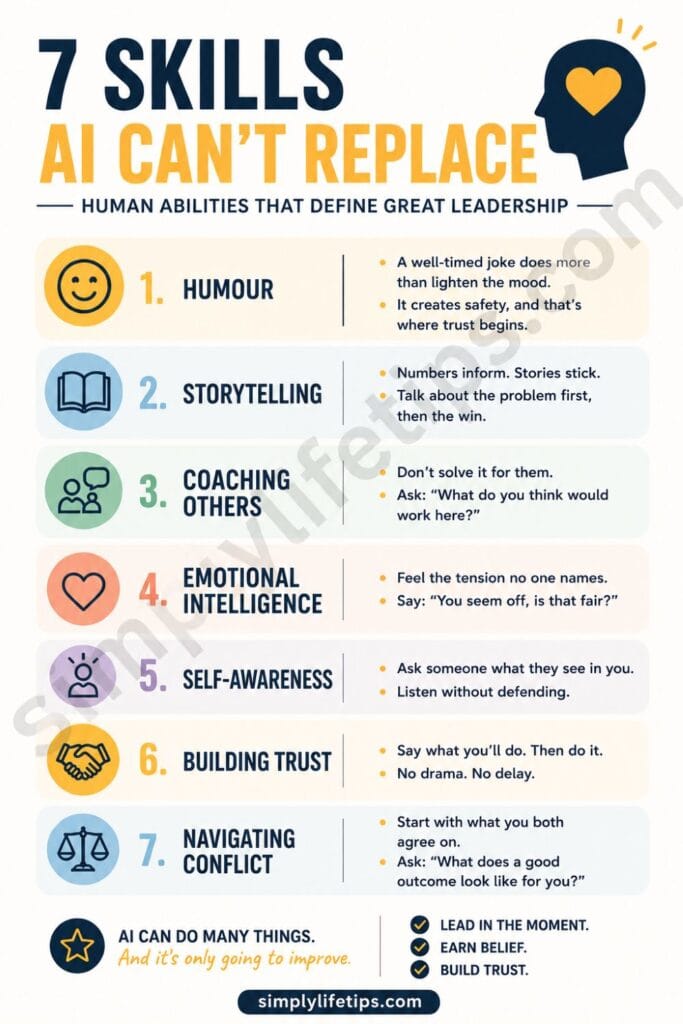
The future doesn’t belong to those who compete with AI. It belongs to those who combine technology with uniquely human strengths. Develop these skills, and you’ll remain valuable, influential, and effective no matter how advanced AI becomes.
1. Humour
Humor is one of the Skills AI Can’t Replace. A well-timed joke does much more than make people laugh. It helps people feel comfortable, reduces tension, and creates an environment where trust can grow.
Leaders who use humour appropriately can connect with others on a personal level. During stressful situations, a light-hearted comment can help teams relax and regain focus.
For example, when a project encounters unexpected delays, a leader who uses humour thoughtfully can ease frustration and help the team move forward with renewed energy.
Humour creates psychological safety, and psychological safety creates trust.
2. Storytelling
Facts and statistics are important, but stories are memorable.
People often forget numbers and presentations, yet they remember experiences and narratives. Effective leaders use storytelling to communicate ideas, explain challenges, and inspire action.
Instead of simply announcing a successful outcome, great leaders explain the journey behind it:
- What problem existed?
- What obstacles appeared?
- What lessons were learned?
- What success was achieved?
For example, a manager introducing a new process can tell the story of a customer who struggled with the old system and benefited from the improvement.
Numbers inform, but stories stick.
3. Coaching Others
Many leaders make the mistake of solving every problem themselves. Coaching requires a different approach.
Rather than providing immediate answers, effective coaches help people think independently and discover solutions on their own.
Simple questions can have a powerful impact:
- What do you think would work here?
- What options have you considered?
- What would success look like?
When employees find their own solutions, they develop confidence, ownership, and critical thinking skills.
AI can provide suggestions, but true coaching develops people.
4. Emotional Intelligence
One of the most valuable leadership skills is the ability to understand emotions—both your own and those of others.
Emotional intelligence helps leaders recognize unspoken concerns, manage difficult conversations, and build stronger relationships.
Sometimes the most important issue in a meeting is not what is being said but what is being left unsaid.
A leader with strong emotional intelligence might notice a normally engaged team member becoming quiet and ask:
“You seem a little off today. Is that fair?”
That simple question can open the door to understanding, support, and trust.
AI can analyze sentiment. Humans can genuinely connect with feelings.
5. Self-Awareness
Great leaders understand themselves.
Self-awareness means recognizing your strengths, weaknesses, blind spots, and impact on others.
Cultivating self-awareness is akin to tilling the soil before planting the seeds of personal growth. One of the most effective ways to improve self-awareness is through honest feedback.
Ask trusted colleagues:
- What am I doing well?
- Where do I create challenges?
- What do you see that I may not see?
The difficult part is listening without becoming defensive.
Leaders who understand themselves are more adaptable, authentic, and effective.
Self-awareness is often the foundation upon which all other leadership skills are built.
6. Building Trust
Trust is not created through speeches or promises. It is built through consistent actions.
People trust leaders who do what they say they will do.
Simple habits make a significant difference:
- Keep commitments.
- Meet deadlines.
- Follow through on promises.
- Communicate honestly.
Consider two managers. One makes ambitious promises but frequently misses deadlines. The other consistently delivers on commitments, even small ones.
Over time, the second manager earns far greater trust.
Trust grows through consistency, not charisma.
7. Navigating Conflict
Conflict is inevitable wherever people work together.
Strong leaders do not avoid disagreements. Instead, they help people move through them constructively.
A productive approach often begins with identifying common ground.
Questions such as these can change the tone of a difficult conversation:
- What do we already agree on?
- What outcome would be good for both sides?
- What does success look like for you?
By focusing on shared goals, leaders can reduce defensiveness and create opportunities for collaboration.
AI may help organize information, but resolving human conflict requires empathy, judgment, and relationship-building.
The Competitive Advantage of Being Human
Many people worry about what AI will replace, but many skills AI can’t replace. A more useful question is: What will become more valuable because of AI?
The answer is often the skills that technology struggles to replicate:
- Humour
- Storytelling
- Coaching
- Emotional intelligence
- Self-awareness
- Trust-building
- Conflict resolution
As automation handles more technical tasks, these human-centered abilities become even more important.
Organizations will continue to need people who can unite teams, inspire confidence, navigate uncertainty, and build meaningful relationships.
FAQs – Skills AI Can’t Replace
Can AI replace leadership completely?
No. AI can assist leaders by providing information and insights, but leadership requires trust, empathy, judgment, and human connection.
Why is emotional intelligence important in leadership?
Emotional intelligence helps leaders understand people, manage relationships, and respond effectively to challenges and conflict.
Is storytelling really a leadership skill?
Yes. Storytelling helps leaders communicate ideas, inspire action, and make information more memorable and meaningful.
How can I improve my trust-building skills?
Focus on consistency, honesty, reliability, and following through on commitments. Trust grows through repeated actions over time.
Which human skill will become most valuable in the AI era?
While all seven skills are important, emotional intelligence and trust-building are likely to become increasingly valuable as workplaces become more technology-driven.
Conclusion
The rise of artificial intelligence does not reduce the importance of human leadership—it increases it. While AI can automate tasks, analyze information, and improve efficiency, it cannot genuinely connect with people, inspire belief, or build lasting trust. The professionals who thrive in the future will not be those who compete with AI, but those who strengthen the uniquely human skills that AI cannot replace. Which of these seven skills do you believe will become most valuable in the future workplace?

Mathukutty P V is a Blogger, YouTuber, and Content Writer and the founder of Simply Life Tips. After taking voluntary retirement in 2017, he embraced a free lifestyle focused on learning, personal growth, and sharing practical wisdom to help others live with more purpose and positivity.