

The impact of parental phone addiction on children is increasingly becoming a silent influence shaping early childhood development across the world. In today’s mobile-centred lifestyle, phones dominate communication, work, and entertainment. Children are born into this digital environment and grow up watching parents frequently engaged with screens. While mobile phones are useful tools, excessive usage reduces meaningful interaction with children. This lack of human connection can influence speech development, emotional bonding, brain growth, social behaviour, and learning ability. Understanding these hidden effects allows parents to make mindful changes that nurture healthy development and stronger parent-child relationships.
The Impact of Parental Phone Addiction on Children
Parental phone addiction is not simply frequent phone use; it is habitual, excessive, and uncontrolled dependence on mobile devices that interferes with attentive parenting. Many parents check notifications repeatedly, scroll social media unconsciously, and remain mentally distracted even while physically present with their child. This “partial attention parenting” reduces emotional responsiveness and communication quality.
For example, when a baby smiles or babbles, a responsive parent typically smiles back, talks, and encourages. This strengthens emotional bonding and communication learning. However, if the parent is focused on a phone, the response becomes delayed or absent, weakening the child’s communication cycle. Over time, children may reduce attempts to communicate because they receive fewer encouraging responses.
Reduction in Speech and Language Development
Language development depends on consistent listening, imitation, and responsive communication. Children learn words by hearing spoken language repeatedly and by engaging in conversation. When parental phone use reduces direct interaction, the child receives fewer language inputs, slowing speech development.
Children exposed to limited conversation often experience delayed first words, reduced vocabulary, and difficulty forming sentences. For instance, a child who hears daily storytelling, singing, and descriptive conversation learns new words naturally and quickly. In contrast, a child who mostly hears background noise from television or passive audio from phones does not receive interactive language stimulation. Human speech involves tone, rhythm, facial expression, and emotional cues, which activate neural pathways essential for language learning. Without these inputs, speech growth slows significantly.
Decrease in Parent-Child Interaction
Healthy child development relies on continuous emotional exchange and interactive communication between parent and child. Babies naturally attempt to connect through sounds, gestures, and facial expressions. When parents respond consistently, this creates a communication loop that supports brain development, emotional bonding, and social learning.
However, excessive phone distraction interrupts this loop. If a child attempts to communicate but receives delayed or weak responses, the child may gradually reduce attempts to interact. This weakens emotional connection and social engagement. For example, when a toddler shows excitement by bringing a toy to a parent, but the parent is absorbed in the phone, the child’s emotional sharing is ignored. Repeated experiences like this reduce emotional confidence and expressive communication.
Reduced Eye Contact and Emotional Bonding
Eye contact is fundamental for emotional security, social awareness, and language development. Through eye-to-eye interaction, babies learn facial expressions, lip movements, attention control, and emotional cues. When parents frequently focus on screens instead of their child, eye contact reduces significantly.
This reduced visual engagement weakens emotional bonding and slows communication and learning. For example, when parents maintain eye contact while speaking, the child observes mouth movements and emotional expressions, helping them understand speech patterns. Without this connection, the child may feel less emotionally secure and less motivated to communicate. Strong eye contact builds trust, confidence, and social responsiveness in children.
Modelling Behaviour – Children Copy Parents
Children learn primarily through observation and imitation. When they constantly see parents holding and using phones, they naturally develop curiosity toward screens. Many parents unintentionally introduce screens early by giving phones during feeding, crying, or bedtime routines. This early exposure can lead to dependency on digital stimulation.
Children who grow up surrounded by screens often prefer passive entertainment over physical play and human interaction. For instance, a child who listens to stories, plays with toys, and interacts socially develops imagination, creativity, and communication skills. In contrast, a child frequently exposed to screens may become less active, less imaginative, and more dependent on visual stimulation for entertainment.
How Mobile Phone Addiction Affects Families And Ways To Overcome It
Cognitive and Brain Development Effects
Early childhood is a critical period for brain growth and neural connection formation. Active interaction, touch, conversation, and play stimulate brain development. Excessive parental phone distraction reduces meaningful stimulation, limiting cognitive growth opportunities.
Possible cognitive effects include slower language processing, reduced problem-solving ability, shorter attention span, and weaker social understanding. Human interaction activates multiple brain regions simultaneously, strengthening neural networks. Passive exposure to screens does not provide the same level of stimulation. For example, interactive storytelling activates imagination and comprehension, while passive screen viewing offers limited engagement.
Emotional and Behavioural Impact
The impact of parental phone addiction on children extends beyond learning and speech. Emotional development is also strongly affected. Children who receive less attention and emotional response may develop insecurity and attention-seeking behaviour.
Common emotional and behavioural signs include irritability, frequent crying, reduced emotional expression, and strong craving for screens. For instance, when children feel ignored repeatedly, they may try to gain attention through disruptive behaviour or withdraw emotionally. Consistent parental responsiveness builds emotional security, trust, and psychological stability.
The Negative Impact Of Mobile Phone Addiction
The Impact of Parental Phone Addiction on Children -Practical Solutions
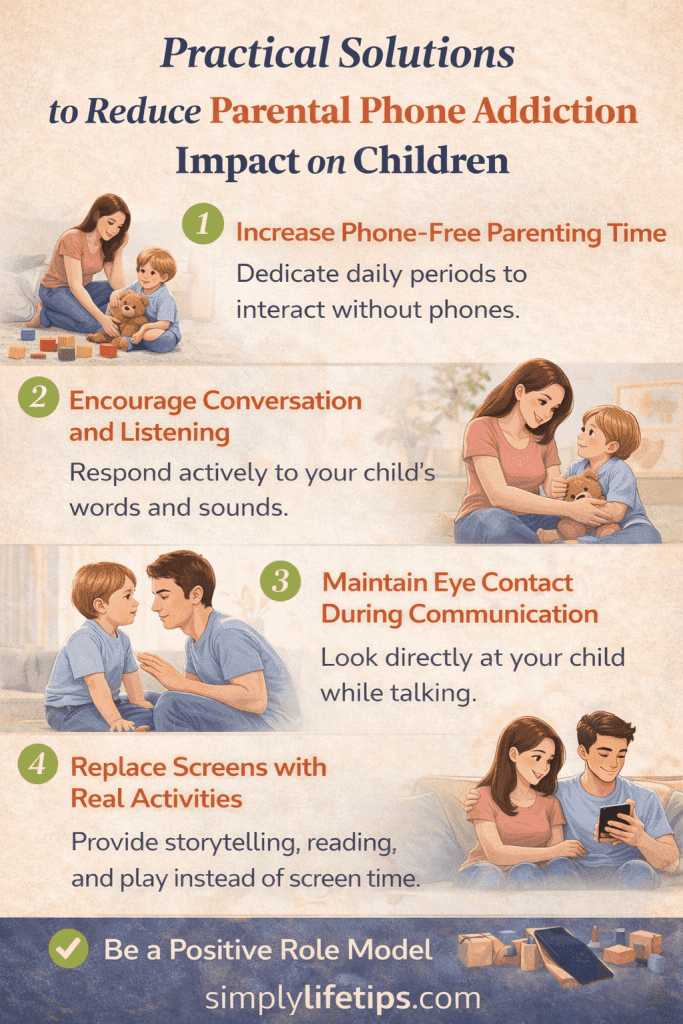
1. Increase Phone-Free Parenting Time
Creating intentional phone-free parenting time is one of the most powerful ways to rebuild connection and communication with children. Parents should set specific daily periods when phones are kept completely away, such as during meals, playtime, waking hours, and bedtime routines. During these moments, the focus should be fully on the child without distraction. Even short but consistent interactions, such as 20–30 minutes of uninterrupted engagement, can significantly strengthen emotional bonding and language development.
For example, when a parent sits on the floor, plays with blocks, listens attentively, and responds to the child’s expressions, the child feels emotionally secure and encouraged to communicate more. Over time, these small daily habits improve speech, confidence, and emotional stability.
2. Encourage Conversation and Listening
Children learn language through active conversation and responsive listening. Parents should talk frequently with their child about everyday activities such as eating, bathing, walking, or playing. Describing actions like “We are washing hands,” “This is a red ball,” or “Let us go outside” helps children associate words with meaning. Asking simple open-ended questions like “What is this?” or “Where is the toy?” encourages thinking and verbal response. When a child attempts to speak, parents should patiently listen, repeat the correct word gently, and encourage imitation.
For example, if a child says “ba” for ball, the parent can respond warmly, “Yes, this is a ball.” This supportive communication builds vocabulary, pronunciation, and confidence while strengthening emotional connection.
3. Maintain Eye Contact During Communication
Maintaining consistent eye contact during communication is essential for emotional bonding and speech learning. When parents look directly at their child while speaking, the child observes facial expressions, lip movements, and emotional tone. This helps the child understand how language works and improves attention and comprehension. Eye contact also communicates love, attention, and reassurance, making the child feel valued and emotionally secure.
For instance, when a parent kneels to the child’s eye level and speaks slowly with a smile, the child becomes more engaged and responsive. Regular eye-to-eye interaction strengthens trust, improves social awareness, and supports healthy emotional development.
4. Replace Screens with Real Activities
Replacing screen exposure with real-life interactive activities provides powerful stimulation for brain and language development. Activities such as storytelling, singing songs, reading picture books, drawing, building blocks, and outdoor play activate imagination, creativity, and communication.
For example, when parents read a picture book and ask “What do you see?” or sing simple rhymes together, the child learns new words, rhythm, and expression. Physical play like running, throwing a ball, or role-playing games improves motor skills, problem-solving, and social learning. These interactive experiences engage multiple senses and brain regions, offering far greater developmental benefits than passive screen viewing.
5. Be a Positive Role Model
Children learn behaviour primarily through observation and imitation. When parents demonstrate balanced and mindful phone use, children naturally adopt similar habits. Parents should avoid excessive scrolling in front of children, especially during interaction time, and show that human connection is more important than screens.
For example, when a child approaches to talk, and the parent puts the phone aside and listens attentively, the child learns the value of communication and respect. Consistently modelling healthy digital habits teaches children self-control, reduces screen dependency, and promotes emotional and social growth. Over time, children raised in such environments develop stronger communication skills, better attention, and healthier relationships with technology.
Signs of Impact of Parental Phone Addiction on Children
Parents should consider seeking professional evaluation when developmental concerns persist despite consistent efforts to improve interaction, communication, and phone-free parenting. Early identification and intervention are crucial because the first few years of life are the most sensitive period for brain, speech, and emotional development. Ignoring early warning signs may delay progress, while timely support can significantly improve outcomes.
1. Persistent Speech Delay
One important sign is persistent speech delay. If a child does not speak meaningful words by around 12–18 months, uses very few words by age two, or struggles to form simple sentences by age three, professional guidance may be needed. Speech therapists can assess language comprehension, pronunciation, and communication patterns and recommend targeted exercises to stimulate speech development.
2. Limited Response to Sound or Name
Another indicator is a limited response to sound or name. If a child rarely responds when called, does not react to familiar voices, or shows minimal interest in communication, a hearing assessment or developmental screening may be necessary. Sometimes, speech delay may be linked to hearing difficulties or communication disorders that require early attention.
3. Reduced Eye Contact and Social Interaction
Parents should also observe reduced eye contact and social interaction. If a child avoids eye contact, shows little interest in playing with others, or prefers being alone most of the time, this may indicate delays in social or emotional development. Developmental specialists can evaluate whether the child needs support in social communication or emotional regulation.
4. Regression in Development
Another sign is regression in development. If a child who previously used words or gestures stops communicating, becomes less interactive, or loses previously acquired skills, immediate professional consultation is important. Early intervention can help address underlying causes and restore developmental progress.
Seeking professional help is not a sign of failure but a proactive step toward supporting a child’s healthy growth. Early guidance, combined with consistent parental involvement, often leads to significant improvement in speech, communication, and emotional development.
Smartphone Addiction: Challenges And Solutions
Conclusion
The impact of parental phone addiction on children is real, gradual, and deeply influential. Speech delay, emotional distance, reduced interaction, and slower brain development can develop when screens replace human connection. However, this problem is preventable. Conscious parenting, meaningful conversation, eye contact, and phone-free interaction can restore the natural learning environment children need. Before worrying about developmental issues, parents must first reflect on how much they truly communicate and connect with their child. Are you giving your child your full attention or divided attention?
Are your daily choices unknowingly increasing the impact of parental phone addiction on children?
How To Reduce Gadget Addiction For Harmonious Family Life
FAQs on The Impact of Parental Phone Addiction on Children
1. How does parental phone addiction affect a child’s speech development?
Excessive phone use reduces conversation between parent and child. Since children learn language through listening and response, limited interaction slows vocabulary growth, sentence formation, and pronunciation development.
2. Can parental phone distraction affect emotional bonding?
Yes. When parents frequently focus on phones instead of interacting with their child, emotional responsiveness decreases. This weakens bonding, reduces emotional security, and may lead to attention-seeking behaviour.
3. At what age is one most sensitive to reduced parental interaction?
The first five years are critical for speech, brain, and emotional development. During this period, consistent communication and interaction strongly influence long-term learning and social skills.
4. How can parents reduce the negative impact of phone addiction?
Parents can set phone-free interaction time, increase conversation, maintain eye contact, encourage play and reading, and model balanced digital habits. Small, consistent changes produce significant improvement.
5. When should parents seek professional help for speech delay?
If a child shows persistent speech delay, weak response, or limited interaction even after improving communication, consulting a paediatrician or speech therapist is recommended for early intervention and support.

Mathukutty P V is a Blogger, YouTuber, and Content Writer and the founder of Simply Life Tips. After taking voluntary retirement in 2017, he embraced a free lifestyle focused on learning, personal growth, and sharing practical wisdom to help others live with more purpose and positivity.



