
The fundamental truth of modern personal development is that an open mind leads to success by allowing us to navigate an increasingly complex and unpredictable world. In the journey toward achieving our highest goals, we often focus on technical skills, networking, and grit. However, there is a silent driver of achievement that often goes unnoticed: the willingness to see beyond our current boundaries. In this guide, we will explore the profound impact of mental flexibility and why keeping an open mind leads to success in every facet of life.
What is Open-Mindedness?
Before we dive into the mechanics of achievement, we must define our core concept. Being open-minded is not simply about being “nice” or “agreeable.” Rather, it is the cognitive ability to remain receptive to new information, even when that information contradicts your existing beliefs or experiences. It involves the refusal to be fixed on any particular idea or way of living, opting instead to explore ways that help us grow. When an open mind leads to success, it does so by dismantling the internal barriers that prevent us from seeing the full spectrum of reality. According to the National Institutes of Health (NIH), cognitive flexibility—a key component of open-mindedness—is essential for executive function and the ability to switch between thinking about two different concepts (Source).
By cultivating this trait, you essentially upgrade your “mental operating system,” allowing you to process new data faster and with less bias.
Why an Open Mind Leads to Success in a Changing World
The world of 2026 moves at a pace that renders fixed mindsets obsolete. One of the reasons we limit our success is by restricting our minds to what we already know. When we operate with a closed mindset, we rely on outdated patterns, which eventually leads to stagnation. To achieve success in life, we must open ourselves up and embrace every possibility that comes our way. This is the psychological engine of progress. An open mind leads to success because it allows you to adopt new ways of thinking, analyzing, and resolving challenges to reach your goals. Without this flexibility, you are essentially trying to navigate a new city using an old map. As noted in the University of Pennsylvania’s Authentic Happiness research center, open-mindedness acts as a “corrective virtue” that helps us fight against our natural tendencies toward confirmation bias (Source).
This internal correction is what allows entrepreneurs to pivot their business models and professionals to reinvent their careers before they become obsolete.
The Importance of Mental Flexibility in Professional Growth
The importance of an open mind cannot be overstated in a rapidly changing global economy. Mental flexibility allows you to pivot when a strategy fails and to innovate when others see a dead end. If you are fixed on a particular method, you become fragile; if you are open to alternatives, you become resilient. This adaptability is what separates industry leaders from those who are left behind.
For more on building these professional foundations, explore our related guides on
These resources further illustrate that success is not a destination but a process of continuous mental expansion.
10 Core Benefits: How an Open Mind Leads to Success
To truly understand the value of this mindset, let’s break down the tangible benefits.
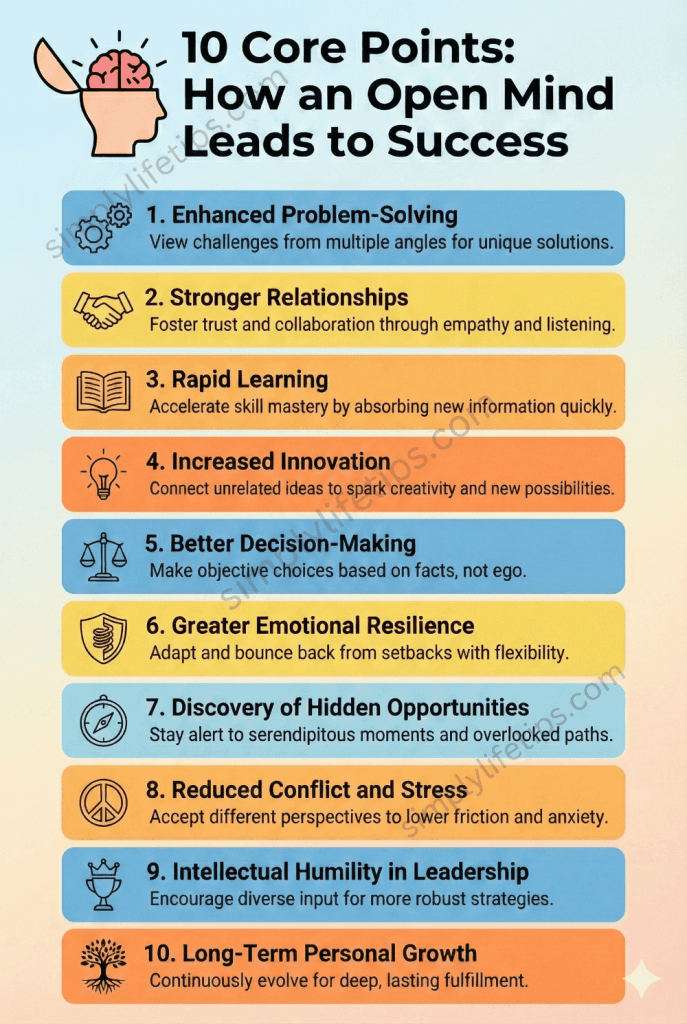
1. Enhanced Problem-Solving Capabilities
When you approach a problem with a fixed idea of the solution, you are likely to miss the most efficient path. An open mind leads to success by allowing you to view problems from multiple angles. Instead of seeing a wall, you see a puzzle. This cognitive flexibility enables you to synthesise different pieces of information to create unique solutions that others might overlook. By being willing to adopt new ways of analysing challenges, you become the person people go to when a situation seems impossible.
2. Stronger Professional and Personal Relationships
Success is rarely a solo journey. It requires the support, trust, and collaboration of others. An open mind helps you listen—truly listen—to the perspectives of your colleagues, partners, and friends. When people feel heard and respected, they are more likely to support your goals. By remaining open to the ideas of others, you foster a culture of mutual respect and innovation. This relational intelligence is a key reason why an open mind leads to success in leadership and team environments.
3. Rapid Learning and Skill Acquisition
A closed mind believes it already knows enough. An open mind, however, is a vessel for continuous learning. To reach your goals, you must be willing to learn from your experiences, both good and bad. When you are open to new ideas, you absorb information faster because you aren’t busy defending your old knowledge. This accelerated learning curve allows you to master new skills and adapt to industry changes at a rate that far outpaces your competitors.
4. Increased Innovation and Creativity
Creativity is the result of connecting seemingly unrelated ideas. If your mind is a closed box, no new ideas are entering to create those connections. An open mind leads to success in creative fields because it allows for the “incubation” of diverse thoughts. By exposing yourself to different cultures, philosophies, and ways of living, you provide your brain with the raw materials needed to innovate. Innovation is the currency of the modern economy, and an open mind is the bank.
5. Better Decision-Making Skills
Good decisions are based on data, not ego. A person with an open mind is willing to look at the facts, even if those facts suggest they were wrong. This intellectual honesty leads to far more accurate decision-making. By analysing every possibility that comes your way without bias, you can weigh the pros and cons objectively. This leads to higher-quality outcomes in both business and personal life, ensuring that your path to success is built on a solid foundation of truth.
6. Greater Emotional Resilience
The road to success is paved with setbacks. Those with a closed mind often view failure as a permanent statement on their worth. In contrast, an open mind views failure as a data point. When you are open-minded, you don’t get stuck in the “why me?” phase of a crisis. Instead, you move quickly to “what now?” This resilience allows you to stay flexible and keep moving toward your goals regardless of the obstacles in your path.
7. Discovery of Hidden Opportunities
Often, the biggest breakthroughs in life come from the most unexpected places. If you are only looking for success in one specific way, you will walk right past a dozen other doors that are wide open. An open mind leads to success by keeping your peripheral vision sharp. You become more aware of serendipitous moments and “hidden gems” in your career that a more rigid person would dismiss as distractions.
8. Reduced Conflict and Stress
Much of the stress in our lives comes from trying to force the world to fit our specific expectations. When you are open-minded, you accept that you cannot control everything and that there are many ways to reach a destination. This reduces the friction in your life. By not being fixed on a particular way of living, you lower your cortisol levels and improve your mental health, which in turn gives you more energy to focus on your actual work and goals.
9. Intellectual Humility and Leadership
True leaders are those who know they don’t have all the answers. Intellectual humility—the recognition that your knowledge is limited—is a superpower. It allows you to hire people who are smarter than you and actually listen to their advice. An open mind leads to success in leadership because it creates a “safe space” for excellence. When a leader is open-minded, the entire organisation becomes more agile and responsive to the market.
10. Long-Term Personal Growth and Fulfilment
Success without growth is empty. An open mind ensures that you are constantly evolving as a human being. It prevents you from becoming a “dinosaur” in your field. By staying flexible and embracing new ideas, you ensure that your life remains an adventure. This constant state of discovery leads to a deep sense of fulfilment that transcends mere financial achievement. It is the ultimate benefit: the realisation that your potential is truly limitless.
How an Open Mind Leads to Success in Leadership?
In leadership, an open mind is the difference between a tyrant and a visionary. Leaders who understand that an open mind leads to success are those who actively seek dissent. They don’t want “yes-men”; they want thinkers who will challenge the status quo. By fostering an environment where ideas are weighed by their merit rather than their source, these leaders unlock the collective intelligence of their teams. This leads to more robust strategies and a culture of psychological safety where innovation thrives. If you are a manager or an aspiring leader, remember that your greatest asset is not your authority, but your ability to listen and integrate diverse viewpoints.
How to Cultivate an Open Mind for Success?
Cultivating an open mind is like training a muscle; it requires consistent effort and a willingness to be uncomfortable. Here are expanded tips to integrate this into your daily life.
1. Practice Active Listening and Reflection
Instead of planning your rebuttal while someone else is speaking, listen to understand their core logic. After they finish, ask yourself, “What if they are right?” This practice alone can transform your negotiation skills and leadership ability. It allows you to find common ground and discover solutions that were previously invisible.
2. Actively Challenge Your Own Biases
We all have “blind spots” created by our upbringing and experiences. To ensure an open mind leads to success, you must actively seek out information that contradicts your current beliefs. If you are convinced a certain marketing strategy won’t work, spend an hour researching why it does work for others. This is called “steel-manning” the opposition, and it is a powerful way to sharpen your own thinking.
3. Embrace New and Unfamiliar Experiences
Comfort is the enemy of growth. To expand your mental horizons, you must step outside your comfort zone. Try a new hobby, travel to a place where you don’t speak the language, or read a technical book outside your primary field. These activities force your brain to build new neural pathways, increasing your overall cognitive flexibility.
4. Learn from Every Experience, Especially Failures
Whether it is a victory or a setback, ask yourself: “What is the lesson here that I didn’t see before?” Success isn’t just about winning; it’s about the data you collect along the way. Every failure is simply a piece of information that helps you refine your next attempt. When you view failure as data, you remove the emotional sting and can move forward with clarity.
5. Stay Flexible in Your Execution
Be willing to change your plans when new data suggests a better path. Many entrepreneurs fail because they are “married” to their original idea. Successful individuals are committed to the goal, but flexible about the method.
As the musician Frank Zappa once said, “A mind is like a parachute. It doesn’t work if it is not open” (Source).
How an Open Mind Leads to Success in Business?
Consider the story of a software company in the early 2020s that insisted on building desktop-only tools. As mobile and AI technology rose, the leadership initially dismissed these as fads. Their revenue plummeted. It wasn’t until a new, open-minded executive took the helm that the company pivoted. By listening to junior developers and analysing market trends they had previously ignored, they rebuilt their platform. Within eighteen months, they reclaimed their market share and hit record profits. This success wasn’t due to a change in engineering talent, but a change in the executive’s willingness to see that their old way of thinking was no longer valid. This case study perfectly illustrates how an open mind leads to success by allowing for necessary, timely adaptation.
Overcoming the Fear of Being Wrong
Why is it so hard to stay open-minded? Often, it is because our identity is tied to our opinions. If someone proves our idea wrong, we feel like we are wrong as a person. To achieve success, you must decouple your identity from your ideas. Treat your ideas like prototypes—test them, break them, and replace them with better versions. When you stop fearing being wrong, you become free to find what is right. This emotional detachment from specific outcomes allows for a much more objective analysis of reality.
As the philosopher Bertrand Russell famously noted, “The whole problem with the world is that fools and fanatics are always so certain of themselves, and wiser people so full of doubts” (Source).
Doubting your own certainty is the first step toward true wisdom and professional excellence.
The Role of Intellectual Humility in Achievement
To be truly open-minded, one must possess intellectual humility—the recognition that the things you believe might actually be wrong. This doesn’t mean you lack conviction; it means you prioritise the truth over being right. High-level CEOs and world leaders often surround themselves with “devil’s advocates” specifically to challenge their thinking. They know that a closed circle leads to “groupthink,” which is the precursor to failure. By inviting dissent, they ensure their plans are robust and battle-tested. Intellectual humility allows you to say “I don’t know,” which is often the most powerful sentence in leadership, as it opens the door to collective problem-solving.
Conclusion
Keep your mind open, learn from every experience, and stay flexible. When you discover more possibilities in life, your chances of success increase exponentially. The only real limit to your potential is the one you set within your own mind. By embracing the philosophy that an open mind leads to success, you position yourself to thrive in an unpredictable world. Start today by questioning one “certainty” you hold about your career—you might just find the door to your next big breakthrough. Success is not just about what you know; it’s about how much you are willing to learn.
We’ve explored the theory—now it’s time for action. Which of the 10 benefits mentioned above do you feel is most critical for your current goals, and how will you practice staying flexible this week?
FAQs About Why an Open Mind Leads to Success
How does an open mind lead to success in professional leadership?
In leadership, an open mind leads to success by creating an environment where innovation can flourish. Leaders who are open to feedback and new ideas are better equipped to navigate market shifts and internal challenges. By valuing diverse perspectives, they avoid the pitfalls of “groupthink” and can make more informed, data-driven decisions that propel their organisations forward. Furthermore, open-minded leaders foster psychological safety, allowing their teams to perform at their highest creative levels.
Does being open-minded mean I have to agree with everyone?
Absolutely not. Being open-minded means you are willing to listen to and honestly evaluate different perspectives, not that you must adopt them as your own. The goal is to ensure you aren’t missing critical information simply because it challenges your current view. An open mind leads to success because it allows you to filter through many ideas and select the most effective ones, regardless of where they originated. It is about intellectual flexibility, not a lack of conviction.
Can open-mindedness actually improve my daily problem-solving skills?
Yes, there is a direct link. An open mind leads to success in problem-solving because it prevents “functional fixedness”—the cognitive bias that limits you to using an object or an idea only in the way it is traditionally used. When you remain flexible, you can see alternative solutions and creative workarounds that a rigid mind would ignore. This ability to “think outside the box” is what allows high achievers to solve complex problems faster and more efficiently.
What is the difference between an open mind and a growth mindset?
While they are closely related, they are distinct cognitive tools. A growth mindset is the belief that your abilities can be developed through dedication and hard work. An open mind is the receptive state that allows you to take in the new information and feedback necessary for that growth to happen. You can think of a growth mindset as the engine and open-mindedness as the fuel. Together, they ensure that an open mind leads to success by providing the raw material for continuous self-improvement.
Is open-mindedness a trait you are born with, or can it be learned?
Open-mindedness is a skill that can be cultivated through practice; it is not a fixed personality trait. While some people may have a natural inclination toward curiosity, anyone can train their brain to be more receptive. By consciously practising active listening, seeking out diverse viewpoints, and practising intellectual humility, you can develop the mental flexibility required for high achievement. Consistent practice ensures that your open mind leads to success over the long term.
For further reading on the science of cognition and professional excellence, explore these resources from Harvard Business Review, Psychology Today, and MindTools.

Mathukutty P V is a Blogger, YouTuber, and Content Writer and the founder of Simply Life Tips. After taking voluntary retirement in 2017, he embraced a free lifestyle focused on learning, personal growth, and sharing practical wisdom to help others live with more purpose and positivity.