

Nervous system regulation for beginners is the most important skill you can learn in 2026 to reclaim your mental clarity and physical health. If you have ever felt “tired but wired,” experienced sudden bursts of irritability, or felt completely shut down after a long day of work, you are likely experiencing a dysregulated nervous system. In this comprehensive guide, we will explore why nervous system regulation for beginners is the “secret key” to managing stress and how you can start resetting your body today with simple, science-backed tools.
What is Nervous System Regulation for Beginners?
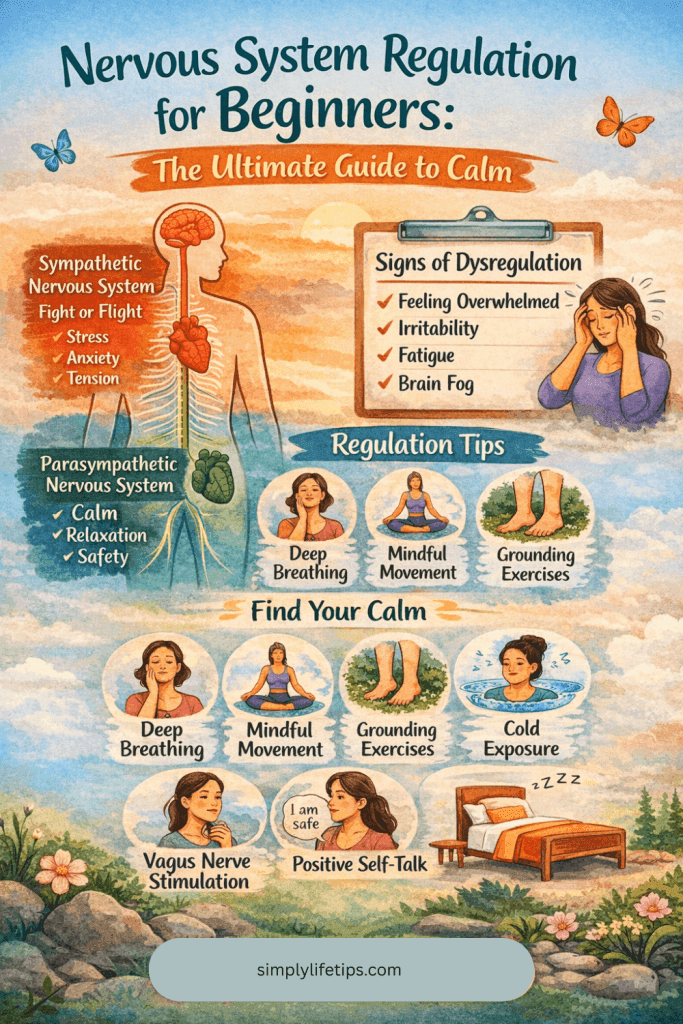
At its core, nervous system regulation is your body’s ability to move fluidly between states of high energy (stress) and states of recovery (rest). Your Autonomic Nervous System (ANS) is like the operating system of your body. It controls your heart rate, digestion, and hormones without you ever having to think about it.
When we talk about nervous system regulation for beginners, we are talking about moving from a “survival state” to a “thriving state.” Most people in our modern, high-tech society are stuck in survival mode. This means their “gas pedal” (the Sympathetic Nervous System) is floored, and their “brakes” (the Parasympathetic Nervous System) aren’t working. Learning to regulate means learning how to hit those brakes manually when life gets too intense.
The Polyvagal Theory | The “Map” of Your Emotions
To master nervous system regulation for beginners, you need to understand the Polyvagal Theory. Developed by Dr. Stephen Porges, this theory explains that our nervous system has three main “zones.” Understanding which zone you are in is the first step toward regulation.
The Green Zone: Ventral Vagal (Safety)
This is the goal of all regulation. In the Green Zone, you feel socially connected, creative, and physically relaxed. Your body is in “rest and digest” mode.
The Red Zone: Sympathetic (Fight or Flight)
When you perceive a threat—like a stressful email or a loud noise—you move into the Red Zone. Your heart rate increases, and you feel anxious or angry.
The Blue Zone: Dorsal Vagal (Shutdown)
If the stress is too much for too long, your body “shuts down” to protect you. This feels like brain fog, numbness, or extreme fatigue.
Five Practical Steps for Nervous System Regulation
You don’t need to be a doctor to practice these techniques. Here are five foundational tools used in nervous system regulation for beginners.
Step 1: Vagus Nerve Stimulation
The Vagus Nerve is the longest in your body and is the “on-off switch” for relaxation. You can stimulate it physically by:
- Humming or Chanting: The vibration in your throat stimulates the nerve.
- Gargling Water: Doing this vigorously for 30 seconds activates the muscles connected to the vagal pathway.
Step 2: Somatic Shaking
This is a core practice in nervous system regulation for beginners. Animals in the wild “shake” after a stressful event to release adrenaline.
- How to do it: Stand up and shake your arms, legs, and torso for two minutes. It tells your brain that the “threat” is over and the energy can be released.
Step 3: The 4-7-8 Breathing Technique
Your breath is your direct “remote control” for your heart rate.
- Inhale for 4 seconds, hold for 7, and exhale through your mouth for 8 seconds.
- The long exhale is vital because it triggers the Parasympathetic Nervous System, forcing your body to calm down.
Step 4: Cold Water Immersion
If you are in a “spiral,” you need a circuit breaker. Splash ice-cold water on your face. This triggers the Mammalian Dive Reflex, which immediately slows your heart rate and brings you back to the present moment.
Step 5: Panoramic Vision
Stress causes “tunnel vision.” To reverse this, look at the horizon or soften your gaze to see your peripheral vision. This “wide-angle” view tells the brain there are no immediate threats in the environment.
Why 2026 Requires Better Digital Hygiene?
In 2026, our nervous systems are under attack by “digital overload.” Constant notifications and short-form video content keep us in a state of high-alert. To maintain nervous system regulation for beginners, you must implement “Digital Hygiene”:
- Phone-Free Mornings: Give your nervous system 60 minutes to wake up before checking emails.
- Analogue Evenings: Turn off screens an hour before bed to allow your body to produce melatonin naturally.
Nutrition and Body Chemistry
What we put in our bodies affects our ability to stay regulated.
- Magnesium: Known as “nature’s chill pill,” it supports nerve function.
- Omega-3s: Essential for brain health and reducing inflammation that leads to “jittery” nerves. Read more on Harvard Health.
📅 The 7-Day Nervous System Reset Schedule
Goal: To move from “Survival Mode” to “Thriving Mode” using 5 minutes of practice each day.
| Day | Focus Area | Action Step (5 Minutes) | Why It Works |
| Day 1 | The Breath | Practice 4-7-8 Breathing for 3 minutes before breakfast. | Signals the “Safe” state to your brain immediately. |
| Day 2 | Vagal Tone | Gargle water vigorously for 30 seconds, then hum your favourite song. | Physically stimulates the Vagus nerve in the throat. |
| Day 3 | Somatic Release | Somatic Shaking: Stand and shake your limbs for 2 minutes straight. | Discharges stored “survival energy” from your muscles. |
| Day 4 | Visual Reset | Spend 5 minutes practising Panoramic Vision (looking at the horizon). | Switches the brain from “Threat Focus” to “Safety Focus.” |
| Day 5 | The Circuit Breaker | Splash ice-cold water on your face 3 times in the morning. | Triggers the Mammalian Dive Reflex to drop your heart rate. |
| Day 6 | Grounding | Wall Pushes: Push against a wall for 10 seconds, repeat 5 times. | Provides proprioceptive input to feel “grounded” in your body. |
| Day 7 | Integration | Choose your favourite two tools from the week and combine them. | Builds a personalised “Emergency Kit” for future stress. |
Conclusion
As you begin this journey into nervous system regulation for beginners, remember that you are not trying to be perfect. You are trying to be flexible. Life will always be stressful, but with these tools, you can ensure that stress doesn’t stay trapped in your body. By regulating your energy, you become a more confident communicator and a more resilient human being. (For more on how calm presence helps you, see my post on making people listen to you.
7. FAQ: Nervous System Regulation for Beginners
Q1: How long does it take to regulate the nervous system?
A: While techniques like cold water or breathing can work in seconds, “re-training” a chronically stressed system usually takes 4 to 6 weeks of consistent daily practice.
Q2: Can I do these exercises while at work?
A: Absolutely. Techniques like “Panoramic Vision” or “4-7-8 Breathing” are invisible and can be done during meetings to keep you calm and focused.
Q3: Is nervous system regulation the same as meditation?
A: Not exactly. Meditation often focuses on the mind, while nervous system regulation for beginners focuses on the body (somatic) to signal safety to the brain.
Q4: How do I know if my nervous system is dysregulated?
A: Common signs include chronic digestive issues, sleeping but never feeling rested, constant “racing thoughts,” and feeling easily overwhelmed by small tasks.
Q5: Are there any side effects to somatic shaking?
A: For most, it is very safe. However, if you have a history of severe trauma, it is best to start slowly (30 seconds) and observe how your body feels before increasing the time.
Thank you for taking the time to explore this post. I sincerely hope you found the insights valuable and actionable. If this content resonated with you, please consider sharing it. Your support enables me to share knowledge and inspiration with others in our community.
PVMG

Mathukutty P V is a Blogger, YouTuber, and Content Writer and the founder of Simply Life Tips. After taking voluntary retirement in 2017, he embraced a free lifestyle focused on learning, personal growth, and sharing practical wisdom to help others live with more purpose and positivity.



