

Conscious parenting teaches that children don’t need flawless parents. They need connected ones. Mindful parenting begins with the understanding that repair is more powerful than perfection. Research indicates that the cycle of rupture and repair in parent–child relationships builds secure attachment. It also fosters strong emotional regulation and long-term psychological well-being. Mistakes don’t damage a child’s future; the absence of reconnection does.
What is Conscious Parenting?
Conscious parenting is a concept widely discussed by psychologists and child-development experts to describe an approach that emphasises the parent’s self-awareness and mindful decision-making rather than focusing only on correcting the child’s behaviour. It encourages parents to become emotionally present, reflective, and intentional in how they respond to their children.
This approach is influenced by a blend of Eastern philosophical principles, such as mindfulness and self-reflection, along with Western psychological understanding of child development and emotional growth. By combining awareness with scientific insight, conscious parenting promotes thoughtful, emotionally balanced parenting choices instead of reactive responses.
In its simplest form, conscious parenting teaches that instead of trying to constantly “fix” or control the child, parents should first look inward, understand their own emotions, triggers, and patterns, and respond with awareness. It recognises children as individual, evolving human beings with their own thoughts, emotions, and learning journeys. Through this perspective, children are not only guided by parents but also help parents grow in self-awareness, patience, and emotional maturity.
Benefits of Conscious Parenting
Conscious parenting, where parents intentionally reduce distractions and increase meaningful interaction, creates powerful and lasting positive effects on a child’s overall development. When parents become emotionally present, communicate actively, and model balanced digital habits, children receive the stimulation and security necessary for healthy growth. These benefits extend far beyond early childhood and influence personality, learning ability, emotional strength, and social success throughout life.
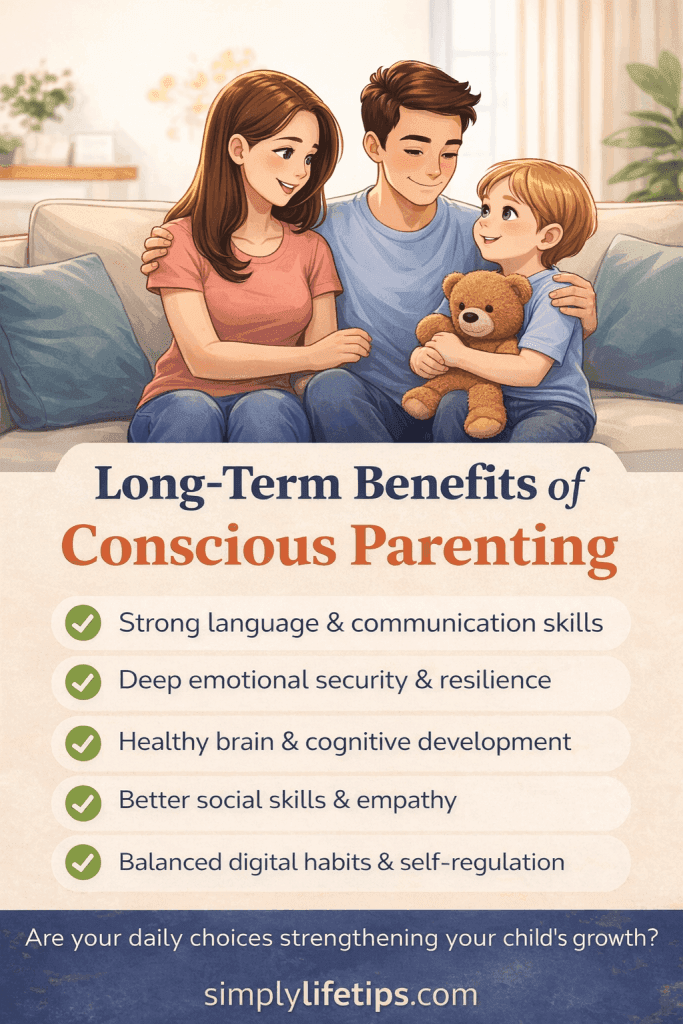
1. Strong Language and Communication Skills
One of the most significant long-term benefits is strong language and communication skills. Children who grow up in environments rich with conversation, storytelling, and responsive listening develop larger vocabularies, clearer pronunciation, and better sentence formation. These communication skills improve academic performance, social confidence, and the ability to express thoughts effectively. For example, a child who regularly engages in meaningful conversations with parents often becomes more articulate and confident in school and social settings.
Benefits of Healthy Communication in Parenting for Strong Family Bonds
2. Deep Emotional Security and Resilience
Another major benefit is deep emotional security and resilience. When parents consistently respond with attention, eye contact, and warmth, children develop a strong sense of safety and belonging. This emotional foundation helps them manage stress, cope with challenges, and build healthy relationships later in life. Children raised with attentive parenting are less likely to experience chronic anxiety, emotional withdrawal, or attention-seeking behaviour because they feel valued and understood.
3. Healthy Brain and Cognitive Development
Conscious parenting also supports healthy brain and cognitive development. Active interaction, play, and communication stimulate neural connections responsible for memory, attention, reasoning, and problem-solving. Over time, this leads to improved learning ability, stronger concentration, and better decision-making skills. For instance, children who grow up in interactive environments often show higher curiosity, creativity, and adaptability compared to those exposed mainly to passive screen stimulation.
4. Better Social Skills and Empathy
Another important long-term outcome is better social skills and empathy. When children experience consistent human connection, they learn to understand emotions, read social cues, and communicate respectfully. This helps them form meaningful friendships, cooperate with others, and develop compassion. Emotional awareness built during early childhood plays a crucial role in building healthy relationships throughout life.
5. Balanced Digital Habits and Self-regulation
Conscious parenting also encourages balanced digital habits and self-regulation. When parents model mindful phone use and prioritise real-world interaction, children naturally learn moderation and self-control. This reduces the risk of technology addiction, improves focus, and promotes healthier lifestyle choices. Over time, children develop the ability to manage distractions, stay present, and engage more deeply in real-life experiences.
In the long run, conscious parenting does not require perfection but consistent presence. Small daily actions such as listening attentively, maintaining eye contact, engaging in conversation, and limiting distractions gradually build a strong foundation for healthy speech, emotional stability, cognitive growth, and confident personality development.
Understanding Rupture and Repair in Conscious Parenting
In the daily rhythm of family life, moments of disconnection are normal. A raised voice during homework struggles or a frustrated reaction during the morning rush can create emotional ruptures. Conscious parenting reminds us that children do not expect perfection; their nervous system expects a return to connection.
Attachment science (Tronick, 1978; Beebe & Lachmann, 2014) explains that even highly attuned mothers succeed only 30% of the time. This data comes from Tronick’s (2007) research. The strength of the relationship comes not from flawless responses. It develops from the caregiver’s ability to come back after the rupture.
For example, when you snap during a stressful moment, but later you return with softness. You say, “I’m sorry, that was not fair to you.” In doing so, you teach your child that love remains steady.
Why Repair Matters More Than Perfection?

Perfection teaches a child to hide emotions and fear mistakes, while repair shows them that relationships can bend without breaking. Conscious parenting emphasises this truth. Repair gives children powerful emotional messages: “I am safe,” “I am loved,” and “Hard moments don’t end connection.”
A simple example is returning to your child after an argument. You say, “Let’s try again. I’m here with you.” This small act becomes a foundational lesson in emotional safety and internal balance.
The Science Behind Connection and Emotional Safety
Neuroscience supports the core principle of conscious parenting: repair rewires the brain for resilience. When caregivers reconnect after conflict, the child’s social engagement system activates (Porges, 2011). This reduces stress hormones and helps them regain emotional clarity. Over time, this strengthens the prefrontal cortex—the brain region responsible for empathy, problem-solving, emotional flexibility, and self-control (Siegel, 2012). For instance, when you soften your voice, you sit at their level. Then, you guide them through overwhelming feelings. In doing so, you are supporting healthy brain development. Interpersonal neurobiology research (Siegel & Bryson, 2014) confirms that these small interactions literally shape a child’s lifelong emotional patterns.
Emotional Awareness in Parenting: Transform Unconscious Reactions into Conscious Connection
Practical Ways to Practice Conscious Repair
Repair is not complicated; it is intentional. Conscious parenting expresses repair through simple, everyday actions. It involves returning after a harsh reaction. Lower your body to their level. Acknowledge your mistake. Offer a calm presence when their emotions overflow. Invite them back into connection.
For example, after a tense disagreement, saying “I got overwhelmed and raised my voice. You didn’t deserve that,” helps your child feel seen and understood. These repairs teach children that relationships are safe spaces where feelings can be managed with love.
How Repair Shapes a Child’s Emotional Future?
Children who experience consistent repair grow up with stronger emotional intelligence, healthier relationships, and deeper self-worth. They become more resilient because they learned early that mistakes are part of growth, not signs of rejection. Such children navigate challenges with confidence, knowing the connection remains intact. On the other hand, children who never see repair believe they must be perfect to be loved. They also think that conflict equals disconnection. Conscious parenting breaks this pattern by teaching children that love is flexible, forgiving, and reliable.
Parenting With Empathy And Emotional Intelligence
Conclusion
Every parent loses patience at times. Conscious parenting shows that these moments are not failures. They are opportunities for deeper connection. When you return, apologise and soften. Reconnect, and you offer your child the most powerful gift: the understanding that relationships heal. Repair shapes secure, confident, emotionally resilient children. Perfection doesn’t create strong kids; repair does.
Imagine if every child grew up knowing that love doesn’t need perfection. It only requires the willingness to repair.
Wouldn’t conscious parenting become even more powerful?
FAQs about Conscious Parenting
1. What does conscious parenting mean?
Conscious parenting is a mindful and intentional approach. Parents focus on emotional awareness, empathy, and connection. Control or punishment is not the focus. It helps parents recognise their own emotional triggers. They stay in the moment, even in tense situations. They choose calm, intentional responses rather than automatic reactions. For example, instead of yelling when a child makes a mistake, a conscious parent pauses. They regulate their own emotions. Then, they guide the child to understanding. This approach helps children feel safe, respected, and emotionally supported.
2. Why is repair more effective than being a perfect parent?
Repair is more impactful because perfection is impossible, and children learn emotional resilience through real-life experiences. When parents repair after conflict—by returning, apologising, and reconnecting—they show children that relationships can handle mistakes. This builds trust and teaches kids that love is steady, even when emotions run high. A perfect parent creates pressure, while a repairing parent models emotional maturity. For instance, if you say, “I shouldn’t have spoken that way.” Follow it with “I’m sorry.” This approach shows children how to handle their own future conflicts with grace.
3. How can I repair my child after losing patience?
Repair involves simple, heartfelt steps. First, calm yourself so your nervous system is regulated. Then go to your child, lower yourself to their eye level, and acknowledge what happened. Use gentle language like, “I was frustrated and raised my voice. You didn’t deserve that.” Let them express how they feel. Hold space for their emotions. Reconnect with a hug or soft touch if they’re open to it. Repair doesn’t erase the moment, but it teaches your child that love continues even after conflict.
4. Does repairing make children less disciplined?
No. In fact, children who experience repair become more cooperative, emotionally aware, and open to guidance. Repair creates emotional safety, and when children feel safe, they are more willing to listen and learn. Discipline becomes easier because the parent–child relationship is rooted in trust, not fear. For example, a child who knows they won’t be shamed or rejected for making mistakes will take responsibility more honestly. They will try harder to improve. Repair strengthens discipline by strengthening the connection.
5. Is repair effective for teenagers, too?
Absolutely. Teenagers value honesty, respect, and authenticity more than perfection. When parents acknowledge mistakes and repair with teens, it builds mutual respect and keeps communication open. For example, saying “I overreacted earlier, and I want to understand your side better” invites meaningful conversation. Teens who experience repair learn emotional responsibility and develop healthier communication skills for adult life. Repair with teens not only heals the moment but also reinforces trust during a sensitive developmental stage.
References
Tronick, E. (1978). Still-Face Paradigm.
Tronick, E. (2007). Mutual Regulation Model.
Beebe, B., & Lachmann, F. (2014). Infant Research and Adult Treatment.
Porges, S. (2011). The Polyvagal Theory.
Siegel, D. J. (2012). The Developing Mind.
Siegel, D. J., & Bryson, T. P. (2014). No-Drama Discipline.
Thank you for taking the time to explore this post. I sincerely hope you found the insights valuable and actionable. If this content resonated with you, please consider sharing it. Your support helps me spread knowledge and inspiration to others in our community.
PVM

Mathukutty P V is a Blogger, YouTuber, and Content Writer and the founder of Simply Life Tips. After taking voluntary retirement in 2017, he embraced a free lifestyle focused on learning, personal growth, and sharing practical wisdom to help others live with more purpose and positivity.



