

Teaching emotional intelligence to children is one of the most valuable life lessons parents, teachers, and caregivers can offer. In a world that often measures success by grades or achievements, emotional intelligence—or EQ—stands out. It is the true foundation of lifelong happiness. It is crucial for strong relationships and resilience. While academic intelligence opens doors, emotional intelligence determines how far a child can go through life’s challenges. This blog delves into the meaning of emotional intelligence. It explains why it’s important and details its benefits. You will find practical strategies for teaching it effectively, with examples that every parent and educator can relate to.
What Is Emotional Intelligence?
Emotional intelligence refers to the ability to recognise, understand, manage, and express emotions—both one’s own and others’. The concept, popularised by psychologist Daniel Goleman, includes five key components:
- Self-awareness – recognising one’s emotions and their impact.
- Self-regulation – managing emotions in healthy ways.
- Motivation – using emotions to drive goal-oriented behaviour.
- Empathy – understanding and sharing others’ feelings.
- Social skills – building healthy relationships and communicating effectively.
For children, emotional intelligence means understanding why they feel sad, excited, angry, or scared. It also involves learning how to express those emotions constructively. A child with strong emotional intelligence doesn’t just react to feelings; they understand, name, and manage them thoughtfully.
Why Emotional Intelligence Matters More Than Ever?
In today’s fast-paced digital world, children face constant social and emotional challenges—peer pressure, online comparisons, academic stress, and family dynamics. Developing emotional intelligence gives them the tools to handle these pressures with balance and confidence.
According to a study by the American Psychological Association, children develop strong emotional skills early in life. They achieve better academically. They excel in academics. They enjoy healthier relationships. Additionally, they have better mental health as adults. In essence, EQ is not just a soft skill—it’s a survival skill for modern life.
When a child understands their emotions, they are less likely to lash out, isolate themselves, or feel overwhelmed. Instead, they develop resilience—the ability to recover from setbacks and adapt to changes positively.
The Importance of Teaching Emotional Intelligence Early
Emotional intelligence isn’t something that develops automatically with age—it must be taught, modelled, and reinforced through everyday interactions. Early childhood is a crucial stage because the brain is still developing emotional pathways.
Teaching emotional intelligence early helps children:
- Build empathy and kindness toward others.
- Communicate effectively, even when upset.
- Develop self-control, preventing impulsive behaviour.
- Cope with stress and disappointment constructively.
- Strengthen friendships and family relationships.
Children who understand emotions are better equipped to manage conflict, express their needs, and cooperate with peers. This emotional awareness forms the foundation for success in school, work, and personal life.
Benefits of Teaching Emotional Intelligence to Children
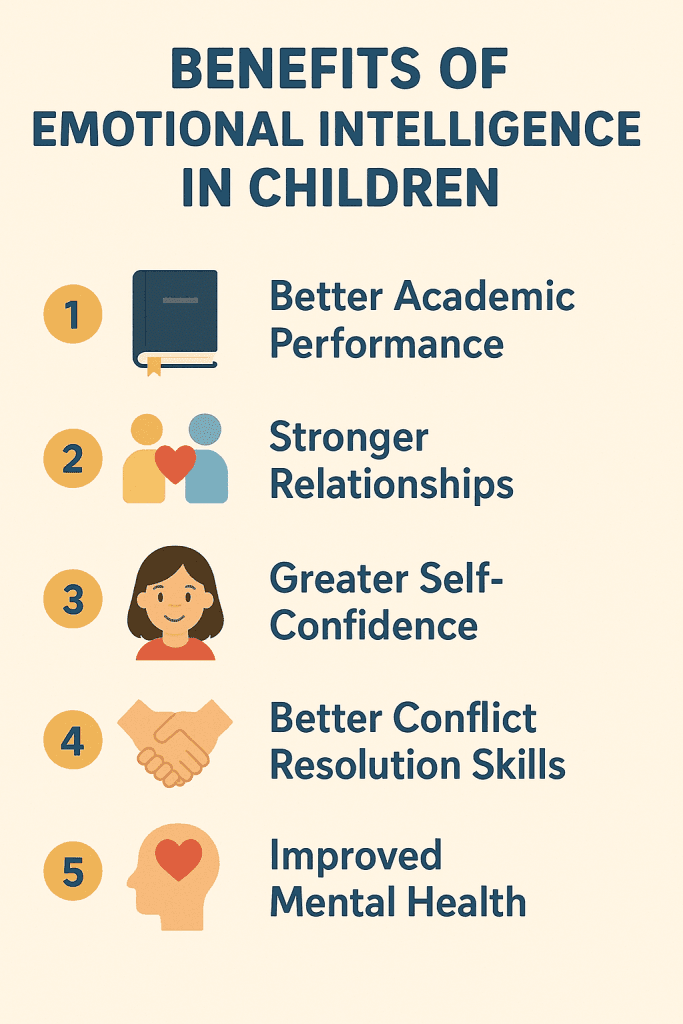
1. Better Academic Performance: Emotionally intelligent children have an advantage in school. They can focus and handle frustration well. These children also build positive relationships with teachers and classmates. When a child encounters difficulty solving a math problem, they pause. They take a deep breath. Then, they approach the challenge calmly. Instead of crying or giving up, they ask for help or try a new approach.
2. Stronger Relationships: Children with high EQ are more empathetic and understanding, making them better friends, siblings, and classmates. They quickly notice when someone feels left out or hurt and respond with kindness. Such children grow into adults who form healthy, long-lasting relationships.
3. Greater Self-Confidence: Understanding emotions builds inner strength. A child who can recognise and manage their feelings doesn’t feel helpless when challenges arise. They trust themselves to handle tough situations. This confidence extends to trying new things, speaking up in class, or pursuing personal goals. Boost Self-Confidence In Children: Easy Tips For Parents
4. Better Conflict Resolution Skills: Children with emotional intelligence know how to manage disagreements without anger or aggression. For example, if two kids want the same toy, an emotionally intelligent child will suggest taking turns. They also find another toy to play with. These problem-solving skills are invaluable throughout life.
5. Improved Mental Health: Emotional intelligence acts as a shield against anxiety, depression, and other emotional struggles. By learning to express emotions rather than suppressing them, children experience fewer emotional outbursts and greater emotional balance.
“When parents offer their children empathy and help them to cope with negative feelings like anger, sadness, and fear, parents build bridges of loyalty and affection.”
― John M. Gottman, Raising An Emotionally Intelligent Child
Read Parenting With Empathy And Emotional Intelligence
How to Teach Emotional Intelligence to Children?
Teaching emotional intelligence doesn’t need special lessons or classrooms—it happens through daily conversations, actions, and mindful parenting. Here are effective strategies with examples:
1. Help Children Recognise Their Emotions
The first step in developing EQ is self-awareness. Encourage children to recognise and name their emotions. You can use simple language and visual tools. Try using emotion charts with faces showing happy, sad, angry, scared, or excited expressions.
Example:
If your child is upset, you say, “It looks like you’re feeling angry because your toy broke. Is that right?” This helps them label their emotions accurately and feel understood.
2. Model Emotional Intelligence
Children learn best by observing their parents and teachers. When you handle stress calmly, express gratitude, or apologise when wrong, you show emotional maturity.
Example:
If you spill something at dinner, instead of yelling, say, “Oops! I made a mess. I’ll clean it up.” Your calm reaction teaches your child that mistakes are part of life and can be fixed without anger.
3. Encourage Empathy
Empathy is the heart of emotional intelligence. Help children understand how others feel and why.
Example:
If your child teases a friend, guide them gently: “How do you think Riya felt when you said that?” Encourage them to see things from another’s perspective. Reading storybooks in which characters face emotional situations can also naturally build empathy.
4. Teach Emotional Regulation
Children often experience intense emotions but lack the tools to manage them. Teach calming techniques such as deep breathing, counting to 10, or taking a short break.
Example:
If your child gets angry during a game, you can say, “Let’s pause for a moment.” You also suggest, “Take a few deep breaths together.” Over time, this becomes their automatic coping response.
5. Encourage Open Communication
Create a safe environment where children feel comfortable expressing their thoughts without fear of punishment or judgment.
Example:
During bedtime conversations, ask, “What made you happy today?” or “Was there something that made you sad?” These gentle prompts invite emotional sharing and trust.
6. Use Stories and Role Play
Stories, cartoons, and role-play activities are powerful tools for teaching emotions. Discuss the characters’ feelings and ask your child how they would react in similar situations.
Example:
After watching a movie, ask, “Why do you think the hero felt scared?” or “What would you do if you were in that situation?” This strengthens emotional reasoning and empathy.
7. Praise Effort and Emotional Growth
Instead of only praising achievements, recognise when your child handles emotions well.
Example:
“You stayed calm even when your block tower fell—that was really mature!” Positive reinforcement helps children associate emotional control with success.
8. Set Clear Emotional Boundaries
Children should learn that all emotions are acceptable, but not all behaviours are. Help them differentiate between feeling and action.
Example:
“It’s okay to feel angry, but it’s not okay to hit. Let’s talk about what made you upset instead.” This teaches responsibility for emotional expression.
9. Encourage Problem-Solving
When conflicts arise, guide children to find their own solutions rather than solving everything for them.
Example:
If siblings fight over toys, ask, “What do you think we can do so both of you are happy?” This empowers them to think critically and manage emotions constructively.
10. Practice Gratitude and Positivity
Gratitude helps children appreciate what they have and reduces negative emotions. Make gratitude a daily family ritual—by sharing one good thing that happened each day.
Example:
At dinner, each family member can say something they are thankful for. For instance, they say, “I’m grateful for playing football today.” Alternatively, they will say, “I’m happy we baked cookies together.”
Common Challenges and How to Overcome Them
1. Children Who Hide Emotions
Some kids are naturally reserved. Create a patient and safe environment. Avoid forcing them to share; instead, model openness, and they’ll gradually follow.
2. Emotional Outbursts
Stay calm and consistent. Remember, children learn emotional regulation by watching you. Offer empathy first, then guidance.
3. Peer Influence
Help children recognise that emotions are personal, and it’s okay to feel differently from others. Encourage self-acceptance.
Role of Schools and Teachers
Educators play a major role in shaping emotionally intelligent children. Schools that include social-emotional learning (SEL) programs report higher academic engagement, lower bullying, and better classroom behavior. Teachers can integrate EQ lessons through:
- Group activities promote teamwork and empathy.
- Reflection journals to express feelings.
- Conflict-resolution exercises encourage understanding over blame.
- Positive classroom language, focusing on encouragement rather than criticism.
For example, a teacher can start the day with a “feelings circle” where students share how they feel. This simple practice builds connection and mutual respect.
Long-Term Impact of Emotional Intelligence
Emotional intelligence (EQ) plays a powerful role in shaping a child’s future. While many parents focus on academic achievement, the ability to understand and manage emotions often has a deeper and more lasting influence on success and happiness in life. Children who learn emotional intelligence at an early age develop skills that guide their decisions, relationships, and responses to challenges as they grow older.
Unlike many academic skills that may fade with time, emotional intelligence becomes a lifelong strength. It helps individuals navigate personal relationships, professional environments, and life’s inevitable difficulties with maturity and balance. The benefits of emotional intelligence extend far beyond childhood and influence how a person thinks, behaves, and interacts with the world throughout adulthood.
Better Leaders and Communicators
Emotionally intelligent children often grow into adults who are effective leaders and communicators. They understand how emotions influence behavior, both in themselves and in others. This awareness allows them to communicate clearly, resolve conflicts peacefully, and motivate people in positive ways.
For example, a leader with high emotional intelligence is more likely to listen carefully to team members, understand their concerns, and respond with empathy rather than frustration. Such individuals build trust and cooperation within groups. They can guide discussions calmly, manage disagreements respectfully, and encourage collaboration.
Good communication skills are also essential in everyday life. Emotionally intelligent individuals express their thoughts confidently while also respecting other perspectives. This balance helps them build stronger relationships at home, in workplaces, and within communities.
More Adaptable to Change
Life is constantly changing, and the ability to adapt is an important skill for long-term success. Children who develop emotional intelligence learn how to handle uncertainty and change without becoming overwhelmed.
Emotionally intelligent individuals are better able to adjust their mindset when circumstances shift. Instead of reacting with fear or resistance, they take time to understand the situation and respond thoughtfully. This flexibility helps them navigate challenges such as career changes, unexpected setbacks, or personal transitions.
For instance, someone with strong emotional awareness may recognize frustration in a difficult situation but choose to remain calm and seek solutions. This ability to regulate emotions helps them remain productive even during stressful periods.
More Compassionate in Personal and Professional Relationships
Another lasting impact of emotional intelligence is the development of empathy and compassion. Children who are taught to recognize and respect emotions often grow into adults who value kindness and understanding in their relationships.
Empathy allows individuals to see situations from another person’s perspective. This skill is especially important in maintaining healthy relationships with family members, friends, and colleagues. When people feel understood and respected, communication becomes more open and meaningful.
In professional settings, compassionate individuals often contribute to supportive and cooperative work environments. They are more likely to encourage teamwork, resolve conflicts constructively, and create positive interactions with others.
Mentally Stronger and More Content in Life
Emotional intelligence also contributes significantly to mental strength and overall well-being. Life inevitably includes disappointment, stress, and challenges. Individuals with strong emotional intelligence are better equipped to manage these experiences without becoming overwhelmed.
Emotionally intelligent adults understand how to process difficult emotions rather than suppress them. They develop healthier coping strategies such as reflection, open conversation, and problem-solving. This emotional awareness helps prevent negative feelings from controlling their behavior.
As a result, they often experience greater life satisfaction. By maintaining emotional balance and focusing on positive solutions, they cultivate resilience and inner peace even during difficult times.
Emotional Intelligence Shapes Life Decisions
Emotional intelligence influences how people respond to both success and failure. Individuals with strong EQ tend to remain humble in their achievements and hopeful in their setbacks. Instead of allowing emotions to control their reactions, they learn to evaluate situations thoughtfully.
For example, when faced with failure, emotionally intelligent individuals are more likely to view the experience as an opportunity to learn and grow. Rather than feeling defeated, they analyze what went wrong and work toward improvement.
Similarly, when they achieve success, they remain grounded and appreciative of others’ contributions. This balanced perspective allows them to maintain healthy relationships and personal integrity.
The Invisible Strength Behind Character
Emotional intelligence may not always be visible in the way academic grades or professional achievements are, but it is one of the most powerful forces shaping a person’s character. It influences how individuals treat others, respond to challenges, and manage their own emotions.
Children who develop emotional intelligence grow into adults who are confident, compassionate, and resilient. They can navigate life’s complexities with maturity and empathy, building meaningful relationships and contributing positively to society.
In many ways, emotional intelligence becomes the invisible strength behind every confident, kind, and resilient individual. By nurturing this ability during childhood, parents and educators help create adults who are not only successful but also emotionally balanced and socially responsible.
Conclusion
Teaching emotional intelligence to children is not a one-time lesson. It is an ongoing process that grows through daily experiences. This growth is supported through meaningful conversations and the consistent example set by parents and teachers. It’s a lifelong journey. This journey is built through daily moments of understanding, patience, and love. Every time you listen without judgment, you nurture emotional strength. When you comfort without scolding, you nurture emotional strength. If you guide without anger, you nurture emotional strength that will serve your child for a lifetime.
When children grow up understanding their feelings and respecting others’, they create a more compassionate world. It all starts with one smile. It continues with one kind word. It includes one mindful act at a time.
To explore more parenting insights and proven strategies for emotional growth, continue reading our related blog posts.
Are we doing enough to teach children emotional intelligence? They need these skills to grow into empathetic, confident, and emotionally balanced adults.
FAQs about Teaching Emotional Intelligence to Children
1. What is emotional intelligence in children?
Emotional intelligence (EI) in children involves their ability to recognise and understand their emotions. They also learn to manage these emotions. Additionally, they empathise with others. It helps them build better relationships, handle stress, and make thoughtful decisions.
2. Why is it important to teach emotional intelligence early?
Teaching children emotional intelligence helps them develop empathy, patience, and self-control. These skills are essential for academic success, conflict resolution, and positive social interactions throughout life.
3. How can parents encourage emotional intelligence at home?
Parents can model emotional awareness by talking about their feelings. They can confirm their child’s emotions. Additionally, they can guide them through problem-solving rather than resorting to punishment. Simple practices like asking “How did that make you feel?” can nurture emotional growth.
4. Can schools play a role in developing emotional intelligence?
Absolutely. Schools can integrate social-emotional learning (SEL) programs, promote teamwork, and create an environment that encourages emotional expression. Teachers can use storytelling, role-play, and group discussions to enhance EI skills.
5. What are the signs that a child has strong emotional intelligence?
A child with strong EI tends to show empathy, communicate openly, handle disappointment calmly, and resolve conflicts peacefully. They are also better at making friends and adjusting to new situations.
PVM

Mathukutty P V is a Blogger, YouTuber, and Content Writer and the founder of Simply Life Tips. After taking voluntary retirement in 2017, he embraced a free lifestyle focused on learning, personal growth, and sharing practical wisdom to help others live with more purpose and positivity.



