
The power of vulnerability becomes easier to understand when we stop seeing vulnerability as weakness and start seeing it as part of genuine human connection. In her widely viewed 2010 TEDxHouston talk, Brené Brown takes listeners through years of research into connection, shame, worthiness, and vulnerability, and explains how those discoveries changed the way she understood her own life. Her central message is not simply that vulnerability can be uncomfortable. It is that meaningful connection, love, belonging, creativity, and joy require us to accept a certain amount of emotional risk.
Brown describes herself as a researcher and storyteller, and her research began with a question that seemed straightforward: why do people connect with one another? Her work eventually took her somewhere she did not expect. Instead of finding a simple explanation for connection, she encountered shame, the fear of disconnection, and the uncomfortable role vulnerability plays in our relationships with other people and with ourselves.
Her talk is therefore more than a discussion about being emotionally open. It is a story about what happens when research challenges the assumptions we use to protect ourselves.
The Power Of Vulnerability | Brené Brown | TED
Why Connection Matters
Brown’s starting point was connection. With a background in social work, she was interested in the relationships that give people’s lives meaning and help them feel that they belong.
Connection is easy to take for granted when life is going well. We may think of it as friendship, family, love, community, or belonging. But when Brown began asking people about these experiences in her research, she discovered something revealing. Questions about love could lead to stories of heartbreak. Questions about belonging could lead to stories of exclusion. And questions about connection could lead to stories about disconnection.
This changed the direction of her research. Instead of simply asking what creates connection, she began exploring what makes people afraid that connection might be lost.
That question led her toward shame.
The Discovery of Shame
One of the major turning points in Brown’s research was her understanding of shame as a fear of disconnection. At the center of that fear is a deeply uncomfortable question: if other people really knew me, would they still accept me?
That question can influence everyday behavior in ways we do not always notice. A person may hide a mistake because they fear being judged. Someone may avoid admitting that they need help because they believe needing help makes them less worthy. Another person may conceal their feelings because they worry that honesty will lead to rejection.
Shame can therefore make people protect themselves from being truly seen.
Brown’s research led her to understand that shame and vulnerability are closely connected to the human need for belonging. Her later explanation of her research also describes connection as a central human concern and identifies the fear of being unworthy of connection as a major part of shame.
Vulnerability Sits at the Heart of Connection
If connection requires people to know and understand one another, then some degree of vulnerability becomes unavoidable.
Think about what happens when you tell someone, “I need help,” “I was wrong,” “I’m afraid,” or “I love you.” You are revealing something about yourself without knowing exactly how the other person will respond.
That uncertainty is part of vulnerability.
It is tempting to believe that we can build meaningful relationships while remaining completely protected. We may want closeness without emotional risk, acceptance without revealing our imperfections, and love without the possibility of disappointment. But Brown’s research challenges that idea.
To connect deeply, we have to allow ourselves to be seen.
That does not mean telling everyone everything about ourselves. It means recognizing that genuine connection requires some willingness to move beyond the protective image we present to the world.
Vulnerability can also strengthen relationships when it is supported by trust, respect, and building trust with emotional intelligence
The Question of Worthiness
As Brown continued her research, she noticed a significant difference between people who seemed to experience a strong sense of love and belonging and those who struggled with it.
The people who appeared to live with a strong sense of connection shared a fundamental belief: they believed they were worthy of love and belonging.
This idea is deceptively simple. A person can understand intellectually that everyone deserves love and belonging while still privately believing that they have to earn those things.
That difference matters.
If you believe you must become perfect before you are worthy of connection, vulnerability can feel dangerous. Every mistake becomes evidence against your worth. Every rejection can feel like confirmation that something is wrong with you. Every imperfect part of yourself becomes something to hide.
A stronger sense of worthiness changes that relationship with imperfection. You can acknowledge that you have flaws without concluding that you are unworthy of love and belonging.
Courage, Compassion, and Connection
Brown identifies three qualities she observed among people who appeared to live with a strong sense of worthiness: courage, compassion, and connection.
Courage, in this context, involves the willingness to accept imperfection rather than waiting until you become flawless. A courageous person can acknowledge uncertainty, take emotional risks, and allow themselves to be seen without having complete control over the outcome.
Compassion involves treating yourself with kindness. People who can extend understanding to themselves are less likely to interpret every mistake as proof that they are fundamentally inadequate.
Connection involves letting go of the pressure to become the person you think you are supposed to be. Instead of constantly performing for approval, you become more willing to show up as yourself.
These qualities reinforce one another. Courage makes vulnerability possible. Compassion makes imperfection easier to accept. And authentic connection becomes possible when people no longer have to hide every part of themselves.
The Power of Being Imperfect
Perfectionism can appear productive because it encourages high standards, careful work, and achievement. But when perfection becomes a requirement for feeling worthy, it can also become a form of protection.
If you believe you must always get everything right, you may avoid situations where mistakes are possible. You might hesitate to start something new, refuse to ask questions, or avoid admitting that you do not know something.
Vulnerability asks for something different.
It allows you to say, “I don’t know.”
It allows you to say, “I made a mistake.”
It allows you to say, “I need help.”
And it allows you to keep participating in life even when you cannot guarantee a perfect outcome.
Accepting imperfection does not mean abandoning responsibility or lowering your standards. It means separating the reality of being imperfect from the belief that imperfection makes you unworthy.
Brown’s Resistance to Vulnerability
One of the most compelling parts of Brown’s talk is that she does not present herself as someone who easily embraced vulnerability.
In fact, her research created a personal struggle.
She had spent years trying to understand vulnerability through research, while personally wishing she could control, measure, and predict it. The more her research revealed about vulnerability, however, the harder it became to keep it at a comfortable intellectual distance.
This created a conflict between what she was discovering and how she wanted to live.
Eventually, she had to confront the possibility that vulnerability could not simply be analyzed from a safe distance. Understanding it intellectually was not enough. She had to experience what it meant to let go of some of her need for control.
That personal shift became one of the most important lessons of her research journey.
Why We Try to Numb Vulnerability
When people experience fear, shame, disappointment, grief, or uncertainty, they often look for ways to avoid uncomfortable feelings.
Numbing can take many forms. A person may stay constantly busy so there is no time to think. Someone else may use entertainment, shopping, food, alcohol, work, social media, or other distractions to escape difficult emotions.
The specific behavior can vary, but the underlying desire can be similar: avoid feeling something that hurts.
Brown’s insight is that emotional numbing has an unintended consequence. We cannot selectively shut down only the emotions we dislike.
If we become less capable of feeling disappointment, we may also become less capable of fully experiencing joy. If we protect ourselves from grief, we may also create distance from gratitude and love. If we avoid emotional exposure altogether, we may reduce our capacity for meaningful connection.
This is one of the most powerful ideas in the talk because it changes how we think about emotional protection.
You Cannot Numb Only the Difficult Emotions
Imagine turning down the volume on every painful emotion in your life. At first, that might sound attractive. No shame. No fear. No disappointment. No grief.
But there is a cost.
The same emotional openness that makes painful experiences possible also makes positive experiences more vivid. Love can hurt because something matters. Joy can feel risky because it reminds us that something valuable could be lost. Creativity can expose us to criticism because sharing an idea means allowing other people to evaluate it.
Emotional life does not come with separate switches for pleasant and unpleasant feelings.
This is why vulnerability matters. When we try to eliminate every possibility of emotional pain, we can unintentionally reduce our capacity for some of life’s most meaningful experiences.
Vulnerability and Authenticity
Another lesson from Brown’s research is the importance of authenticity.
Authenticity does not mean saying everything that comes into your mind or sharing private information with everyone. It means allowing your actions and relationships to become more consistent with who you actually are instead of constantly performing a version of yourself designed to win approval.
Consider someone who always says what others want to hear. That person may avoid conflict, but they can eventually lose touch with their own preferences, values, and needs.
Now consider someone who can respectfully say, “This is what I really think,” or “This is difficult for me,” even when there is some uncertainty about the response.
That person is taking an emotional risk.
Authenticity can therefore require vulnerability because being genuine means accepting that not everyone will respond exactly as you hope.
Vulnerability and Love
Love is one of the clearest examples of vulnerability.
When you love another person, you cannot completely control the future of the relationship. You cannot guarantee that the person will always understand you, that circumstances will never change, or that disappointment will never occur.
Yet avoiding love entirely would also mean avoiding one of the deepest forms of human connection.
The same principle applies to friendship and family relationships. Caring deeply about someone creates emotional exposure because their experiences matter to you.
Vulnerability does not guarantee that relationships will last. It does not eliminate conflict or disappointment. What it does is allow people to participate in relationships more honestly.
Vulnerability and Creativity
Creativity also involves emotional risk.
When you create something, you are putting part of your thinking into the world. A writer publishes an article. An artist displays a painting. A musician performs a song. An entrepreneur presents an idea.
Once the work is visible, other people can judge it.
That uncertainty can create fear. It may feel safer to keep the unfinished idea private than to risk criticism.
But creativity requires participation. If fear of judgment prevents you from sharing anything, your ideas remain protected but unrealized.
The power of vulnerability therefore extends beyond personal relationships. It can influence whether we are willing to create, experiment, take chances, and allow our work to be seen.
The Difference Between Vulnerability and Weakness
Vulnerability is often misunderstood as weakness because it involves uncertainty and emotional exposure. Brown’s broader work explicitly challenges the idea that vulnerability should be treated as weakness and connects it with courage.
Consider the difference between pretending that you have everything under control and admitting that you are uncertain but willing to continue.
The first may look strong from the outside.
The second may require greater courage.
Strength does not always mean being unaffected. Sometimes it means acknowledging what affects you and choosing how to respond.
Vulnerability Does Not Mean Oversharing
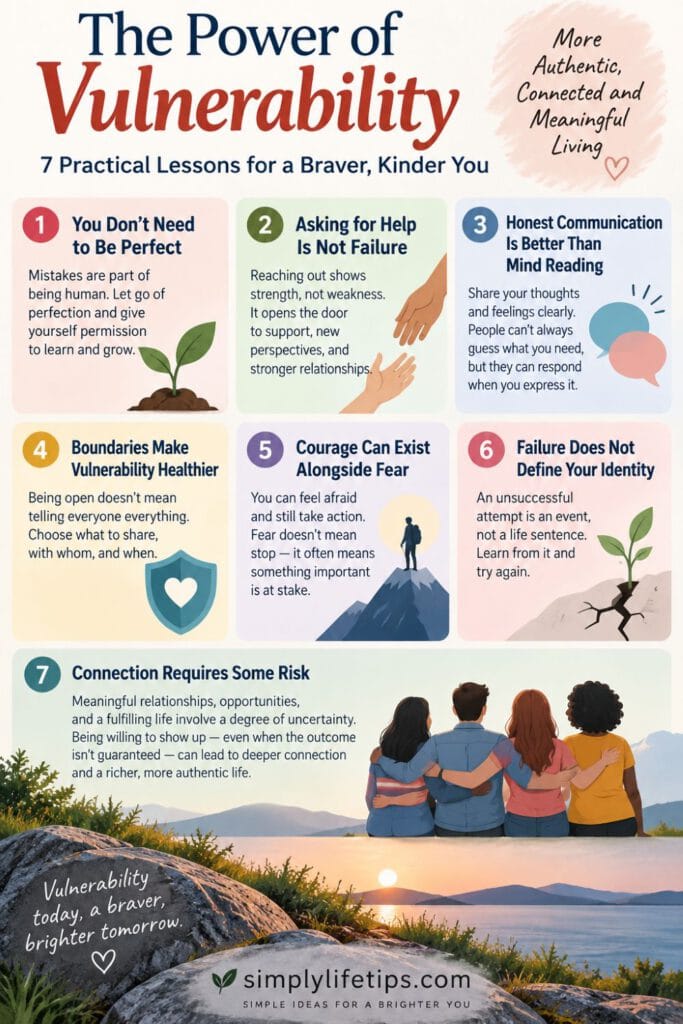
Embracing vulnerability does not mean abandoning boundaries.
You do not need to tell everyone your deepest fears. You do not need to disclose private experiences to strangers. And you do not need to remain emotionally open with someone who has demonstrated that they cannot treat your vulnerability with respect.
Healthy vulnerability involves judgment.
You decide what to share, when to share it, and who has earned your trust. Being authentic does not require being completely exposed.
This distinction is important because vulnerability without boundaries can become unhealthy. The goal is not maximum disclosure. The goal is meaningful connection without abandoning self-respect or personal safety.
What the Power of Vulnerability Can Teach Us
Brown’s research journey offers lessons that can be applied to ordinary situations.
When you need help, asking for it can be an act of vulnerability because you are admitting that you cannot do everything alone.
When you apologize, you make yourself vulnerable because you accept that the other person may still be hurt or disappointed.
When you try something new, you become vulnerable because failure is possible.
When you tell someone how you feel, you become vulnerable because you cannot control their response.
When you allow yourself to experience happiness fully, you may also become aware of how much you have to lose.
None of these situations guarantees a positive outcome. That is exactly why they require courage.
How to Practice Healthy Vulnerability
You do not have to make dramatic changes to become more comfortable with vulnerability. Start with small moments of honesty.
If you do not understand something, say so instead of pretending.
If you need help, ask someone you trust.
If you made a mistake, acknowledge it without creating a long list of excuses.
If someone has earned your trust, consider sharing how you genuinely feel instead of expecting them to guess.
If you have created something meaningful, allow yourself to share it even though criticism is possible.
These actions may feel uncomfortable at first. That discomfort does not automatically mean that something is wrong. Sometimes it simply means you are doing something unfamiliar.
Learning to recognize your emotions, fears, and reactions can make vulnerability easier to approach, which is why cultivating self-awareness for personal growth is an important part of the process.
Vulnerability Is About Living More Fully
The deeper lesson of the power of vulnerability is not that everyone should become more emotionally exposed. It is that protecting ourselves from every possible emotional risk can also prevent us from experiencing life fully.
Connection requires risk.
Love requires risk.
Creativity requires risk.
Belonging requires risk.
Even joy can require vulnerability because something has to matter enough for us to care about its outcome.
The question, therefore, is not whether vulnerability can be eliminated. It cannot. The more useful question is whether we will allow fear of vulnerability to determine how much of life we are willing to experience.
Conclusion
The power of vulnerability is not about becoming weak or exposing every private part of your life. It is about understanding that meaningful connection requires some willingness to be seen.
Brené Brown’s research began with a desire to understand connection, but it led her into much deeper questions about shame, worthiness, vulnerability, and the ways people protect themselves from emotional risk. Her journey showed her that the people who experienced a strong sense of love and belonging were not people who had eliminated uncertainty or imperfection from their lives. They were people who accepted their worthiness and allowed themselves to participate fully.
That participation requires courage.
We cannot remove every possibility of disappointment, rejection, grief, or failure. We also cannot completely numb painful emotions without affecting our ability to experience positive ones. Love, joy, creativity, and belonging all involve some degree of emotional exposure.
Vulnerability, then, is not something we need to conquer once and for all. It is something we learn to approach with greater awareness, courage, compassion, and self-respect.
Perhaps the most important lesson is simple: a meaningful life cannot be completely protected from emotional risk.
Sometimes, the very things that make us vulnerable are also the things that make life worth living.
Frequently Asked Questions About the Power of Vulnerability
What is the power of vulnerability?
The power of vulnerability is the potential for honest emotional openness to create deeper connection, authenticity, courage, love, creativity, and belonging. In Brené Brown’s research, vulnerability emerged as an important part of meaningful human connection rather than simply a sign of weakness.
What does Brené Brown say about vulnerability?
In her 2010 TEDxHouston talk, Brown connects vulnerability with connection, shame, worthiness, courage, love, belonging, creativity, and joy. She also describes how her own research forced her to confront her resistance to vulnerability.
Why is vulnerability important for connection?
Connection requires people to be seen and understood. Because revealing your genuine thoughts and feelings involves uncertainty about how another person will respond, vulnerability becomes part of meaningful connection.
Is vulnerability a weakness?
No. Vulnerability can involve uncertainty and emotional exposure, but Brown’s work connects it with courage rather than weakness. Being willing to admit uncertainty, acknowledge mistakes, ask for help, or express genuine feelings can require considerable courage.
How can I practice vulnerability in everyday life?
Start with small acts of honest communication. Ask for help when you need it, acknowledge mistakes, express your feelings respectfully, accept that you cannot control every response, and share meaningful parts of yourself with people who have demonstrated that they can be trusted.
References
- Brené Brown — The Power of Vulnerability, TED — the primary source and transcript for Brown’s 2010 TEDxHouston talk.
- Brené Brown — Research — Brown’s explanation of the research journey behind her work on connection, shame, vulnerability, and wholehearted living.
- Brené Brown — Official Website — background on Brown’s work as a researcher and storyteller and her research into courage, vulnerability, shame, and empathy.

Mathukutty P V is a Blogger, YouTuber, and Content Writer and the founder of Simply Life Tips. After taking voluntary retirement in 2017, he embraced a free lifestyle focused on learning, personal growth, and sharing practical wisdom to help others live with more purpose and positivity.