
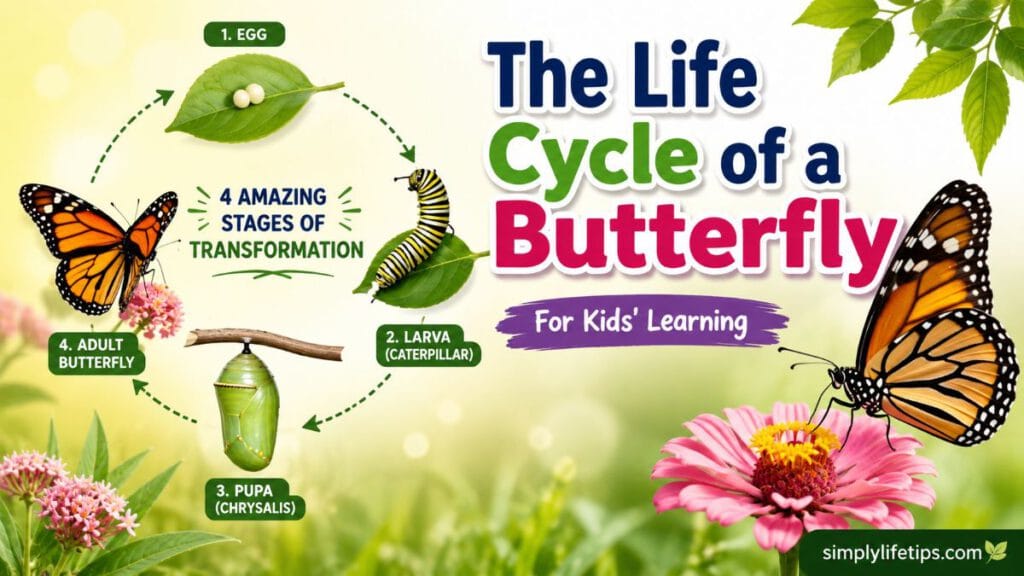
Do you know the life cycle of a butterfly? Butterflies are among the most beautiful insects in nature, but they do not start life with colourful wings. Every butterfly begins as a tiny egg and goes through an amazing transformation before becoming an adult butterfly. This incredible journey is called the life cycle of a butterfly. In this fun guide for kids, you’ll learn about the four exciting stages—egg, caterpillar (larva), chrysalis (pupa), and adult butterfly—with interesting facts that make learning easy and enjoyable.
Did You Know? 🦋
- Butterflies are insects.
- There are more than 17,000 species of butterflies around the world.
- Butterflies can taste with their feet.
- Every butterfly goes through four life stages.
- Butterflies help flowers grow by carrying pollen from one flower to another.
Life Cycle Of A Butterfly Overview
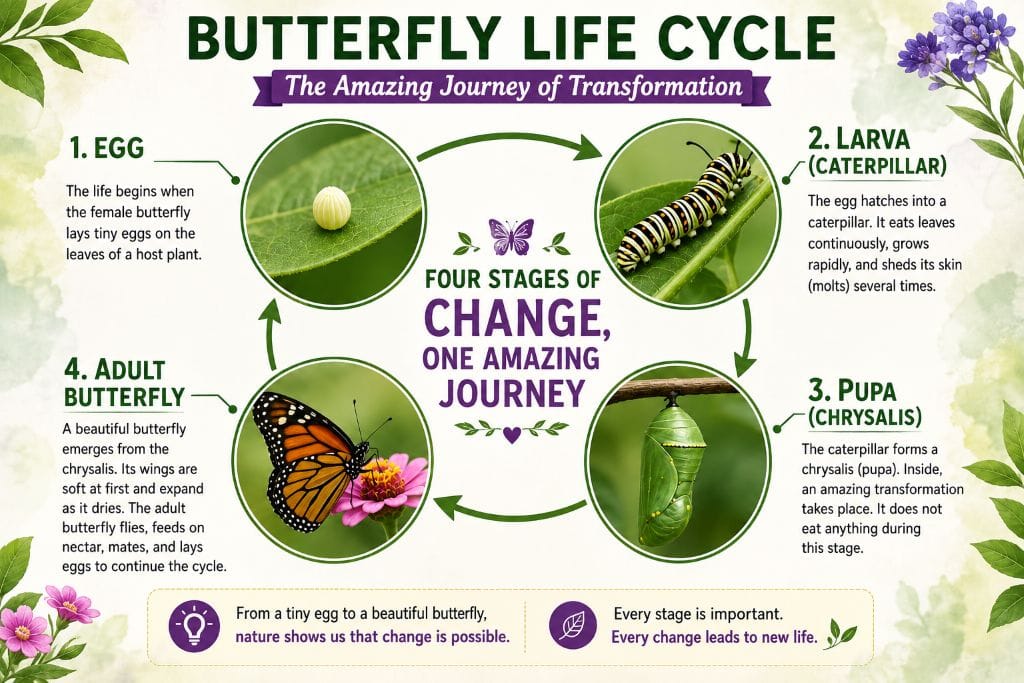
Before exploring each stage in detail, take a quick look at the complete butterfly life cycle. Butterflies undergo complete metamorphosis, transforming through four distinct stages: egg, larva (caterpillar), pupa (chrysalis), and adult butterfly. Each stage has a unique role in the butterfly’s growth and survival, making this transformation one of nature’s most fascinating processes.
Life Cycle Of A Butterfly At a Glance
| Stage | What Happens |
|---|---|
| 🥚 Egg | The butterfly lays tiny eggs on leaves. |
| 🐛 Caterpillar (Larva) | The caterpillar eats leaves and grows quickly. |
| 🟢 Chrysalis (Pupa) | The caterpillar changes into a butterfly inside the chrysalis. |
| 🦋 Adult Butterfly | The butterfly flies, drinks nectar, and lays eggs to start the cycle again. |
Fun Fact 🦋
Not all butterflies complete their life cycle at the same speed. Some species become adult butterflies in just a few weeks, while others may take several months, depending on the weather and the species.
4 Stages Of The Life Cycle Of A Butterfly
Butterflies undergo complete metamorphosis, which means they develop through four distinct stages. Each stage has a different role in the butterfly’s growth and development.
Let’s explore each stage of the life cycle of a butterfly in detail.
| Stage | Main Activity | Approximate Duration* |
|---|---|---|
| 🥚 Egg | Developing inside the egg | Around 3–7 days |
| 🐛 Caterpillar (Larva) | Eating and growing | About 2–5 weeks |
| 🟢 Chrysalis (Pupa) | Transforming into an adult butterfly | Around 1–3 weeks |
| 🦋 Adult Butterfly | Flying, feeding, and reproducing | Several weeks to months |
Note: The exact time varies depending on the butterfly species and environmental conditions.
Did You Know?
A caterpillar may increase its body weight many times before it changes into a chrysalis. During this stage, eating and growing are its most important jobs!
Life Cycle Of A Butterfly Video
Egg Stage
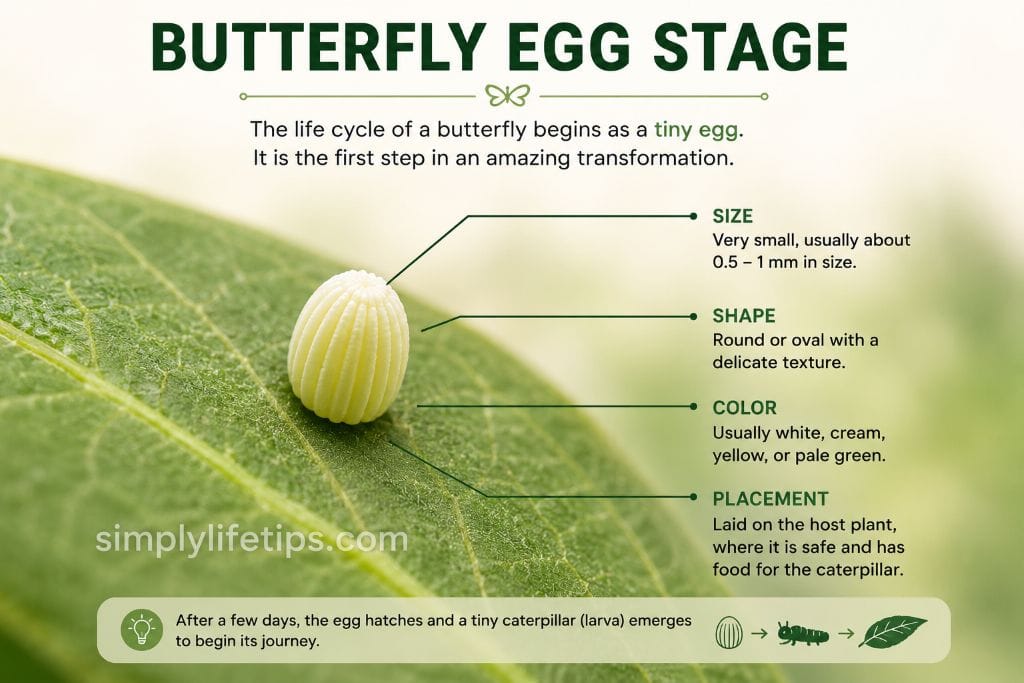
A butterfly’s life begins as a tiny egg. A mother butterfly carefully chooses a healthy plant before laying her eggs because the baby caterpillar will need fresh leaves to eat as soon as it hatches.
Butterfly eggs are usually very small and may be difficult to see without looking closely. Depending on the butterfly species, the eggs can be round, oval, or slightly ridged and may be white, yellow, green, or pale orange.
To keep the eggs safely attached, the mother butterfly uses a special sticky substance that works like natural glue. This helps prevent the eggs from falling off the leaf.
Inside each tiny egg, a baby caterpillar slowly develops. After several days—usually about 3 to 7 days, depending on the species and weather—the egg hatches, and a tiny caterpillar crawls out to begin the next stage of its amazing journey.
Fun Facts About Butterfly Eggs
🦋 Most butterflies lay their eggs on the underside of leaves for extra protection.
🦋 Some butterflies lay only one egg on a leaf, while others lay many eggs together.
🦋 Butterfly eggs are among the smallest eggs found in nature.
Did You Know?
A mother butterfly carefully chooses the right plant before laying her eggs. This is because many caterpillars can eat only certain kinds of leaves after they hatch.
Activity for Kids
Can You Spot Butterfly Eggs?
The next time you visit a garden, look underneath the leaves of plants. If you’re lucky, you might find tiny butterfly eggs. Remember to observe them gently without touching them.
Larva (Caterpillar) Stage
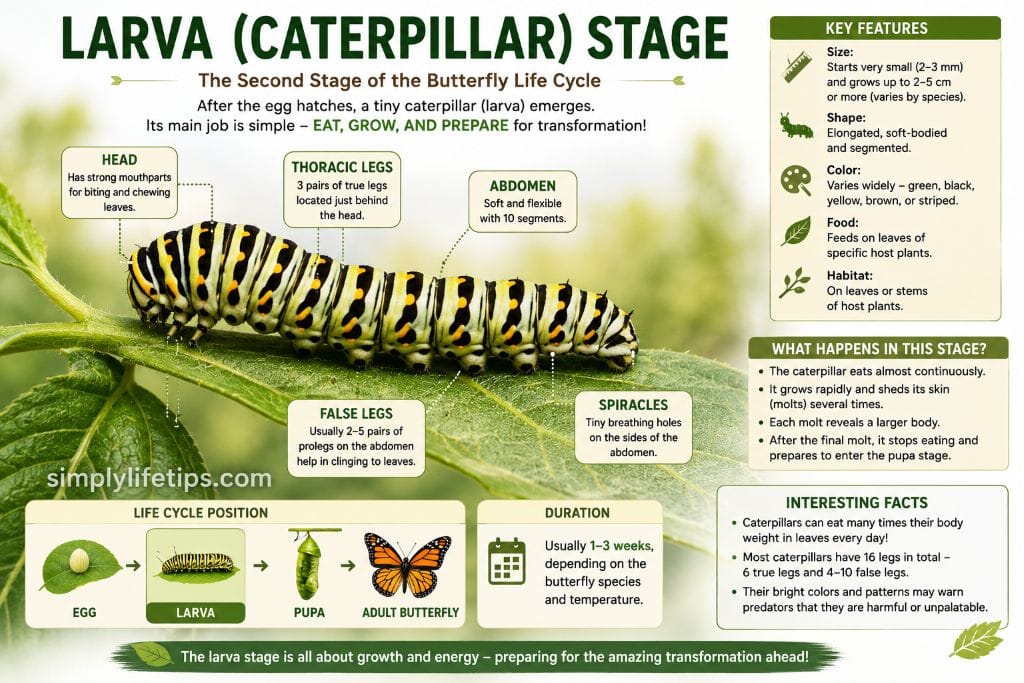
When the butterfly egg hatches, a tiny caterpillar, also called a larva, comes out. This is the second stage in the life cycle of a butterfly.
The caterpillar’s main job is to eat and grow. It starts by eating the leaves of its host plant, often beginning with the plant where the egg was laid. Soon, it begins munching on more leaves almost all day long.
As the caterpillar eats, its body grows quickly. Since its skin cannot stretch forever, it sheds its old skin several times. This process is called molting. Each time it molts, the caterpillar becomes larger and stronger.
After growing to its full size, the caterpillar is ready for the next exciting stage of its transformation.
Amazing Caterpillar Facts
🟢 Caterpillars spend most of their time eating.
🟢 Some caterpillars can grow more than 100 times their original size before becoming a chrysalis.
🟢 Caterpillars have strong jaws that help them chew leaves.
🟢 Different butterfly species prefer different types of plants.
Did You Know?
Some caterpillars have bright colours or patterns that help scare away predators, while others blend in with leaves to stay hidden.
Activity for Kids
Find a Caterpillar
Visit a garden or park and carefully look at the leaves of plants. If you spot a caterpillar, watch how it moves and eats. Remember not to touch or disturb it.
New Vocabulary
Larva – The caterpillar stage of a butterfly.
Molting – Shedding old skin to make room for a larger body.
Pupa (Chrysalis) Stage
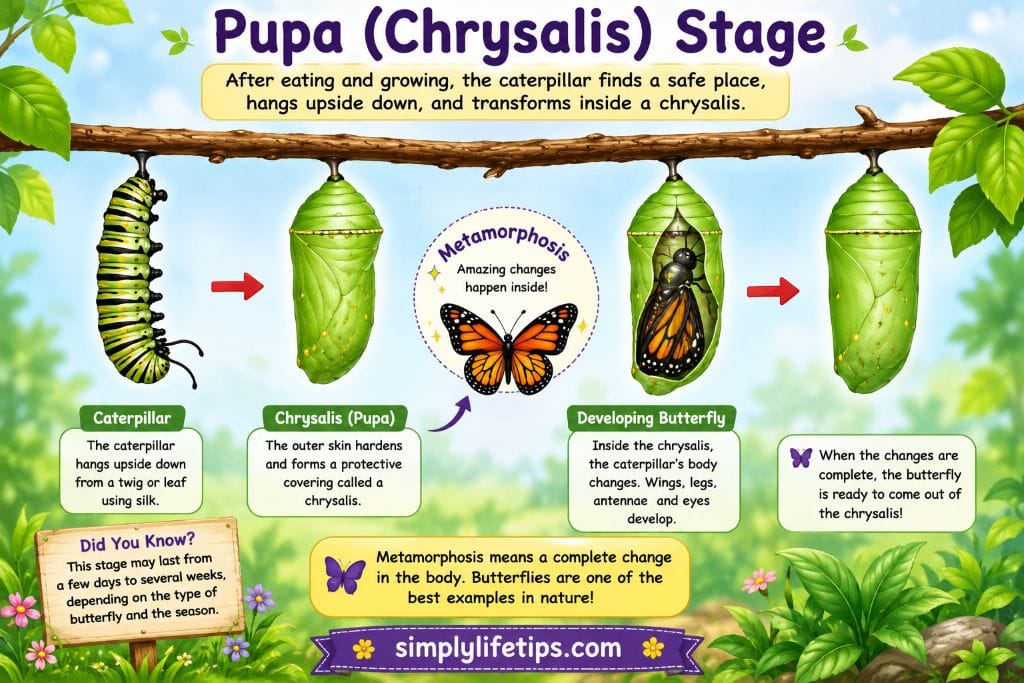
After eating and growing as much as it can, the caterpillar is ready for the third stage of the life cycle of a butterfly. It finds a safe place on a twig or leaf and hangs upside down. Soon, the caterpillar sheds its final skin and forms a protective covering called a chrysalis, also known as a pupa.
Although the chrysalis looks still from the outside, amazing changes are happening inside. This special process is called metamorphosis. During metamorphosis, the caterpillar’s body slowly changes into a butterfly. New body parts such as colourful wings, long antennae, six legs, compound eyes, and a proboscis develop inside the chrysalis.
The pupa stage may last one to three weeks, although some butterfly species remain in the chrysalis much longer depending on the weather and the season.
When the transformation is complete, the butterfly is ready to emerge from the chrysalis and begin the final stage of its life.
Amazing Chrysalis Facts
🟢 A chrysalis protects the developing butterfly.
🟢 The butterfly grows completely new wings inside the chrysalis.
🟢 Some chrysalises are green, while others are brown or even shiny like gold.
🟢 The butterfly cannot fly immediately after coming out of the chrysalis.
Did You Know?
The word metamorphosis means a complete change in shape or form. Butterflies are one of the best examples of metamorphosis in nature.
New Vocabulary
Chrysalis – The hard covering that protects the butterfly while it changes.
Pupa – Another name for the chrysalis stage.
Metamorphosis – The amazing process of changing from a caterpillar into a butterfly.
Activity for Kids
Observe Nature
If you ever find a chrysalis in a garden, watch it from a distance. Never touch or remove it. You may be lucky enough to see a butterfly emerge one day.
Adult Butterfly Stage
The final stage in the life cycle of a butterfly begins when the adult butterfly slowly emerges from the chrysalis. At first, its wings are small, soft, and wet.
The butterfly pumps fluid into its wings, helping them expand and take shape. Then it rests while the warm air and sunlight help the wings become dry and strong. Only after its wings have fully dried is the butterfly ready to fly.
Adult butterflies use a long, tube-like mouthpart called a proboscis to drink sweet nectar from flowers. As they move from flower to flower, they carry pollen, helping many plants produce fruits and seeds. This makes butterflies important pollinators.
The adult butterfly spends its time flying, finding food, avoiding predators, searching for a mate, and laying eggs. Once the eggs are laid, the amazing life cycle of a butterfly begins all over again.
Amazing Butterfly Facts
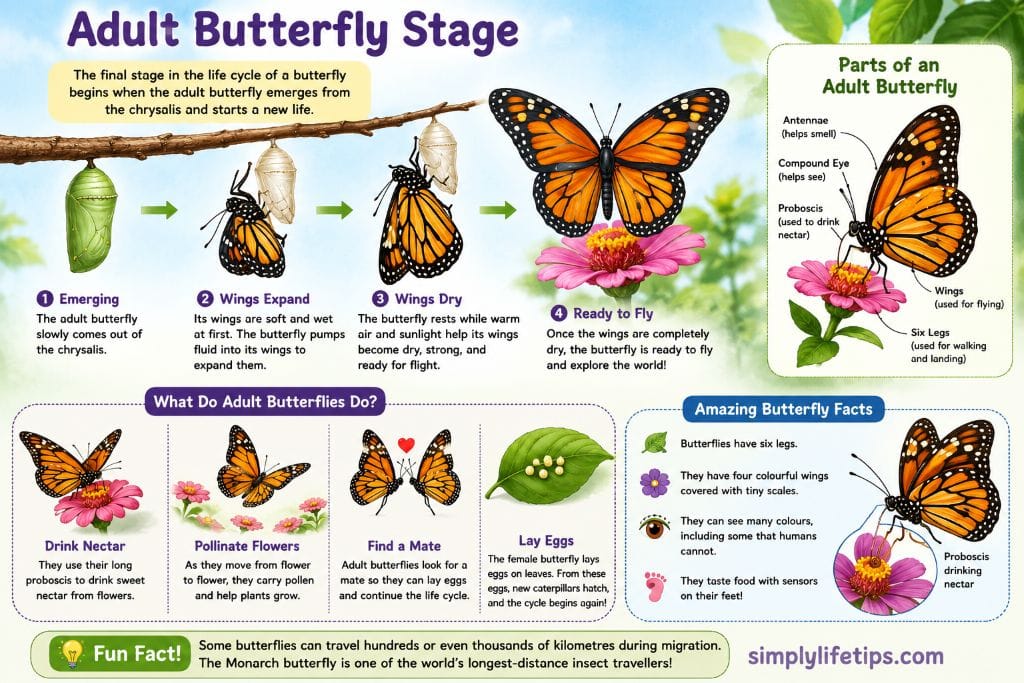
- Butterflies have six legs, like other insects.
- Their wings are covered with tiny scales that create many of their colours and patterns.
- Butterflies have large compound eyes that help them see their surroundings.
- They use their antennae to sense smells and help with orientation.
Did You Know?
Butterflies do not chew their food. Instead, they drink nectar using their long proboscis, which works like a drinking straw.
New Vocabulary
Adult Butterfly – The fully grown butterfly that can fly and reproduce.
Proboscis – A long tube used to drink nectar from flowers.
Pollination – The process of carrying pollen from one flower to another, helping plants make seeds and fruits.
Activity for Kids
Butterfly Watching
Visit a flower garden and quietly watch butterflies.
Can you observe:
✅ A butterfly drinking nectar?
✅ Different wing colours and patterns?
✅ How it flies from one flower to another?
Remember to observe without chasing or catching the butterflies.
Fun Fact Box
Fun Fact 🦋
Some butterflies can travel hundreds or even thousands of kilometres during migration. The famous Monarch butterfly is one of the world’s longest-distance insect travellers.
Butterfly Life Cycle Infographic
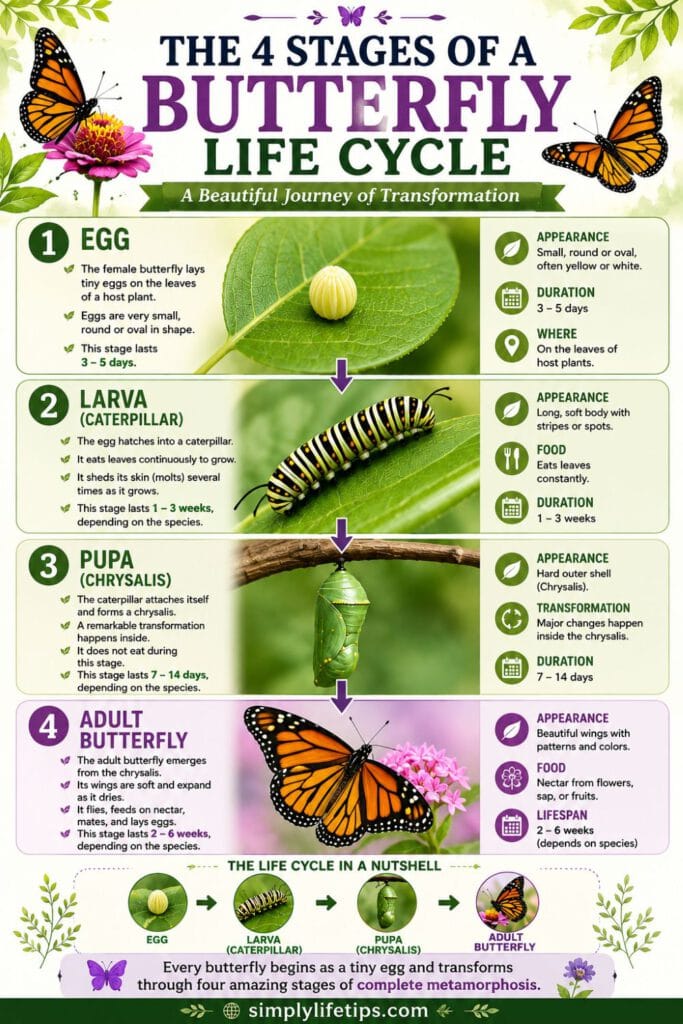
If you prefer learning through visuals, this infographic summarizes the butterfly life cycle in a simple and engaging format. It highlights the four stages of complete metamorphosis—egg, larva (caterpillar), pupa (chrysalis), and adult butterfly—along with the key characteristics and duration of each stage, making it an excellent quick-reference guide.
Conclusion
The life cycle of a butterfly is a remarkable example of complete metamorphosis. From a tiny egg to a growing caterpillar, a developing chrysalis, and finally an adult butterfly, each stage has an important role in its growth and survival.
Understanding these four stages helps us appreciate the fascinating changes that take place in nature. The next time you see a butterfly, remember the incredible journey it has completed—from egg to caterpillar, chrysalis, and adult.
Frequently Asked Questions (FAQs)
What are the 4 stages of a butterfly life cycle?
The four stages of a butterfly life cycle are egg, larva (caterpillar), pupa (chrysalis), and adult butterfly. This complete transformation is called complete metamorphosis, where the butterfly undergoes significant physical changes before becoming an adult.
How long does the butterfly life cycle take?
The length of the butterfly life cycle varies by species and environmental conditions. Some butterflies can complete their life cycle in a few weeks, while others may take several months.
What does a caterpillar do during the larva stage?
During the larva (caterpillar) stage, the caterpillar spends most of its time eating leaves from its host plant. It grows rapidly, sheds its skin several times through molting, and stores energy needed for the next stage of development.
What happens inside a butterfly chrysalis?
Inside the chrysalis, the caterpillar undergoes major changes as it develops into an adult butterfly. Adult structures such as wings, antennae, legs, and other body parts develop during this stage.
Why are butterflies important to the environment?
Butterflies are important pollinators because they carry pollen from one flower to another while feeding on nectar. They are also part of food webs, providing food for birds and other animals. Because butterflies depend closely on plants and their habitats, changes in butterfly populations can also provide useful information about changes in ecosystems.
Further Reading
Continue exploring the fascinating world of animals and nature with these related articles from Simply Life Tips:
- Baby Animals Names with Fun Facts – Discover the names of baby animals and learn interesting facts about them.
- Fun Facts About Sea Animals for Kids – Explore amazing sea creatures and learn fun facts about life under the ocean.
- Learn Wild Animal Names – Videos for Kids – Help children learn the names of wild animals through engaging educational videos.
External References
For additional information about the butterfly life cycle and butterfly conservation, explore these trusted resources:
- Smithsonian National Museum of Natural History – Explore butterfly biology, insect diversity, and metamorphosis.
https://naturalhistory.si.edu/ - U.S. Forest Service – Pollinators – Learn about butterflies and their role as important pollinators in healthy ecosystems.
https://www.fs.usda.gov/wildflowers/pollinators/ - Encyclopaedia Britannica – Butterfly – Read a comprehensive overview of butterfly anatomy, behavior, and life cycle.
https://www.britannica.com/animal/butterfly-insect

Mathukutty P V is a Blogger, YouTuber, and Content Writer and the founder of Simply Life Tips. After taking voluntary retirement in 2017, he embraced a free lifestyle focused on learning, personal growth, and sharing practical wisdom to help others live with more purpose and positivity.



